7 Best Open Source LLMs in 2026 & How to Choose the Right Model
On this page
In April 2025, Meta launched Llama 4 and promoted Maverick as one of the top models on the LMArena leaderboard. Soon after, developers found that the version Meta tested was not the same as the one released to the public. In LMArena’s X statement, the team said Meta should have been clearer that it submitted a custom version tuned for human preference. When the public model was added later, it ranked much lower.
We've seen questions from the community about the latest release of Llama-4 on Arena. To ensure full transparency, we're releasing 2,000+ head-to-head battle results for public review. This includes user prompts, model responses, and user preferences. (link in next tweet) Early analysis shows style and model response tone was an important factor (demonstrated in style control ranking), and we are conducting a deeper analysis to understand more! (Emoji control? 🤔) In addition, we're also adding the HF version of Llama-4-Maverick to Arena, with leaderboard results published shortly. Meta’s interpretation of our policy did not match what we expect from model providers. Meta should have made it clearer that “Llama-4-Maverick-03-26-Experimental” was a customized model to optimize for human preference. As a result of that we are updating our leaderboard policies to reinforce our commitment to fair, reproducible evaluations so this confusion doesn’t occur in the future.
— Arena.ai (@arena) April 8, 2025
For your enterprise, depending on one open-source LLM is risky when benchmark results do not always match real-world performance. A multi-model setup gives you a better way to test different models on your own workloads and keep alternatives ready.
You can use one model for coding and another for document work based on how each one performs for you. At Prem AI, we give you access to more than five open-source model families through one OpenAI-compatible Enclave API. You can use them through our managed API or run them on your own GPU infrastructure and VPC with Prem Enclave. When you compare models, look beyond benchmark scores. Model size and license terms matter too. Hardware needs and image support should also be part of your decision.
Benefits of using open source LLMs for your enterprise
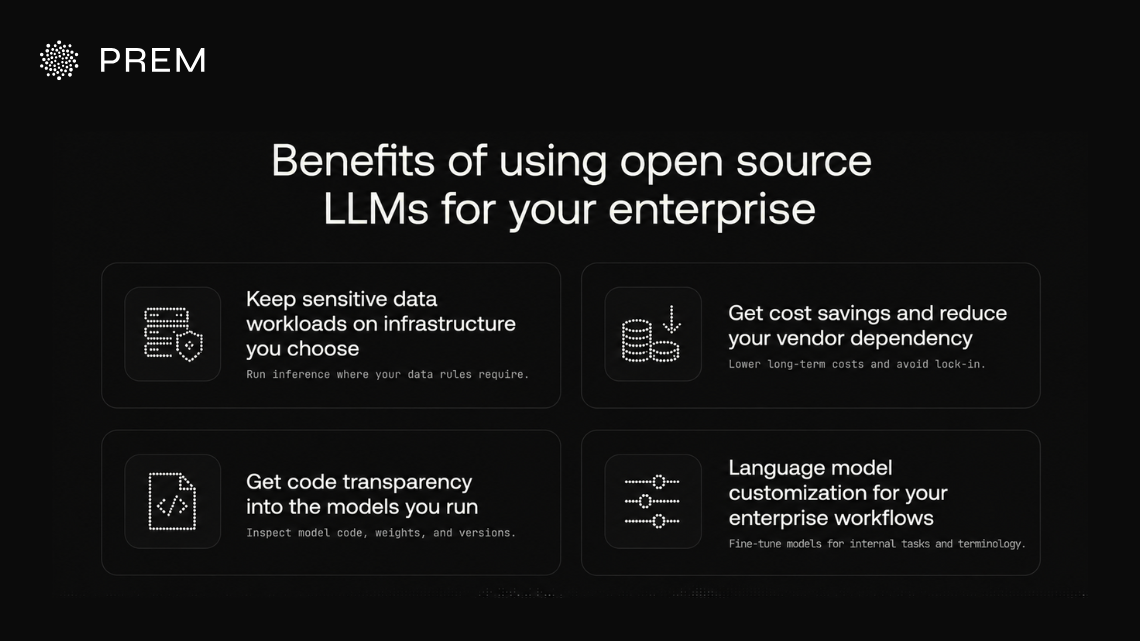
Below are some of the top benefits of using open source LLMs for your enterprise workloads.
Keep sensitive data workloads on infrastructure you choose
When model weights are available for self-hosting, you have more freedom over where inference happens. You can run a suitable model on your own hardware or use a private cloud environment that meets your data requirements.
This becomes useful when prompts contain customer records or proprietary company information. Your hosting environment also determines who can access the data while the model processes it. You still need to check the individual model license before deployment. Some releases use permissive licenses such as MIT or Apache 2.0, while others have their own commercial conditions.
Get cost savings and reduce your vendor dependency
Closed AI services charge you for every token, so your bill grows each time your teams use the tool more. When you host an open source model yourself, your main cost comes from the hardware or cloud capacity needed to run it. As usage grows, the savings become more noticeable. Relying on one closed provider also leaves your applications exposed to decisions you do not control.
In November 2025, OpenAI emailed API customers that its chatgpt-4o-latest model would be switched off in mid-February 2026, and VentureBeat's GPT-4o report noted that developers had roughly three months to move their apps to another model. Open source LLMs reduce your vendor dependency, because the model you downloaded keeps running on your infrastructure for as long as you need it.
Get code transparency into the models you run
Open source LLMs give your team more transparency by allowing you to inspect the model architecture and weights. They can also review the serving code before testing the model on their own data.
Some models also publish training data and recipes, giving your security and compliance teams more to review. This makes audits easier because you can track the exact model version and how it was tested. You also control when updates happen, instead of relying on changes made behind the scenes by a closed model provider.
Language model customization for your enterprise workflows
Open source LLMs give you more freedom to customize a model around your own workflows. If the license allows it, you can fine-tune the model on your industry terms or document formats. You can also train it to follow the tone your support team uses with customers.
Fine-tuning also does not always require a large hardware budget. In The Batch by DeepLearning.AI, Andrew Ng explained that LoRA and similar methods can make fine-tuning more affordable for models with 13 billion parameters or fewer. LoRA updates only a small part of the model instead of changing the whole model. You also do not need a huge dataset to get started. That makes it easier to build something specific to your business such as a banking chatbot or a medical assistant.
Access multiple open-source LLMs using Prem’s Enclave API
Use private infrastructure for sensitive workloads while keeping full control over how inference runs.
Talk to Prem AI7 best open source LLMs in 2026 for your enterprise
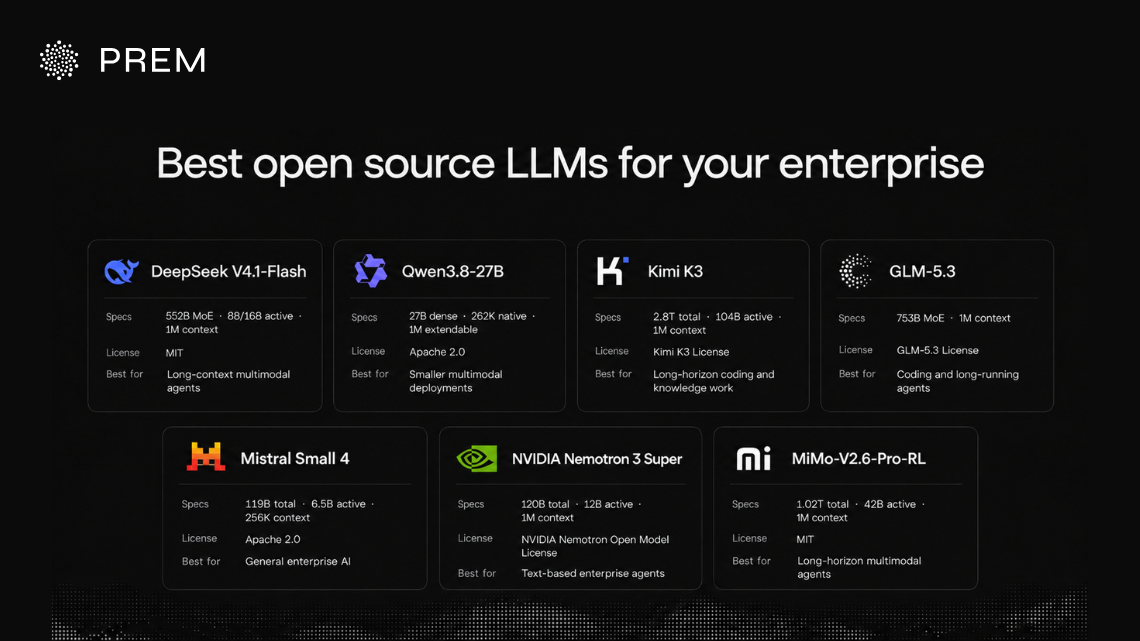
The table below compares some of the best open source LLMs for enterprises and what each one is best suited for.
| Model | Core specifications | License | Best suited for |
|---|---|---|---|
| DeepSeek V4.1-Flash | 552B MoE, 8B prefill / 16B decode active, 1M context | MIT | Long-context multimodal agents |
| Qwen3.8-27B | 27B dense, 262K native context, extendable to 1M | Apache 2.0 | Smaller multimodal deployments |
| Kimi K3 | 2.8T total, 104B active, 1M context | Kimi K3 License | Long-horizon coding and knowledge work |
| GLM-5.3 | 753B MoE, 1M context | GLM-5.3 License | Coding and long-running agents |
| Mistral Small 4 | 119B total, 6.5B active, 256K context | Apache 2.0 | General enterprise AI |
| NVIDIA Nemotron 3 Super | 120B total, 12B active, 1M context | NVIDIA Nemotron Open Model License | Text-based enterprise agents |
| MiMo-V2.6-Pro-RL | 1.02T total, 42B active, 1M context | MIT | Long-horizon multimodal agents |
DeepSeek V4.1-Flash
DeepSeek V4.1-Flash is the model we would point you to when your work starts with a lot of reading. The DeepSeek V4.1-Flash announcement from September 2026 describes a model that takes in up to one million tokens of text and images in a single request.
That makes it a strong pick for document-heavy agents in your enterprise, where contracts or long chat histories need to be read before the model answers. The model itself is large, so you need to plan the hardware requirements early even if each request uses only a small portion of its capacity.
DeepSeek’s pricing can also help you reduce the cost of running AI workloads. According to TNW’s DeepSeek launch report, Bloomberg Intelligence estimated that DeepSeek lowered its prices by up to 32% with the V4.1-Flash release.
Project information
- 552 billion total parameters in a Mixture-of-Experts (MoE) design
- One-million-token context window
- Accepts text and image input
- Released under the MIT license
Key features of DeepSeek V4.1-Flash
- A new Causal Encoder-Decoder (CED) design uses 8 billion parameters while reading your input and 16 billion while writing the answer, which keeps each request lighter to run.
- A redesigned Key-Value (KV) cache needs less memory for long inputs than the older V4-Flash did.
- Image support lets your application read documents that mix text with charts, scans or screenshots.
- The MIT license gives you broad freedom to use and change the model in commercial products.
Qwen3.8-27B
Qwen3.8-27B comes from Alibaba's Qwen team and gives you image and video understanding in a model small enough to plan around. Its dense design uses every parameter on each request, so your memory needs to stay predictable as usage grows.
We see it as a practical starting point for private assistants and document processing when your hardware budget is limited. It is also one of the easier models in this list to test on a single server before you commit to a larger rollout. Alibaba’s own testing gives you a good idea of what this model can handle. According to DataNorth’s Qwen3.8-27B report, Qwen3.8-27B scored 61.7% on SWE-bench Pro in Alibaba’s evaluation. That shows solid coding performance for a model of this size.
Project information
- 27 billion parameters in a dense design
- 262,144-token native context window, extendable toward one million tokens
- Accepts text, image and video input
- Released under the Apache 2.0 license
Key features of Queen 3.8-27B
- Context scaling lets you stretch the window for long documents, though Qwen advises switching it on only for the requests that need it.
- Support for Transformers, vLLM and SGLang means your team can run it with tools it already knows.
- Video input lets you work with recorded meetings or training clips alongside text and images.
- The Apache 2.0 license keeps commercial use simple for your legal team.
Kimi K3
Moonshot AI built Kimi K3 for long, multi-step work such as coding across a large repository or research that spans many documents. The Kimi K3 model card positions it for extended tool-driven sessions, so your agent can keep going without losing track of earlier steps.
Your team would feel the difference in work that takes hours rather than seconds, such as reviewing a full codebase or pulling answers from hundreds of pages of research. The trade-off is size, so Kimi K3 makes the most sense when you already have strong GPU capacity or plan to run it through a private hosted setup. Soon after Kimi K3 launched, its coding performance started getting attention. Tom’s Hardware reported that the model ranked first in the Frontend Code Arena with 1679 points and moved ahead of Claude Fable 5.
Project information
- 2.8 trillion total parameters with 104 billion active per token
- One-million-token context window
- Accepts text and visual input
- Released under the Kimi K3 License, which has its own commercial terms
Key features of Kimi K3
- The one-million-token window lets your agent hold a large codebase or document set in view during a single session.
- Visual input means your team can share screenshots or scanned pages along with text.
- Its scale suits hard reasoning tasks, though you will need far more hardware than the smaller models in this list.
- The custom license allows commercial use with conditions, so read its terms before you build a product you sell to customers.
In our Prem CyberScan launch post, we listed Kimi K3 among the open source models that power our AI security agent, and you can pick it when you run a scan.
Excited to announce the launch of Cyberscan - Prem's proprietary security agent for vulnerability detection built in partnership with @ArkLabsHQ and the @Breez_Tech Powered exclusively by open-source models like Kimi-K3, Qwen-3.8-Max and more, Cyberscan has helped over 20 teams find mission critical vulnerabilities in their codebases, preventing massive liabilities. Starting Today, Cyberscan is available for public access (link below) with $25 in free-credits for new users. Login with your github, connect a repo and it takes care of the rest - surfacing vulnerabilities that you definitely might have missed out.
— Prem (@premai_io) August 20, 2026
Prem CyberScan uses the model to trace how your files connect and follow possible attack paths, then returns prioritized findings with severity ratings and file-level evidence. Every run goes through our EU North infrastructure.
GLM-5.3
Z.ai designed GLM-5.3 with software engineering as its main focus. It shares its base model with GLM-5.2, and the gains come from extra training aimed at coding and long-running agent tasks. If code is the main work you want AI to handle, this is one of the first models we would test.
The NVIDIA GLM-5.3 reference lists support for reasoning and tool calling, which your coding agents need when they run commands and check their own output. On the Artificial Analysis leaderboard, GLM-5.3 scored 45 on the Intelligence Index in late September 2026. That placed it second among open-weight models.
Project information
- Developed by Z.ai and released in August 2026
- 753 billion parameters in an MoE design
- Context window of 1,048,576 tokens
- Released under the GLM-5.3 license
Key features of GLM-5.3
- Extra post-training for code makes it a good match for repository-scale work and terminal-based agents.
- The long context window helps your agent follow changes across many files in one session.
- Reasoning and tool calling support lets your agent plan its steps and act on the results.
- Commercial use is allowed, with extra conditions only for very large Model-as-a-Service (MaaS) providers.
Connect your applications to open source models through one endpoint
Use Enclave API to work with supported models while keeping Zero Data Retention and cryptographic attestation in place.
Request an Enclave API demoMistral Small 4
From Mistral AI, Mistral Small 4 combines instruction following with reasoning and coding in one model. It activates only part of its parameters for each token, which helps keep each request lighter than the model’s full size suggests.
For your enterprise, it works well for internal assistants and document workflows because the same model can handle both chat and coding tasks. Mistral AI is also the only company on this list based in Europe and its platform runs on EU servers. That matters when your data needs to stay under European rules. CNBC reported that the company raised €3 billion at a €21 billion valuation in September 2026.
Project information
- Developed by Mistral AI and released in March 2026
- 119 billion total parameters with 6.5 billion active per token
- 256K context window
- Accepts text and image input
- Released under the Apache 2.0 license
Key features of Mistral Small 4
- Function calling lets your assistant connect to other tools and internal systems.
- Structured outputs help when you need answers in a fixed format such as JSON.
- Image input means your document workflows can handle scans and screenshots too.
- Memory needs depend on the checkpoint format and precision you pick, so you can match the model to the hardware you already have.
Build Your Private Open Model Stack With Prem AI
Combine private inference with task-specific model development on infrastructure you control.
Talk to Prem AINVIDIA Nemotron 3 Super
NVIDIA built Nemotron 3 Super for agent work and busy enterprise workloads such as IT ticket handling. It works with text only, which keeps it focused on the jobs where your teams read and reason over documents. NVIDIA publishes the training data and recipes along with the weights, so your compliance team can see more of how the model was built. That makes it one of the more open releases in this list.
Large enterprises are already using the NVIDIA Nemotron Super 3 in production. In SiliconANGLE’s coverage, NVIDIA said Palantir and Cadence are using the model to automate workflows across areas such as telecommunications, semiconductor design and manufacturing.
Project information
- Developed by NVIDIA and released in March 2026
- 120 billion total parameters with 12 billion active per token
- Context window of up to one million tokens
- Accepts text input only
- Released under the NVIDIA Nemotron Open Model License
Key features of NVIDIA Nemotron 3 Super
- A hybrid LatentMoE design mixes Mamba-2, MoE and attention layers to keep long inputs efficient.
- Adjustable reasoning lets you trade speed for depth depending on the task.
- Tool calling support helps your agents work with other systems in your stack.
- An NVFP4 version runs on a single B200 or DGX Spark, so you can start with far less hardware.
MiMo-V2.6-Pro-RL
Xiaomi's MiMo-V2.6-Pro-RL is the flagship of the MiMo-V2.6 series and one of the few models that handles text, images, video and audio together. Xiaomi built the MiMo series for long-running tasks that use tools across multiple steps. For your enterprise, that makes MiMo-V2.6-Pro useful when one application needs to work with different types of content such as call recordings and written reports.
Running a trillion-parameter model also requires serious infrastructure, so you need to plan the hardware before deployment. Since Xiaomi released the model in September 2026, MiMo-V2.6-Pro has also performed well in independent rankings. WinBuzzer reported that it scored 46 on the Artificial Analysis Intelligence Index and ranked highest among open-weight models.
Project information
- Developed by Xiaomi
- 1.02 trillion total parameters with 42 billion active per token
- One-million-token context window
- Accepts text, image, video and audio input
- Released under the MIT license
Key features of MiMo-V2.6-Pro-RL
- Audio and video input let you build one assistant for meetings, calls and documents.
- The one-million-token window suits long agent runs and large repositories.
- Its sparse MoE design uses only 42 billion parameters per token, which lowers the compute behind each request.
- The MIT license gives your enterprise broad commercial rights.
Run supported models on infrastructure your enterprise controls
Use Prem Enclave with your existing GPU infrastructure or VPC for private model deployment.
Request an Enclave API demoHow to choose the right open source LLM for your enterprise
The open source LLM you use affects how fast your applications run and how much hardware you need. Relying on one model also puts every workload at risk when that model changes or does not perform well for a task.
A multi-model setup lets you use different models for different workloads and keep a backup ready. With our Enclave API, you can access more than five open source model families through one OpenAI-compatible endpoint. You can also run supported models on your own GPU infrastructure or VPC with Prem Enclave.
| If your main workload is | Start with | Why it fits |
|---|---|---|
| Very long documents with visual content | DeepSeek V4.1-Flash | One-million-token context and image support, with low active parameters during input processing |
| Multimodal work on a smaller infrastructure budget | Qwen3.8-27B | Image and video understanding in a 27B dense model under Apache 2.0 |
| Long-running coding or knowledge work | Kimi K3 | One-million-token context in a much larger model, so review its license and hardware needs together |
| Software engineering and coding agents | GLM-5.3 | Post-training focused heavily on coding and long-running agent work |
| General enterprise assistants | Mistral Small 4 | Text and image input with reasoning and coding support under Apache 2.0 |
| Text-based enterprise agents | NVIDIA Nemotron 3 Super | 12 billion active parameters and a one-million-token context under a commercial license |
| Demanding work across text, images, audio and video | MiMo-V2.6-Pro-RL | The broadest input support in this list, with trillion-parameter infrastructure needs |
Keep Sensitive AI Workloads Under Your Control | Access 7 open source model families in less than 2 minutes
Deploy supported models privately when your applications handle code or confidential documents.
Talk to Prem AIReal-life use cases of open source LLMs for enterprises
Each real-life use case below shows how the model choice connected to cost, privacy or the kind of data the application had to process.
Coding agents built on open source base models
Coding is another area where open source models give you more room to build in-house. Cursor released Composer 2 in March 2026 and built it on Moonshot AI’s Kimi K2.5. According to TechCrunch's Cursor coverage from that week, Cursor said only about a quarter of the compute spent on the final model came from the base, with the rest coming from its own training.
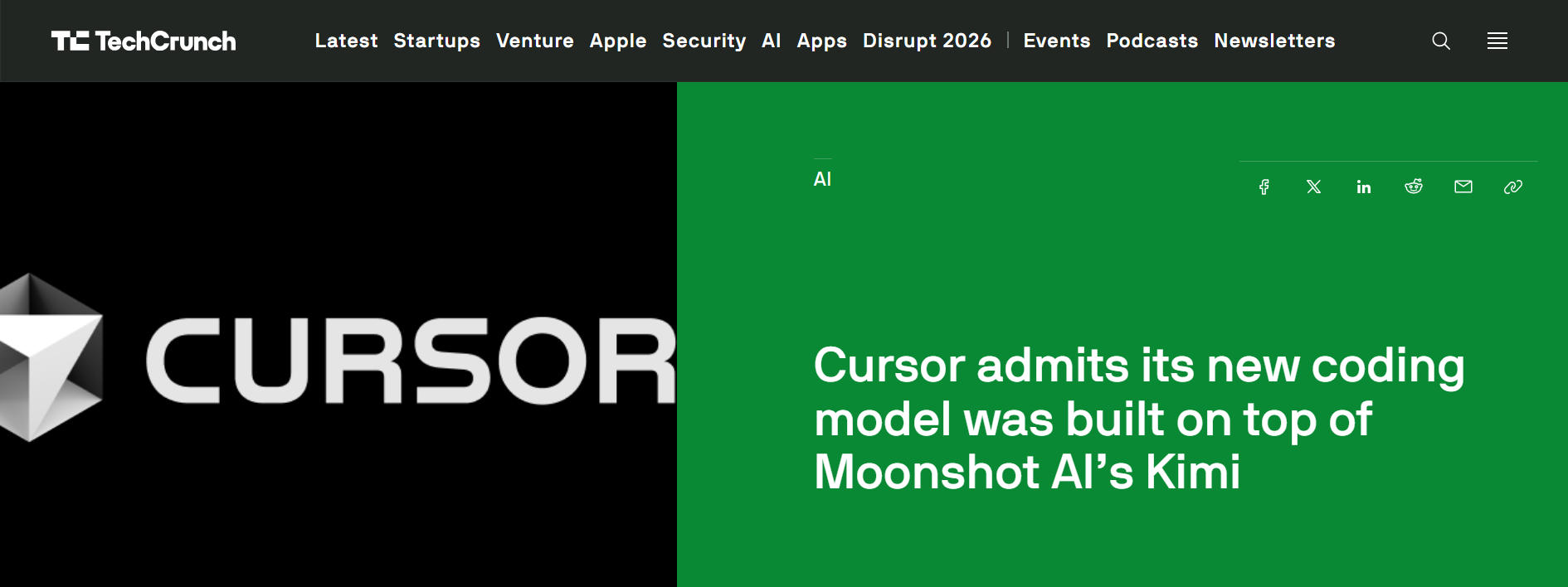
Moonshot confirmed that Cursor used Kimi through an authorized commercial partnership with Fireworks AI. The example shows how you can build on an open model and adapt it to your own workflows. It also shows why license terms matter early, especially when usage or revenue thresholds apply.
Multimodal product discovery at a fraction of the cost
Visual search and shopping assistants need models that understand both images and text. Pinterest post-trains open source models in its secure cloud for features like Pinterest Assistant.
During Pinterest’s second-quarter 2026 earnings call, CEO Bill Ready said open models had reduced cost per transaction to less than 8% of comparable closed proprietary models. PYMNTS’s Pinterest earnings report also linked this shift to the company’s record user growth. Bill Ready also stated that Pinterest’s own post-trained open models performed better for its use cases. For product images or scanned documents, models like Queen 3.8-27B or Mistral Small 4 offer a strong starting point.
Private clinical assistants inside hospital networks
Healthcare shows why privacy rules often shape where a model runs. After DeepSeek released its open reasoning model in early 2025, many Chinese hospitals began deploying it on their own servers.
A JMIR scoping review found 58 DeepSeek models across 48 of China’s top 100 hospitals. Private deployment was the most common setup, with clinical decision support as the leading use case. Running models locally helps hospitals keep patient data inside their own systems. The review also stressed the need for rigorous validation, so clinical testing should be planned alongside the infrastructure work.
Deploy open source LLMs privately with Prem AI
Using one open source LLM for every workload limits what your enterprise can do when that model changes or does not perform well for a specific task. A multi-model setup lets you use different models for different workloads and keep another option ready when needed.
At Prem AI, we make it easier to run that setup privately. Our Enclave API gives you access to more than five open source model families through one OpenAI-compatible endpoint.
If you want to run supported models on your own infrastructure, Prem Enclave works with your existing GPU infrastructure or VPC. It gives you a private way to run AI workloads inside infrastructure you control.
Our Fluso launch announcement also explains how Fluso brings this setup into a ready-to-use workspace for your teams. It runs on open source models hosted on Prem AI infrastructure.
If you are planning a private deployment of open source LLMs for your enterprise, Prem AI gives you everything you need to run them without your data leaving your control. Contact our sales team or email us at sales@premai.io to get started.
FAQs About Open Source LLMs
What is the best open source LLM in 2026?
The best open source LLM depends on the work you need it to handle. DeepSeek V4.1-Flash is suited to long multimodal inputs, while GLM-5.3 has a strong coding focus. Qwen3.8-27B gives you a smaller deployment profile, and MiMo-V2.6-Pro-RL covers a broader mix of input types.
Your hardware and latency requirements should be part of the choice from the beginning.
Which open source LLM is best for coding?
GLM-5.3 is one of the models in this list that focuses heavily on coding and long-running software tasks. Kimi K3 is another option when your coding agent needs to work across very large repositories.
Qwen3.8-27B deserves attention when you need coding capability from a much smaller model.
Which open source LLM is best for enterprise use?
Mistral Small 4 and Qwen3.8-27B are practical starting points when you want multimodal support under Apache 2.0. NVIDIA Nemotron 3 Super is another option when your workload focuses on text-based agents and long documents.
Larger models such as Kimi K3 may be better suited to complex agent work when you have the infrastructure to run them.
Which open source LLM is easier to self-host?
Smaller weight sets are usually easier to self-host because they need less memory and storage. Qwen3.8-27B has a much smaller model footprint than Kimi K3 or MiMo-V2.6-Pro-RL.
NVIDIA Nemotron 3 Super also has a clear hardware target because NVIDIA provides an NVFP4 version that runs on a single B200 or DGX Spark.
What is the difference between open source and open-weight LLMs?
An open-weight LLM makes its trained model weights available for use or modification. A fully open-source AI system usually provides broader access to the components and information needed to study or change the system.
The terms are often used interchangeably in everyday AI discussions, so the license and release terms are more useful than the label alone.