What Is an LLM Gateway? How It Works and How to Choose One
On this page
On March 24, 2026, a threat group called TeamPCP uploaded two malicious versions of LiteLLM to PyPI. LiteLLM is an open-source library that AI teams use to route requests across different model providers. The compromised versions included code that collected cloud credentials and API keys from machines where they were installed.
According to Project OSINT Substack alert, the package was seeing more than 95 million downloads each month. That meant one malicious upload could spread across enterprise AI systems very quickly.
The incident exposed a security gap that many teams had overlooked. The layer routing your model traffic also has access to important parts of your AI stack. If that layer is compromised, the risk can extend far beyond a single application.
This is why private inference and verifiability need to be part of your LLM gateway setup from the start. You need to know where each request is processed and whether that environment can be verified. You also need clear controls around what data the gateway can access before the request reaches a model.
What is an LLM gateway
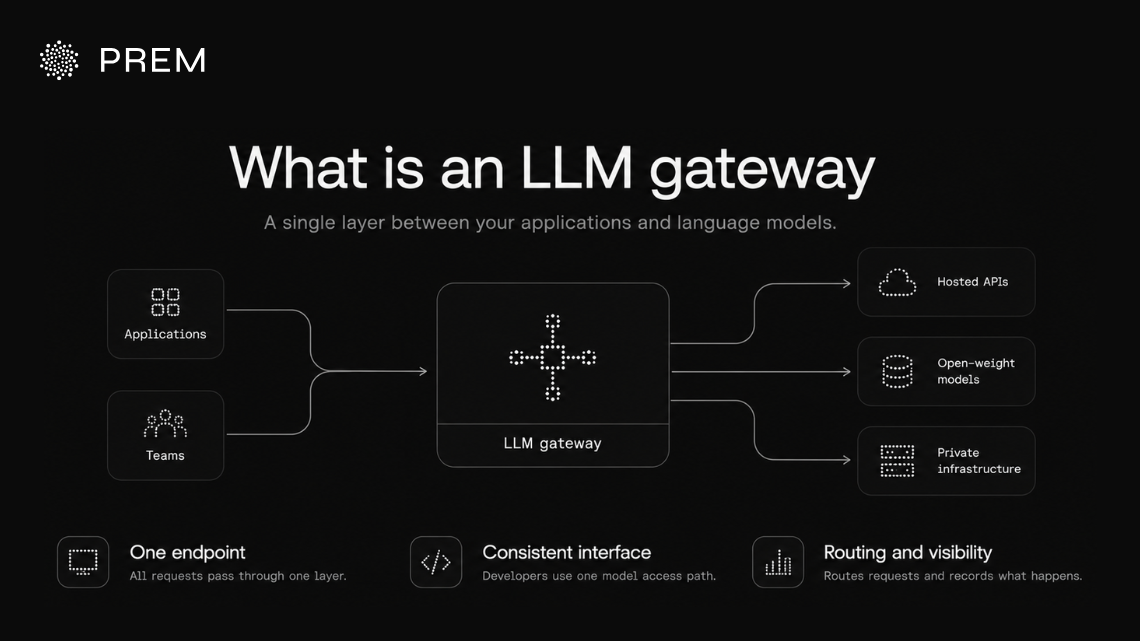
An LLM gateway is a single layer between your applications and the language models your applications connect to. Instead of each team building a separate connection to a hosted model API or an open-weight model on your servers, every request goes through one endpoint controlled by your platform team.
An LLM gateway works much like the API gateway your engineers already use for microservices. The difference is that it also handles tasks specific to LLMs such as prompts and tokens. Your developers work with one consistent interface while the gateway decides which model should receive each request. It also records what happens during that request.
Core functions of an LLM gateway
| Core function | What it does | Why it matters for your enterprise |
|---|---|---|
| Unified API access across models | Lets your developers use one API format across different model providers. You can switch between closed and open-weight models without changing your application code. | Makes model changes easier and reduces the need to maintain separate integrations. |
| Intelligent routing and failover | Routes each request based on rules such as cost, response time or data sensitivity. If one model becomes unavailable, traffic can move to a backup model. | Helps keep your applications running and gives you flexibility in how requests are handled. |
| Access control and cost governance | Uses separate virtual keys to control which models each team can access. You can also set spending limits for teams or projects. | Gives your finance and platform teams a clearer view of usage while helping prevent unexpected costs. |
| Guardrails and observability | Checks prompts for sensitive data before they leave your network. It can also log the model used, token consumption and response time. | Helps your security and platform teams monitor AI traffic and investigate issues from one place. |
Keep your LLM gateway traffic inside verifiable environments
Process model requests with private inference and cryptographic attestation through Enclave API.
Request an Enclave API demoHow does an LLM gateway work for your enterprise
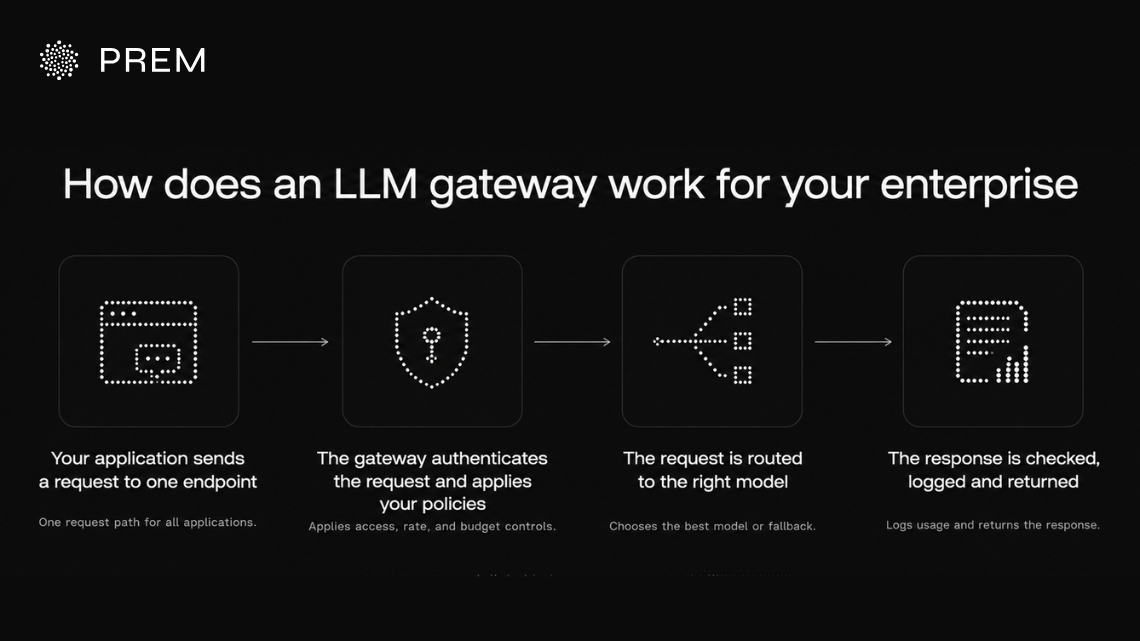
Below is a four-step framework for how an LLM gateway handles requests across your enterprise AI stack.
Your application sends a request to one endpoint
Your chatbot, internal copilot or AI agent sends a standard request to the gateway endpoint using its virtual key. The application does not need to know which model will handle the request. This separation lets your platform team change models later without asking developers to rewrite application code.
The gateway authenticates the request and applies your policies
The gateway checks the key and confirms whether the team can use the requested model. It also checks the request against your rate and budget limits.
Those limits help you control both usage and spending. TechCrunch reported that Uber used its full 2026 AI coding budget within four months. The company later capped each employee at $1,500 per month for each tool. If you set a budget for each key from the start, you can stop excessive usage before it turns into a much larger cost. This is especially useful when a team suddenly increases usage or an agent gets stuck in a repeated loop.
The request is routed to the right model
After the policy checks are complete, the gateway decides which model should handle the request. A simple summarization task might go to a smaller open-weight model running on your infrastructure. A more complex reasoning task could be sent to a larger model instead. If the selected model becomes unavailable, the gateway can route the request to a fallback model so your application keeps running.
The response is checked, logged and returned
When the model responds, the gateway can check the output before sending it back to your application. It can also record details such as the model used, token consumption and response time.These records help you see which teams are using which models and where your AI spending is coming from.
According to AI Weekly’s report on Meta, the company’s employees consumed 73.7 trillion tokens in about 30 days. Meta then built a central AI Gateway dashboard to track usage and spending by team. If you log each request from the start, it becomes much easier to see how your teams are using AI and where the costs are coming from.
Apply your LLM gateway policies before private inference begins
Protect sensitive requests while keeping the environment that processes them cryptographically verifiable.
Request an Enclave API demoHow to choose the right LLM gateway for your enterprise
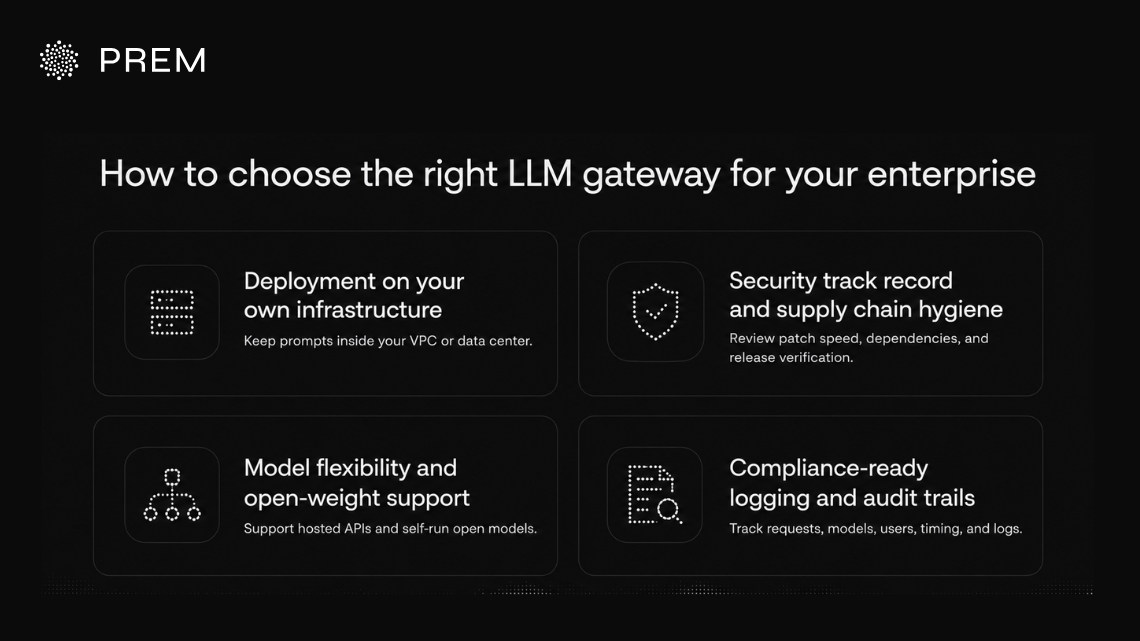
Below are some of the key factors you must consider when choosing an LLM gateway for your enterprise.
Deployment on your own infrastructure
When your enterprise works with regulated or sensitive data, look for a gateway that can run inside your own VPC or data center. A hosted gateway may process your prompts outside your infrastructure before they reach the model. This gives you less control over where your data is handled.
Check whether the vendor offers a self-hosted version with the same core features as its hosted product. You should also review any differences between the two before moving production workloads to the gateway.
Security track record and supply chain hygiene
An LLM gateway often has access to credentials for several model providers. That makes its security practices an important part of your evaluation.
The CSA research note from June 2026 describes how multiple flaws in a widely used open-source gateway could be chained together to run code without authentication. CISA had also listed one of those vulnerabilities as actively exploited.
Before choosing a vendor, check how quickly security issues are patched and how releases are verified. You should also understand how dependencies are managed and updated, these checks help you assess how well the gateway protects one of the most sensitive layers in your AI stack.
Model flexibility and open-weight support
Your gateway should support open-weight models on your own infrastructure as easily as it supports hosted model APIs. This gives you more flexibility over where different workloads run.
Open-weight models also give you full control over model versions and data handling. With the right gateway in place, you can move suitable workloads away from closed APIs without changing the rest of your application stack.
Compliance-ready logging and audit trails
Your logs should make it clear which user or team sent a request and which model handled it. They should also record when the request happened and how it was processed.
Look for a gateway that can send logs to your existing SIEM and lets you configure how long those records are stored. You should also be able to verify that sensitive fields are removed before they are written to logs. For enterprises operating in the EU, these records can also support the logging requirements that apply to certain high-risk AI systems under the EU AI Act.
Connect your LLM gateway to supported open models through one API
Use one OpenAI-compatible endpoint for private inference across supported models without rebuilding your applications.
Request an Enclave API demoRoute your enterprise LLM traffic privately with Enclave API
By now you know why your enterprise needs an LLM gateway you can trust. Our Enclave API by Prem AI gives your applications one OpenAI-compatible endpoint for supported open models. Your teams can connect to different models without rebuilding the application each time.
The gateway checks your API key and access rules without reading your prompts. Each prompt is encrypted on your side and opened only inside a hardware-isolated enclave. Model routing and inference happen there with ZDR.
Every request also comes with cryptographic attestation, so your compliance team can verify how the request was processed.
If you want to run your LLM gateway without handing your data to any external parties, contact our sales team or email us at sales@premai.io and we will help you plan the right setup for your enterprise.
Frequently asked questions about LLM gateways
What is an LLM gateway?
An LLM gateway is a layer between your application and the AI models it uses. Your application sends model requests through the gateway instead of connecting directly to every endpoint. The gateway can then manage functions such as authentication, routing and monitoring depending on the platform you choose.
Why does your enterprise need an LLM gateway?
An LLM gateway becomes useful when several applications or models are part of your AI stack. It gives you one point for managing model access and AI traffic. This reduces the need to recreate similar infrastructure for every model integration and makes your overall setup easier to manage.
How does an LLM gateway work?
Your application sends a request to the gateway first. The gateway checks the request and sends it to the required model. Once the model creates a response, it returns through the gateway to your application. The gateway may also collect usage or performance information during this process.
What is the difference between an LLM gateway and an API gateway?
A traditional API gateway manages traffic between applications and backend APIs. An LLM gateway focuses on traffic going to AI models. It may provide AI-specific capabilities such as model routing and token monitoring. Some gateways also add controls designed specifically for generative AI workloads.
Can an LLM gateway connect your application to multiple models?
Yes. Many LLM gateways are designed to place several models behind a common access layer. The exact support depends on the platform. Check which models and providers are available before choosing one. You should also see how much application code needs to change when you switch between supported models.
How does an LLM gateway improve security?
An LLM gateway provides a central place where you can apply controls before requests reach your models. These may include authentication and rate limits. Some platforms offer additional AI security controls. The gateway alone does not guarantee data privacy, so you should still understand how every provider processes your information.
Can an LLM gateway help reduce your LLM costs?
It can give you better visibility into costs when it tracks model and token usage. Some platforms also provide caching or routing features that can reduce unnecessary model calls. The capabilities vary by provider. Check exactly how the gateway handles cost control rather than assuming optimization happens automatically.