
EU AI Act Compliance: What Enterprises Need to Prepare for Secure AI Deployment
The EU AI Act is no longer a proposal. It is now in force, with compliance obligations taking effect in phases across the coming years. Some requirements have already started to apply, while others will become mandatory as the implementation timeline progresses.
For your enterprise, this marks a shift in how AI is governed. Building accurate models is no longer enough. You must also demonstrate how AI systems are managed, monitored, documented, and deployed responsibly.
The Reuters video below highlights how the EU AI Act is continuing to evolve, including recent changes to its implementation timeline, while reinforcing that enterprise AI compliance remains a priority across Europe.
The challenge is that the EU AI Act can quickly become difficult to interpret. Risk classifications, provider and deployer responsibilities, governance requirements, and compliance obligations often sound more complex than they need to be.
Let's break down the EU AI Act step by step. The following sections walk you through the requirements, responsibilities, timelines, and governance expectations your enterprise should understand before deploying AI at scale.
What the EU AI Act means for your enterprise
The EU AI Act is the world's first comprehensive law designed to regulate artificial intelligence. Instead of applying the same rules to every AI system, it uses a risk-based approach that assigns different obligations based on how an AI system is developed and used and the potential impact it can have.
For your enterprise, the regulation goes beyond AI development. It also governs how AI systems are procured, deployed, monitored, and governed throughout their lifecycle, making AI governance a business-wide responsibility rather than only a technical one.
The Act introduces clear expectations around risk management, transparency, data governance, human oversight, technical documentation, and ongoing monitoring. These requirements help establish a consistent approach to deploying AI systems responsibly across the enterprise.
The impact extends beyond compliance teams. Technology, security, legal, procurement, risk, and business leaders all have a role in ensuring AI systems remain compliant throughout their lifecycle.
Understanding whether the regulation applies to an enterprise is the first step. The next is identifying the role it plays under the Act.
Who it applies to: Providers vs. AI deployers
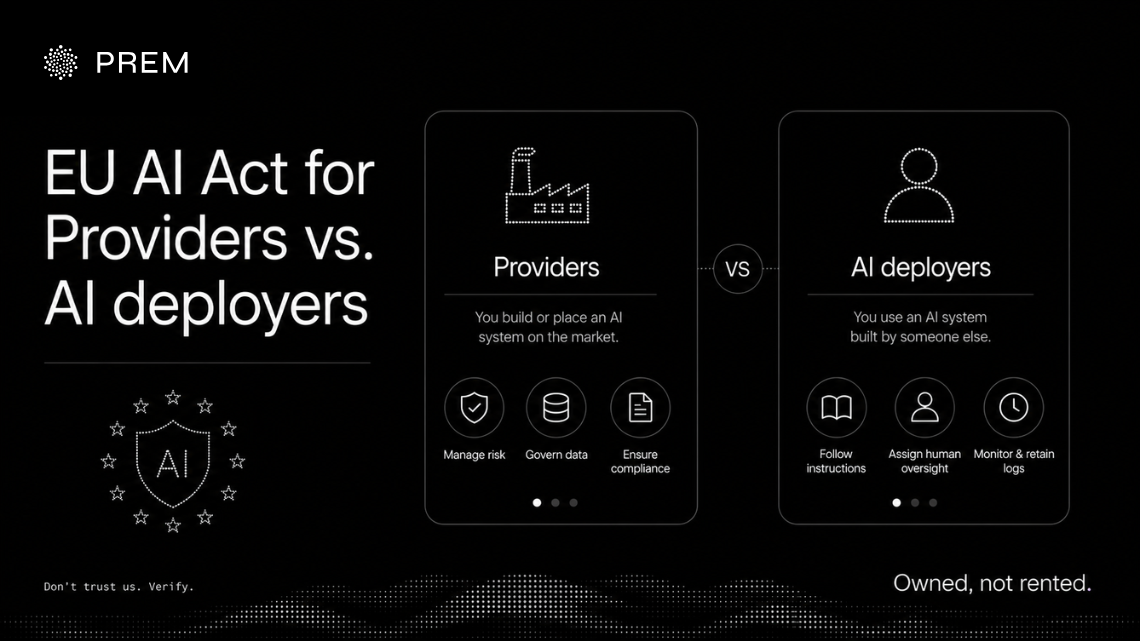
One of the first steps in EU AI Act compliance is identifying which role you play. The Act assigns different responsibilities to AI providers and AI deployers, and you may find yourself operating as both across different AI systems.
AI providers
An AI provider develops an AI system or a general-purpose AI model and places it on the market under its own name or trademark. This also includes you if you make significant changes to an existing AI system before making it available to your customers or users.
Providers have the broadest set of compliance obligations. Depending on the risk level of the AI system, these may include implementing risk management processes, maintaining technical documentation, establishing data governance practices, completing conformity assessments, and continuously monitoring AI systems after deployment.
AI deployers
An AI deployer uses an AI system within its own business operations. This includes you if you use internally developed AI, as well as AI solutions you've purchased from third-party vendors.
Deployers are responsible for using AI systems in accordance with the provider's instructions while maintaining appropriate human oversight, monitoring performance, and meeting operational obligations defined under the Act. Additional requirements apply when deploying high-risk AI systems.
Can an enterprise be both?
Yes. Many enterprises act as both AI providers and AI deployers at the same time.
For example, you may develop AI-powered products for customers while also using third-party AI tools for recruitment, customer support, software development, or internal productivity. Each AI system may fall under a different set of responsibilities depending on how it is developed and used.
Your role can also change over time. If you initially deploy a third-party AI system, you may become a provider if you significantly modify the system, change its intended purpose, or offer it under your own brand. When that happens, additional provider obligations apply to you.
Understanding these roles matters because compliance is determined by how an AI system is developed, modified, and deployed, not simply by whether you build AI from scratch.
Does it apply outside the EU?
Yes. The EU AI Act can apply to your enterprise even if you have no offices, employees, or legal entity within the EU.
The regulation focuses on where AI systems are used and who they affect, not where you're headquartered. If your AI system is made available in the EU, or its outputs are used by people or enterprises within the EU, the Act may still apply to you.
This means the regulation can affect you whether you're a software company, a multinational enterprise, a cloud service provider, an AI vendor, or simply serving European customers from somewhere else. Expanding into the EU market or offering AI-enabled products to EU customers can also bring you within the scope of the Act.
If you operate globally, compliance is no longer just a regional consideration. Your AI governance, documentation, and risk management increasingly need to support operations across multiple jurisdictions, with the EU AI Act becoming one of the key frameworks shaping how you deploy AI.
EU AI Act risk categories for your enterprise
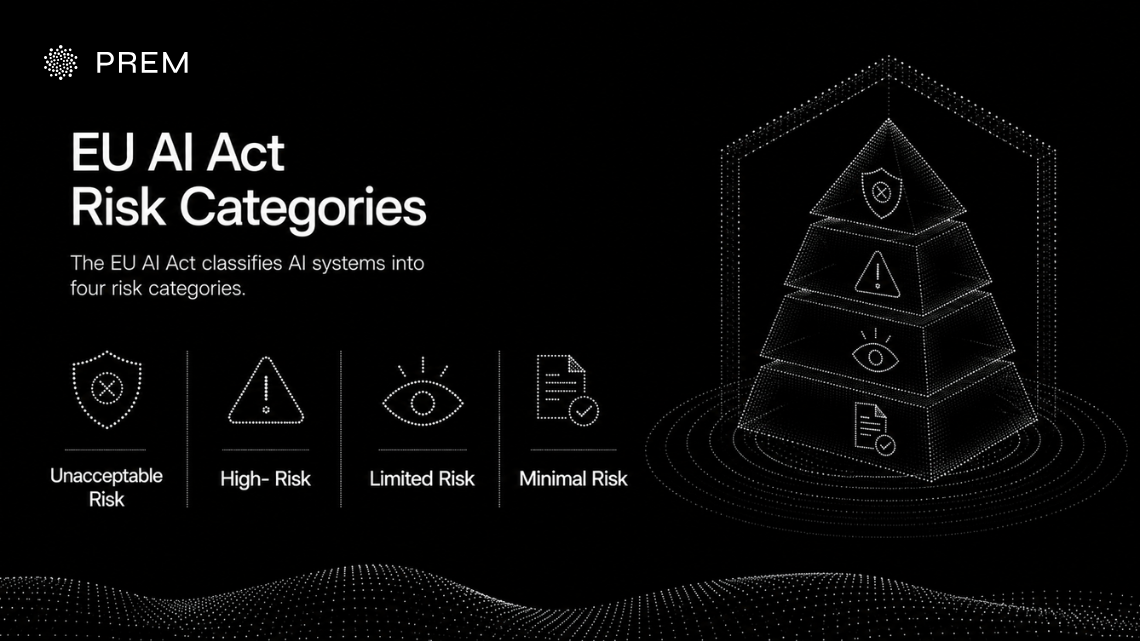
The EU AI Act classifies AI systems into four risk categories. The level of compliance required depends on which category an AI system falls into, making risk classification one of the first steps in any enterprise AI governance program.
Not every AI application is treated the same. While some AI practices are prohibited entirely, others require strict governance controls, transparency measures, or few to no additional regulatory obligations.
Unacceptable risk: Practices banned outright
The highest risk category includes AI practices that the EU considers unacceptable because they pose a serious threat to people's safety, rights, or freedoms. These systems are prohibited, and you generally can't develop, sell, or use them within the EU.
Examples include AI systems that manipulate human behavior, exploit vulnerable individuals or groups, perform social scoring, or use certain forms of biometric categorization and emotion recognition in restricted contexts.
A widely discussed example is Clearview AI. The company built a facial recognition database by collecting billions of publicly available images from the internet. As reported by Reuters, privacy regulators in France, Italy, Greece, and the Netherlands found the practice violated the GDPR and imposed enforcement actions and nearly €100 million in cumulative fines. Those actions were brought under the GDPR rather than the EU AI Act, but the case shows why large-scale biometric surveillance is now treated as one of the highest-risk areas under European AI regulation.
For you, this category works best as a screening checklist. Your AI procurement, development, and governance processes should catch prohibited practices before they ever reach production.
High-risk: Annex III use cases Enterprises overlook
High-risk AI systems face the most extensive compliance requirements under the Act. They're not prohibited, but you can only deploy them after meeting specific governance, documentation, and risk management obligations.
You might assume high-risk AI only applies to healthcare or law enforcement. In reality, Annex III also covers AI systems used in employment, education, essential public and private services, critical infrastructure, law enforcement, border management, and the administration of justice.
Common examples include AI used to screen job applicants, evaluate employee performance, assess creditworthiness, support insurance decisions, or determine access to essential services. If you're using AI in any of these areas, it's worth carefully checking whether your system falls within the high-risk category.
Limited risk: Transparency-Only Obligations
Some AI systems only need to meet transparency requirements, not the full governance obligations high-risk systems carry. The goal is to make sure people know when they're interacting with AI or viewing AI-generated content.
Examples include AI chatbots, virtual assistants, and systems that generate synthetic images, audio, or video. Depending on your use case, you may need to inform users that AI is involved or disclose when content has been generated or manipulated by AI.
The compliance burden here is lighter than for high-risk systems, but transparency still matters for building trust with your users and meeting regulatory expectations.
Minimal risk: What Carries No Extra Burden
Many everyday AI applications, such as spam filtering, grammar correction, recommendation features, and internal productivity tools, fall into the minimal-risk category. These systems don't carry the additional obligations that apply to high-risk AI under the EU AI Act.
That doesn't mean you can ignore them. As AI adoption grows, enterprises often lose visibility into which AI systems are being used, what data they access, and whether those deployments continue to fit their original use case.
Keeping an inventory of your AI systems, documenting their purpose, and reviewing how they're used makes it much easier to identify higher-risk use cases as they emerge and demonstrate good AI governance.
Even here, good AI governance still matters. Visibility into your AI systems today makes it much easier to assess future use cases, respond to evolving regulatory requirements, and scale AI responsibly across your enterprise.
EU AI Act compliance requirements for your enterprise
Complying with the EU AI Act involves more than just classifying your AI systems by risk. You also need governance processes that demonstrate your AI systems are developed, deployed, and monitored responsibly throughout their lifecycle.
The exact obligations depend on the role you play and the level of risk associated with each AI system. That said, a few compliance requirements form the foundation of any enterprise AI governance program.
Documenting risk management the way the Act requires
The EU AI Act expects you to identify, assess, and manage risks throughout an AI system's entire lifecycle. Risk management isn't a one-time task; it's an ongoing process that runs from development and deployment through regular monitoring and updates.
Your risk assessments should evaluate how your AI systems could affect individuals, your business operations, and your regulatory compliance. You should also document the risks you've identified, your mitigation measures, testing results, and decisions made before and after deployment.
Keeping clear records helps you demonstrate compliance during internal reviews, customer assessments, and regulatory audits, while also supporting better governance across your AI initiatives.
Building data governance and traceability into your systems
Strong data governance is essential for trustworthy AI. You need to understand where your training and operational data come from, how it's processed, who can access it, and how it's used throughout the AI life cycle.
Traceability matters just as much. Keeping documentation around your datasets, models, prompts, system changes, and deployment decisions creates an audit trail that supports accountability and makes compliance investigations easier.
These practices also help your security, compliance, engineering, and business teams collaborate better, since everyone's working from the same view of how your AI systems actually operate.
Strengthening human oversight and technical robustness
The EU AI Act recognizes that AI should support human decision-making, not replace it, in situations that significantly affect individuals. Real human oversight means important decisions can actually be reviewed, challenged, or corrected when you need to.
You should also have processes for testing AI systems before deployment and monitoring them after release. Accuracy, reliability, cybersecurity, resilience, and ongoing performance all need regular evaluation to keep your operational and compliance risks in check.
Together, human oversight and technical robustness help you build AI systems that stay reliable as your business requirements, data, and the regulations themselves evolve.
Meeting deployer obligations under Article 26
If you're acting as an AI deployer, you also have specific responsibilities under the EU AI Act. These include using AI systems according to the provider's instructions, maintaining appropriate human oversight, monitoring system performance, and keeping records where required.
For high-risk AI systems, you may also need to ensure your input data is relevant, report serious incidents when they happen, and cooperate with providers and regulatory authorities during compliance activities.
This reinforces an important principle worth remembering: buying an AI solution from a third-party provider doesn't transfer all compliance responsibility to them. Effective governance stays your job throughout the entire deployment lifecycle.
Challenges in EU AI Act compliance
Meeting the requirements of the EU AI Act isn't simply a legal exercise. You probably already have some AI governance processes in place, but if they evolved independently across your different business units, demonstrating consistent compliance gets hard fast.
Here are the challenges that commonly slow down compliance efforts and increase operational risk.
Data Governance and Traceability Gaps
You may struggle to maintain complete visibility into how your AI systems use data throughout their lifecycle. Training data, prompts, model versions, system updates, and deployment records often end up managed across different teams and platforms, and that's exactly where gaps in documentation and accountability creep in.
Without clear traceability, demonstrating compliance gets significantly harder. Missing documentation can also delay your audits, vendor assessments, and internal governance reviews.
The consequences of weak AI governance are already showing up elsewhere. As reported by AP News, Italy's privacy watchdog fined OpenAI €15 million under the GDPR over ChatGPT's handling of personal data, citing issues including transparency and user information. That enforcement action came under the GDPR rather than the EU AI Act, but it shows the direction regulators are heading: they expect you to maintain clear governance and accountability around your AI systems.
Building a centralized AI governance framework helps you close these gaps. Keeping consistent records for your data sources, model versions, deployment history, ownership, and system changes creates an audit trail that supports both compliance and your day-to-day governance.
Lack of Human Oversight and Audit Trails
AI systems increasingly support decisions that affect your customers, employees, and business operations. Without clearly defined human oversight, you may struggle to explain how a decision was reviewed, challenged, or corrected when it mattered.
Audit trails carry a similar risk. If AI-generated outputs, user actions, or system changes aren't recorded consistently, demonstrating accountability becomes difficult during internal reviews or regulatory inspections.
Setting up clear review processes and keeping comprehensive audit logs helps you demonstrate accountability. Recording approvals, interventions, and significant system changes also makes your investigations and compliance reviews faster when you actually need them.
Shadow AI and Ungoverned Tool Sprawl
Your business teams probably adopt AI tools independently to boost productivity. These tools can genuinely accelerate innovation, but they frequently bypass whatever security, procurement, and governance processes you already have in place.
This creates a fragmented AI environment and increases the risk of shadow AI, where you lack visibility into which tools are actually being used, what data they process, and whether they comply with your policies or regulatory requirements.
Keeping an enterprise-wide inventory of your AI systems and introducing standardized approval processes improves your visibility across the board. Regular governance reviews also help you catch unauthorized AI usage before it turns into a compliance or security problem.
Risk Management Treated as a One-Time Audit
You might be treating risk management as a project you finish before deployment, rather than an ongoing part of governance. As your AI models, datasets, regulations, and business requirements evolve, an assessment that was solid six months ago can go stale fast.
The EU AI Act expects you to monitor your AI systems throughout their entire lifecycle, not just rely on a single compliance review. Continuous oversight helps you catch emerging risks before they turn into regulatory or operational issues.
Building AI risk management into your existing governance, security, and compliance programs makes this far more sustainable. Regular reviews and reassessments help keep your AI systems aligned with your changing business needs and regulatory expectations.
Penalties for non-compliance
The EU AI Act introduces significant financial penalties if you fail to meet its requirements. How severe the penalty is depends on the nature of the violation, with prohibited AI practices carrying the highest fines.
| Violation | Maximum Penalty |
| Prohibited AI practices | Up to €35 million or 7% of total worldwide annual turnover, whichever is higher |
| Non-compliance with obligations under the AI Act (including requirements for high-risk AI systems, GPAI models, transparency obligations, and other applicable requirements) | Up to €15 million or 3% of total worldwide annual turnover, whichever is higher |
| Supplying incorrect, incomplete, or misleading information to competent authorities or notified bodies | Up to €7.5 million or 1% of total worldwide annual turnover, whichever is higher |
Note: The Act also provides lower fine thresholds for SMEs and startups in certain cases.
Financial penalties are only part of the risk. Non-compliance can delay your AI deployments, increase regulatory scrutiny, damage customer trust, and create additional legal and operational costs.
The bigger challenge for you is usually demonstrating that appropriate governance, documentation, and oversight were already in place before your AI system came under review. Building these capabilities early reduces your compliance risk while helping you adopt AI more responsibly across your enterprise.
Key EU AI Act compliance deadlines
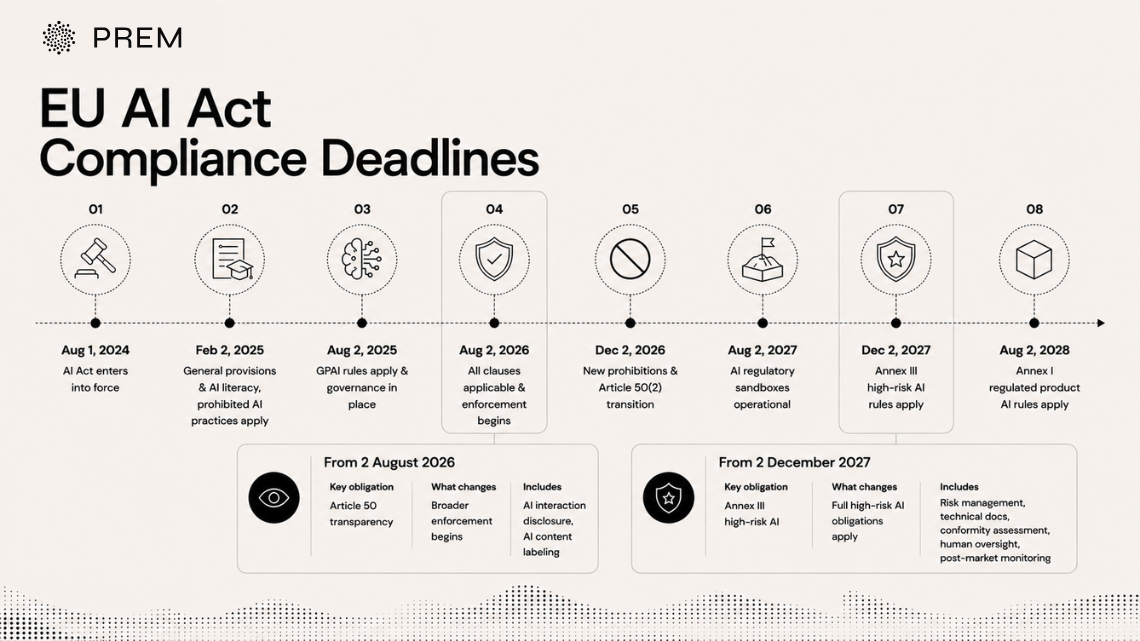
The EU AI Act is being implemented in phases rather than all at once. Some obligations are already in effect, and others will become applicable over the next few years, giving you time to strengthen your governance, documentation, and compliance processes.
| Date | What Takes Effect | Enterprise Impact |
| 1 August 2024 | EU AI Act enters into force | The regulation officially becomes law, beginning the phased implementation timeline. |
| 2 February 2025 | General provisions (definitions and AI literacy) and prohibited AI practices apply | Enterprises must avoid prohibited AI practices and ensure personnel working with AI have an appropriate level of AI literacy. |
| 2 August 2025 | Rules for General-Purpose AI (GPAI) apply, and governance must be in place | Providers of GPAI models must comply with applicable obligations. Member States establish national authorities, and EU AI governance structures become operational. |
| 2 August 2026 | Most AI Act obligations become applicable, and broader enforcement begins | Transparency obligations under Article 50 take effect, and enforcement begins for applicable provisions already in force, including GPAI models, prohibited AI practices, transparency rules, and AI literacy. |
| 2 December 2026 | New prohibited AI practices and Article 50(2) transition apply | Additional prohibitions relating to certain AI-generated illegal content take effect, while transitional transparency requirements apply to eligible AI systems already on the market. |
| 2 August 2027 | AI regulatory sandboxes operational in each Member State | Enterprises gain greater access to national regulatory testing environments for developing and validating AI systems. |
| 2 December 2027 | Rules for high-risk AI systems listed in Annex III apply | Enterprises developing or deploying Annex III high-risk AI systems must comply with the Act's high-risk requirements. |
| 2 August 2028 | Rules for high-risk AI embedded in regulated products covered by Annex I apply | Additional requirements apply to AI systems that are safety components of regulated products, such as medical devices and machinery. |
Treat these dates as planning milestones, not just implementation deadlines. Building governance frameworks, documenting your AI systems, and assessing your compliance readiness all take real preparation before the legal obligations actually kick in.
Key AI Act obligations by implementation milestone
The timeline above tells you when things change. It doesn't tell you what actually becomes enforceable at each point, and that distinction matters when you're deciding what to prioritize first.
Here's a closer look at the two milestones that carry the most weight for most enterprises: 2 August 2026 and 2 December 2027.
What becomes applicable from 2 August 2026
Article 50 transparency obligations begin to apply from this date, including requirements to disclose when someone is interacting with an AI system and to label certain AI-generated or manipulated content.
Alongside this, the European Commission's AI Office and national authorities begin enforcing key provisions of the Act more broadly. This includes obligations that were already applicable before this date, such as general-purpose AI provider requirements in force since 2 August 2025, as well as the prohibited AI practices and AI literacy requirements that took effect earlier in the timeline.
In practical terms, 2 August 2026 is less about brand-new obligations appearing overnight and more about enforcement catching up to requirements that, in several cases, were already live.
What becomes applicable from 2 December 2027
This is where the compliance burden increases substantially for enterprises developing or deploying Annex III high-risk AI systems.
Obligations that become applicable from this date include a documented risk management system, technical documentation covering the system's design and intended purpose, conformity assessment procedures, post-market monitoring, human oversight requirements, and, where applicable, fundamental rights impact assessments.
Providers placing Annex III high-risk AI systems on the market or putting them into service from this date onward must meet these conformity assessment obligations as part of that process, not as something to retrofit afterward.
| From 2 August 2026 | From 2 December 2027 | |
| Key obligations | Article 50 transparency | Annex III high-risk AI |
| What changes | Broader enforcement begins | Full high-risk AI obligations apply |
| Includes | AI interaction disclosure, AI-generated content labeling | Risk management, technical documentation, conformity assessment, human oversight, post-market monitoring |
Note: GPAI provider obligations have applied since 2 August 2025. The 2 August 2026 milestone marks broader enforcement under the AI Act, not the start of GPAI obligations.
Where Prem AI fits into your EU AI Act compliance plan
The EU AI Act is much more than a documentation exercise. Depending on whether you’re an AI provider or deployer, it introduces requirements around risk management, governance, transparency, technical documentation, human oversight, logging, post-market monitoring, and, for high-risk systems, conformity assessments.
Across many of these obligations, one theme keeps coming up: you need to demonstrate that your controls actually work, not just describe them in a policy. That means being able to show how your AI systems are governed, how sensitive data is handled, how outputs can be traced, and how security controls are enforced.
This is where Prem Enclave and Prem Enclave API fit into an enterprise AI compliance strategy.
For organizations that need complete infrastructure control, Prem Enclave runs inside infrastructure you own, whether that’s on-premises, in your VPC, or in a private cloud. It provides hardware-backed Trusted Execution Environments (TEEs), cryptographic attestation, and infrastructure-level controls that help security teams verify how sensitive AI workloads are executed.
If you don’t want to operate GPU infrastructure yourself, Prem Enclave API provides the same confidential AI inference through managed APIs while Prem operates the underlying infrastructure. This allows development teams to integrate private AI more quickly without giving up hardware-backed security guarantees.
For enterprise AI applications built on top of that infrastructure, Fluso adds another layer of governance. It gives organizations a secure AI workspace with role-based access, enterprise knowledge management, auditability, and workflow controls, making it easier to manage how employees interact with AI across sensitive business processes.
Together, these capabilities help organizations strengthen their AI governance posture by supporting data custody, traceability, access control, and verifiable security controls. They don’t replace the legal work required under the EU AI Act, such as system classification, conformity assessments, or risk management. Instead, they provide infrastructure and governance capabilities that make those compliance efforts easier to implement, demonstrate, and independently verify.
Build EU AI Act Readiness With Prem AI
December 2027 may seem far away, but preparing for it takes time. You need to inventory your AI systems, classify them against Annex III where applicable, establish governance processes, and build the data governance and audit trails regulators will expect to review.
Start early, and you can build compliance into your AI operations over time. Wait until the final deadline, and you'll have far less flexibility to address the governance gaps you find.
Prem AI helps enterprises move beyond compliance checklists by building governance, traceability, and verifiable AI directly into the infrastructure. That means you're preparing for the EU AI Act while building AI your business can trust for the long term.
If you're ready to build EU AI Act compliance into your AI infrastructure instead of adding it later, Prem AI can help. Contact our sales team to discuss your enterprise requirements or email us at sales@premai.io.
FAQs about EU AI Act compliance
What is the EU AI Act?
The EU AI Act is the European Union's regulatory framework for artificial intelligence. It classifies AI systems into four risk categories: unacceptable, high, limited, and minimal. The compliance requirements depend on the level of risk. Organizations that fail to comply can face fines of up to €35 million or 7% of their global annual turnover.
Does the EU AI Act apply to companies outside the EU?
Yes. The EU AI Act has an extraterritorial scope. It can apply to organizations outside the EU if they place AI systems on the EU market or if the outputs of those systems are used within the EU, even when the organization has no physical presence there.
What is the difference between a provider and a deployer under the Act?
A provider develops or places an AI system on the market and is responsible for meeting the applicable regulatory requirements. An AI deployer uses an AI system within an organization and must operate it responsibly by maintaining oversight, following applicable obligations, and monitoring its use.
Which AI use cases count as high-risk under Annex III?
Recruitment, employee management, education, credit scoring, insurance, law enforcement, and access to essential public services are among the AI use cases classified as high risk under Annex III. If your AI system could significantly affect people's rights or opportunities, it should be assessed against those criteria.
When do the high-risk obligations actually kick in?
Under the current implementation timeline, the rules for standalone high-risk AI systems listed in Annex III apply from 2 December 2027. Requirements for high-risk AI systems embedded in regulated products covered by Annex I apply from 2 August 2028, giving organizations time to prepare.
What happens if I don't comply?
The penalties depend on the type of violation. The most serious breaches can result in fines of up to €35 million or 7% of global annual turnover. Other violations carry lower penalties, while non-compliance can also increase regulatory scrutiny and delay AI deployment initiatives.
Can I become a provider without meaning to?
Yes. Your organization can become a provider if it substantially modifies a high-risk AI system, changes its intended purpose, or places it on the market under its own name. In that case, it assumes the additional compliance obligations that apply to AI providers.
What's the compliance gap most enterprises actually run into?
Many enterprises struggle with data governance and traceability. Beyond documenting policies, your organization should be able to demonstrate how AI systems are managed, how data is protected, and how governance controls are applied throughout the AI lifecycle to support regulatory compliance.
Do I need a dedicated compliance team to meet deployer obligations?
Not necessarily. Your organization should assign clear ownership for AI governance, human oversight, monitoring, and compliance activities. These responsibilities are often shared across legal, security, engineering, and business teams to ensure AI systems remain compliant throughout their lifecycle.
How does infrastructure actually help with EU AI Act compliance?
AI infrastructure helps your organization demonstrate compliance through built-in governance controls, audit logs, and secure data handling. When these capabilities are embedded into the platform, it becomes easier to produce verifiable evidence during internal reviews, customer audits, or regulatory inspections.
See how Prem AI can help your enterprise build private AI without compromising control over your data and infrastructure. Contact our sales team, or email us at sales@premai.io.