Enterprise AI Governance: A Complete Framework For Secure, Verifiable AI Adoption
On this page
Ungoverned AI is already creating measurable business risk for you. IBM's Cost of a Data Breach Report 2025 found that one in five organizations experienced a breach involving shadow AI. Enterprises with extensive shadow AI also incurred an average of $670,000 more in breach costs than those with little or no shadow AI. AI isn't the problem; ungoverned AI is.
The challenge is that governance hasn't kept pace with adoption. Your employees are adopting AI tools and autonomous agents faster than you can establish ownership, oversight, and security controls. That governance gap is growing faster than most governance functions were built to handle. By April 2026, two-thirds of enterprises with deployed AI agents had already experienced a confirmed security incident, according to Kiteworks' 2026 research on AI agent security.
The gap is not for lack of awareness. Deloitte's 2026 State of AI in the Enterprise survey found that only 21% of companies currently have a mature governance model for autonomous AI agents, even as adoption plans keep accelerating. If that's you, you're not alone, and you're not behind either. Most of the market is in the same spot.
Regulators are closing that gap for enterprises that don't close it themselves. The EU AI Act's transparency obligations take effect in August 2026, and "we didn't know" is no longer a viable defense once an ungoverned agent causes a data exposure incident.
This isn't hypothetical. It's already playing out in production. Here's what that looks like:
Let's break down what enterprise AI governance actually takes, where most policies quietly fail, and how you can build a program that holds up under an audit, not just a slide deck.
An Enterprise AI governance overview
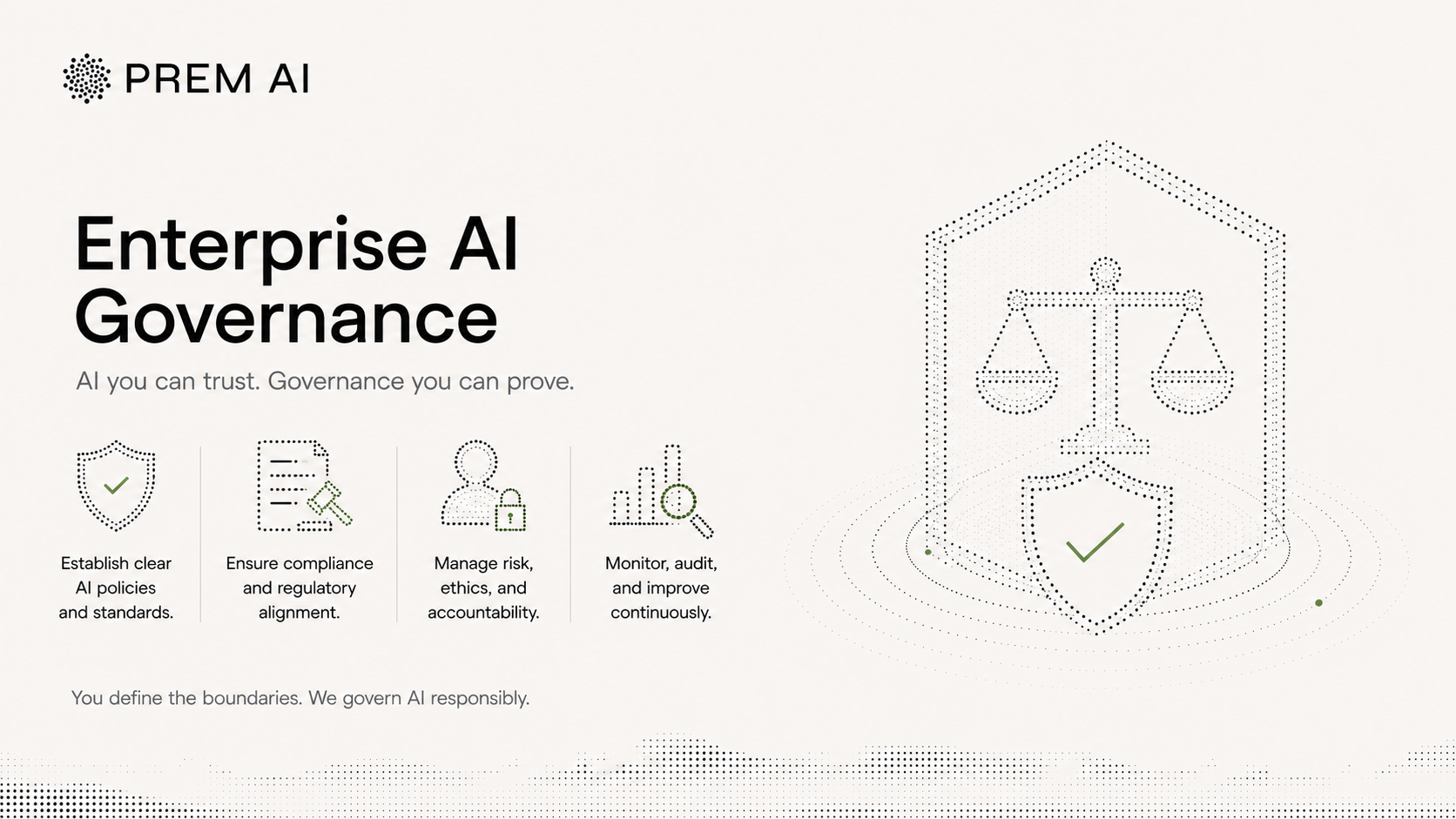
Enterprise AI governance is the set of policies, controls, and accountability structures that guide how you deploy and monitor AI systems throughout their lifecycle. It defines who is responsible for AI decisions and how those decisions are managed over time.
It answers critical questions. Who on your team owns the risk when your AI system makes a wrong decision? How can you explain that decision to a regulator or customer? How do you verify that the system still behaves as approved months after deployment?
AI governance is often confused with related disciplines. This is where your governance gaps usually emerge.
Data governance focuses on how your data is classified, stored, and accessed. It does not govern what an AI model does with that data once it gets there. IT governance manages infrastructure and change processes. It rarely addresses whether your AI outputs can be explained. AI ethics defines principles such as fairness, transparency, and accountability.
However, principles alone do not enforce responsible AI use on your end. Enterprise AI governance brings these disciplines together by adding accountability for how your AI systems actually operate in production.
Frameworks such as NIST's AI Risk Management Framework (AI RMF) support this effort. They give you a structured way to identify, assess, and reduce AI risks. However, they are only one part of governance. They will not tell you who owns a given system or verify that it's still operating as originally approved.
In practice, an effective governance program rests on a few core pillars you'll want in place. Every AI system has a clearly defined owner. Explainability cannot depend on "the vendor doesn't tell us." Controls should match the level of risk, so a marketing assistant is not reviewed like a credit decision model. Data custody must be clearly defined.
Compliance should be backed by evidence, not trust. Your AI systems need continuous monitoring instead of one-time approval. Your enterprise knowledge should compound securely instead of disappearing at the end of every chat session.
The four commitments behind every Enterprise AI governance standard
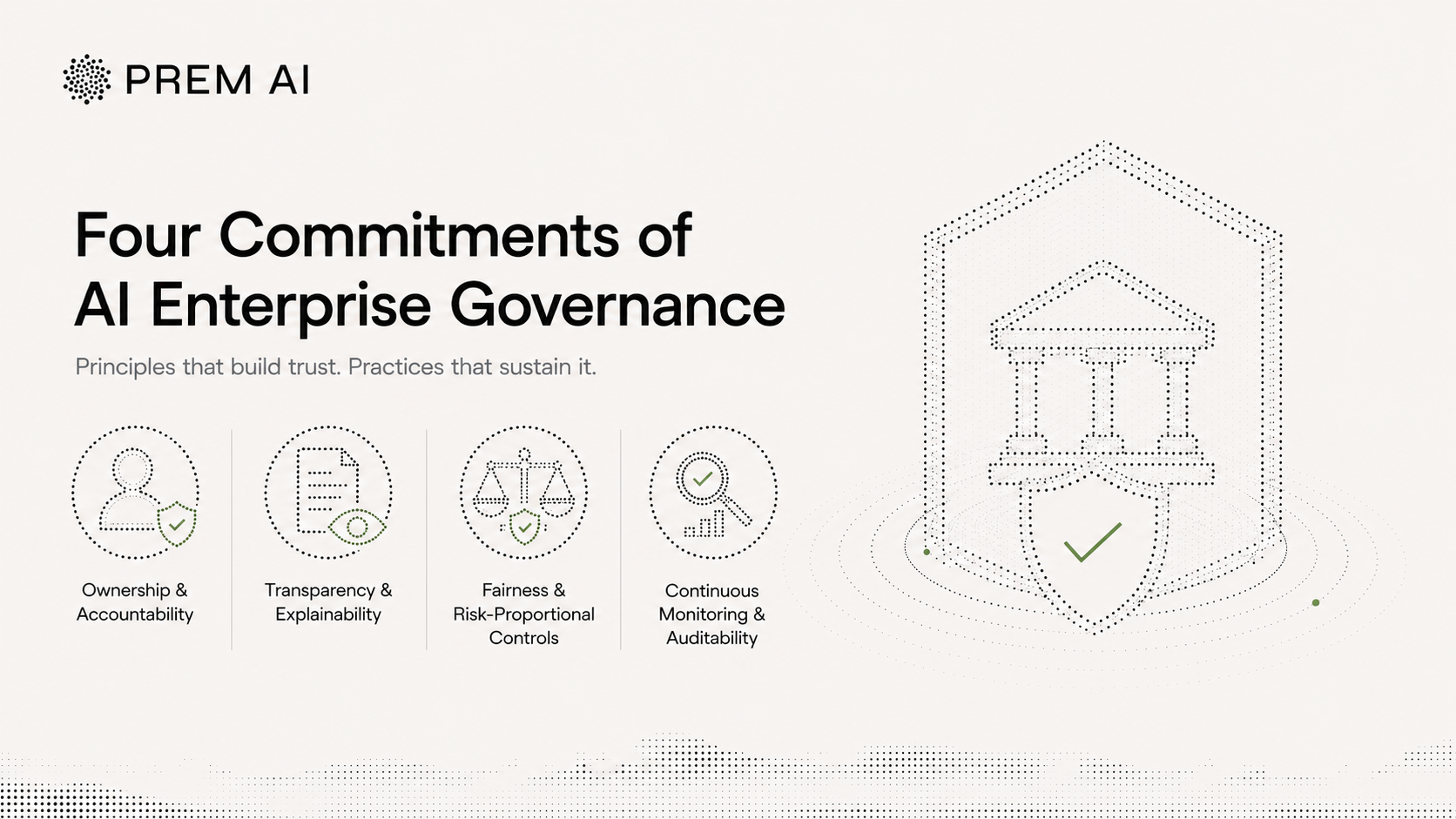
A governance program is defined by what it actually commits to, not by who's assigned to run it. The pillars below represent the core principles that guide effective AI governance.
Every recognized AI governance standard, NIST's AI RMF, the OECD AI Principles, the EU AI Act, and ISO/IEC 42001, converges on the same four foundations. A governance program missing any one of these isn't really a governance program yet. It's a draft.
Ownership & accountability
Every AI system has a named owner responsible for its outcomes, not an implied one nobody on your team could point to if asked.
Transparency & explainability
Your stakeholders can understand how a system reached a decision, and that logic can be documented for a regulator or an affected customer.
Fairness & risk-proportional controls
Bias testing and oversight scale to the stakes of the decision, so a marketing assistant isn't reviewed the same way as a lending model.
Continuous monitoring & auditability
A system approved in January isn't assumed to behave the same way in June. Governance is a cycle, not a one-time gate.
These four are the floor. They'll get you started, but on their own, they don't answer the question every governance program eventually gets asked: How do you actually prove any of this is true, rather than just documented?
The risks without Enterprise AI governance and how you can address them
Most enterprises already have an AI policy. Most of those policies fail at the same point. They govern the decision to use AI. They don't govern what happens once that data actually reaches the model during inference, and that's exactly where most governance stops watching.
A policy can say sensitive data must not be shared with public AI platforms. Access controls can restrict who has a login. None of that stops one of your employees from pasting a document into a chat window the policy never anticipated. None of it stops an AI agent from taking an action nobody explicitly approved.
Every governance program eventually has to answer one question. Is AI use in your organization controlled by architecture or just trusted because a policy document said so?
The good news: every risk below has a fix that enterprises have already proven out in practice, and you can build toward the same thing.
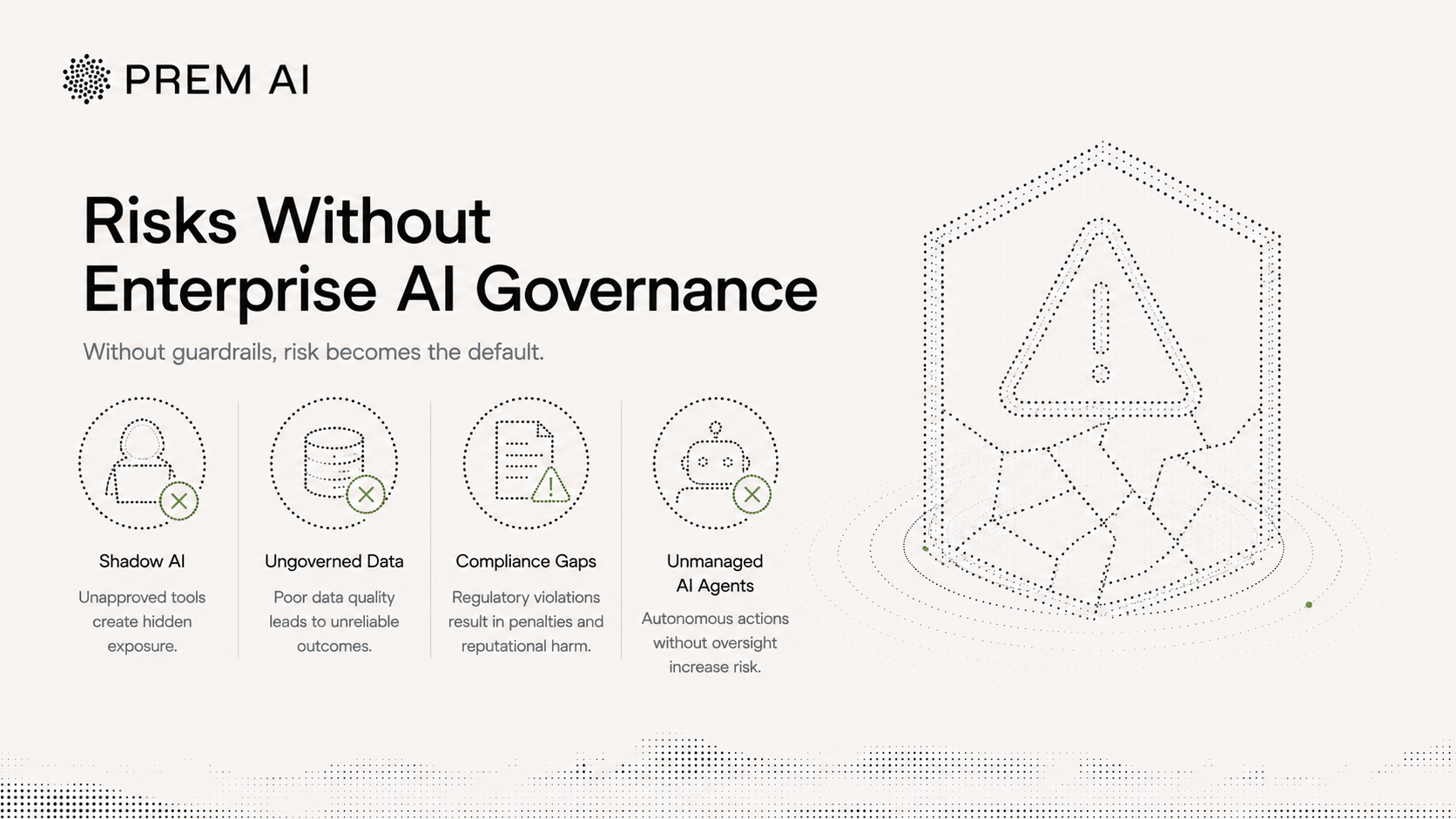
Shadow AI: When policies fail to control AI use
Shadow AI is the gap between a written policy and what employees actually do under deadline pressure.
This isn't a rare exception. According to Cyberhaven's 2025 AI Adoption & Risk Report, 34.8% of enterprise data shared with AI tools is now sensitive, up from just 10.7% two years earlier. Worse, 83.8% of that data flows into platforms Cyberhaven classifies as critical or high risk. Written policies haven't slowed this down. AI usage frequency has grown 61x in the last two years, far outpacing any enterprise's ability to govern it through policy documents alone.
That pattern is worth paying attention to. Banning individual AI apps doesn't fix shadow AI. Your employees under deadline pressure will just find the next one. What actually closes the gap is an approved AI environment that's as fast and capable as the public platforms employees would otherwise reach for, with visibility and data controls built in from the start.
Once that exists, shadow AI stops being a blind spot in your organization. It becomes an inventoried, governed part of your AI environment.
Ungoverned data: The hidden risks in AI systems
AI-specific data governance goes beyond classic data governance. AI systems create new categories of risk: the prompts your employees write, the outputs a model generates, and the context a system accumulates over time.
That means governing what data a system can train or fine-tune on, on your end. It means knowing whether prompts are retained after a session and how long logs persist. Zero data retention (ZDR) is the clearest version of this in practice. Data that is never retained cannot be breached, subpoenaed, or repurposed later.
The benefit shows up once retention is architectural, not promised. If you can show exactly what data a system touched and prove nothing was retained beyond the session, you can support your privacy claims with verifiable evidence instead of relying on a policy document. Structural retention is a materially stronger guarantee than retention that depends on a vendor honoring a policy.
Compliance gaps: When governance can't be proven
In March 2023, Italy's data protection authority, Garante, temporarily banned ChatGPT nationwide. The agency cited a suspected breach of privacy rules, including a lack of age verification and no clear legal basis for collecting personal data at scale, according to Reuters. OpenAI responded with changes to data handling and user controls, and the ban was lifted soon after. It was one of the first concrete signals that regulators would act on AI governance gaps, not just write about them.
Regulation since then hasn't converged on one global standard. But it has converged on the same underlying demand: prove it, don't just promise it. The EU AI Act's transparency obligations take effect in August 2026, with real penalty powers behind them. GDPR continues to apply in parallel.
Enterprises that treat compliance as something to demonstrate, not just claim, are the ones positioned to move fast when a regulator asks. If that's your goal too, ISO/IEC 42001 gives you a certifiable, auditable structure. Procurement teams increasingly ask AI vendors to demonstrate it before purchase, rather than take it on faith. Compliance stops being a scramble for you. It becomes a standing answer.
AI agents: When AI acts without oversight
When AI only answers questions, a wrong answer is a mistake. When AI takes real actions on its own, a mistake becomes a liability, one your enterprise owns, whether you approved it or not.
In 2024, a Canadian tribunal ruled that Air Canada was liable for a refund policy its own customer service chatbot had invented, according to CBC News. The airline argued the chatbot was a separate entity, responsible for its own actions.
The tribunal disagreed. Air Canada was ordered to pay damages. The case became one of the clearest early examples that your enterprise is accountable for what your AI does, whether or not a human reviewed the specific output first.
Before any agent you deploy goes into production, your governance needs to define what it can access. It needs to define what requires human approval versus what the agent can execute independently and how its actions are logged well enough to reconstruct afterward.
Traditional security frameworks weren't built for AI-specific attacks like prompt injection or data poisoning. MITRE ATLAS fills that gap. It documents tactics and techniques targeting AI systems specifically, giving security teams a shared way to identify and defend against them.
Get this right, and an agent stops being a liability you can't explain after the fact. It becomes a system you can point to, showing exactly what it was allowed to do, what it actually did, and why the two match.
How Enterprise AI governance applies in regulated industries
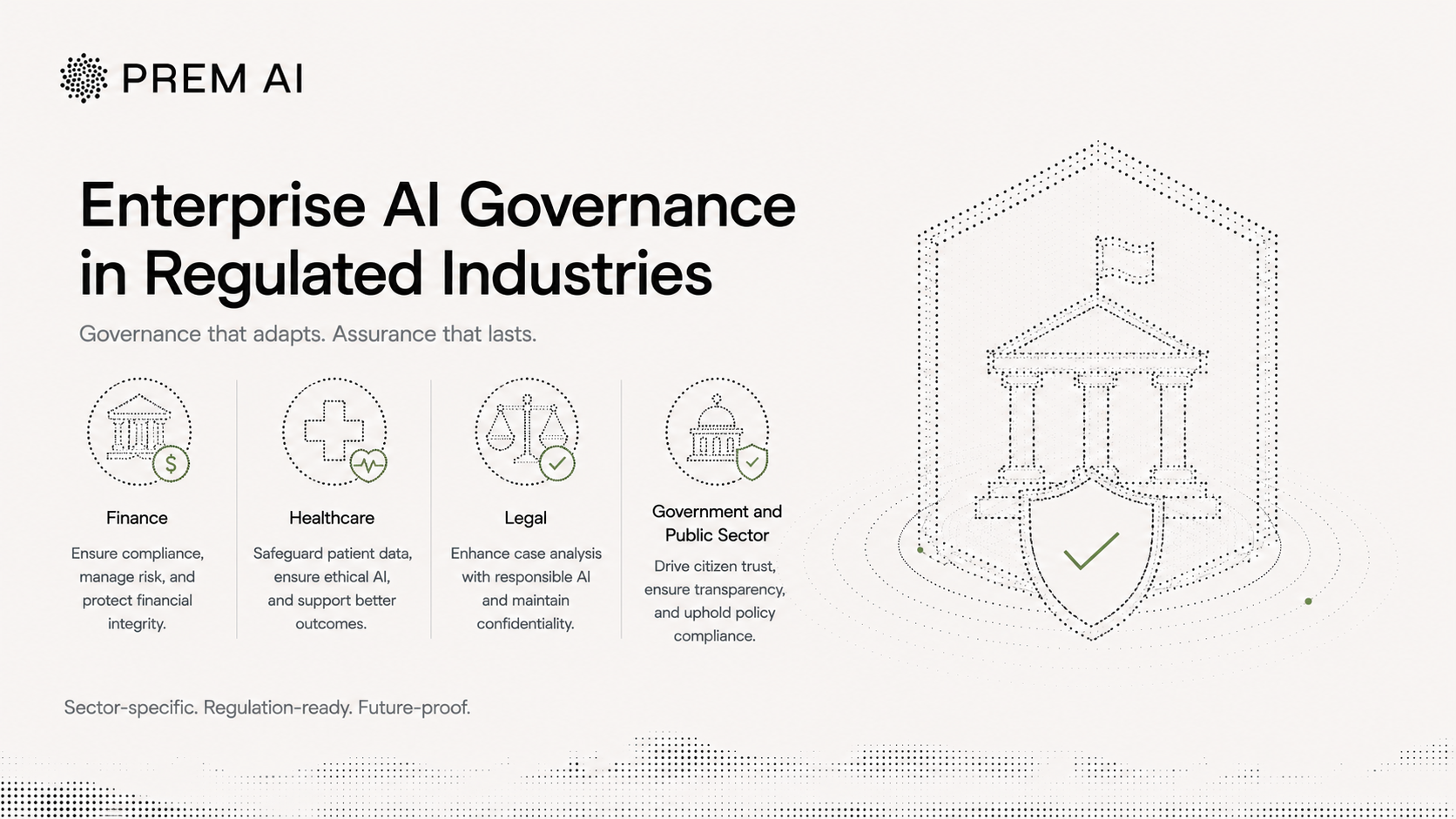
You need the governance basics mentioned above, no matter what industry you're in. But regulated industries carry extra obligations on top of that baseline. In these sectors, a governance gap isn't just a security risk. It's often a direct violation of a specific law, with its own regulator and its own penalty attached.
Finance
Under DORA, AI systems used within a bank’s technology environment may fall within DORA's broader ICT risk framework. This framework covers ICT risk management, ICT-related incident reporting, and ICT third-party risk management and oversight. DORA applies across 20 different types of financial entities and their ICT third-party providers, with a formal oversight framework for providers considered critical to the sector. Non-compliance can carry regulatory consequences under the applicable DORA enforcement framework.
Healthcare
Patient data governance is not optional. Regulations such as HIPAA in the United States and the GDPR in Europe impose strict requirements on how healthcare data is collected, processed, and protected. Governance must keep sensitive patient data inside a controlled, auditable environment rather than routing it through public AI services or unsecured APIs.
Legal
Nearly 8 in 10 legal professionals now use AI tools for work, according to Clio's Legal Trends Report, yet a large share of firms still have no formal AI governance policy. Every ungoverned tool here is a potential breach of attorney-client privilege, since privilege depends on information staying genuinely confidential, not just being labeled that way.
Government and public sector
Public sector bodies and critical infrastructure operators across the EU now fall under NIS2. It classifies public administration among its 11 high-criticality sectors. Board-level accountability for cybersecurity risk is now required, and that includes any AI systems touching those operations.
Public sector AI carries its own high-risk obligations under the Act's Annex III. On top of that, citizen data often cannot legally leave certain jurisdictions at all.
How to build an AI governance program for your enterprise
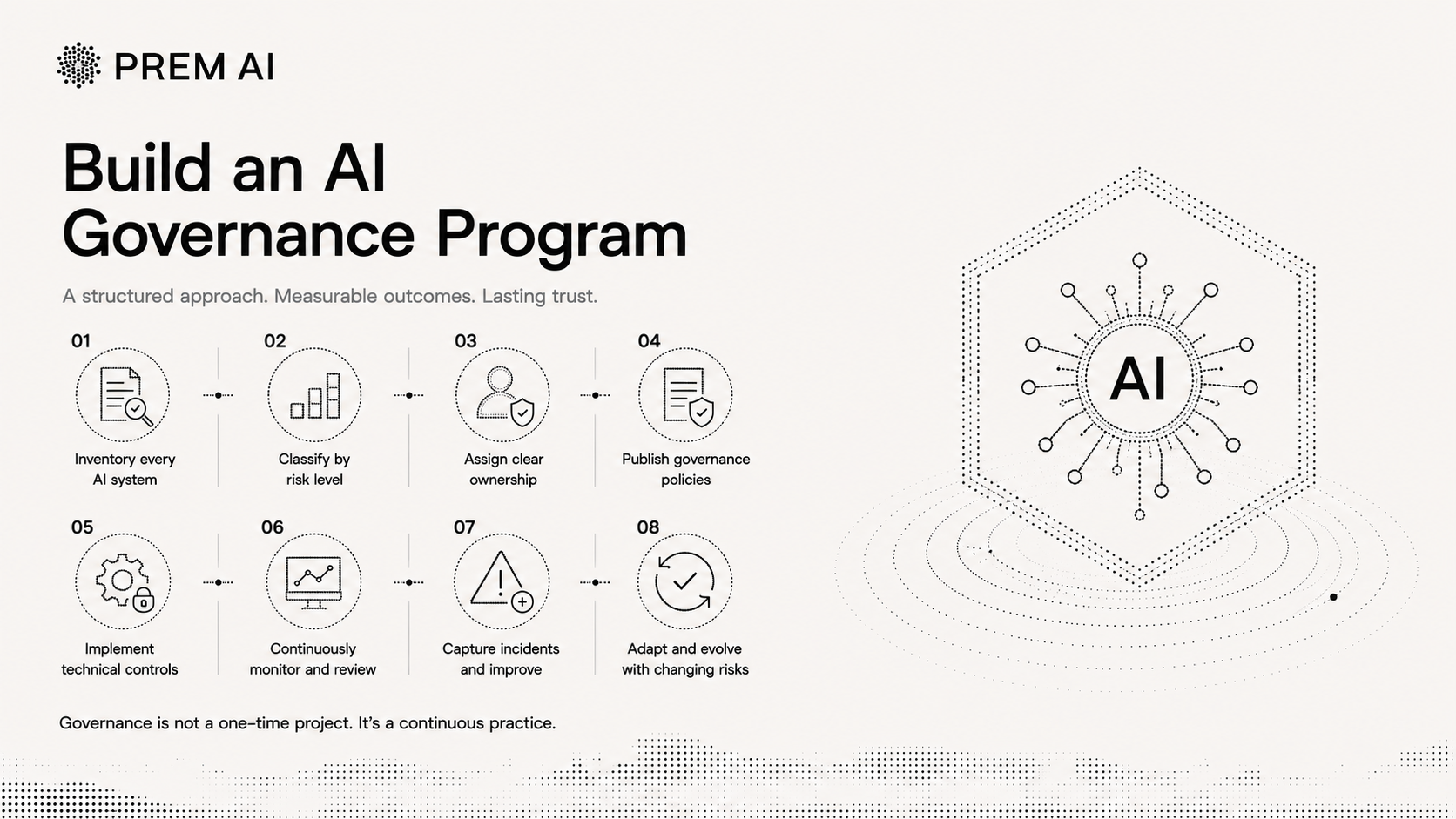
Every credible governance framework converges on the same underlying sequence. For organizations operating in the EU, that sequence now maps directly onto binding law, not just voluntary best practice.
The EU AI Act follows this exact logic. You cannot classify a system's risk tier before you know it exists. You cannot assign accountability before you know who's responsible under the Act's own rules. You cannot demonstrate compliance with a national authority without monitoring already in place.
Inventory every AI system, including shadow AI.
You cannot govern what you cannot see. Under the EU AI Act, you cannot classify what you haven't inventoried either.
This means every model, every embedded vendor AI feature, every RAG pipeline, and every tool an employee adopted without asking IT first. Map all of it against the Act's own risk categories: unacceptable, high-risk, limited, and minimal.
Classify each system by risk tier.
A chatbot summarizing meeting notes and a system used in employment decisions should not sit in the same review process. Under Annex III of the EU AI Act, they legally can't.
High-risk systems, those touching employment, credit, or critical infrastructure, carry mandatory conformity assessments. Lower-risk tools don't.
Assign ownership explicitly.
Every AI system needs someone accountable, not an implied owner nobody could name if asked.
This isn't just good practice. GDPR's Article 22 already requires a human accountable for decisions with legal or similarly significant effects on individuals. The EU AI Act extends that expectation to high-risk systems more broadly.
Publish the policy suite.
Employees need a clear, written answer to what they are and are not allowed to do.
That language also has to satisfy the EU AI Act's Article 50 transparency obligations. Users need to know when they're interacting with an AI system in the first place.
Implement technical controls.
This is where governance stops being a document and becomes real: access controls, data loss prevention, model access gateways, and infrastructure that enforces policy rather than merely stating it.
For any system processing personal data, these controls also have to satisfy GDPR's data minimization and purpose limitation principles. That's separate from, and in addition to, the AI Act's own requirements.
Monitor continuously and review on a set cadence.
A model that passed review in January is not guaranteed to behave the same way in June. EU high-risk systems require monitoring for their entire lifecycle, not just at initial deployment.
Governance is a cycle, not a one-time gate. National market surveillance authorities can ask to see that cycle in action.
Report incidents and feed what you learn back into the program.
When something goes wrong, log what happened, who was affected, and which control failed or was missing.
Under the EU AI Act, serious incidents involving high-risk systems carry their own reporting obligations to national authorities. That's separate from a GDPR breach notification, so the two processes need to run side by side, not be treated as the same thing.
How Prem AI supports Enterprise AI governance
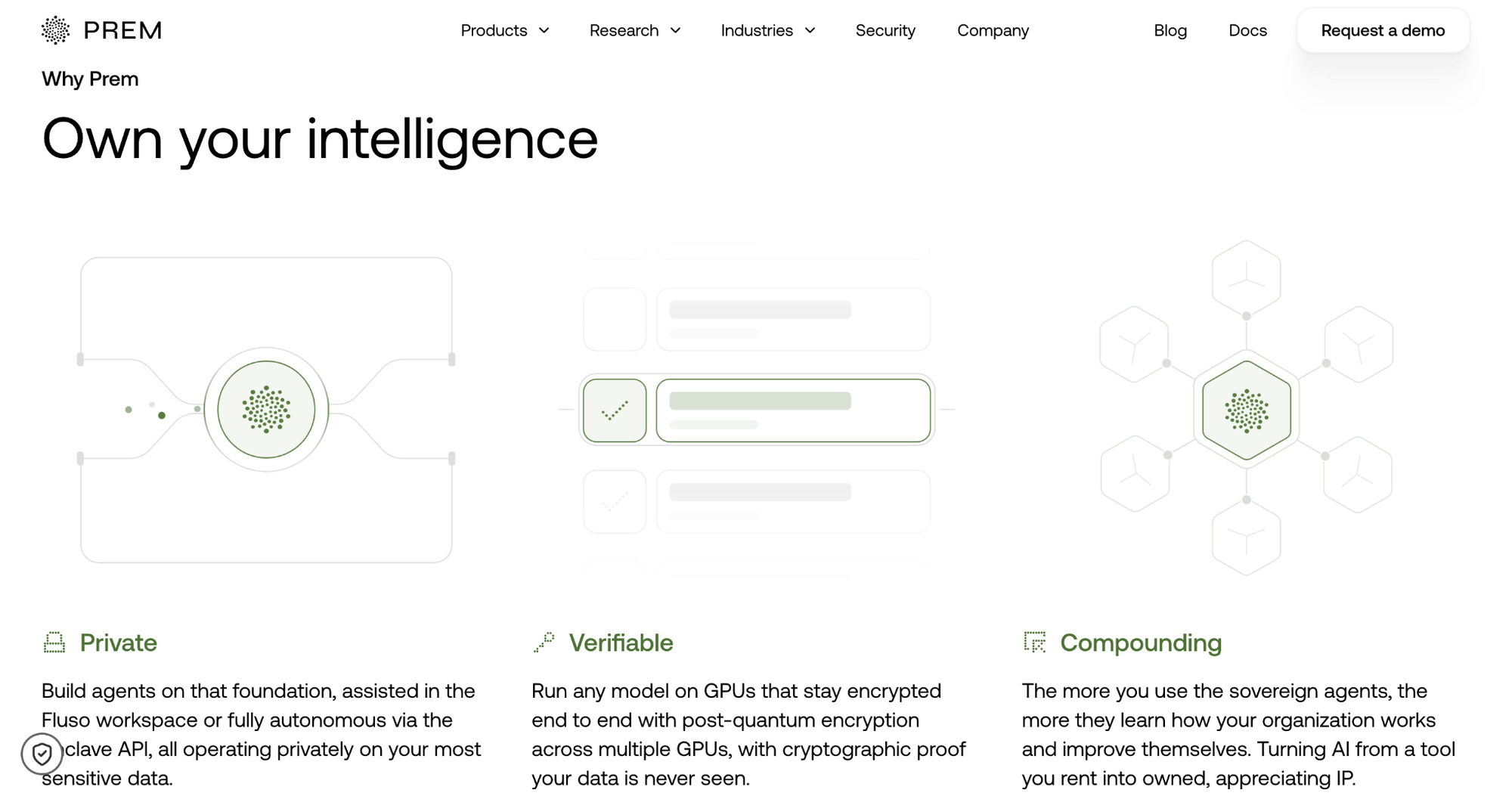
The seven steps above get you a working governance program. But a program only holds up if what it promises can actually be checked.
Earlier, we covered the four commitments every recognized standard agrees on: Ownership, Transparency, Fairness, and Continuous Monitoring. Prem AI extends all four.
Ownership means nothing if you can't trace what a system actually did. Prem ties every inference back to the model, the prompt, and the person accountable for it.
Transparency breaks down the moment a vendor won't tell you what happened to a prompt after it left your organization. Prem's architecture removes the black box entirely. You can see exactly where inference ran.
Risk-proportional controls only work if your higher-risk systems get tighter enforcement, not just a stricter policy. Prem lets you enforce that tiering at the infrastructure level.
Continuous monitoring is only as good as the proof behind it. Prem generates that proof as a byproduct of how the system runs. You don't have to reconstruct it by hand after a regulator asks.
Meeting these four commitments on paper is one thing. Proving them in production is another. Most governance programs stop at the first part. They tell you what should happen. They rarely tell you what makes it structurally true, rather than something you're asked to take on faith.
Closing that gap takes three more pillars. These are the ones standard frameworks don't name, because they were written for policy, not architecture. It's exactly the gap Prem AI was built to close.
Data sovereignty
Data sovereignty extends beyond access controls. It requires knowing where AI inference runs, who can access prompts and outputs, and how sensitive data is protected throughout execution.
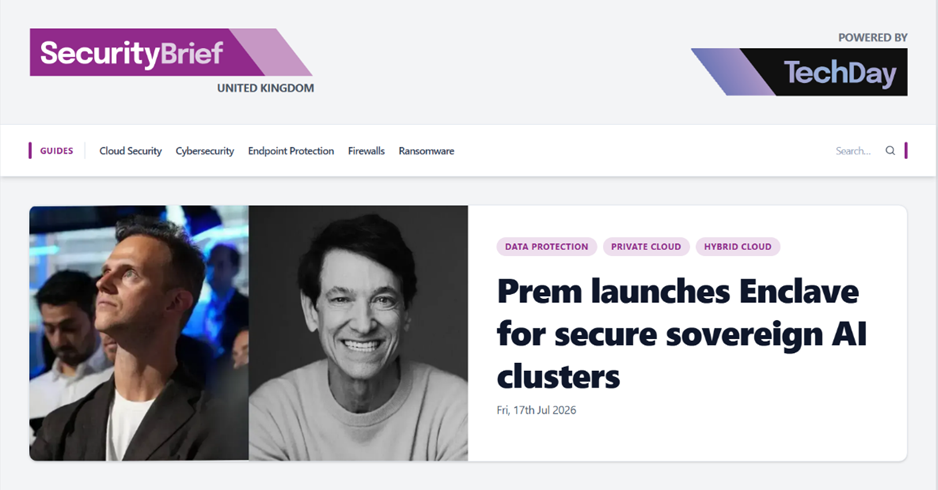
Prem Enclave executes inference inside a hardware-isolated Trusted Execution Environment (TEE), ensuring data remains protected even while models are running. Enclave became generally available in July 2026 and was recognized by SecurityBrief UK following its launch.
Your data remains within your defined security boundary. It is never processed in a shared environment or used to train third-party models.
Verifiability
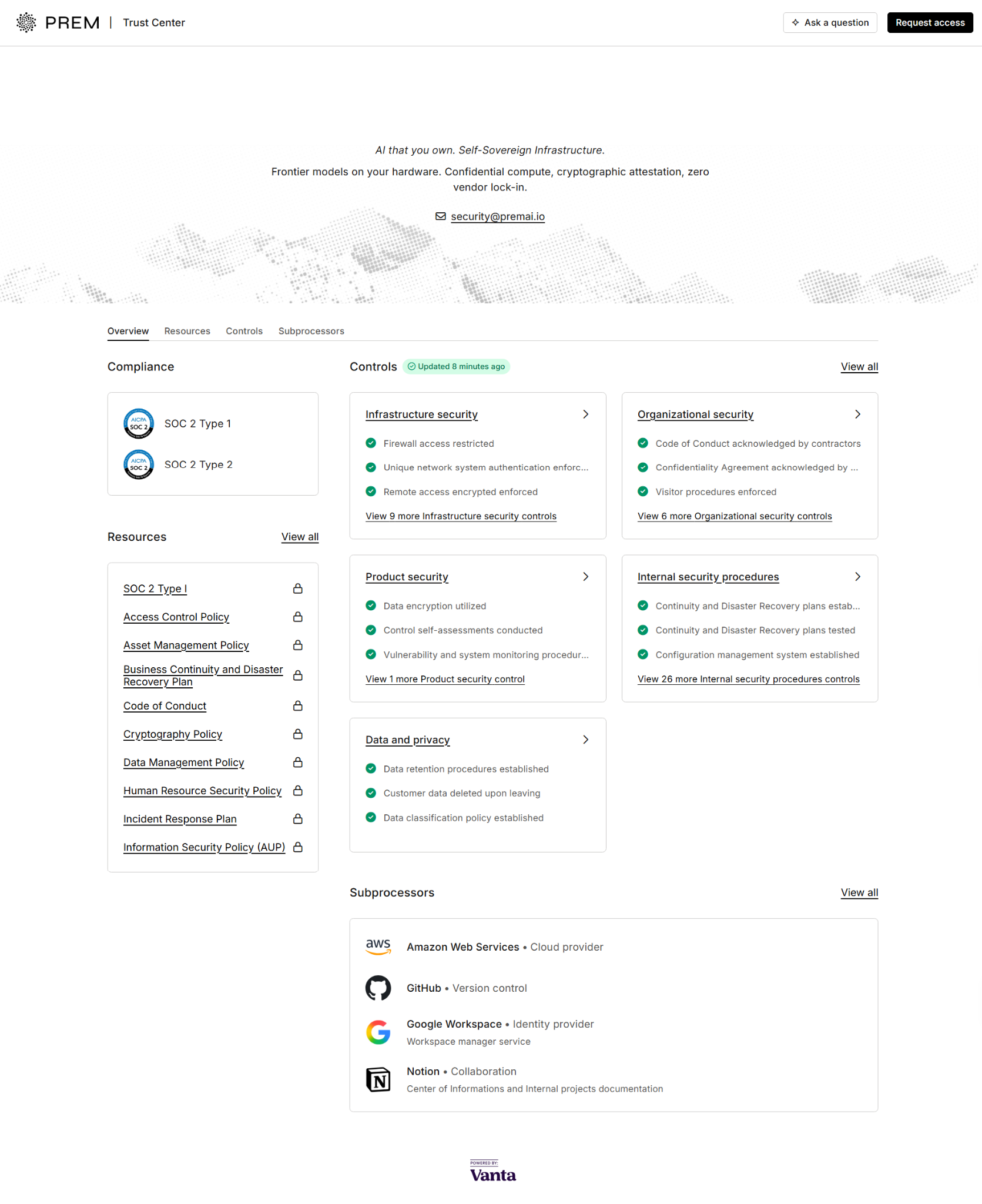
Proof that comes from hardware and cryptography, not a vendor's word.
A policy that says your data won't be retained is a commitment. Enclave is built so your data is never written to disk in the first place. Cryptographic attestation proves the code that ran wasn't tampered with.
Content stays encrypted throughout. Metadata like timestamps and request size remain visible for billing and rate-limiting; the actual data never does. That's a guarantee your security team can independently check. Not a promise you have to take on faith.
You don't have to take our word for that either. Prem's own Trust Center publishes its SOC 2 certifications, security controls, and subprocessors publicly, so your team can verify the claims directly instead of relying on this page alone.
Context compounding
Every correction, workflow, and fine-tuning decision your teams make either compounds inside infrastructure you own or trains a third-party vendor's next model update.
Running inference inside infrastructure you control means that value stays inside your own walls. Your data is never used to train, fine-tune, or improve Prem's own models; it works for you, and nobody else.
If you're treating governance as infrastructure, not paperwork, you're the one who'll still be able to answer "prove it." That matters more as agentic AI and regulatory scrutiny both keep accelerating.
Build enterprise AI governance with Prem’s sovereign AI infrastructure and frontier intelligence
Governance isn't just about writing the right policy. It's about building AI systems that can prove, on demand, exactly what happened, who's accountable, and why it won't happen again.
As you evaluate your own governance program, look beyond the policy document. Ask whether your infrastructure can actually enforce what it promises: verified data custody, provable monitoring, and controls that hold up when a regulator comes asking.
This is exactly what Prem AI is built for. Prem's private AI technology combines customer-controlled deployment, confidential AI infrastructure through Prem's Enclave, flexible model support, governance controls, and verifiable AI in a single private AI workspace, Fluso. It helps you deploy AI without compromising your privacy, security, or control.
If you're ready to move beyond public AI tools and build enterprise AI you can trust, Prem AI can help. Explore how Prem AI lets you securely connect your enterprise knowledge, deploy AI within environments you control, and build private, verifiable AI that grows alongside your business. Contact our sales team or email us at sales@premai.io.
FAQs about Enterprise AI governance
What is enterprise AI governance?
Enterprise AI governance is the set of policies, controls, and accountability structures that determine how an organization builds, deploys, and monitors AI systems throughout their lifecycle. It covers who owns each system's risk, how outputs are explained, and whether behavior stays verifiable in production.
How is AI governance different from AI risk management?
AI risk management is a method for identifying and mitigating risk, and it forms one part of governance. Governance also covers ownership, accountability, verifiability, and continuous monitoring, none of which a risk framework alone defines or enforces across an organization.
What is shadow AI, and why does it matter for governance?
Shadow AI is any AI tool employees use without formal IT approval. It matters because policy alone rarely stops it. Most enterprises run hundreds of unapproved AI applications with zero visibility into what data they touch, creating exposure nobody is actively managing.
What does AI-specific data governance actually cover?
AI-specific data governance covers what data a system can train or fine-tune on, whether prompts and outputs are retained after a session, and how long logs persist. Zero Data Retention (ZDR), built structurally rather than promised contractually, is the strongest version of this control.
How does the EU AI Act classify AI systems by risk?
The EU AI Act uses four risk tiers: unacceptable, high-risk, limited, and minimal. Annex III lists the specific high-risk categories, including employment, credit, and critical infrastructure. High-risk systems carry mandatory conformity assessments, documentation, and human oversight requirements that lower-risk systems don't.
What penalties does the EU AI Act carry for non-compliance?
Fines scale with the severity of the violation and can reach into the tens of millions of euros or a percentage of global annual turnover, whichever is higher. National market surveillance authorities are responsible for enforcement in each member state.
How does GDPR interact with EU AI Act obligations?
The two apply in parallel and cover different ground. GDPR governs how personal data is collected, minimized, and processed, including Article 22's protections around automated decision-making. The EU AI Act governs the AI system itself, its risk classification, transparency obligations, and human oversight requirements. A compliant AI system usually has to satisfy both at once, not one instead of the other.
Which regulations most affect enterprise AI governance in the EU today?
The EU AI Act's transparency obligations under Article 50 apply now, with high-risk Annex III obligations phasing in on a longer timeline. GDPR continues to apply in full alongside it. ISO/IEC 42001 is increasingly requested by EU procurement teams as proof of a certifiable governance structure, even though it isn't a legal requirement.
How does AI agent governance differ from governance for regular AI systems?
Agents take autonomous action rather than producing output for a person to review. Governance for agents has to define tool access, approval thresholds, and audit logging in advance, since failures can compound before any human checkpoint is reached, particularly once access spans multiple systems.
What is MITRE ATLAS, and why does it matter for AI security governance?
MITRE ATLAS is a knowledge base of adversarial tactics and techniques targeting AI and machine learning systems, modeled on the MITRE ATT&CK framework. It gives security teams a structured way to identify and defend against attacks like prompt injection and data poisoning.
Do I need ISO 42001 certification for enterprise AI governance?
It is not legally required, but it is becoming a procurement expectation. Major cloud providers have already pursued certification, and enterprise buyers increasingly ask AI vendors to demonstrate it as proof of a working governance program before signing a contract.
What should an enterprise AI governance program include at a minimum?
A full inventory of every AI system, including shadow AI, risk-tiered classification, named ownership for each system, published policy, technical controls that actually enforce that policy, and continuous monitoring reviewed on a regular cadence rather than only at initial launch.
How does infrastructure support enterprise AI governance?
Infrastructure turns governance commitments into guarantees. A policy stating that data will not be retained is a promise; infrastructure that never writes that data to disk in the first place is proof, which is what actually holds up when a regulator asks for evidence.