How to Build Sovereign AI for Enterprise: A Framework for Private, Secure & Verifiable AI
On this page
In March 2023, Italy became the first Western country to shut down ChatGPT, ordering OpenAI to stop processing Italian users' data after a breach exposed people's payment details and chat titles, with no clear legal basis on record for the data collection behind the model in the first place.
According to Synthedia’s coverage of the ChatGPT shutdown, the Italian regulator ordered OpenAI to stop processing users’ data in the country after a security breach exposed payment information and chat titles. The regulator also raised concerns that there was no clear legal basis for collecting and processing the personal data used to train the models.
OpenAI’s first public response came through a Sam Altman's tweet, It was just two lines: the company would defer to the Italian government, and he hoped to visit Italy again soon. There was no mention of where the affected data had gone.
We of course defer to the Italian government and have ceased offering ChatGPT in Italy (though we think we are following all privacy laws). Italy is one of my favorite countries and I look forward to visiting again soon!
— Sam Altman (@sama) March 31, 2023
This case also shows why sovereign AI has become such an important topic. It is no longer something only governments or defense organizations need to think about. If your enterprise uses AI with sensitive or private data, you need to understand how that data is handled. With sovereign AI, you keep that control within your enterprise instead of depending on separate promises from different providers about how your data and models are handled.
Key pillars of sovereign AI implementation for your enterprise
A sovereign AI setup requires your enterprise to maintain control across four key areas: infrastructure, data, models, and operations.
| Pillar | Core Controls | Implementation Priority |
|---|---|---|
| Infrastructure Sovereignty | On-premises, private cloud, customer-managed VPC, air-gapped deployment | High |
| Data Sovereignty | Data residency, enterprise-held encryption keys, confidential computing, enterprise-controlled storage | High |
| Model Sovereignty | Open-weight foundation models, fine-tuning, the freedom to switch models | Medium |
| Operational Sovereignty | AI governance, audit logging, identity and access management, policy enforcement | High |
Infrastructure sovereignty is about where your AI runs and who controls that setup. Depending on your security needs, you can run it on your own infrastructure or within a private cloud. You can also deploy it inside your VPC or use a fully isolated environment.
With Data Sovereignty, the focus is on how your enterprise data is handled. You have control over where it is stored and processed, as well as who can access it. Measures such as data residency and enterprise-held encryption keys help keep sensitive information within the boundaries your organization has defined.
Model Sovereignty gives you more control over the models your enterprise uses. You can choose models based on your requirements and fine-tune them when needed. If those requirements change, you also have the flexibility to switch models instead of being tied to one provider.
Operational Sovereignty covers how you manage your AI systems day to day. Governance policies and access controls help you define how AI can be used across your organization. Audit logs and policy enforcement also give you a clear record of AI activity for internal reviews, customers, and regulators.
The main challenges you face when building sovereign AI for your enterprise
Let's just quickly go through the main challenges you can face when building sovereign AI for your enterprise.
Keeping track of where your AI data goes
The bigger concern is what happens to your data once it reaches an external AI model. Your enterprise may have limited visibility into where the data is stored or how long it stays there. You may also have little control over who can access it.
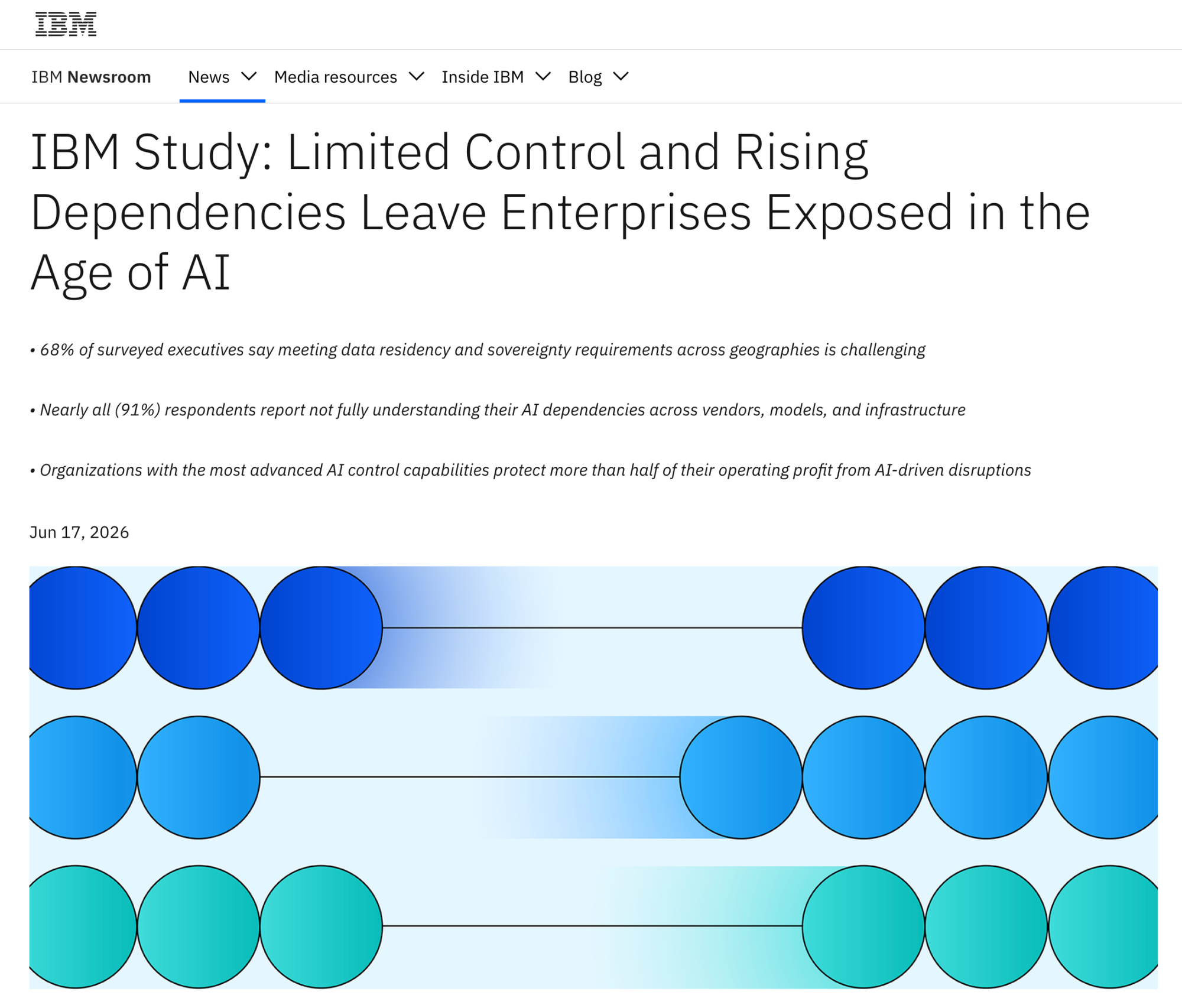
An IBM enterprise study found that 68% of surveyed executives already find it challenging to meet data residency and sovereignty requirements across different geographies.
When your AI stack involves multiple models, APIs, and infrastructure providers. In that setup, knowing exactly where each part of your data is processed becomes even more important.
Depending on models and infrastructure outside your control
When you rely on someone else’s infrastructure, their decisions affect your AI systems. Outages disrupt operations. Price changes and policy updates also make planning harder. OpenAI faced this in December 2024. A server configuration change took ChatGPT, the API, and Sora offline for several hours during a product launch.
OpenAI's outage update on X confirmed the fix was underway, and enterprises running production tools on that same API had no choice but to wait it out.
We're experiencing an outage right now. We have identified the issue and are working to roll out a fix. Sorry and we'll keep you updated!
— OpenAI (@OpenAI) December 12, 2024
If your own AI stack depends on one outside provider, an incident like this hits your own product and your own customers directly.
Meeting different sovereignty requirements across regions
If your enterprise uses AI in the EU, you also need to be able to show how your systems handle data, manage risks, and meet the required compliance standards. The EU AI Act sets out these requirements and the authorities responsible for enforcing them.
Keeping your data in an EU cloud region may help with data residency, but it does not always mean the data is outside the reach of foreign laws. For example, a US-based provider can still be subject to US legal requirements even when its servers are located in Europe.
This is where we've built Prem AI differently. We operate under Swiss jurisdiction, which sits outside the US legal reach but still has full EU data adequacy, so your data moves freely within Europe without ever falling under US law.
Protecting sensitive workloads without losing performance
Adding security to your AI systems used to mean giving up speed to get that level of security for your enterprise. For years, that trade was real, and locking a workload inside an encrypted environment could cut its throughput by 30 to 40 percent, enough to make the whole approach too expensive to run at scale.
Dion Harris, an NVIDIA infrastructure lead, said as much in an interview with Computerworld, explaining that older confidential computing setups forced enterprises to choose between privacy and running their hardware at full capacity.
He also explained that older confidential computing setups came with a trade-off. Enterprises often had to choose between privacy and getting full performance from their hardware. Newer hardware has changed that balance for your enterprises. The security layer now adds almost no performance cost, and sensitive workloads stay protected without slowing down production.
Build Security Into Your Sovereign AI From the Start
Protect sensitive AI workloads with confidential computing and controlled access.
Talk to Prem AIHow to build sovereign AI for your enterprise: A step-by-step framework
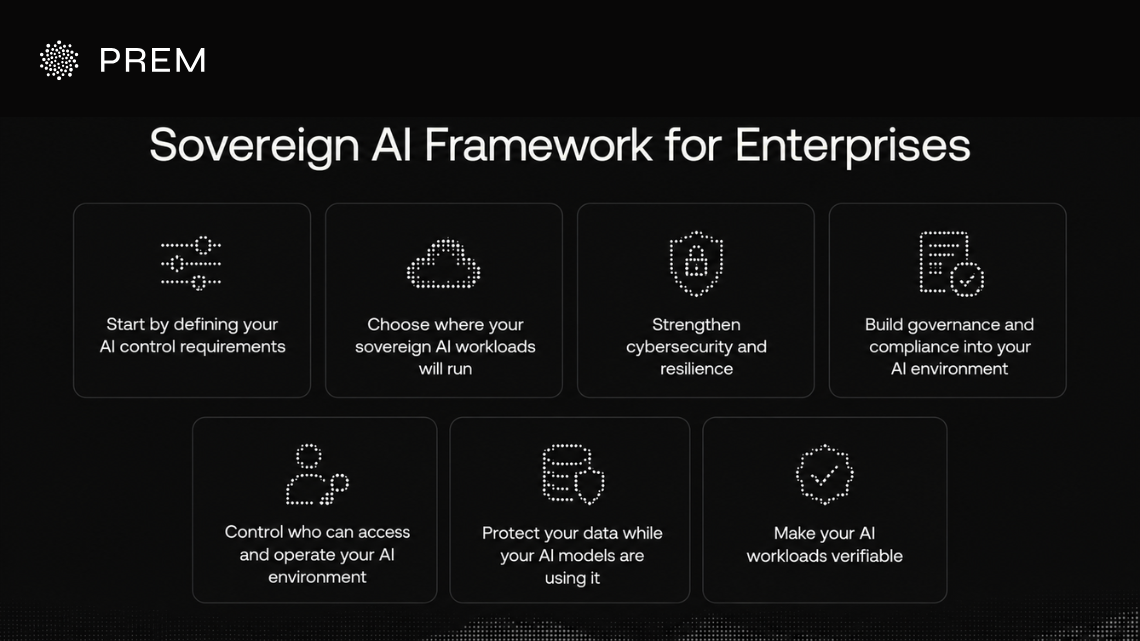
Step 1: Start by defining your AI control requirements
Before choosing a vendor or model, be clear about what you want AI to handle. Decide what AI should handle on its own and what still needs human approval. Keep some tasks fully with your team. This helps you choose AI based on your needs instead of adapting your process to a vendor.
Klarna shows what happens when this step is skipped. The company moved most of its customer service to an AI agent built with OpenAI. Initially, the results looked strong: responses were faster, and support costs were lower. But over time, Klarna started bringing people back into customer service because some cases, such as disputes or financial hardship, still needed human judgment. According to the Bicrement newsletter, the issue was not that AI had no value. The problem was that some decisions should not have been fully automated.
Step 2: Choose where your sovereign AI workloads will run
Your deployment choice should come down to three things: how sensitive your data is and how much infrastructure control you actually need to hold onto.
On-premises
You run your AI on hardware within your own environment. This gives you direct control over how your AI setup operates. Your team manages the infrastructure and is also responsible for keeping it running.
Private cloud or VPC
Your workloads sit inside an isolated cloud environment built just for you. You get the flexibility of cloud, but you keep tighter control over networking, access, and data.
Sovereign cloud
This is cloud infrastructure built around residency and operational control within a specific jurisdiction. But the label alone does not tell you how much control you have. You still need to check who operates the cloud and holds the encryption keys. You should also know where your logs are stored and which country’s laws apply.
A French Senate hearing showed why this matters. Microsoft’s legal director for France was asked whether he could guarantee that French citizens’ data would never be accessed by US authorities without French approval. According to PPC Land's coverage of the hearing, he said no. The data could be stored in Europe, but Microsoft is still a US company and remains subject to US law. So where the data center sits does not always tell you who can legally reach the data.
Dedicated infrastructure
Here, your AI runs on compute reserved just for your enterprise, not shared with anyone else. You get stronger isolation without having to run the entire hardware stack yourself.
Air-gapped environment
For your most restricted workloads, your AI infrastructure stays fully disconnected from outside networks. Isolation goes up, but so does friction. Updating models, adding integrations, and running day-to-day operations all get harder without that outside connection.
Build Sovereign AI Around Your Enterprise Requirements
Align AI deployment with your security, data, compliance, and sovereignty requirements.
Contact Prem AI sales teamStep 3: Strengthen cybersecurity and resilience
Sovereign AI needs the same core security measures as any enterprise system. Weak code, poor access controls, or unpatched systems put sensitive data at risk. These systems now connect to models and internal data. They also connect to business workflows. A small security gap may therefore affect a much larger part of your environment.
This is where Prem CyberScan can be a great fit for your enterprise. It reviews your code as your AI systems are built and updated, helping your team find vulnerabilities earlier instead of discovering them after deployment or during a formal audit. That makes security part of the development process, rather than something you add only at the end.
Step 4: Build governance and compliance into your AI environment
For AI systems operating in the EU, you need to show where your data goes and how it is handled. You also need to show what checks are in place. The EU AI Act and GDPR both put clear requirements around documentation, data protection, and risk management.
Meta's €1.2 billion GDPR fine shows how expensive gaps in data governance can become. Ireland's Data Protection Commission issued the fine over Meta's transfer of EU user data to the US, finding that the transfers did not meet GDPR's Chapter V requirements. Meta was also ordered to suspend the transfers and bring its data handling into compliance. IAPP's coverage of the ruling covers the decision and its requirements.
For your enterprise AI environment, that means keeping the evidence behind your compliance work in place as you build and operate the system. Keep your data flows and processing locations easy to verify. The same applies to risk assessments and security controls.
Step 5: Control who can access and operate your AI environment
A poorly configured access token may expose more data than intended. Microsoft saw this firsthand when an Azure access token used by an AI researcher to share an open-source training dataset on GitHub gave access to an entire 38 TB storage account.
Hacker News reported that the exposed storage included internal credentials and private employee messages, with read and write access available to anyone who found the link.The problem wasn't a sophisticated attack. The token simply had broader permissions than it should have had, and the exposure went unnoticed for years.
In your enterprise AI environment, you should limit access to what each person or service needs. You should also review and rotate API keys and other credentials regularly. This helps prevent broad permissions from staying open too long.
Build Your Enterprise Sovereign AI Strategy
Define how your data, models, and AI decisions stay under your control.
Contact Prem AI sales teamStep 6: Protect your data while your AI models are using it
Your data stays protected when stored or moved between systems. But the model still needs access while processing it. That is where extra protection is needed.
OpenAI saw the risk firsthand when a bug in an open-source library caused ChatGPT to expose parts of some users' chat histories to other users. In a smaller number of cases, users could also see billing information such as names and partial card numbers. Infosecurity Magazine reported that the incident lasted around 9 hours and affected a small number of paying subscribers.
For your enterprise AI, you need to protect more than stored data and network traffic. You also need to secure the processing environment when your models handle sensitive information.
Step 7: Make your AI workloads verifiable
You should be able to verify what happens to your data when an AI workload runs, not just rely on a provider's security claims.
That's where Prem AI's infrastructure uses hardware-based attestation. It provides cryptographic proof of the model and data handling during processing, so an enterprise can verify where its data was processed and how it was handled.
Prem also operates without access to your enterprise data. This gives you clear evidence to share with auditors, regulators, or customers when they ask how your AI environment protects their data.
How Prem AI helps you build private, secure, and verifiable sovereign AI
Building sovereign AI means combining privacy, infrastructure control, security, and verifiability from the start, and they should work together as part of one system. With Prem AI, you can run sensitive AI workloads inside hardware-isolated Trusted Execution Environments, where your data stays protected while models process it.
ZDR keeps prompts and outputs from being written to persistent storage, while cryptographic attestation gives you technical evidence about the environment handling each request.
If you do not want to manage the infrastructure yourself, Enclave API gives you managed confidential inference through an OpenAI-compatible interface.
This gives you a way to build sovereign AI around your own requirements for data privacy, infrastructure control, deployment, and verification, while still keeping the environment practical for production use.
If you are planning your sovereign AI infrastructure and want to understand how Prem AI can fit your enterprise requirements, contact our sales team or email us at sales@premai.io.
FAQs about how to build Sovereign AI for enterprises
How do you build sovereign AI infrastructure?
Start by defining which data, models, workloads, infrastructure, and jurisdictions need to remain under your control. Then choose the right deployment model, control where your data and models run, protect sensitive data during inference, manage access, add governance, and make your environment verifiable through logs, provenance, monitoring, and technical proof where needed.
Is data residency enough to make your AI sovereign?
No. Data residency tells you where your data is stored or processed. It does not automatically tell you who can access the infrastructure, who controls the encryption keys, where your models run, which external providers are involved, or which laws apply to them.
Can you build sovereign AI in the cloud?
Yes. Sovereign AI does not always mean running everything on-premises. You can use a private cloud, VPC, sovereign cloud, or dedicated cloud infrastructure if the setup meets your requirements for residency, access, security, operations, encryption keys, and jurisdiction.
Do you need to run sovereign AI on-premises?
Not necessarily. On-premises infrastructure can give you direct control over hardware and operations, which may suit highly sensitive workloads. Other workloads may meet their sovereignty requirements through a VPC, private cloud, dedicated infrastructure, or sovereign cloud. Your deployment should follow your control requirements.
How can you verify that your AI workloads are sovereign?
Start with evidence you can inspect, including access logs, model versions, data provenance, infrastructure records, and audit trails. For confidential computing workloads, cryptographic attestation can provide stronger technical evidence by verifying the hardware and execution environment handling your data.