Enterprise AI Adoption: How Organizations Are Moving from Pilots to Production in 2026
On this page
95% of enterprises spending on generative AI are getting nothing back for it.
That is what MIT's Project NANDA found in The GenAI Divide: State of AI in Business 2025. The study examined more than 300 public AI deployments. Researchers also interviewed 52 executives and surveyed 153 business leaders. Despite $30 billion to $40 billion in enterprise generative AI investment, only 5% of AI pilots reached production and created measurable business value, according to Fortune.
The problem starts when your AI moves beyond the demo. A pilot can work well in a controlled environment. Production introduces messy business data, unclear ownership, security requirements, and pressure to prove ROI.
You can have a model that performs well in testing and still struggle when your business depends on it every day. Your team needs reliable infrastructure, clear accountability, measurable outcomes, and controls that your security and compliance teams can actually review.
That is the pilot-to-production gap.
If you want your AI investments to create measurable business value, you need to close that gap. So, let’s look at why AI pilots fail, what gets in the way of production, and what you need to turn a promising pilot into reliable enterprise AI.
What enterprise AI adoption actually means
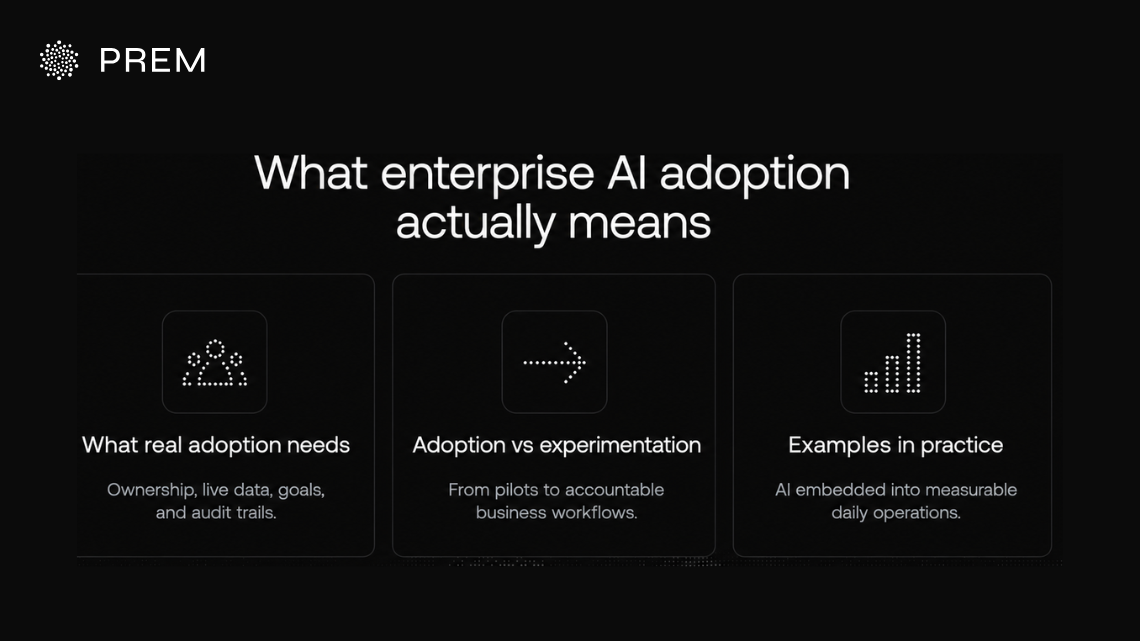
Before you look at why so many AI pilots fail, it helps to understand what real adoption looks like. A good demo is not the same as AI that works in your business.
Real adoption needs four things: clear ownership, access to your real business data, measurable goals, and a reliable audit trail. A pilot can look impressive with a lightweight setup. Production AI needs these foundations in place from the start.
What separates enterprise AI adoption from AI experimentation
The difference is simple: experimentation tests what AI can do, while adoption makes AI work reliably in your business.
| AI experimentation | Enterprise AI adoption |
|---|---|
| Runs as a pilot or proof of concept | Runs as part of your regular business process |
| Uses clean or limited data | Works with your live business data |
| Ownership may be unclear | A specific person or team is accountable |
| Success may be loosely defined | Success is tied to clear, measurable outcomes |
| Can rely on manual intervention | Works reliably within your workflow |
| Keeps limited records | Maintains a clear audit trail |
Examples of enterprise AI adoption in practice
You can see the difference between AI experimentation and real adoption in how companies use AI in their day-to-day operations.
At Kraft Heinz, Microsoft reports that Plant Chat gives factory operators real-time guidance using more than 300 variables. It helped reduce supply chain waste by 40%, improve sales forecast accuracy by 20%, and increase product yield by 6% across North American manufacturing sites. The company also reported more than $1.1 billion in gross efficiencies from 2023 through Q3 2024.
IBM took a broader approach by building AI and automation into its own operations. According to IBM’s case study, its “Client Zero” initiative generated $4.5 billion in productivity gains within two years, along with $12.7 billion in free cash flow in 2024.
Both examples show the same thing: AI creates more value when you build it into your existing workflows, give someone clear ownership, and measure the results.
Build an AI Foundation You Can Scale
Move beyond pilots with private AI infrastructure built around your data, workflows, security requirements, and production needs.
Build with Prem AIWhy most enterprise AI pilots never reach production
The AI usually works. The problem is everything you need around it to make it work reliably in production.
| Why pilots stall | What it means |
|---|---|
| Data isn’t ready | Your pilot may use clean, curated data. Production has to handle your real, messy business data. |
| Ownership is unclear | A pilot can have a project team. Production needs someone accountable for how it performs and what happens when it fails. |
| The workflow isn’t ready | A model can give a good answer without fitting into the way your teams actually work. |
| Costs are harder to predict | What looks affordable in a pilot can become expensive when usage grows, and the system runs every day. |
| Governance comes later | Security, access controls, monitoring, and auditability are often added after the pilot instead of built in from the start. |
Running another pilot won’t fix these problems. You need a production foundation that handles your data, security, governance, and infrastructure requirements from the start.
Turn Your AI Pilots Into Production Systems
Build the infrastructure and deployment environment you need to take AI from experimentation into production.
Talk to Prem AIWhy you need to prove AI ROI in production
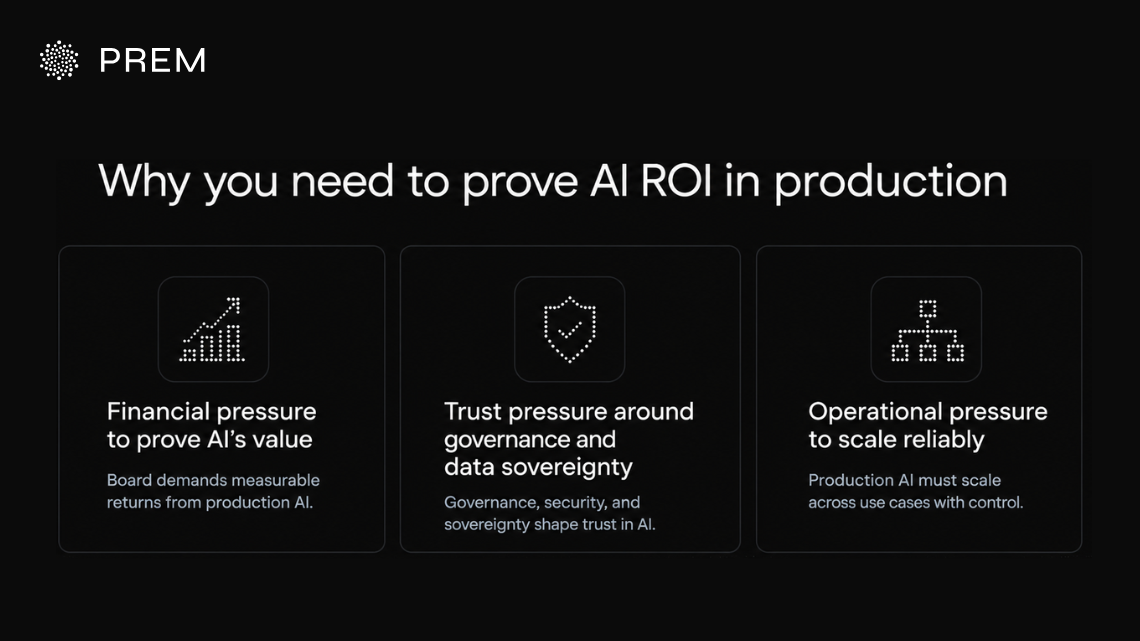
AI is no longer judged only by what it can do. Once you put an AI system into production, it needs to create enough value to justify its cost, risk, and resources. Enterprises are facing this pressure from two sides: proving financial returns and proving that AI can be trusted.
The financial pressure to prove AI’s value
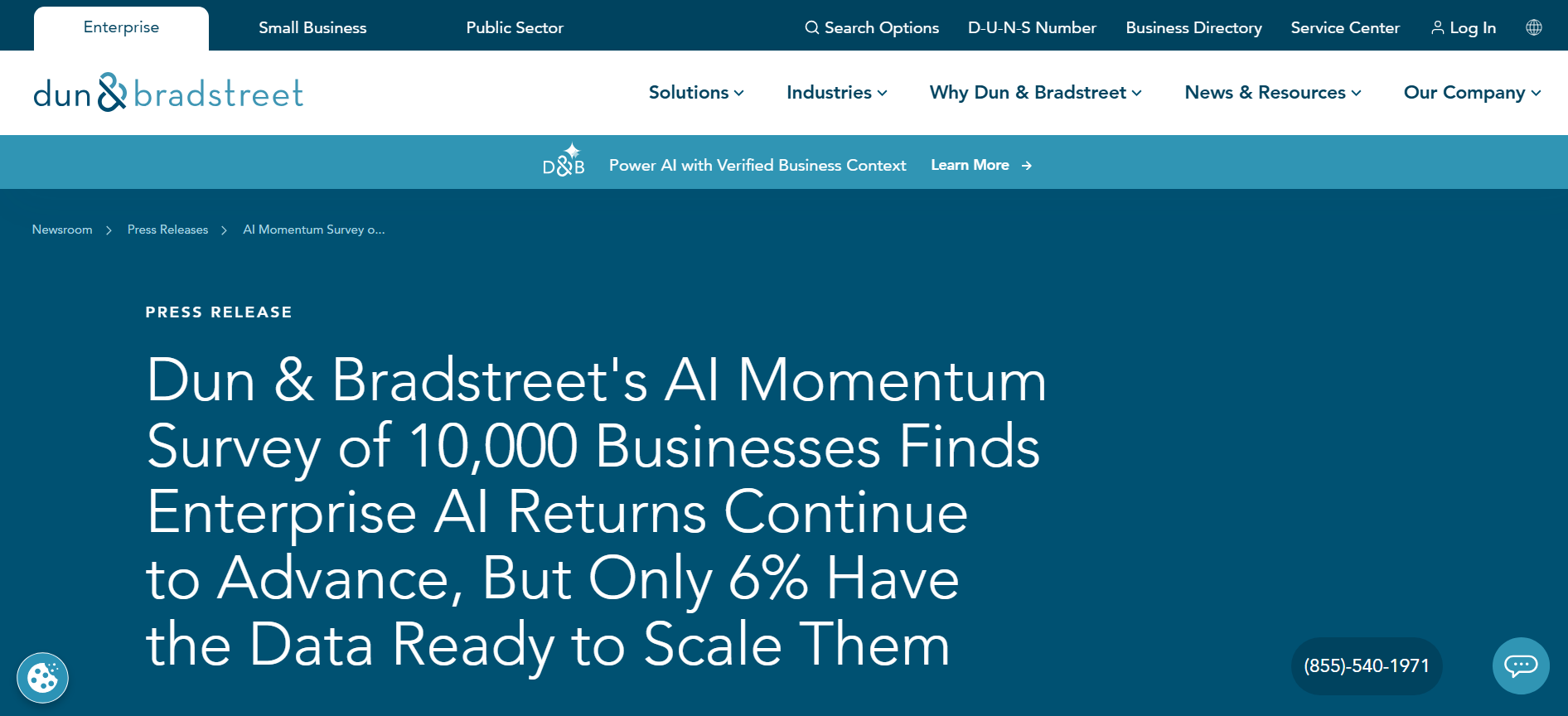
Boards are asking for measurable business value as AI adoption moves beyond experimentation. According to Dun & Bradstreet's July 2026 AI Momentum Survey of around 10,000 businesses, more than 75% of enterprises report some measurable ROI from AI. The survey also found that around 34% are scaling AI into production, while 6% say their enterprise data is fully ready to support AI at scale.
The focus is now shifting to the next stage of adoption: building the data, infrastructure, and workflows needed to extend proven AI value across the enterprise.
Production also brings new requirements around traceability and explainability. A separate 2026 Dataiku study based on a Harris Poll of 600 CIOs found that 85% of CIOs had seen traceability or explainability gaps delay or stop an AI project from reaching production, according to CIO Dive.
KPMG’s Global Tech Report 2026 shows how much room there is to scale. More than 65% of organizations want to reach the highest level of AI maturity by the end of 2026, while around 25% have reached that level today. The report also found that almost 24% are achieving ROI across more than one AI use case.
The next stage of enterprise AI adoption requires production systems that can deliver measurable value across multiple use cases while keeping costs and governance under control.
The trust pressure around governance, agentic AI, and data sovereignty
The second pressure is trust. Your enterprise, customers, and regulators need to know that your AI is secure, explainable, and being used responsibly.
AI governance is becoming part of how you deploy and procure AI. Frameworks such as ISO/IEC 42001 and the NIST AI Risk Management Framework can help you manage AI risk, security, and accountability.
Agentic AI is also gaining adoption, but you do not have to give an AI agent full autonomy from day one. You can start with controlled workflows, give agents specific tasks and limited permissions, and define clear points where a person takes over.
Data sovereignty is becoming a business decision too. If you operate across countries, where your data and infrastructure are located can affect your compliance requirements, procurement decisions, and which AI services you can use.
For enterprise AI, proving ROI and proving trust are now part of the same production challenge.
Turn Your AI Pilots Into Production Systems
Build the infrastructure and deployment environment you need to take AI from experimentation into production.
Talk to Prem AICase study: why a vendor's promise isn't a security architecture
Have you ever wondered what actually happens to your code when you give an AI coding assistant access to a private repository?
One independent security researcher decided to find out. In July 2026, a user published a wire-level analysis of xAI's Grok Build CLI on GitHub.
Grok Build CLI is a coding assistant designed to work with your code. So the researcher watched what was actually happening on the network while it ran.
The first finding was surprising. Grok Build CLI was uploading entire Git repositories to a Google Cloud Storage bucket associated with the service. The uploads included full Git history and repository files. The analysis also captured unredacted secrets in the transmitted data.
Then the researcher looked at how much data was being sent.
According to AI Weekly, on a 12 GB test repository, the model-turn channel transferred 192 KB of traffic, while a separate storage channel transferred 5.10 GiB of data across 73 chunks. That is roughly 27,800 times more data moving through the storage channel than the model-turn channel.
And the investigation kept going.
The researcher tested what happened when files were explicitly kept away from the agent. A file the agent had been told not to open still appeared in the uploaded Git bundle. The analysis also found that turning off the "Improve the model" setting did not stop the repository upload.
That completely changes the question you should be asking about an AI tool.
It’s easy to look at a privacy setting and assume you know how the data is handled. The trickier part is figuring out what actually happens to your data once the system is live.
The researcher was careful about the limits of the findings. The analysis showed that repository data was transmitted and stored. It did not say anything about whether xAI used the data to train its models.
xAI later disabled the codebase upload mechanism server-side and publicly committed to deleting previously uploaded data.
That response matters because it shows just how fast your security boundary can shift when you're relying on a vendor-controlled system.
You may have a privacy setting. You may have a policy that says certain data will not be used for training. Your security team still needs to know what the system is technically doing with that data.
Where does the data go? What gets stored? Which systems can access it? And can you verify the answers?
That is the bigger lesson from this incident.
When you put AI into production with sensitive data, your security boundary needs to exist in the architecture itself. You need controls around how data is processed and who can access it. You also need a way to verify that those controls are actually in place.
That is the difference between trusting a vendor's promise and being able to verify the security boundary yourself.
Give Your AI Workloads a Verifiable Security Boundary
Protect sensitive AI workloads with private infrastructure, confidential computing, and cryptographic attestation.
Talk to Prem AIWhat enterprises need for enterprise AI adoption from pilot to production
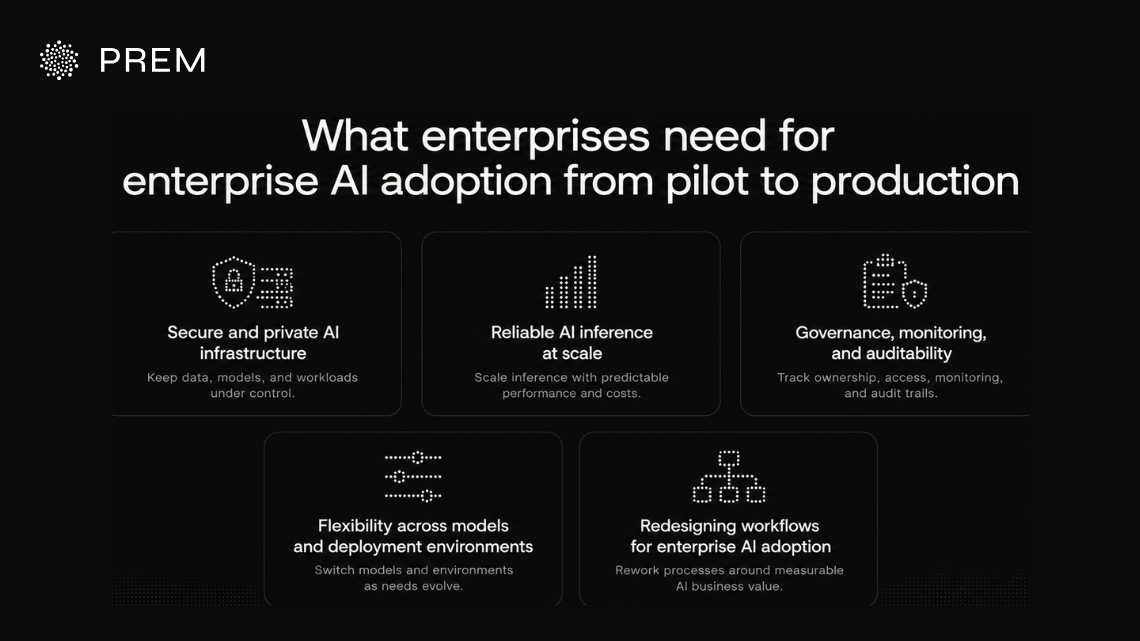
Everything above points to the same conclusion. Moving AI into production requires the right foundation around the technology. The model is only one part of that foundation.
Secure and private AI infrastructure, with control over data and workloads
Your data, context, and IP need to stay within a boundary you control and can verify. You need to know where your AI runs and who can access the environment.
You should control where your data is processed and where the workload is retained. That matters as AI moves into production. A 2026 DigiCert survey of around 1,000 IT and cybersecurity decision-makers found that around 78% had experienced an AI-related incident or identified an AI-related vulnerability. Almost half lacked centralized visibility into their AI systems and activity. Your infrastructure should give you flexibility when you change providers or bring a workload in-house.
Reliable AI inference at scale
An AI system that works in a pilot may become expensive or difficult to operate at a production scale. Production workloads can generate far more inference activity than a simple chatbot, especially when you start using AI agents.
Reliability also includes cost control. You need predictable performance and usage. You also need visibility into infrastructure costs so you can understand what it takes to scale each workload.
Inference now accounts for roughly two-thirds of all AI compute, up from a third in 2023 and half in 2025, according to Deloitte. The shift toward inference at scale is increasing demand for AI compute across data centers and enterprise infrastructure.
Governance, monitoring, and auditability built in from the start
Governance needs to start before your AI system goes live. You need clear ownership, access controls, monitoring, and an audit trail from day one.
These controls make it easier to review what a system is doing and investigate problems. They also help you move new use cases through security and compliance checks without rebuilding the foundation each time. Schellman's 2026 State of AI Governance Report, based on a survey of more than 500 U.S. enterprise leaders, found that 74% believed their organization could pass an AI compliance audit today. Only 27% described their AI governance program as fully mature.
Prem AI's Enclave API adds a technical verification layer through cryptographic attestation. Your security team can use the attestation report to verify the environment processing your AI workload.
Flexibility across models and deployment environments
Your AI strategy should support multiple models and deployment options. Open-weight models are giving enterprises more ways to run capable models in environments they control.
You can choose models based on performance, cost, privacy, and the needs of each workload. Your infrastructure should also make it easier to change models or deployment environments as those requirements evolve.
IBM's Calculus of AI Sovereignty study, based on a survey of 1,000 senior executives, found that 71% said switching their primary AI vendor or model would be difficult. The study also found that organizations with the most advanced AI control capabilities protected 55% more operating profit from AI-driven disruptions.
Redesigning workflows for enterprise AI adoption
Enterprise AI adoption starts with the workflow. Identify where AI can create measurable value. Then redesign the process around that opportunity.
This can mean changing the workflow from end to end. AI may handle several connected steps instead of being added to a single task.
The technology should follow the business decision. Your workflow, data, and business goals should determine where AI fits.
Move Your Sensitive AI Workloads Into Production
Build private AI infrastructure for sensitive workloads with greater control over how your data is processed and cryptographic attestation to verify the environment.
Talk to Prem AIThe next phase of Enterprise AI
Enterprise AI adoption is entering a more demanding phase. As more AI systems move into production, regulation, costs, and vendor trust will play a bigger role in how enterprises deploy and scale AI.
| What's changing | What it means for your enterprise |
|---|---|
| AI regulation expands | The EU AI Act’s high-risk provisions continue to phase in beyond the August 2026 milestone. Your AI systems need stronger governance and controls as more requirements take effect. |
| AI economics keeps shifting | Token prices keep falling, while your AI budget can still grow. Agentic workflows, longer context windows, and background processes can increase your token usage quickly. Understanding your real AI token economics helps you see what your AI workloads actually cost as you scale. |
| Vendor trust faces more scrutiny | Privacy policies tell you what a vendor promises. They do not always show what the underlying architecture actually does. You need ways to verify how your data is processed and protected. |
As enterprises take on more AI use cases, evaluation, governance, deployment, and cost architecture will become increasingly important. Your AI infrastructure needs to support all four.
Turn your AI pilots into production systems with Prem AI
Moving AI from pilot to production requires decisions about your infrastructure, data, models, and security controls. You need to know where your data goes and how the environment processes it.
This is where Prem AI's approach focuses on verifiable control. Prem AI provides private AI infrastructure for sensitive workloads. Your data and model interactions can stay within a controlled environment.
Cryptographic attestation gives your team a way to verify the environment processing your workload. This gives you evidence about the infrastructure behind your AI system.
If your organization is moving a regulated, sensitive, or IP-heavy AI workload from pilot to production, you need infrastructure that gives you greater control over your data and how it is processed.
Contact our sales team or email us at sales@premai.io if you want to see what that looks like for your enterprise.
FAQs about enterprise AI adoption
Why do most enterprise AI pilots fail to reach production?
You need more than a working model to run AI in production. Your team needs the right infrastructure, governance, ownership, and security controls. Start with a specific workflow, assign clear accountability, and build the necessary controls into the architecture from the beginning.
What is the biggest barrier to moving AI from pilot to production?
Your organizational readiness can determine whether an AI project reaches production. You need reliable data, production infrastructure, governance, and clear success metrics. These foundations also help you justify costs and get new use cases through security reviews.
How can you prove that AI delivers measurable ROI?
Start by assigning a clear owner and defining your success metrics before deployment. Then measure the results against a specific business outcome. Depending on your use case, this could include lower costs, faster workflows, higher productivity, or increased revenue.
Why has AI governance become important for enterprise procurement?
Your governance requirements can determine whether an AI system is approved for production. Frameworks such as ISO 42001 and the NIST AI Risk Management Framework give you structured ways to identify and manage AI risks before deployment.
Why are enterprises adopting narrow AI agents instead of general-purpose ones?
Narrow agents give you a more defined scope for your AI workflows. You can give an agent a specific task, limit its permissions, and define when a person needs to take over. This makes the system easier for your team to evaluate, monitor, and govern.
Why is data sovereignty becoming a major enterprise AI concern?
You need to know where your sensitive data and AI workloads are processed. Regulatory requirements and cross-border data transfer rules can affect how you deploy AI. Private and sovereign infrastructure can give you greater control over data location, jurisdiction, and access.
What should you look for in an AI infrastructure provider?
Look at more than model performance. Evaluate how your data is handled, how you can audit the system, what access controls are available, and how much deployment flexibility you have. For sensitive workloads, look for security controls that you can independently verify.
Are open-weight AI models becoming viable for enterprise use?
Yes. Open-weight models are becoming capable enough for a growing range of enterprise workloads, including reasoning and coding. They also give you more options for running AI within infrastructure you control and reducing dependence on a single external provider.
What separates enterprises that scale AI from those stuck in pilots?
You need clear ownership, success criteria, and governance before you expand an AI use case. Start with one workflow and build reusable infrastructure around it. Each additional use case can then build on the same foundation.
How can Prem AI help you move sensitive AI workloads into production?
Prem AI provides private AI infrastructure for sensitive enterprise workloads. You can run capable AI while keeping your data, context, and IP within an environment you control. Cryptographic attestation also gives your team a way to verify the environment processing your workload.
See how Prem AI can help your enterprise build private AI without compromising control over your data and infrastructure. Contact our sales team or email us at sales@premai.io.