Tokenomics in Enterprise AI: Why AI Token Economics Is Reshaping Enterprise AI & Infrastructure Decisions
On this page
Your AI bill this month is probably higher than what your finance team modeled last year, even though the price per token has fallen. And as AI gets cheaper to use, teams tend to use more of it. Just like we end up buying more nachos packets in supermarkets even when the cost per unit is lower.
![Enterprise LLM API spend grew from $3.5 billion to $8.4 billion in six months. [Source: Menlo Ventures]](https://storage.ghost.io/c/53/9d/539d90d7-be1a-4f26-a556-107272955307/content/images/2026/09/data-src-image-ad984207-9133-40b9-a1ae-d482d2185940.png)
Enterprise LLM API spend doubled from 3.5 billion dollars to 8.4 billion dollars in just six months in 2025, according to Menlo Ventures, and the FinOps Foundation found that 73 percent of enterprises blew past their original AI cost projections in the last year.
If you are running production AI workloads today, you already know the feeling. Token prices keep dropping in the headlines, but your invoice keeps climbing. In this blog, I’m going to walk you through why that happens, what actually drives your token consumption, how to calculate your real AI inference cost, and how to decide whether public APIs or private infrastructure make more sense for your workload going forward.
Let’s get started.
What is AI tokenomics?
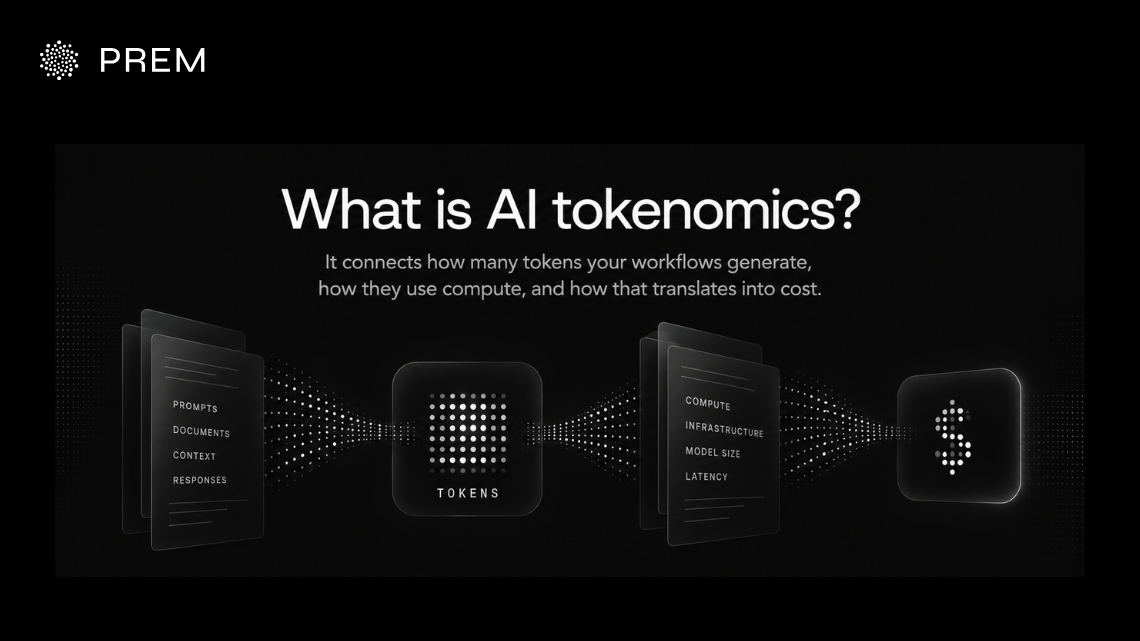
AI tokenomics is the study of how AI usage affects cost. It looks at how many tokens an AI model uses, what those tokens cost, and how they add up to your overall AI bill. Once you understand it you can plan and manage your AI costs better.
What are tokens in an AI model?
A token is the basic unit an AI model reads and writes in. It is roughly three quarters of a word in English, that means a thousand tokens is close to 750 words. Every prompt you send, every document you retrieve, every response the model generates gets broken down into tokens before the model can process any of it.
This is important to understand because whatever billing you’re getting: it’s not for the requests you or your team made. It is for the tokens.
For example, if we ask an AI model to summarize a short email, it might use only a few hundred tokens. But if we ask it to summarize a 10-page report, it can use thousands of tokens, even though both are just one request.
What is token economics in enterprise AI?
Token economics connects three things: how many tokens your workflows generate, how those tokens map to compute and infrastructure, and how that compute translates into a dollar figure on your invoice. Most teams only look at the first and last piece. They see token volume going up and a bill going up and assume the two move together in a simple straight line.
But in actuality they do not. Why?
Because a workflow that doubles its token volume can also become much more expensive if it requires a larger model, lower latency, or more compute. That’s why looking at the price per token alone doesn’t tell you what the workload will actually cost.
Why tokens are becoming the unit of AI consumption
In traditional software like Microsoft 365, Salesforce, and AWS, you paid for seats or for compute hours. In AI, you pay for tokens, and tokens are tied directly to how much your application actually thinks. The more context you feed a model, the more reasoning steps an agent takes, the more documents a retrieval system pulls in, the more tokens flow through the system.
That is why token consumption, not user count or request count, is becoming the real unit enterprises need to track. A flat number of users can generate a token bill that grows five times over if their workflows get more complex behind the scenes.
What drives token consumption in enterprise AI?
Token prices have fallen by roughly 280 times in about eighteen months according to Stanford HAI's AI Index, yet enterprise AI budgets have grown from an average of 1.2 million dollars a year in 2024 to 7 million dollars in 2026, as per AI to ROI. The gap between falling prices and rising bills comes down to a handful of specific architectural choices.
Longer context increases tokens per request
Every additional page of context you feed a model gets billed as input tokens, whether or not the model actually needed all of it to answer well. Teams often paste entire documents, chat histories, or system instructions into every call simply because it is convenient. Over time, this context compounding can quickly increase token usage and costs at production volume.
RAG increases token usage through retrieved context
Retrieval augmented generation pulls in external content before generating an answer, and that retrieved content adds directly to your input tokens. NVIDIA's own enterprise RAG sizing research found that adding roughly 1400 tokens of retrieved context can drop system throughput by 36 to 46 percent, because every retrieved chunk has to be processed on top of the original query.
AI agents can turn one task into multiple model calls
Agentic workflows do not make a single model call per user action. An agent might plan a task, call a tool, reflect on the result, retrieve more context, and generate a final answer, and each of those steps is its own model call with its own token cost.
OpenAI reported that average reasoning token consumption per organization increased approximately 320X over the previous 12 months, as enterprises increasingly integrated more capable models into their products, services, and workflows. As agentic systems take on more complex, multi-step tasks, this deeper model usage can translate into significantly higher token consumption.
Multimodal workloads change token consumption
Images, audio, and video can also be converted into tokens for multimodal models, and a single input can consume significantly more tokens than a plain text prompt. For example, a single high-resolution image can consume more tokens than several paragraphs of text, which is easy to miss if your cost model was built around text-only chat use cases.
AI applications can hide token consumption behind workflows
The token calls that hurt enterprises the most are often invisible in the product itself. Monitoring agents, background compliance checks, and document watchers run continuously and consume tokens against every event they process, even when no human is actively waiting for a response.
As enterprises move from simple chat interfaces to always-on agents and automated workflows, these background processes can become a growing part of monthly inference costs. A system that looks like a single AI interaction from the user's perspective may trigger multiple model calls behind the scenes. And that makes the actual token consumption much higher than request counts suggest.
What determines the real cost of AI inference?
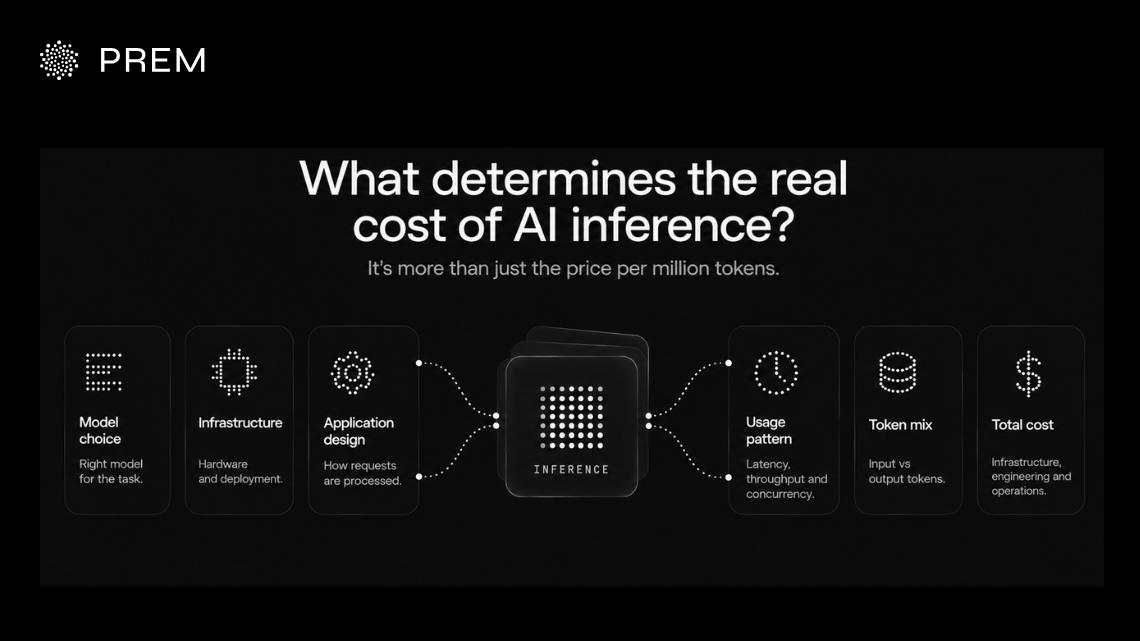
The price per million tokens listed on a provider's pricing page is only the starting point. Your real cost depends on the model you choose, how efficiently that model runs on the underlying hardware, and how your application sends requests over time.
The same model can have very different economics depending on how it is deployed and used. You can reduce your blended inference costs by routing simple workloads to smaller models, reserving frontier models for tasks that genuinely require their capabilities, and optimizing how requests are processed.
Afterall we wouldn't send a delivery van to move a single envelope across town or use a heavy truck for every trip. Because the right vehicle depends on the job. In the same way AI infrastructure works. For routine tasks use lightweight models and for tasks that require deeper reasoning and capabilities you can use frontier models.
Input and output token pricing
Output tokens usually cost several times more than input tokens because generating each new token requires a full forward pass through the model, while input tokens can often be processed in parallel. A workflow that generates long, detailed responses will feel this difference far more than one that mostly reads and summarizes.
Model size changes inference requirements
Bigger models need more memory, more compute per token, and more GPU capacity to serve at the same latency. Flagship reasoning models can carry a price premium averaging over 30 times non reasoning models for comparable token volume, which is why picking the right model size for each task, not the biggest available model for every task, has become one of the highest leverage cost decisions a team can make.
GPU utilization affects infrastructure economics
A GPU that sits idle for much of the time can make each token more expensive because you are still paying for the hardware while it is not processing requests. So, the cost of running a model on paper can be very different from what you actually pay in production. The more efficiently you use your GPUs, the better the economics of private AI infrastructure can be.
Latency, throughput, and concurrency affect cost
Low latency requirements, like customer facing chat, force you into infrastructure configurations that trade off throughput for responsiveness, which raises cost per token. Batch workloads that can tolerate delay can be processed far more cheaply because they allow better hardware utilization.
Concurrency, meaning how many requests hit your system at once, determines whether your infrastructure is sized efficiently or sitting mostly idle waiting for peak load.
The complete cost of processing AI tokens
The real cost per token includes the listed API price or GPU compute time, plus infrastructure overhead, plus engineering time to build and maintain the pipeline, plus the operational cost of monitoring, scaling, and fixing things when they break.
Teams that only track the sticker price consistently underestimate their total AI spend. The cost of processing AI at scale depends not just on what providers charge per token, but also on the infrastructure and operational resources required to deliver those tokens reliably.
How can you reduce AI token costs?
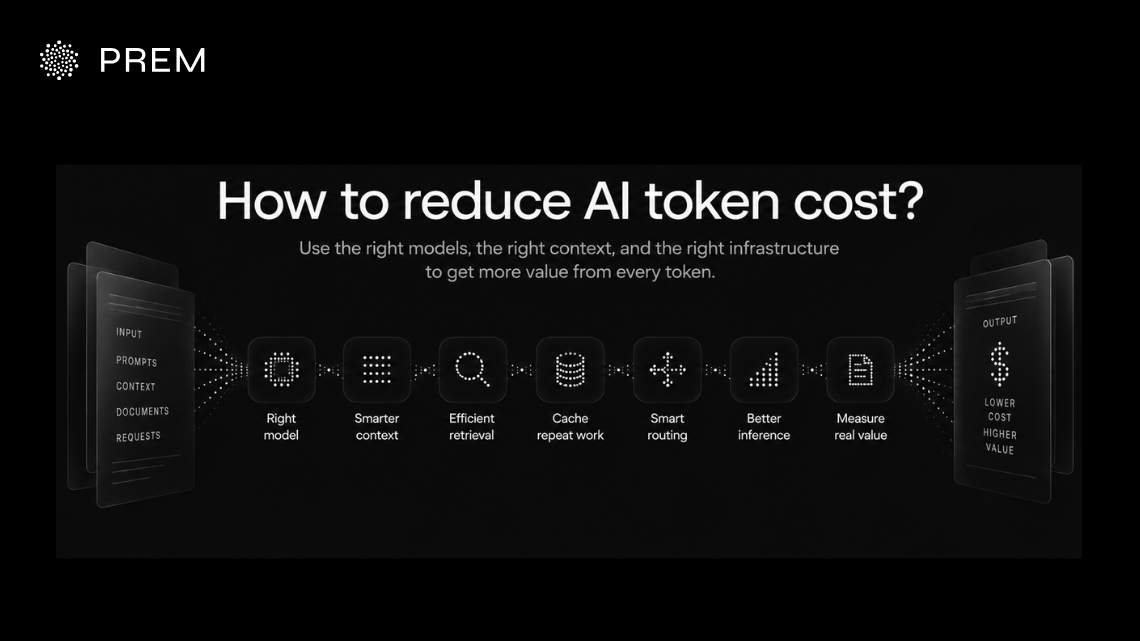
Reducing doesn't always mean to settle for less. For example, if you remember the times when we bought extra nachos packets just because there was a great offer? We probably didn't need that many packets in the first place. The deal that looked cheaper and made us buy more has ended up with a simple thing which is spending money on something that we didn't really need.
That means we need to think about the value that amount of money is driving.
AI token consumption works the same way. Processing more tokens doesn't always mean getting more value. A model may repeatedly process the same context, take in unnecessary information, or use a larger model for a task a smaller one could handle just as well. You still pay for those tokens, even when they add little to the final outcome.
Use the smallest model that meets the requirement
Not every task needs your most capable, most expensive model. Routing routine tasks like classification, extraction, and simple summarization to smaller or mid-tier models while reserving frontier models for genuinely complex reasoning tasks can significantly reduce inference spend without compromising performance.
Reduce unnecessary context
Put your prompting on a diet. Every extra paragraph you send in a prompt is billed, whether or not the model needs it. Auditing your prompts for unnecessary history, boilerplate instructions, and redundant context is one of the simplest changes you can make with almost no engineering cost.
Optimize RAG retrieval
Retrieving fewer, more relevant chunks instead of large blocks of loosely related content reduces token volume while often improving accuracy. As per Microsoft Community Hub post, Microsoft's own engineering team documented an 80 to 85 percent drop in token consumption after moving to context aware chunking in their RAG pipeline.
Cache repeated requests and context
If your users or systems are asking similar or identical questions repeatedly, caching prior responses and reusable context avoids paying for the same tokens twice. This is especially valuable for internal tools and support workflows where question patterns repeat often.
Route workloads across different models
Model routing sends each request to the model best suited for its complexity instead of sending everything to one default model. This single change is consistently cited as the highest return cost optimization available to enterprises right now, because it directly targets the gap between frontier pricing and tiered pricing.
Optimize inference with batching and quantization
Batching groups multiple requests together so GPUs process them more efficiently instead of running one at a time. Quantization reduces the precision of a model's weights to shrink memory use and speed up inference, often with negligible quality loss. Both techniques directly raise the utilization numbers that determine your real cost per token.
Measure cost per task instead of cost per token
Cost per token tells you the unit price. Cost per completed task tells you whether that price is actually delivering value. A workflow that costs more per token but completes a task in one call will often beat a cheaper workflow that needs five calls to get the same result.
How to calculate your enterprise AI token economics
Most teams never do this math until a budget review forces them to, and by then the surprise is already sitting in a finance report. Working through it early gives you a framework you can revisit every time usage grows.
Step 1: Measure tokens per request
Log the average input and output tokens for each of your core workflows separately. Most of the best EU LLM APIs provide token usage in their API responses, which makes it possible to track how many tokens each request consumes. A support chatbot, an internal search tool, and an agentic pipeline will have very different token profiles, and averaging them together will not define which workflows actually drive your spend.
Step 2: Calculate monthly token consumption
For each workflow, multiply the average input and output tokens per request by the number of requests that workflow handles each month. Add the totals across workflows to calculate your overall monthly token consumption. This gives you a realistic view of how many tokens your AI workloads actually process each month.
Step 3: Calculate your current AI inference cost
Multiply your monthly token consumption by your applicable token price for each model you use. If you route across multiple models, calculate this separately for each one and sum the totals to get your true blended cost.
Step 4: Estimate future AI demand
Take your current monthly token number and project it forward based on expected user growth and expected increases in workflow complexity, since agentic and RAG based features tend to raise tokens per request even if user count stays flat. A five times increase in usage without any workflow changes is a conservative starting assumption for most growing AI products.
Step 5: Estimate the cost of private inference
Calculate GPU rental or ownership cost, add a realistic utilization assumption rather than a theoretical peak, then add engineering and operational overhead for monitoring, scaling, and maintenance. Industry estimates put this operational overhead at 20 to 40 percent on top of raw GPU costs, and in many cases engineering labor alone exceeds the infrastructure spend itself.
Step 6: Compare deployment economics
Line up your projected API cost against your projected private inference cost at both your current volume and your projected future volume. The breakeven point usually is not a single number, it shifts depending on which model tier you compare against and how efficiently you can run your own infrastructure.
Public APIs vs private AI infrastructure: Which makes more economic sense?
Ahh, the most interesting part. If someone tells you private AI infrastructure is always cheaper, they're probably leaving out a few things. Public APIs can make more sense when your usage is still unpredictable or you don't want to manage infrastructure yourself.
Private infrastructure can become more economical as your usage grows, especially when you need more control over your data, latency, and deployment. The right choice comes down to your volume, performance needs, compliance requirements, and whether your team is actually equipped to run the infrastructure.
When public APIs make more sense
If your AI usage is low, unpredictable, or still changing, public APIs can be a better choice. You don't need to invest in GPUs or build your own AI infrastructure, and the provider takes care of scaling, maintenance, and updates. APIs also make sense for teams that don't have the people or expertise to manage AI infrastructure themselves.
When private AI infrastructure makes more sense
Private AI infrastructure can make more sense when you have high and consistent AI usage, need greater control over your data, or want more flexibility in the models you run. It can also help you optimize inference around your own workloads instead of paying for every request through an external API.
For example, a documented 70B-model deployment reduced its monthly infrastructure cost from roughly $39,100 to $16,151 after optimizing the model, improving GPU utilization, using more efficient GPU capacity for batch workloads, and reducing infrastructure overhead. The example shows that token volume is only part of the cost equation. How you deploy and run the model can have a major impact on the overall cost.
Turn your AI tokenomics into smarter infrastructure decisions with Prem
Your token economics are not a warning to abandon APIs, and they are not proof that private infrastructure is automatically cheaper. They are a framework for making a better deployment decision. Once you measure your tokens per request, monthly consumption, current AI costs, and expected future demand, you have a clearer basis for deciding how your AI workloads should be deployed instead of relying on a single invoice.
This is where Prem AI comes in. When the economics support private infrastructure, Prem AI helps enterprises like yours turn that decision into a working AI environment. Teams can deploy AI within their own private infrastructure, run and manage open-source models, optimize inference for their workloads, maintain greater control over their models and enterprise context, and scale infrastructure as usage grows.
Prem AI will not tell you private infrastructure always reduces your costs, because it does not always. What it does is give you the platform to build and manage private AI infrastructure that is optimized around your workload, once your own tokenomics tell you that it is the right move.
If you're evaluating private AI infrastructure for your enterprise, contact our sales team or email us at sales@premai.io.
Frequently asked questions about AI tokenomics
Is AI tokenomics only relevant for large enterprises?
Not really. The moment your AI is running in production, this stuff starts mattering, no matter your size. Honestly, smaller teams often feel it faster, since a sudden spike in usage hits a tighter budget harder. Getting a handle on this early just saves you from an ugly surprise on next month's bill.
Do all AI models use tokens in the same way?
Nope, each one has its own way of breaking text down, so the same sentence can turn into a different number of tokens depending on the model. Throw images or audio into the mix and it gets even more different. So comparing raw token counts across models doesn't really tell you much, comparing actual cost does.
Why can two AI applications with similar usage have very different costs?
Usage numbers alone don't tell the whole story. One app might be sending short, clean prompts to a lightweight model, while the other is stuffing long context into a top tier model for basically the same job. It's really the model choice and how much is happening behind the scenes that moves the needle, not just how many people are using it.
How do I know if my AI workload is ready for private infrastructure?
Look past your busiest day and check your steady monthly volume instead. If you're consistently pushing millions of tokens a month, your traffic is fairly predictable, and your team can actually handle running infrastructure, it's worth doing the math. If things are still bursty or changing fast, staying on APIs is probably the easier call for now.
Is self-hosting private AI infrastructure cheaper than using an API?
Not always. APIs can be cheaper for low or unpredictable usage because you pay only for what you use. Self-hosting can make more sense when usage is high and consistent, but GPU, power, maintenance, and infrastructure costs still need to be included.
How should enterprises monitor AI token costs over time?
Don't just watch one big number. Break it down by workflow, set up alerts for anything that spikes unexpectedly, and check cost per finished task alongside cost per token every so often. Usage patterns shift as things grow, so a single audit early on won't catch problems that show up quietly, months down the line.
Can open-source models reduce enterprise AI costs?
Often, yeah, especially once you're running high enough volume that self hosting starts to beat paying per token. But don't forget, open-source still needs GPUs, tuning, and someone keeping an eye on it day to day. The savings are real, they just come with real work your team needs to be ready to take on.
What is the difference between token cost and inference cost?
Token cost is just the price tag, what a provider charges per million tokens. Inference cost is different, because it's the token cost plus GPU compute, infrastructure, and all the engineering time it takes to keep everything running smoothly. Basically, token cost is one line inside a much larger bill.
How many tokens does an AI application use?
There is no fixed number. It depends on the prompt, conversation history, retrieved documents, system instructions, and model response. A simple request may use hundreds of tokens, while an agent or RAG workflow can process thousands or more.
See how Prem AI can help your enterprise build private AI without compromising control over your data and infrastructure. Contact our sales team, or email us at sales@premai.io.