LLM Token Cost Explained: How Enterprises Can Reduce AI Inference Costs Without Compromising Performance
If you've spent any time reading about LLM token costs, you've probably hit the same advice over and over. Tighten your prompts. Cache repeated answers. Trim your context. Route simple tasks to cheaper models. All decent advice. All of it will save you something.
Here's what nobody tells you upfront, though: that "something" is usually not much. You clean up your prompts, you cache a few responses, and your bill goes from painful to slightly less painful. You're still writing the same check every month, just a tad bit smaller.
That's because none of those tricks touch the actual problem.
The problem isn't that your prompts are messy or your context windows are bloated, though they might be. The problem is the pricing model itself. As long as you're running on a public AI platform, OpenAI, Anthropic, Google, or whichever, you're paying for every single token you generate, forever, on infrastructure you'll never own a piece of. Optimize all you want. You're still a tenant, not an owner, and tenants don't get to decide the rent.
The real fix isn't optimizing how you use public AI. It's owning your AI infrastructure instead of renting it, which is precisely what private AI is built for. Let's walk through why the bill continues to climb, why the popular fixes cap out fast, and what it actually looks like when you own the thing instead of leasing it token by token.
The enterprise AI cost crisis is already here
This is not a future problem that you should anticipate. It's already sitting on your books right now.
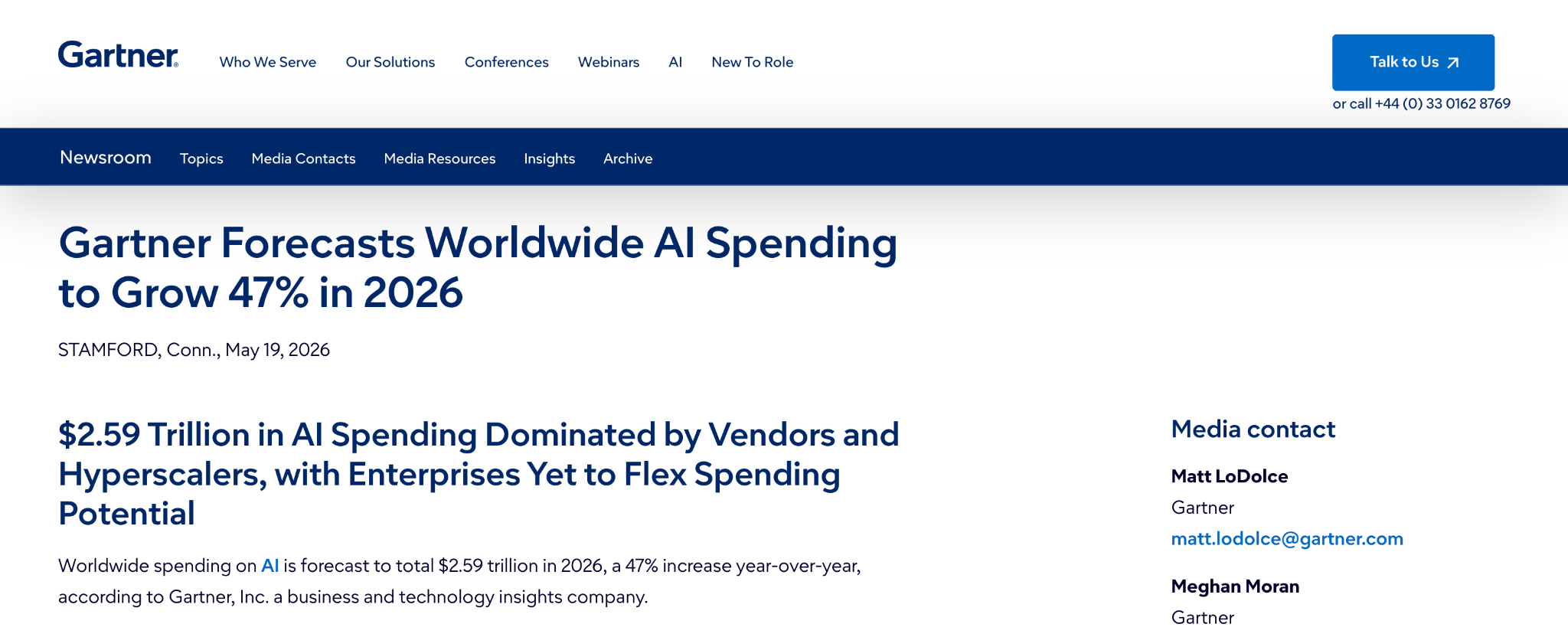
Worldwide AI spending is on pace to hit $2.59 trillion in 2026, according to Gartner's own May 2026 forecast, a 47% jump from the year before. That's not gradual growth. That's a curve that's outrunning most companies' ability to budget for it.
And it's not translating into value at anywhere near the same rate. IBM's own CEO study, which surveyed 2,000 CEOs globally, found that only around a quarter of AI initiatives deliver the ROI executives expected, and just 16% have actually scaled enterprise-wide.
IBM's own AI ROI research points to an MIT finding that hit the industry hard: roughly 95% of generative AI pilots are failing to produce measurable business impact.
Imagine the pressure from finance, either. Deloitte's 2026 State of AI in the Enterprise report, based on a survey of 3,235 business and IT leaders across 24 countries and 6 various industries, found companies pushing hard into production AI while still struggling to convert that spend into enterprise-wide financial impact.
Forbes has also mentioned this as well. Deloitte frames this as "embracing the rise of physical, agentic, and sovereign AI," which tells you where the smart money is already moving.
Gartner’s Agentic AI project gives us an idea that more than 40 percent of agentic AI projects will be canceled by the end of 2027 because of rising costs, unclear business value, or inadequate risk controls.
Read that again.
Not because the technology doesn't work. Because the economics don't hold up once you actually try to run it at scale.
What are LLM tokens and why do they matter?
A token is the smallest chunk of text a model reads or writes, roughly three quarters of a word. Every request you send has input tokens (what you write) and output tokens (what the model generates back for you), and reasoning models add a third, often invisible category: reasoning tokens, the internal steps the model works through before it gives you an answer, which you get billed for even though you never see them.
As a rough rule of thumb, for context, 100 tokens works out to about 75 words in English. So a report with roughly 500 words lands around 650 to 700 tokens once it's tokenized. A single-sentence question might be 10 to 15 tokens. A long customer support thread pasted in as context could easily run into the thousands.
Public AI companies like OpenAI and Anthropic charge per token, split by input and output, usually at different rates. That's the whole mechanic. Simple in theory. The reason it gets complicated is that nobody controls the volume side of that equation once AI is running across dozens of teams and workflows, which is exactly where the next section comes in.
Why public AI Is driving enterprise token costs higher
Public AI platforms are built on a pricing model that works great for the vendor and works against you as you scale. A few things stack up against you specifically.
Token price trend data
Stanford HAI's AI Index Report found that inference for a model matching GPT-3.5 level performance dropped more than 280-fold between November 2022 and October 2024, with per-million-token pricing that fell from around $20 to roughly $0.07 in about 18 months. That's the number to use anywhere you want to show the raw price collapse.
Rising bills despite falling token prices
Here's the part that confuses most finance teams: per-token prices have been falling for years, and the bill keeps climbing anyway. Fortune's reporting points to Goldman Sachs forecasts that agentic AI could push token consumption up 24-fold by 2030, since agents call the model far more times per task than a simple chatbot ever did. Cheaper tokens don't help when usage is climbing that much faster than the price is dropping.
Per-token and usage-based pricing
Per-token, usage-based pricing means your bill has no ceiling.
There's no flat fee that caps what a bad month of usage costs you. Large context windows make it easy to send more than you need, and you pay for every token in that window whether the model actually needed it or not.
Reasoning models consume meaningfully more compute per answer. The Data Letter’s AI Inference Economics 2026 shows us that Gartner has estimated agentic AI workloads can burn 5x to 30x more tokens per task than a standard chatbot interaction since an agent plans, calls tools, checks results, and retries, all before it gives you a final answer.
Vendor-controlled pricing and vendor lock-in
Then there's the part that doesn't show up on an invoice: vendor-controlled pricing and vendor lock-in.
The provider sets the rate. The provider changes the rate. And once your workflows are deeply wired into one vendor's API, switching gets expensive fast, which is exactly the leverage a single-vendor relationship hands over to them and takes away from you.
On top of that, you're depending on infrastructure you don't control. OpenAI's own status page confirmed a significant service disruption in February 2026 that hit login and conversation availability, and a separate global outage in April 2026 took down ChatGPT, Codex, and API access with over 7,600 users in the UK and 1,700 users in the US.
That's not a knock on any one company specifically; it's simply what happens when your production workflows sit entirely on someone else's infrastructure.
Why traditional token optimization isn't enough
None of the standard advice is wrong.
Prompt engineering, context engineering, semantic caching, retrieval optimization, and model routing. These all genuinely reduce waste. Optimizing prompt length alone can only do so much.
It's a reduction in waste within the same pricing model. You're still paying per token to the same vendor at whatever rate they've set for as long as you use their platform. You've made the meter run a little slower. You haven't turned the meter off. There’s a big difference here.
Compare that to what happens when companies change the infrastructure underneath, not just the prompts on top of it. NVIDIA's own analysis, reported by VentureBeat in February 2026, found inference providers achieving 4x to 10x cost reductions running open-source models on newer hardware.
Decagon, an enterprise AI company, reported cutting its own inference costs sixfold, so there’s a reduction here after moving off closed, per-token APIs onto infrastructure built around open-weight models.
This is the difference between trimming a rental bill and no longer renting at all.
Why enterprises are moving towards private sovereign AI
This isn't a shift we're pointing at because it's convenient for us to say. It's showing up in earnings calls, product roadmaps, and enterprise budgets from the companies with the least incentive to say it, the same public cloud giants who'd rather keep you renting. Here's what they're actually building and reporting.
NVIDIA
NVIDIA's own Q4 fiscal year 2026 earnings, covered by Futurum Group, showed sovereign AI revenue exceeding $30 billion for the year, more than tripling year over year, with governments and enterprises across the UK, France, the Netherlands, Canada, and Singapore among the biggest buyers. That's real capital moving toward owned, sovereign infrastructure, not rented API access.
IBM
IBM didn't just write about this trend; it built for it. At its Think 2026 conference, IBM announced a new lineup of enterprise products explicitly built around agents, data, automation, and what IBM itself calls "sovereignty," with IBM’s chairman and CEO, Arvind Krishna, noting that "the enterprises pulling ahead are not deploying more AI; they're redesigning how their business operates."
As per AI News inference cost, even Google, which runs one of the largest public AI clouds on earth, is now offering Gemini models on NVIDIA Blackwell hardware through Google Distributed Cloud specifically so finance and healthcare organizations can keep frontier models entirely inside their own controlled environment, not because it's trendy but because regulated enterprises are demanding it.
Add it up: multi-model deployments, self-hosted and open-source models, and infrastructure enterprises actually own are no longer the alternative path. They're becoming the default path for anyone running AI at real scale.
Why private sovereign AI is the long-term solution for reducing LLM token costs
Strip away the framework talk, and it comes down to two very different bills. One moves with your usage and someone else's rate card. The other flattens out because you own what's running it. Here's what each one actually looks like in practice:
Token costs when it comes to public AI
Public AI means per-token commercial pricing with no ceiling, a bill that moves with your usage and the vendor's rate card, single-model dependency, vendor lock-in, and data leaving your boundary every time you send a request.
Token costs when it comes to private AI
"Private sovereign AI" means infrastructure you own or control; costs that flatten out instead of climbing indefinitely; the freedom to run multiple models and pick the right one for each workload instead of being stuck with one vendor's roadmap; and data that stay inside your walls the entire time.
That last point matters more than it sounds. Being able to run several models side by side, an open-weight model for routine tasks and a specialized one for a specific workflow, isn't just a technical nicety.
It's what actually eliminates vendor lock-in, because no single provider going down, changing its pricing, or changing its policies can take your whole operation down with it. And when the infrastructure is yours, the long-term ROI math looks completely different than a monthly API invoice ever could, because you're building an asset instead of renting access to one.
Metrics every CIO should track beyond monthly AI spend
Your monthly AI bill is the least useful number on this list. It tells you what happened, not why.
A single total can't tell you if you're burning tokens on bloated context, paying for requests that never turned into a result, or running an agent that quietly calls the model ten times instead of once. These are the numbers that actually explain the bill and give you something to act on.
How Prem AI helps your enterprise build cost-efficient private sovereign AI
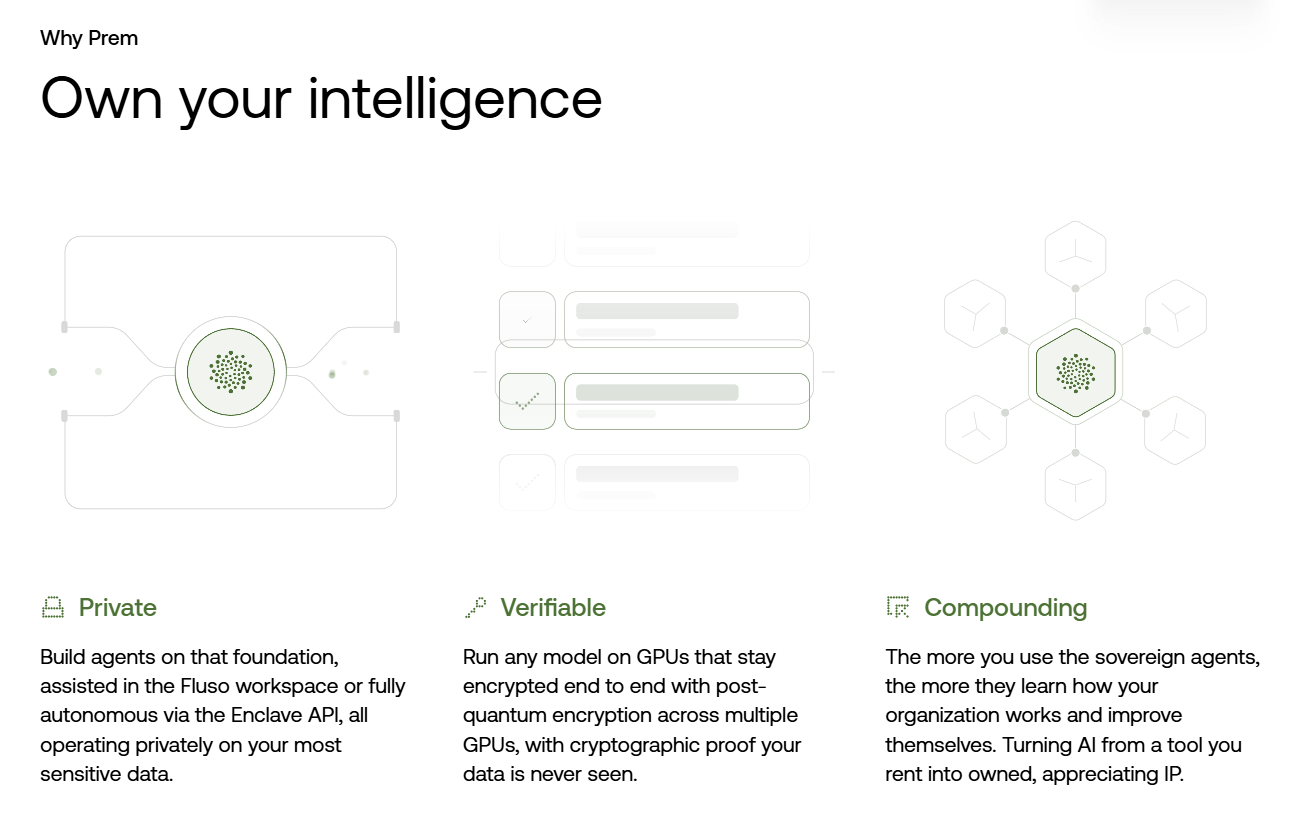
Prem AI's approach rests on three things working together, and each one answers a different part of the question you just asked: who can see your data, who can prove what happened to it, and who keeps what your teams build. Prem AI's approach rests on three things working together:
Privacy
Your workloads run inside infrastructure you control, not inside a shared cloud where every prompt quietly becomes training data for someone else's model.
Verifiability
You don't have to take anyone's word for it; our hardware-level attestation lets your own security team independently confirm what happened to a request, rather than trusting a policy document.
Context compounding
Everything your teams teach the system stays inside your walls, allowing context to compound for better AI inference over time, instead of that accumulated knowledge evaporating the moment you switch vendors or renegotiate a contract.
Practically, this means you can run multiple open-source models instead of tying your AI strategy to a single vendor’s roadmap. You can choose the right model for each workload, reduce dependency on any one provider, and maintain greater control over inference costs.
With governance and security controls built for regulated environments, you can build a more predictable AI operating model that your technology and finance teams can plan around.
Prem AI: frontier intelligence you own
Here's the thing about AI spending that nobody really says out loud. Every prompt, every agent call, and every document you pull into context is a small bet that the meter stays fair, that this month's bill looks roughly like last month's.
Most of the time you don't even notice you're placing that bet. Then adoption doubles, or some agent workflow quietly starts calling the model ten times instead of once, and the bet comes due all at once in a bill you never actually signed off on.
The companies getting ahead of this aren't the ones pulling back on AI. They're the ones who got tired of letting someone else's meter decide their budget for them.
That's really all private sovereign AI is when you strip away the jargon: your intelligence running on infrastructure you own instead of rent, with costs that flatten out over time instead of climbing forever right alongside your usage.
That's what Prem AI is built around. Your data stays private, you can verify what happens to it, and everything your teams build stays yours, even if you switch vendors later.
You get to run the models you want, on infrastructure you actually control, without wondering what next month's invoice is going to look like.
If you're ready to stop chasing your AI bill and start owning your AI infrastructure instead, we've got you. Contact our sales team or just drop us a line at sales@premai.io.
FAQs about LLM token costs
What is an LLM token?
A token is the smallest unit of text a language model processes, roughly three quarters of a word. Every request you send has input tokens and output tokens, and reasoning models add a third category, internal reasoning tokens, all billed by most public AI providers per token.
Why do public AI platforms cost so much at enterprise scale?
Public AI charges you per token with no ceiling, so cost rises directly with your usage. As adoption spreads across teams and agentic workflows multiply model calls, that per-token pricing model compounds fast, regardless of how efficient your prompts are.
Can tightening up your prompts actually lower your AI bill?
Sure, a bit. Cleaner prompts and smart caching shave off some waste, but it can only do so much. But you're still paying per token to the same vendor at the same rate. You've slowed the meter down, not turned it off.
So what exactly is private sovereign AI anyway?
Basically, it's AI that runs on infrastructure you actually own or control instead of a public API you're renting. You get to decide who touches your data, which models you run, and what happens to your costs, instead of leaving all three up to someone else's roadmap.
Is self-hosted AI cheaper than using public APIs like OpenAI or Anthropic?
For steady, high-volume workloads, often yes, and not by a small margin either. NVIDIA's own data showed inference providers cutting costs 4 to 10 times over by running open models on newer hardware, and Decagon reported cutting its bill sixfold after making the same switch.
Why should you care about vendor lock-in when it comes to AI costs?
Vendor lock-in is what happens when your whole AI setup depends on one provider's models and pricing. You lose your leverage to negotiate, you're stuck absorbing whatever price hikes come your way, and if that one vendor has an outage, your business feels it too.
Can you actually run more than one AI model instead of betting everything on one vendor?
Yeah, plenty of companies already do this. You route different tasks to different models based on what's cheapest or best suited for the job, instead of forcing everything through one vendor's stack. That gives you way more control over both performance and what you're actually spending.
If not the monthly AI bill, what should you actually be watching?
Look at cost per request, cost per business outcome, and cost per active user. Track your average tokens per workflow, how well model routing and caching are working, and your infrastructure utilization too. Your total bill tells you what happened. These numbers tell you why and what to fix.
So why are companies going all in on sovereign AI instead of just tweaking their token usage?
Because tweaking can only work so much. Recently, owning infrastructure has shown documented savings of a good amount. On top of token usage, private sovereign AI also solves data privacy, compliance, and vendor dependency issues that prompt tweaks simply cannot address.
How does Prem AI help enterprises reduce long-term AI costs?
Prem AI provides your enterprise with private, verifiable, and compounding AI infrastructure that you can own instead of renting it. Prem AI supports multiple open-source models, removes single-vendor dependency, and turns unpredictable per-token spending into a fixed, controllable long-term cost structure.
See how Prem AI can help your enterprise build private AI without compromising control over your data and infrastructure. Contact our sales team, or email us at sales@premai.io.