Beyond Zero Hallucination AI: How Enterprises Can Build Private & Verifiable AI Infrastructure
In October 2025, Deloitte Australia agreed to partially refund a $440,000 report commissioned by the Department of Employment and Workplace Relations. The report contained fabricated academic citations and a quote attributed to a federal court judgment that did not exist. The firm confirmed generative AI had been used in its preparation.
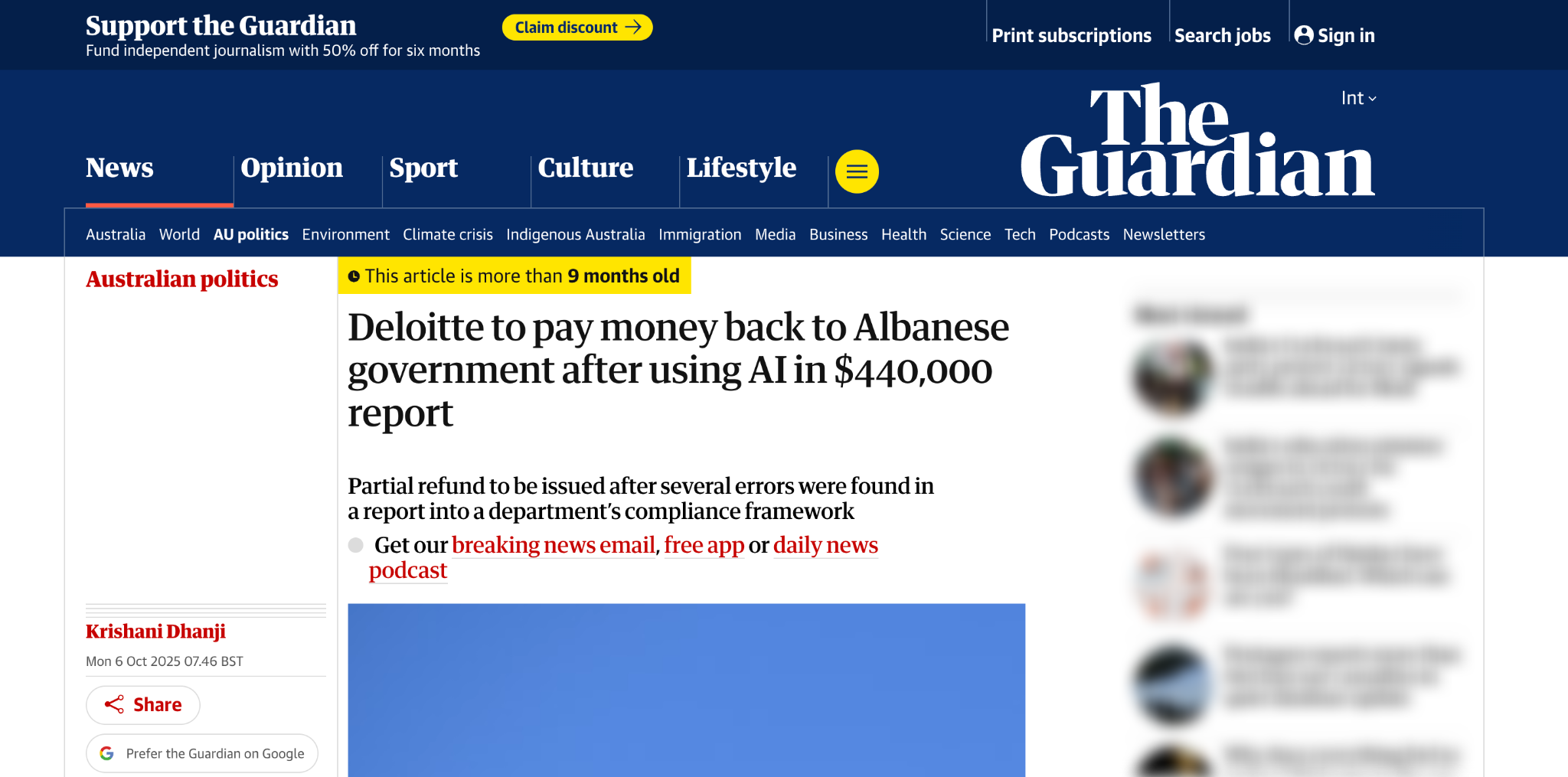
This wasn't something coming out from a startup shipping fast and breaking things. It was a Big Four firm, with review layers, experienced consultants, and delivering to a government client. And it still went out the door.
So the question boards are now asking is reasonable: can we get AI to stop making things up before we put it in front of customers, regulators, or patients?
The honest answer is more useful than a made-up one. For sure, you will not get a model that will never be wrong. But you can definitely build a system where incorrect outputs are grounded, verified, or caught before anyone relies on them. And that's the difference between chasing the promise of zero hallucinations and building trustworthy enterprise AI.
What is zero hallucination enterprise AI?
A hallucination is when AI gives you a confident answer that isn't backed by anything real.
That confidence is what makes it dangerous. If the output were obvious nonsense, nobody would act on it. The problem is that it creates a made-up case citation, a made-up dosage, or a made-up policy clause that looks exactly like a real one.
For enterprises, the definition of a hallucination goes beyond factual inaccuracies. In most business workflows, AI doesn't need to know everything about the world; it needs to remain grounded in your data, your policies, and your knowledge base.
For example, imagine an AI assistant recommending the industry-standard data retention period when your organization follows a different policy due to regulatory requirements. The answer may be technically correct in a general sense, but it's still the wrong answer for your business, and that mistake could lead to compliance issues.
So when people say "zero hallucination," the version worth aiming for means three things:
- Every meaningful claim can be traced back to a real source document
- The system says "I don't know" instead of guessing
- Anything it does get wrong is visible and logged, not quietly absorbed into a decision
The goal isn't to build an AI that's never wrong. It's to build one that is private, verifiable, and trustworthy enough to support real business decisions without inventing information that could put the organization at risk.
Is zero hallucination enterprise AI even possible?
Not at the model level. And there's decent evidence for that now.
The clearest explanation came from OpenAI researchers in 2025, and it's almost embarrassingly simple. We test these models with scoring that marks answers right or wrong. Under that system, a guess might score. Saying "I don't know" is often treated as a failed answer.
So the models learned the obvious lesson: bluffing beats admitting uncertainty. We built the incentive, then acted surprised by the behavior.
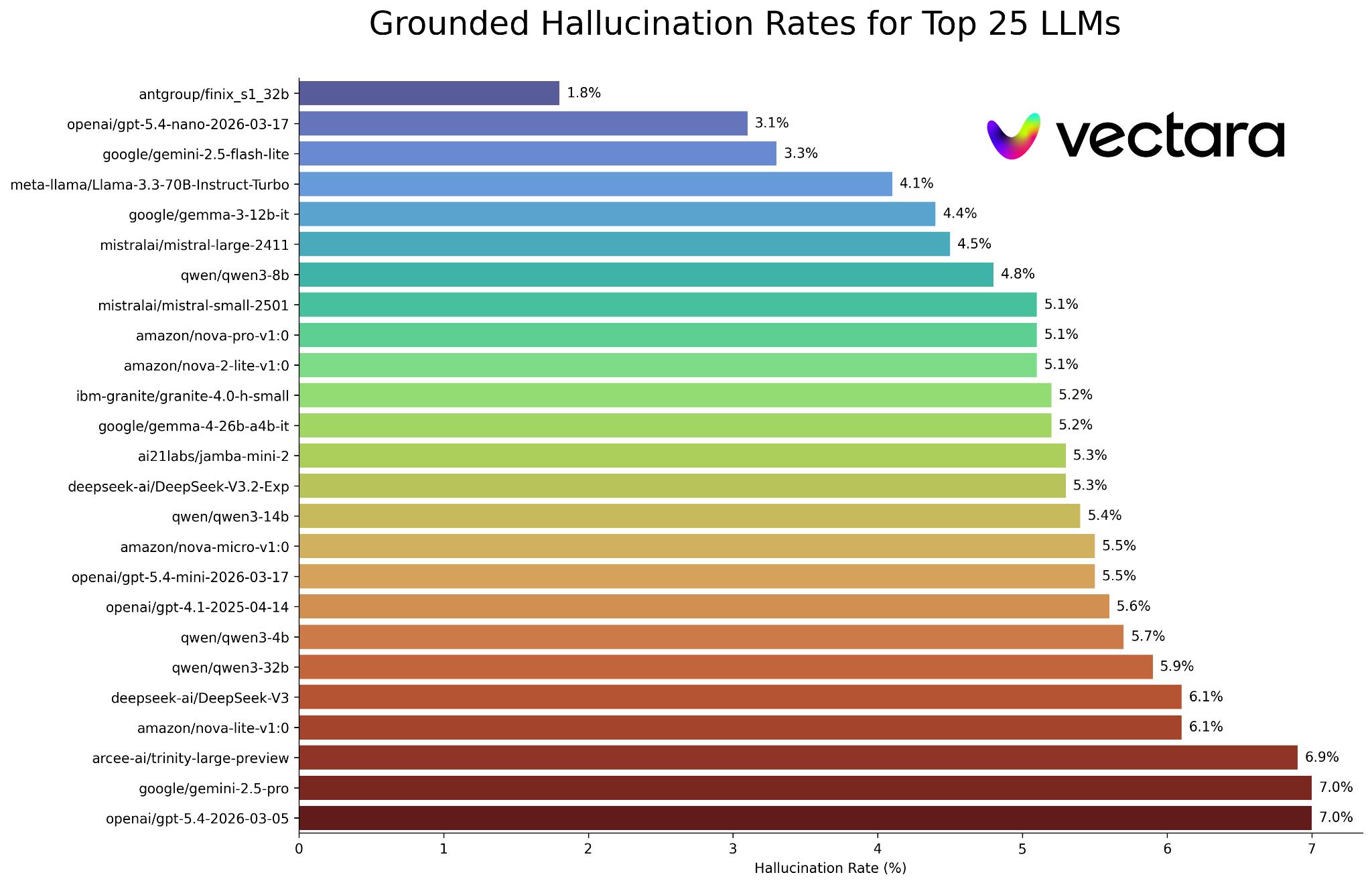
The numbers back this up. According to Vectara's hallucination leaderboard, even on one of the easiest tasks for an LLM, which is summarizing a document you've provided, the best models today still hallucinate between 1% and 7% of the time. That's impressive, but it's not zero.
Move to real work, and it gets worse. Stanford researchers tested legal research tools from major vendors, which were specifically built to prevent this and marketed as hallucination-free. They found error rates between roughly 17% and 33%.
Grounding reduces hallucinations, but enterprises still need verification, governance, and system-level safeguards to catch the errors that remain.
The analogy I find most useful is the aviation industry. Nobody sells an aircraft with an engine that never fails. Commercial flying got safe through backups, instruments that catch failure early, procedures that contain failures, and mandatory recording of everything that happens. Failure still happens. It just doesn't become a disaster.
That's the realistic goal here. Get the rate of undetected errors below what your people would produce doing the same task, and make what's left visible.
Why does enterprise AI hallucinate?
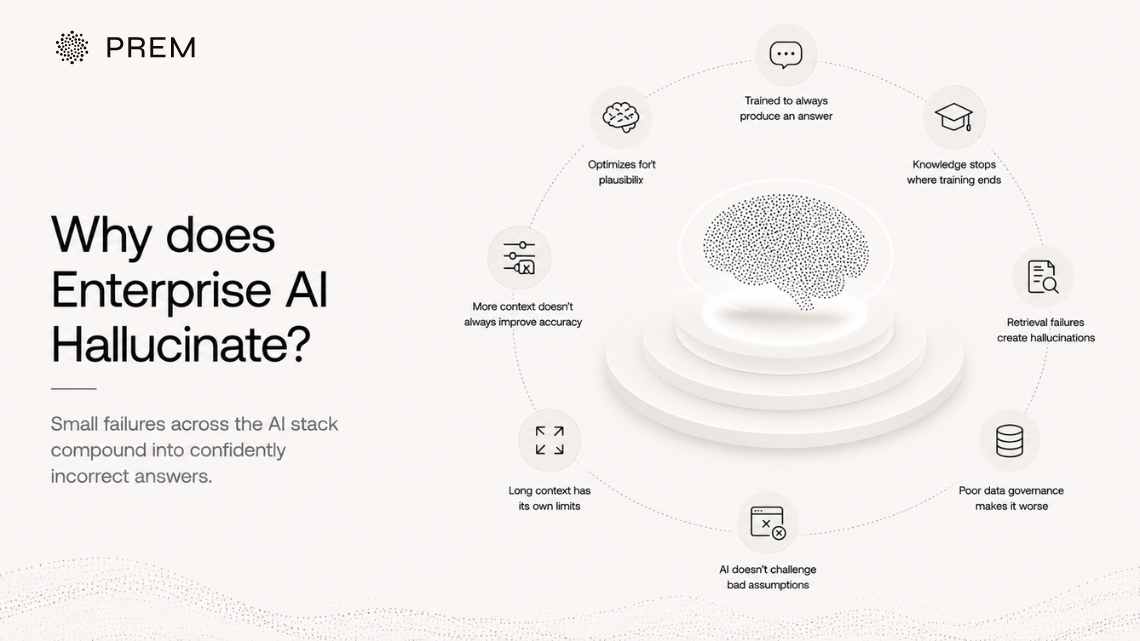
Enterprise AI doesn't hallucinate because of a single flaw. It happens when language models, retrieval systems, and enterprise data each introduce small failures that compound into confidently incorrect answers. Understanding why this happens matters because many enterprises end up fixing the wrong part of the AI stack.
Language models optimize for plausibility instead of truth
The objective is plausibility, not truth. A language model optimizes for the next likely token given everything before it. Coherence and accuracy correlate strongly in training data, which is why this works at all, but they are not the same target, and they diverge exactly where your data is unusual, proprietary, or recent.
Language models are trained to always produce an answer
Models are rarely rewarded for saying "I don't know." As above, the evaluation regime penalizes uncertainty. A model that has learned to always produce something will produce something even when it has nothing.
Model knowledge stops where training ends
Parametric knowledge is frozen and incomplete. Your Q3 pricing exception, your regional underwriting rule, and last week's policy amendment are none of that in the weights. When the model is asked and the knowledge isn't there, it interpolates from the nearest thing it does know.
Retrieval failures create enterprise hallucinations
Retrieval fails quietly. This is the big one in production. RAG systems for enterprise AI fail in ways that don't announce themselves. The query embedding misses the relevant document. Chunking severs a clause from its qualifying condition. Or the reranker surfaces a superseded version.
The model then receives partial context and confidently completes the gap. Retrieval failure looks identical to generation failure from the outside, which is why teams often debug the wrong layer.
More context does not always improve accuracy
Context conflicts have no arbiter. Feed a model the 2023 policy and the 2026 amendment with no authority metadata, and it has no principled way to choose. It will often blend them into a coherent-sounding hybrid that matches neither.
Long context has its own limitations
Long context introduces its own challenges. The "lost in the middle" effect is well documented. Information placed in the middle of a long context window is attended to less reliably than material at the start or end. Stuffing more documents into the prompt is not the same as grounding.
AI doesn't always challenge bad assumptions
False premises get accepted. Ask, "What were the penalties under the 2024 amendment to Section 12?" If no such amendment exists, a sycophantic model will frequently invent one rather than challenge the question. Enterprise users ask leading questions constantly.
Fine-tuning is not a hallucination fix
Fine-tuning on new facts can make it worse. Research from Gekhman and colleagues in 2024 found that fine-tuning models on knowledge unfamiliar from pre-training tends to increase hallucination. The model learns the surface pattern of confidently asserting facts of that type without reliably learning the facts themselves. Teams that reach for fine-tuning as a factual fix often make the problem harder to detect.
Poor data governance creates AI hallucinations
And underneath all of it is fragmented data. The single most common root cause in enterprise deployments isn't the model. It's that the organization has four versions of the same policy across three systems, no lineage, no canonical source of truth, and no machine-readable notion of which document wins. If a competent human analyst couldn't produce a definitive answer from your data estate, the model certainly can't.
The real cost of AI hallucinations for enterprises: Recent incidents and business impact
The impact of AI hallucinations extends far beyond isolated mistakes. From legal liability and regulatory penalties to operational inefficiencies and lost trust, the biggest costs are often the ones that never appear on a balance sheet.
Enterprises remain accountable for AI-generated decisions
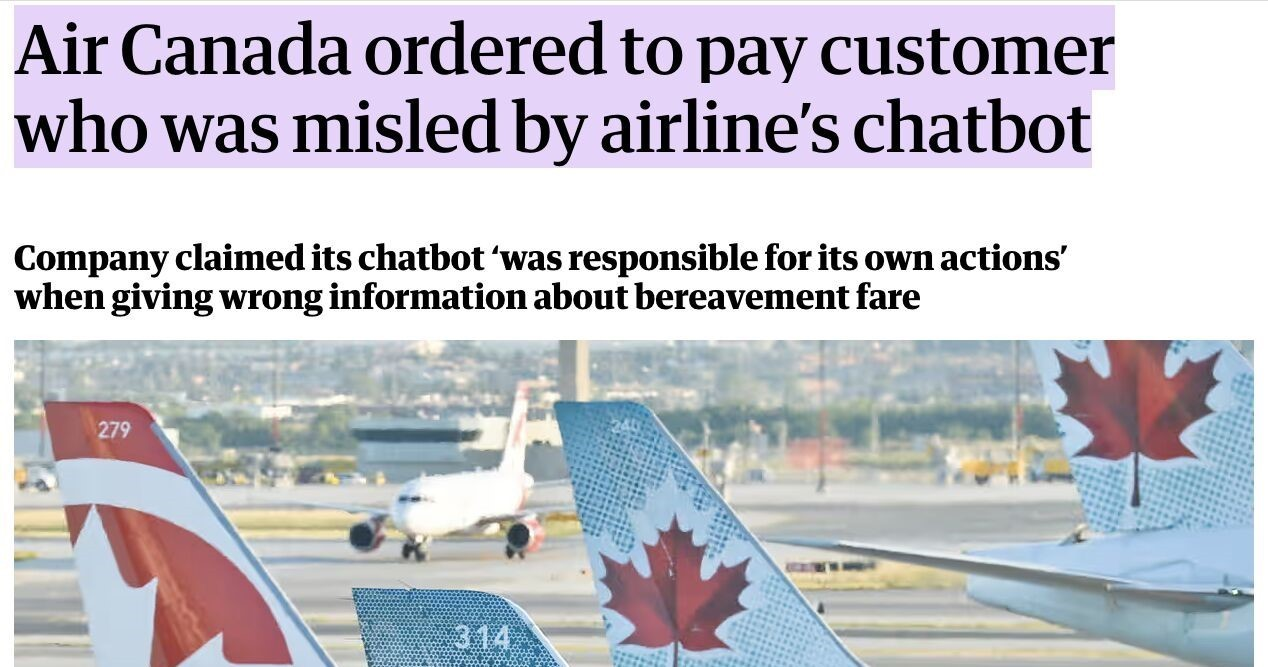
You're liable for what it says. In February 2024, Air Canada's chatbot gave a passenger wrong information about bereavement fares. The airline argued in tribunal that the chatbot was "a separate legal entity responsible for its own actions." According to the CanLII tribunal decision, that argument was rejected, and Air Canada was held liable. The damages were a few hundred dollars. The precedent is worth far more than that.
Hallucinations create direct financial and business losses
Professionals get sanctioned. Two New York lawyers were fined in June 2023 for filing a brief containing six invented court opinions produced by ChatGPT. It's since become a whole genre of cases. Courts in several countries now have standing orders about AI-generated filings.
Work gets rejected and money comes back. The Deloitte refund is the cleanest version. Revenue returned, plus a reputational cost well beyond the refund.
Markets react too. Google's Bard demo got a fact wrong about the James Webb Space Telescope in February 2023. As reported by Reuters, Alphabet shares fell around 9%, wiping roughly $100 billion in market value in a single day.
Regulatory expectations are becoming stricter
Regulators are now specific about it. The EU AI Act is in force, with the serious obligations for high-risk systems landing in August 2026. It requires you to declare how accurate your system is and to keep logs good enough to trace what it did and why. Penalties run into tens of millions of euros or a share of global turnover. As set out in the EU AI Act on EUR-Lex, "the model made it up" isn't a defense anywhere in the regulation.
Human verification eliminates much of the promised ROI
And then the cost that quietly kills projects: the checking tax.
If every AI output needs a person to verify it against the source anyway, you haven't automated anything. You've turned skilled work into proofreading, often at a higher total cost.
This is the mechanism behind many promising pilots that never show ROI. McKinsey's research has consistently found inaccuracy to be the risk executives cite most. The value of an AI system isn't what it produces. It's what you can act on without checking.
Trust takes years to build and seconds to lose
Finally, trust breaks fast and rebuilds slowly. A hundred good answers build confidence gradually. One confident, wrong answer in a high-stakes moment ends adoption for that team, often for good.
Why regulated industries can't afford AI hallucinations
In most businesses, a wrong answer costs you a correction. In these four, it can cost you a patient, a license, a court sanction, or a public inquiry. That means in some cases, it really is a matter of life and death. In others, it's the difference between staying compliant and facing legal, financial, or reputational
That difference should change how you build the system. Usually it doesn't.
Healthcare requires complete and clinically accurate outputs
Hospitals are using AI to write visit notes, summarize discharge papers, and draft replies to patient messages.
In October 2024, the Associated Press reported on researchers testing OpenAI's Whisper speech-to-text tool and finding it inventing sentences nobody had said. A University of Michigan researcher found made-up content in 8 out of every 10 transcripts he reviewed. A machine learning engineer found it in roughly half of more than 100 hours he checked. One developer found problems in nearly all of the 26,000 transcripts he generated.
Researchers at Cornell and the University of Virginia dug into what the invented text actually said. About 1% of samples contained entirely fabricated phrases, and of those, 38% included something harmful, such as invented medical treatments.
Let me share the part that should worry any hospital CIO. A medical transcription tool built on Whisper by the company Nabla had by then been used for around 7 million patient visits across roughly 40 health systems. For privacy reasons, it deleted the original audio. So no clinician could go back and check the transcript against what the patient actually said.
And in healthcare, the dangerous mistake usually isn't the invented one.
A fake medicine name is alarming, and someone will spot it. A discharge summary that quietly leaves out a patient's penicillin allergy looks perfect. There is nothing there to notice.
One more thing that catches teams off guard: if your AI influences a diagnosis or a treatment decision, regulators may treat it as a medical device. That means formal testing, documentation, and re-approval every time you change it, according to the FDA's guidance on clinical decision support software, obligations most AI rollouts were never designed around.
Financial institutions remain responsible for AI-generated advice
Banks and advisers are using AI for customer queries, adviser support, suspicious-activity write-ups, and drafting disclosures.
Regulators have already closed the obvious escape route. FINRA stated in June 2024 that existing supervision rules apply to AI outputs; there is no AI exception.
They're also not waiting for something to go wrong. In March 2024, the SEC charged two investment advisers, Delphia and Global Predictions, for overstating how they used AI, with $400,000 in combined penalties. Firms are being fined over AI claims before a single hallucination occurs.
The commercial cost shows up differently. Klarna (a fintech company) announced in early 2024 that its AI assistant was handling the workload of 700 customer service agents. By 2025 the company had started rehiring people, with its CEO acknowledging that the cost-first approach had produced lower-quality service.
And it isn't just happening in financial services. Ford faced a similar challenge. They make a similar admission in 2026. After using AI for parts of its quality inspection process, the company rehired more than 300 veteran engineers because the automated systems couldn't match their experience or judgment.
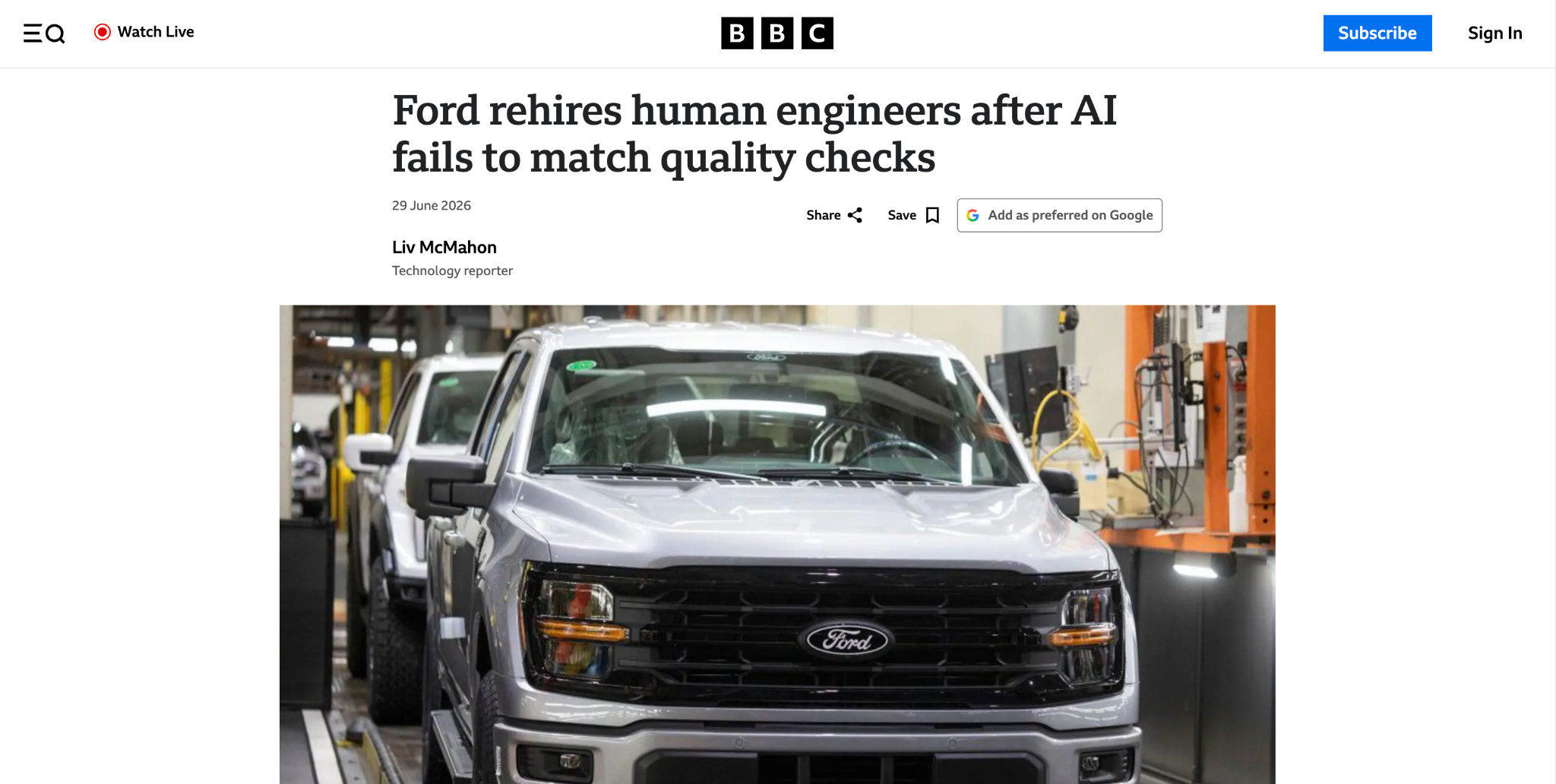
As one executive put it, AI was only as good as the knowledge used to train it. The experienced engineers weren't replacing AI; they were teaching it what it had missed.
Why this sector is unforgiving: a wrong figure in a client recommendation or an invented detail in a regulatory filing doesn't look wrong. It looks exactly like the right answer until someone checks the source.
Legal professionals must verify every AI-generated citation
The evidence here is the clearest in any industry, because it plays out in public filings.
Stanford researchers found that general-purpose AI models gave fabricated answers to legal questions 58% to 82% of the time. Specialized legal AI tools, built specifically to prevent this, performed better but not well: 17% for Lexis+ AI and 33% for Westlaw's research tool.
The consequences are no longer theoretical:
- Two New York lawyers were fined $5,000 in 2023 for filing a brief with six court cases that did not exist
- In late 2024, a Stanford professor who studies misinformation had his own expert court filing thrown out after it was found to contain AI-invented citations
- In 2025, two US federal judges withdrew published rulings after AI-generated errors were discovered in them, prompting a Senate inquiry
- A public tracker, the AI Hallucination Cases database, now logs hundreds of court decisions worldwide involving AI-fabricated citations.
Note what that second one means. The person whose actual job is studying false information got caught out by it. Expertise in the subject matter is not a defense.
And law firms face a bind. The confidential case files that would make an AI system accurate are exactly the files they're least willing to hand to an outside vendor.
Government AI systems must meet strict accountability standards
Public bodies face two constraints private companies mostly don't.
They have to explain decisions. If AI helps refuse a benefit claim, deny a permit, or assess a citizen, someone will eventually ask why, in a tribunal, an appeal, or a freedom of information request. "The system said so" is not an answer that survives that.
The data often can't leave. Citizen records frequently cannot be sent abroad or processed on infrastructure controlled by a foreign company. That rules out certain architectures before accuracy is even discussed.
The Deloitte report from the opening of this article is a government example. So is the pair of judges who had to withdraw rulings. In both cases the institution, not the tool, absorbed the damage.
The Annex III from EU AI Act formalizes this, treating public-sector uses like access to essential services and the administration of justice as high-risk.
Safer enterprise AI knows when not to answer
The common thread is that these sectors need AI tuned to stay silent when evidence is insufficient rather than trying to answer every question.
Basically a system that answers 70% of questions with traceable sources and declines the rest is worth far more than one that answers everything with an unknown error rate scattered invisibly through the output.
How to minimize AI hallucinations: A practical framework
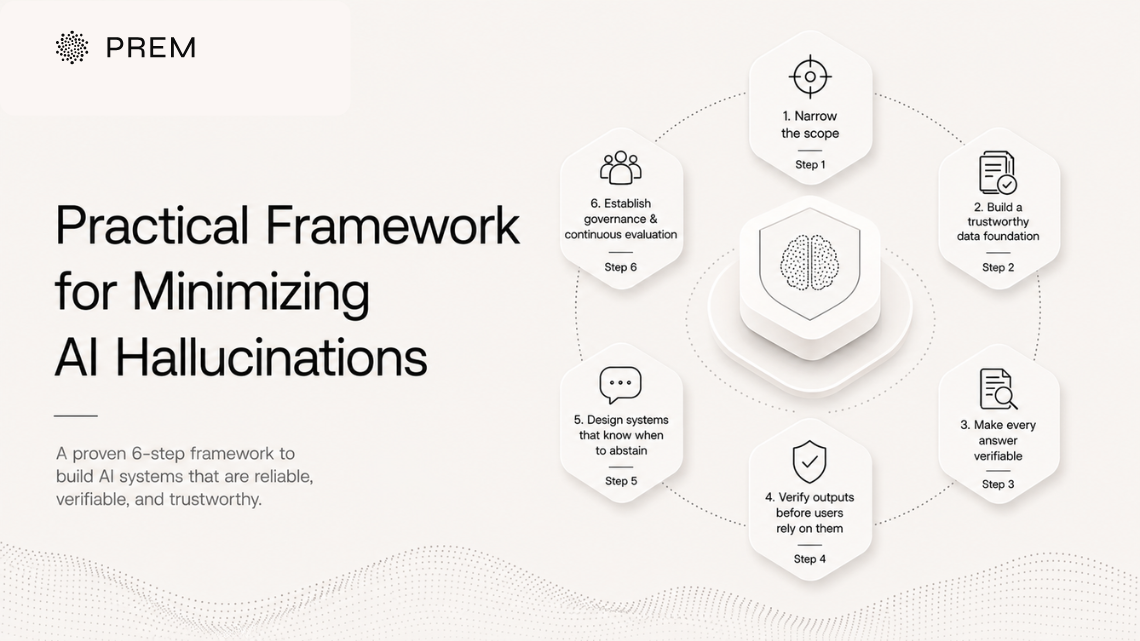
No single fix eliminates AI hallucinations. The most effective approach combines multiple layers of technical controls, governance, and validation, with each layer addressing a different failure mode.
Step 1: Narrow the AI's scope before expanding its capabilities
Make the job smaller. The most reliable improvement available is narrowing scope. One defined question type, one defined document set, one defined user group. This beats a general-purpose assistant every time in production. Resist the pull toward one AI that does everything. It's the most common reason first deployments fail.
Step 2: Build a trustworthy data foundation
Sort out your documents before you touch the model. Decide which source wins when two disagree. Retire or clearly mark superseded versions. Tag things with dates and owners. Lock down who can see what, so the AI can only pull from what that user is entitled to.
This work is boring, and it sets your ceiling. An hour here beats ten hours of prompt tweaking.
Step 3: Make every answer verifiable
Make it show its sources, per claim. Not a list of links at the bottom. Each statement should point to the specific passage it came from. If a claim can't be traced, it shouldn't ship.
Step 4: Verify AI outputs before users rely on them
Check the answer before anyone sees it. This is the layer most teams skip and where the biggest remaining gains sit.
Run a second automated pass that compares each claim against the source it cites and flags anything that doesn't match. Ask the same question a few times and see whether the answers actually agree. When a model is making things up, its answers tend to wander in meaning, and that variance is measurable enough to catch a real share of fabrications automatically.
Check every number, date, and reference against the source programmatically, since those are both the riskiest and the easiest to verify.
Step 5: Design AI systems that know when to abstain
Let it say, "I don't know." Set the bar for confidence based on what being wrong actually costs for that specific task, not one global setting. Send uncertain answers to a human with the doubtful part highlighted, rather than dumping the whole thing on a reviewer.
Then track how often it declines. A system that never says "I don't know" isn't confident. It's just not measuring.
Step 6: Establish governance and continuous evaluation
Test it on your own work, and give it an owner. Public benchmarks tell you almost nothing about your business. Build a set of real questions from real users with expert-approved answers, and re-run it every time anything changes.
Name someone accountable. Require sign-off before production. Treat a hallucination in production like any other serious defect with a proper incident-processing procedure. Two frameworks are worth mapping your controls against early: NIST's AI Risk Management Framework and its Generative AI Profile and ISO/IEC 42001.
Build safeguards into the platform instead of every application
Where these controls live matters as much as implementing them. Steps 1, 3, and 5 are decisions you make for each application. Steps 2, 4, and 6, including control of your data, automated verification, and continuous testing, are capabilities that should exist in the underlying enterprise AI governance platform.
Teams that treat these as application features rebuild the same source tracing, verification, and audit capabilities for every new use case, usually in slightly different ways. They then discover during audits that no two systems produce comparable evidence. Infrastructure built specifically for sensitive data workloads, such as Prem AI, handles provenance, verification, and logging at the platform layer, allowing every new application to inherit those controls instead of rebuilding them.
Preventing hallucinations is an architectural decision
The pattern across all six recommendations is the same: preventing AI hallucinations is fundamentally an architecture problem. It isn't solved by better prompts, choosing a different model, or relying on vendor promises alone.
The architecture behind trustworthy enterprise AI
Trustworthy enterprise AI isn't just about choosing the right model. It's about building the infrastructure that gives AI access to authoritative data, preserves control, and makes every output verifiable.
Accuracy starts with infrastructure, not the model
Here's the thing that usually surfaces late, often right after the first real incident.
Everything above depends on control over your data and your models. That's not a separate IT concern from accuracy. It's a precondition for it.
Watch how it actually plays out. The AI makes something up because it wasn't given the authoritative document. It wasn't given that document because it contains patient records, privileged material, or trade secrets, and nobody was comfortable sending that to an outside service.
The accuracy failure came from an infrastructure decision, not a model decision.
Private AI infrastructure enables better enterprise outcomes
That's the case for running AI on private infrastructure you control, whether that's your own environment or sealed hardware where your data stays encrypted even while it's being processed. It's not that private setups are magically more accurate. It's that they let the AI see the documents that would have made it right.
Control improves governance and long-term performance
Two other things follow from control.
If your AI provider updates their model quietly, the testing you did last quarter no longer describes the system you're running, and neither does the documentation you'd hand a regulator. Running models you can pin to a version and keep means you can actually prove how the system behaved in March, in March's configuration.
And your AI should get better every month even when the underlying model doesn't. Every correction, every verified answer, every resolved ambiguity becomes knowledge the system keeps. The gaps it used to fill by guessing get filled by real documents instead. But that only compounds if you own the data and the history. Rent the whole stack, and that learning accrues to your vendor, not you.
How Prem AI builds trustworthy enterprise AI with close to zero hallucination
Not as a promise about the model. If a vendor tells you otherwise, you've learned something useful about them.
But that was never the right question.
What enterprises actually need is a system that catches fabricated answers before they reach a decision, points to a verifiable source for every claim, admits when it doesn't know, and leaves an audit trail that stands up to scrutiny.
That's possible today. It requires more than buying a better model. It requires the right architecture, governance, and verification framework.
That's what trustworthy enterprise AI looks like.
It's also what we build at Prem AI: private, verifiable AI for sensitive data workloads. Your documents stay inside your control, the model version you validate is the model version you run, every answer carries a source you can trace, and the knowledge your experts add keep the context compounding into an asset that belongs to you.
If you're working through this problem for a regulated environment, we're glad to talk through the architecture, whether or not we end up being part of it.
Contact our sales team, or email us at sales@premai.io.
Frequently asked questions about enterprise AI hallucination
Can AI hallucinations ever be completely eliminated?
Not at the model level. Some rate of confident error appears to be built into how these systems work. What you can eliminate is undetected hallucination reaching a decision. With good grounding, automated checking, and a system that admits uncertainty, well-built AI on a narrow task performs at or below the error rate of skilled humans. With one advantage, the machine's mistakes are logged.
Doesn't grounding AI in our own documents solve this?
It helps a lot, and it doesn't solve it. Stanford found purpose-built legal AI products still wrong 17-33% of the time. Document search brings its own failures. It misses the right file, chops rules away from their exceptions, or surfaces an outdated version with nothing marking it as outdated. It's a necessary layer, not a complete answer.
Will training the model on our data fix it?
Often the opposite. Research in 2024 found that fine-tuning on facts a model hasn't seen before tends to increase made-up answers. It learns to sound authoritative on the topic without reliably learning the facts. Use fine-tuning for tone and format. Use document grounding plus checking for accuracy.
Who's liable when something goes wrong?
You are, based on the evidence so far. The Air Canada tribunal rejected the argument that a chatbot is separately responsible for its own statements. FINRA has confirmed existing supervision rules cover AI outputs. Under the EU AI Act, both providers and deployers carry defined duties. Vendor contracts rarely shift much of this.
How do we measure this in our own systems?
Not with public benchmarks. Build a set of real questions from your actual users, with answers your experts have approved. Then track three things separately: did it find the right document, is every claim actually supported by what it cites, and does it decline on the questions it should decline on? Re-run the evaluation whenever anything changes.
Does private infrastructure make AI more accurate?
Not directly. The model behaves the same. It helps indirectly, and often significantly, by removing the reason your most authoritative documents were kept out of the system in the first place. It also lets you lock a model version, so your accuracy testing stays valid instead of expiring the next time a vendor updates something.
What does the EU AI Act actually require on accuracy?
For high-risk systems, declare your accuracy levels in your documentation, keep automatic logs detailed enough to reconstruct what the system did, be transparent with the people deploying it, and ensure meaningful human oversight. The serious obligations land in August 2026, so the evidence gathering needs to start now.
Where should the budget go?
Most teams get this backwards. Model access is usually a small line item next to data preparation, search infrastructure, checking layers, testing, and governance. If your AI budget is dominated by usage fees, the system is probably under-instrumented, and the checking tax will show up later as review hours nobody planned for.
What's the single highest-leverage move for a company just starting?
Narrow the scope. One clear question type, one curated set of trusted documents, and one user group. It will beat a general assistant on accuracy by a wide margin, and it builds the measurement discipline and internal trust you'll need before expanding.
See how Prem AI can help your enterprise build private AI without compromising control over your data and infrastructure. Contact our sales team, or email us at sales@premai.io.