Inside Enterprise RAG: How AI Retrieves, Verifies & Responds with Enterprise Knowledge
Your LLM is remarkably capable. Ask it to reason through a problem, draft a memo, or summarize a dense report, and it delivers. But even the most capable model works from what it learned during training, not from your latest pricing sheet, your open compliance tickets, or last quarter's incident report. That gap between what a model can do and what it actually knows about your business is exactly what enterprise RAG closes.
Even a company operating at Palantir's scale keeps landing on the same point. Palantir's post on X discusses that grounding a model in the actual reality of a business, not just retrieved text, but the data, logic, and context that reflect how an enterprise actually runs, is what separates an application people trust from one they merely find impressive.
Grounding #LLMs in the Ontology effectively anchors them in the reality of a given business, not only driving more accurate, powerful applications, but also enabling even greater trust.
— Palantir (@PalantirTech) December 5, 2023
See #Palantir's @cmwahlqu demonstrate how to leverage OAG in AIP: https://t.co/iChOwT2sTS
Most teams learn this the hard way, well after launch, when a confident but wrong answer finally reaches someone who knew better and asked a pointed question in a meeting.
This blog is about how enterprise RAG retrieves the right information, verifies it before your model ever sees it, and turns it into a response you can actually trust and act on.
What is enterprise RAG and why do enterprises need it?
Think about how much of what your company knows lives outside any model’s training data: your latest pricing sheet, the compliance memo legal published last week, or the runbook your ops team just updated.
Enterprise RAG lets an AI system reach that knowledge instead of guessing at it. It pulls relevant information from your own systems and gives it to the model, so the answer is grounded in what your business actually knows, not just what the model absorbed during training.
For you as a buyer or builder, that matters because a standalone LLM has never seen your latest contracts or this week’s product update. Meta AI’s original RAG announcement made the same point: RAG lets models pull from up-to-date information when they need it, without retraining the model every time something changes.
Why do enterprises need it?
Enterprise RAG becomes important when the knowledge your AI relies on keeps changing. Your policies change monthly, your product specs update every release, and regulatory obligations shift across jurisdictions. Staying ahead of something like EU AI Act compliance gets harder if your AI cannot reference your current documentation. Constantly retraining a model around these changes is slow, expensive, and still leaves gaps between training runs.
Aravind Srinivas's enterprise AI post makes a similar point: every enterprise has knowledge about its workflows, domain, and customers that an off-the-shelf model cannot pick up from the outside. That means your AI assistant can reference the exact clause in your newest vendor agreement without another round of retraining.
How enterprise RAG verifies and ranks retrieved information
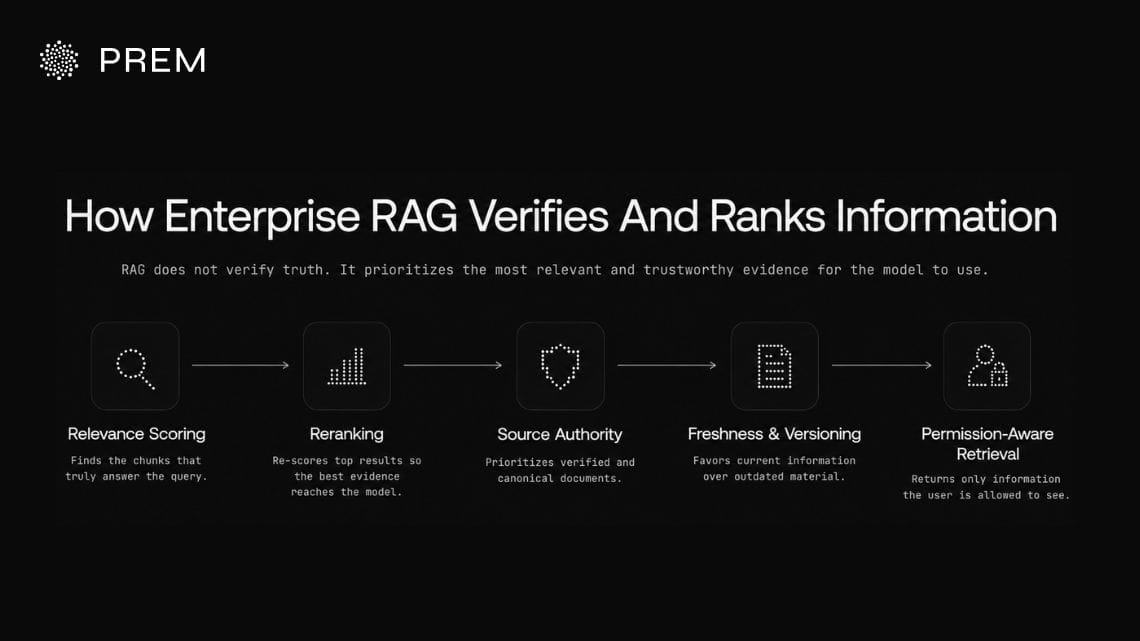
RAG does not verify whether information is true. It retrieves and prioritizes the most relevant and trustworthy evidence available for the model to use.
Relevance scoring
Your first retrieval pass usually casts a wide net, pulling in chunks that appear related to the query. This gives you a strong recall, but it also means some results may only be loosely relevant. Relevance scoring helps you identify which chunks actually answer the query rather than simply looking similar. You should also look beyond similarity alone. Factors such as recency and source diversity can help you prioritize more useful information. This reduces the amount of irrelevant context reaching your model and gives it better information to work with.
Reranking
Reranking helps you narrow down your retrieved results to the ones that matter most.You retrieve broadly for speed and coverage, then re-score the strongest candidates with a more sophisticated model so only the most relevant information reaches the language model.
NVIDIA’s RAG reranking shows how reranking can combine results from semantic search, BM25, and other sources to improve what reaches the model. For an underperforming RAG pipeline, it can be one of the highest-return upgrades you make.
Source authority
Not every document in your knowledge base deserves equal trust. A policy from your legal team should outrank an old project comment, even if both mention the same topic. Source authority helps your system prioritize these verified, canonical sources during retrieval.
Tagging documents by origin, ownership, and review status helps maintain that hierarchy. Without it, your assistant could pull from an outdated wiki page instead of the current policy simply because it scored higher on similarity.
Document freshness and versioning
Enterprise knowledge changes constantly, but a retrieval system with no sense of time can surface an outdated document right alongside the current one. Even a good reranker cannot judge recency if that information is missing from the metadata.
Your documents and embeddings need to be refreshed as the underlying data changes. Versioning and freshness metadata help your RAG system pull from this quarter’s policy instead of last year’s.
Conflicting information
Large enterprises are full of documents that quietly disagree with each other. When retrieval surfaces conflicting information, your system needs to recognize that disagreement instead of blending both into one confident but contradictory answer.
This is where retrieval starts to overlap with verification: the system has to evaluate conflicting evidence rather than simply accept whatever it retrieves.
Permission-aware retrieval
Standard vector search does not know who is allowed to see what. Without permission checks at the retrieval layer, your RAG system can surface restricted information to the wrong user.
A Private AI Workspace keeps your retrieval workflows, enterprise knowledge, and access policies within the same security boundary. Permission checks can then happen directly during retrieval, so users only get information they are authorized to access.
How enterprise RAG turns retrieved knowledge into grounded responses
Retrieval and ranking put the right evidence in front of the model. What happens next determines whether the model uses that evidence or falls back on what it already learned during training.
Context assembly
Once your top-ranked chunks are selected, how you arrange them matters. Relevant information can still get overlooked when it is buried inside a large context window.
As IBM’s guide to RAG architecture explains, retrieval, chunking, and indexing choices carry through to generation. For your deployment, a few precisely ranked passages are more useful than filling the context with loosely relevant information.
Prompt construction
How you add retrieved evidence to the prompt shapes how well the model uses it. Without clear instructions, the model can mix that evidence with its own knowledge and produce a confident but wrong answer.
OpenAI’s prompting guide recommends clear instructions and reference text. For enterprise RAG, your prompt should also tell the model what to do when evidence is missing or conflicting, along with how to handle citations, tone, and source priority.
Grounded generation
Grounded generation is where all this work shows up in the final answer: the model responds from the evidence it retrieved rather than falling back on its training.
Google Cloud’s grounding overview describes the same idea. For your pipeline, that means checking whether the model’s claims can be traced back to the retrieved evidence before those answers reach customers.
Source attribution and citations
Grounding only helps if your team can verify where an answer came from. A response about your PTO policy, for example, is far more useful when it points to the exact policy document behind the answer.
For enterprise RAG, citations should be a requirement, especially for compliance, finance, or legal use cases. A citation pointing to the wrong source can be worse than having no citation at all.
Abstention rather than hallucination
The fix for that problem is giving the model explicit permission, and explicit reward, for saying it does not know. Many hallucinations happen simply because the model was never allowed to refuse, and once you build abstention into your evaluation criteria rather than penalizing every non-answer equally, you change what the model is incentivized to do.
Microsoft's confidence-aware RAG post puts the stakes plainly: the most dangerous system isn't one that fails openly, it's one that fails silently, with total confidence, and teaching your pipeline to say "I don't know" is not a limitation, it's a feature you have to design for on purpose.
How to secure enterprise RAG and protect sensitive data
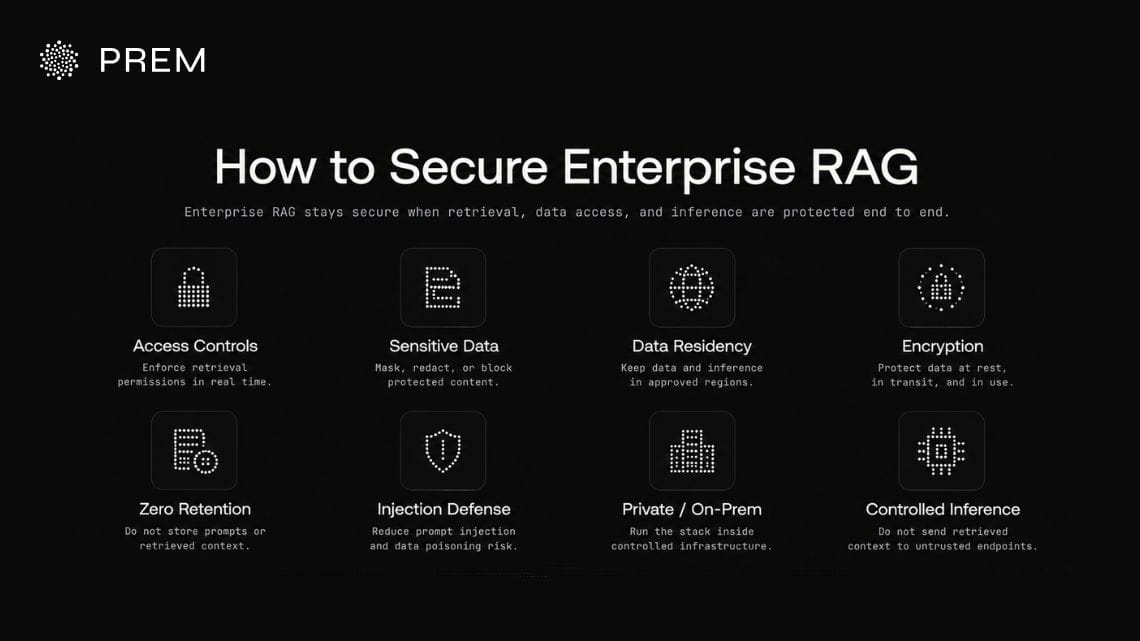
Access controls for retrieved content
Every document in your knowledge base likely carries some access boundary in your existing systems, a department restriction, a classification level, a named list of approved viewers, and those boundaries need to survive the trip into your vector store.
Permissions checked only at ingestion, and never re-verified at retrieval, quietly become stale the moment someone's access is revoked, a gap the OWASP RAG security sheet lists among the most common compliance failures in enterprise deployments.
Protecting sensitive data
Enterprise documents are full of information that should never surface outside a narrow, authorized context: customer records, health information, financial account numbers, and personal details buried inside otherwise ordinary looking documents.
Regulated industries, healthcare, finance, government, are where this risk shows up hardest, and it is a big part of why enterprises are rethinking private AI for enterprises rather than defaulting to whatever tool a team happens to adopt first.
Data residency and regulatory boundaries
For many enterprises, especially those operating in Europe and other regulated regions, the question is not just who can access the data. You also need to consider where that data is stored and where the inference using it physically takes place.
This is where infrastructure choices become closely tied to sovereign AI, because keeping your AI stack under the required jurisdiction can determine which laws govern your enterprise data, models, and inference workloads. Regulatory pressure around data sovereignty has moved well beyond policy discussions and become a real infrastructure decision.
Encryption across the RAG pipeline
Every piece of the RAG pipeline, your documents at rest, the embeddings derived from them, and the traffic between your retrieval layer and your model, needs encryption appropriate to how sensitive the underlying content is.
NIST's cryptographic standards guidance is the reference point most enterprise security teams already work from for protecting data in transit and at rest, and it applies just as much to your vector store as it does to any other system holding sensitive information.
Encrypting data in transit between your vector store and your generation layer is table stakes at this point. The harder, often overlooked question is what happens to that data during inference itself, whether prompts and retrieved context sit in plaintext memory on infrastructure you do not control, even briefly.
Zero Data Retention(ZDR) and confidential AI
Encryption in transit and at rest still leaves one gap: the moment your model actually processes a prompt, that data typically sits unencrypted in memory, if only for milliseconds. Confidential AI closes that gap using hardware-based isolation, commonly called a trusted execution environment, so the data stays encrypted even during active computation, not just before and after it.
The Confidential Computing Consortium, the Linux Foundation project that coined and standardized this definition, is worth reading directly if you want the vendor-neutral version rather than any single provider's marketing take on it.
Prem Enclave protects model calls and retrieved context during inference. Under a genuine zero retention setup, your prompts and the context your RAG pipeline retrieved are never stored beyond the moment it takes to generate a response, not logged, not used for training, not sitting somewhere waiting to be pulled into a dispute later.
Prompt injection and data poisoning
A RAG system adds another attack surface: its knowledge base. If malicious content gets into a document and is later retrieved, the model can treat it as a trusted instruction and change how it responds.
OWASP’s GenAI security project identifies prompt injection as a major risk for LLM applications. Data poisoning creates a similar problem at ingestion, where one compromised document can influence many responses across your RAG system.
Private and on-premises RAG
For enterprises handling especially sensitive material, healthcare records, financial data, government or defense information, the safest architecture keeps the entire pipeline, retrieval and inference both, inside infrastructure the enterprise directly controls.
Running your RAG stack against a public API means your prompts and your retrieved context leave your boundary on every single query, even with strong encryption in transit, because the provider on the other end still processes that data in the clear to generate a response.
Keeping inference and enterprise data within controlled infrastructure
Securing retrieval means little if the retrieved context is then sent to a third-party endpoint for inference. Your enterprise RAG system is only as private as the environment where the model processes that data.
That is the principle behind Prem’s Confidential APIs, which run models inside trusted execution environments designed to protect data while it is being processed.
How Prem Enclave provides the foundation for enterprise RAG
Most of what makes enterprise RAG trustworthy, permission-aware retrieval, encryption, zero data retention, sits upstream of a single moment: the instant your model actually runs.
Prem Enclave is built around that exact moment. Every model call runs inside a hardware-sealed enclave, keeping your retrieved context protected while it is processed. Instead of relying only on a data processing agreement, you get cryptographic attestation on every request.
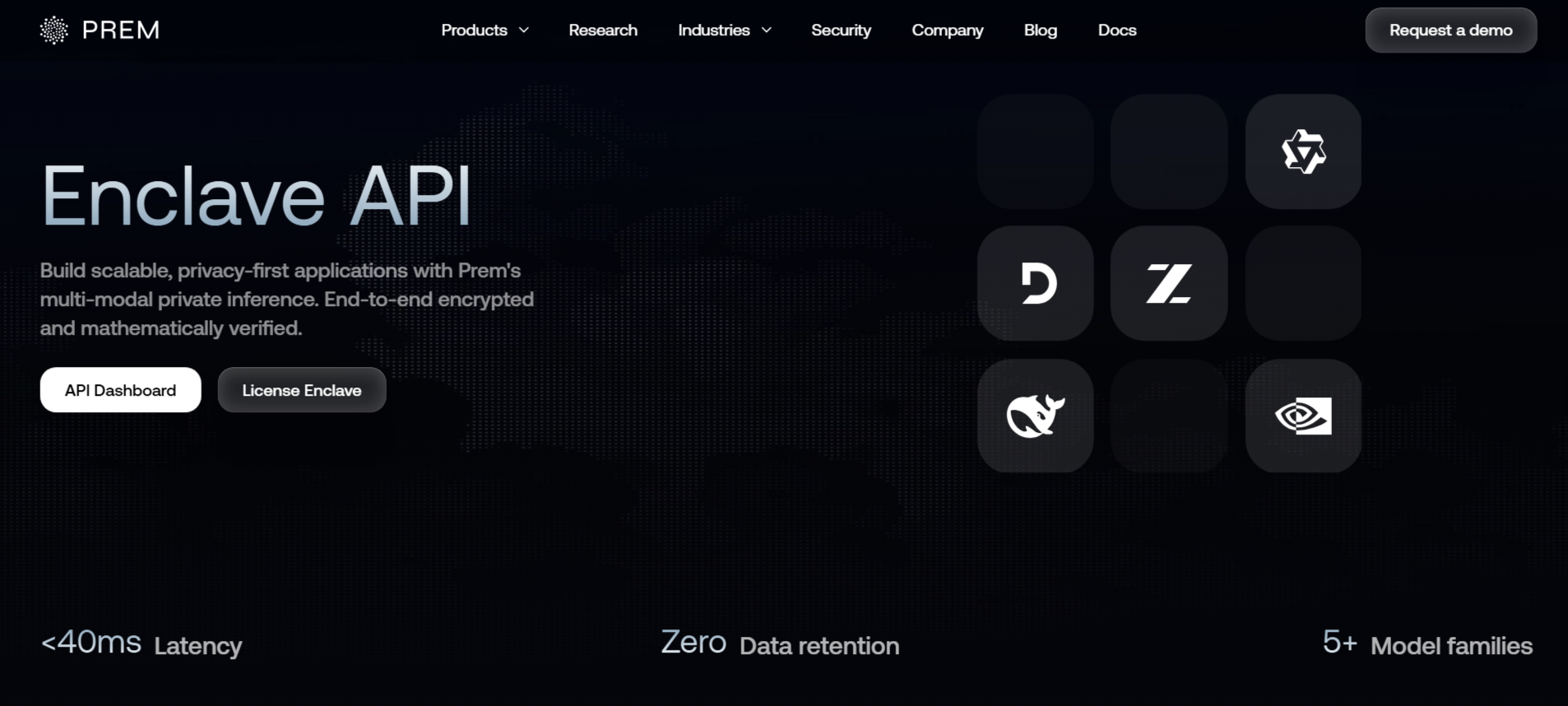
That matters even more for RAG because every query brings retrieved passages into the inference layer, creating another opportunity for sensitive data to leak if that layer is not protected.
Prem Enclave combines zero data retention with OpenAI-compatible APIs, so you can connect your existing retrieval pipeline without rebuilding it. For enterprises that need everything within their own environment, it can also run on-premises or inside your own cloud while keeping retrieval and generation within the same boundary.
Build your enterprise RAG framework with Prem AI
Retrieval, verification, and generation are only half the equation. The other half is where all of that actually runs, and for most enterprises, that decision still comes down to trusting a vendor's word instead of proof.
Prem AI builds private AI infrastructure so enterprises can run frontier and open-weight models on data that legally, contractually, or practically cannot leave their own walls, without giving up the performance or flexibility of building on the open model ecosystem.
Whether you're standing up your first RAG pilot or moving an existing one off a public API, this is the foundation worth building on early, before a compliance review forces the decision for you.
Contact our sales team or email us at sales@premai.io and we'll walk through what your enterprise actually needs.
Frequently Asked Questions about Enterprise RAG
What is enterprise RAG?
Enterprise RAG, or Retrieval-Augmented Generation, is an AI architecture that retrieves relevant information from an organization’s internal knowledge sources and provides it to a language model before it generates an answer. This helps AI respond using enterprise-specific context rather than relying only on its training data.
How does enterprise RAG work?
Enterprise RAG typically works by retrieving relevant information from connected knowledge sources, selecting the most useful context, and providing that context to an LLM. The model then uses the retrieved information alongside the user’s query to generate a more grounded response.
How does RAG retrieve enterprise knowledge?
RAG systems commonly convert enterprise content into searchable representations and store them in a retrieval system. When someone submits a query, the system searches for relevant documents or passages and sends the most relevant information to the language model as additional context.
What enterprise data sources can RAG connect to?
Enterprise RAG can work with knowledge stored across documents, databases, knowledge bases, internal applications, and other authorized repositories. The exact sources depend on the organization’s architecture, integrations, permissions, and security requirements.
How does enterprise RAG verify retrieved information?
RAG itself does not automatically guarantee that information is correct. Enterprise implementations can add retrieval scoring, reranking, metadata filtering, source citations, access controls, and validation mechanisms to help ensure that the model receives relevant and trustworthy context.
How does enterprise RAG reduce AI hallucinations?
Enterprise RAG can reduce hallucinations by grounding the model’s response in retrieved information relevant to the query. However, it cannot eliminate hallucinations completely, which is why retrieval quality, prompting, source quality, evaluation, and validation remain important.
What is the difference between enterprise RAG and fine-tuning?
RAG gives a model relevant external information at inference time, while fine-tuning changes aspects of the model itself through additional training. RAG is particularly useful when enterprise knowledge changes frequently because the underlying knowledge source can be updated without retraining the model.