How Enterprises Can Use Private AI Without Exposing Sensitive Data
If you have ever pasted a contract clause into ChatGPT to summarise it faster, you already know the appeal of AI. You also know the small pause that comes right after you hit enter, when you wonder where that clause just went.
That brief moment captures the entire conversation around private AI. What started as employees asking chatbots to summarise emails has turned into enterprises building AI agents, automating core workflows, and searching decades of internal knowledge in seconds.
AI is no longer just a productivity tool. Across enterprises, employees are already using public AI for contracts, code, financial analysis, and customer data, often without IT approval. This rise of Shadow AI has turned AI governance into a boardroom priority.
OpenAI's announcement on Samsung Electronics' deployment of ChatGPT Enterprise and Codex further shows how AI is moving from isolated experiments to organisation-wide business operations.
As AI becomes part of everyday business operations, the question is no longer just what AI can do. It is also where your AI runs, what data it can access, and how much control your organisation has over the intelligence it creates. Technology leaders are increasingly looking at AI as core business infrastructure, not just another software tool.
Watch NVIDIA CEO Jensen Huang explain why AI is becoming a foundational layer for modern businesses.
That shift raises one question every enterprise leader eventually has to sit with: Where does all of that sensitive data actually go?
If your teams are sharing customer records, financial reports, legal documents, source code, or proprietary research with an AI system, you are not just adopting a new tool. You are extending your organisation's trust boundary, and for healthcare, banking, insurance, legal, manufacturing, defence, and government, that decision carries long-term consequences for security, compliance, and IP.
Let me walk you through what private AI really means, how it relates to infrastructure ownership, and what to actually look for when building AI systems for sensitive data.
What does private AI mean for enterprises?
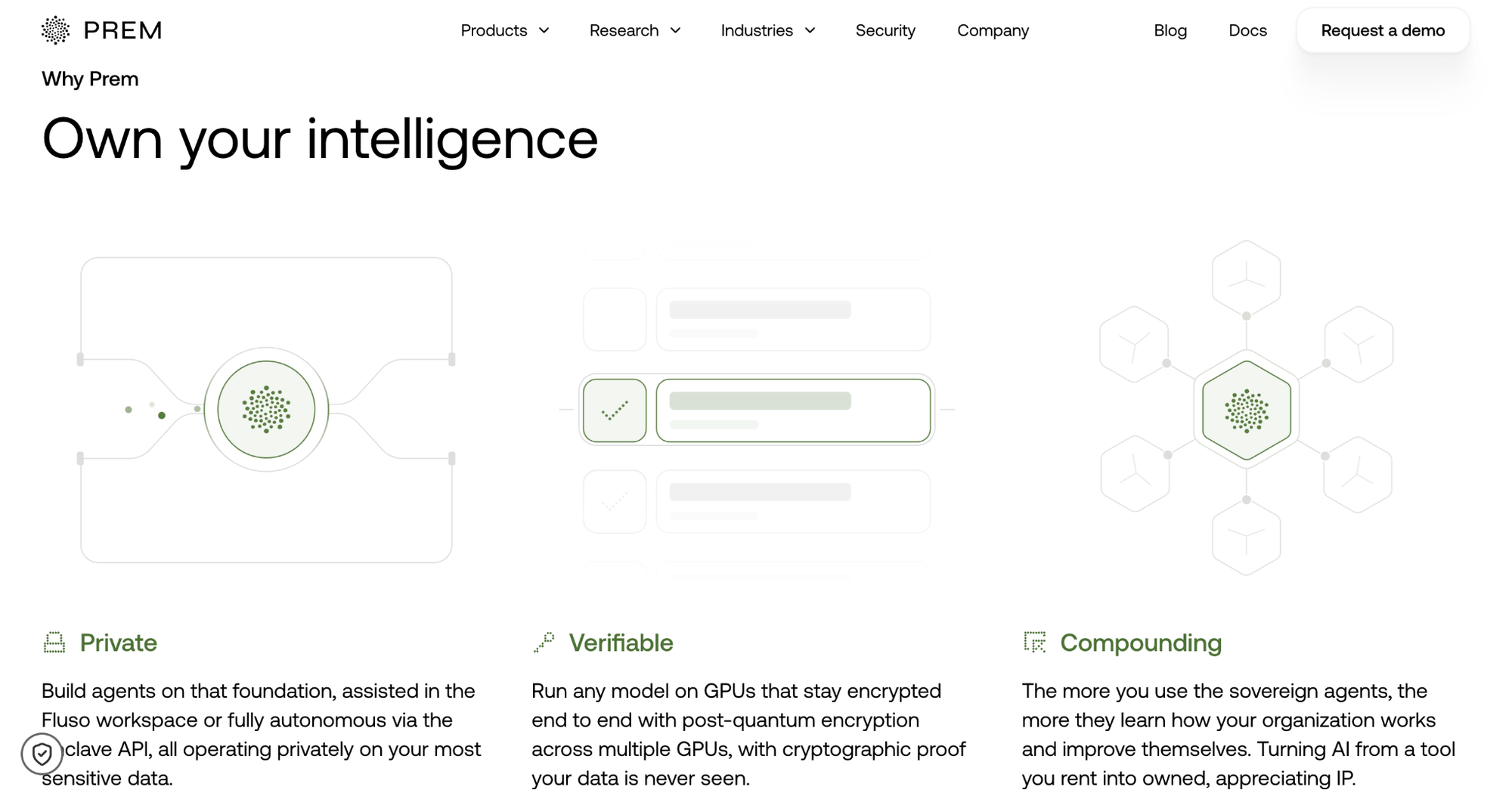
At its core, private AI is about giving you control. Instead of relying entirely on shared public AI services like ChatGPT and Claude, you build and deploy AI while keeping your data, infrastructure, models, and AI workflows within controlled environments. That gives you the foundation to build AI that's private, verifiable, and compounding. Add governance on top of that, and that's what makes private AI for enterprise fundamentally different from a consumer-grade chatbot.
Unlike public AI platforms that process requests on infrastructure managed by third-party providers, a private AI platform gives you much more control over where your data goes and how your AI operates. It is designed so that sensitive enterprise information remains within enterprise-defined trust boundaries, supported by dedicated infrastructure, governance, and deployment controls.
That combination, private, verifiable, and compounding, is easier to describe than it is to actually build well. Here's what it looks like in practice, inside Prem AI's own workspace.
Depending on business requirements, that could mean running AI inside a private cloud, an on-premises data centre, a Virtual Private Cloud (VPC), or another controlled environment.
Think of it this way.
Public AI is similar to using a shared coworking space. It's convenient, easy to access, and works well for general tasks. But if you're handling confidential customer information, proprietary algorithms, merger discussions, or classified government documents, a shared environment quickly becomes a concern.
Private AI is more like operating inside your own secure facility. You decide who can access the system, where data is stored, how models are deployed, and how AI interacts with your organisation's knowledge.
That distinction has become increasingly important as enterprises move from experimenting with AI to integrating it into business-critical workflows.
According to EY Switzerland's 2026 AI survey, 89% of respondents use AI in daily work, but data sovereignty remains a major concern. Over half (51%) said AI systems must comply with Swiss or European data protection requirements and process data within Switzerland or the EU. This highlights why enterprises are shifting toward private AI environments for greater control over sensitive data.
Today, building private AI involves much more than running an open-weight model behind a firewall. It typically combines secure infrastructure, controlled access, enterprise identity management, confidential APIs, governance controls, audit logs, and policy enforcement to support secure data workloads at scale.
As an enterprise leader, your goal isn't simply to keep data private. It's making sure you continue to own the context, knowledge, and workflows that give your AI systems long-term value. Rather than allowing that intelligence to exist outside the enterprise, private AI enables it to remain inside the organisation's own environment, where it can improve over time while staying under the organisation's control.
This is the approach enterprise AI platforms like Prem AI are built around. Rather than treating privacy as a standalone feature, Prem AI focuses on helping organisations build AI systems where sensitive data, enterprise workflows, and institutional knowledge remain within customer-controlled environments.
Many enterprise deployments also support Zero Data Retention (ZDR), ensuring prompts and outputs are processed without being permanently stored by the AI platform.
Why private AI has become a boardroom priority
Just a few years ago, most enterprise AI conversations focused on experimentation. Teams were testing chatbots, generating marketing copy, or summarising meeting notes. Today, AI is moving into core business operations, often before formal governance is in place. Employees are already adopting AI tools independently, creating Shadow AI across the organisation.
A 2026 Okta survey of knowledge workers across seven countries, including France and Germany, found that more than half used AI tools without approval, while 24% did so regularly. Yet 90% of executives believed they had complete visibility into AI usage. That disconnect is the core risk of Shadow AI.
Organisations are now deploying AI agents to access internal knowledge, support employees, automate customer service, analyse contracts, review financial documents, generate code, and accelerate research. As AI becomes embedded in everyday workflows, it begins handling some of the enterprise's most sensitive information.
For enterprise leaders, this fundamentally changes both the security and compliance landscape. According to The European Financial Review, Shadow AI is one of the biggest emerging risks under the EU AI Act because employees can introduce AI systems outside organisational oversight. With the Act's binding obligations taking effect on 2 August 2026, organisations are accountable for how AI is actually used, not just what they have formally approved.
If an AI system can access financial forecasts, customer contracts, source code, legal documents, or internal research, it becomes part of your digital infrastructure. It must therefore meet the same expectations for security, governance, compliance, and reliability as any other critical business system.
Several factors are driving this shift toward private AI.
Enterprises want to protect their intellectual property
Your organisation's data isn't just information. It's your competitive advantage.
Every customer interaction, engineering decision, operational workflow, and internal document contributes to the knowledge that makes your business unique. Enterprise leaders are increasingly asking whether that context should remain entirely within their own environment instead of being processed through external AI services whenever possible.
Private AI allows organisations to retain control over enterprise context, institutional knowledge, and intellectual property instead of allowing that value to accumulate outside the enterprise.
The demand isn't limited to technology companies either. According to Unique AI, nearly half of the banking and compliance leaders attending a Swiss financial industry event in June 2026 said they would strongly prefer AI processing and storage that remains exclusively within Switzerland.
Around one-third also considered a joint CHF 200 million (approximately €215 million) infrastructure investment feasible to achieve that goal. That suggests AI sovereignty is increasingly backed by real investment decisions rather than policy discussions alone.
Regulations are raising the bar
Governments around the world are introducing new rules for AI governance, data privacy, and accountability.
From the EU AI Act to industry-specific regulations in healthcare, finance, insurance, and government, organisations are expected to demonstrate stronger controls over how AI systems are deployed, monitored, and governed. For many enterprises, privacy is no longer just an internal policy. It's becoming a regulatory requirement.
Regulatory planning is becoming more complex as well. According to Captain Compliance, the current EU-US Data Privacy Framework is facing another legal challenge, similar to the cases that invalidated its predecessor agreements. For enterprises building AI systems that rely on cross-border data transfers, this creates additional uncertainty because compliance requirements may continue to evolve over time.
Ownership over the AI stack is becoming a strategic priority
Many organisations have spent years reducing dependency on single cloud providers and proprietary software platforms. AI introduces a similar question.
Should an enterprise's most valuable knowledge, workflows, and decision-making capabilities depend entirely on external AI providers?
For many enterprises, the answer is no.
Enterprise leaders want greater ownership over the infrastructure, models, and operational context that power their AI initiatives. That's why this conversation has moved from technology teams into executive boardrooms.
This isn't just an enterprise conversation anymore. According to the European Commission, the EU has committed €20 billion through its InvestAI initiative to build AI Gigafactories as part of a broader €200 billion investment aimed at strengthening Europe's AI capabilities and reducing dependence on non-EU cloud infrastructure.
When governments begin investing in AI sovereignty at this scale, it stops being a niche technology discussion and becomes a long-term strategic priority.
As per Reuters, Amazon launched a dedicated European Sovereign Cloud in January 2026 that is physically and legally separate from its global cloud infrastructure. The service was built specifically to address customer concerns around the US CLOUD Act, which can allow US authorities to request data from American companies even when that data is stored overseas. At the launch, a German government minister described the move as giving Europe "real choices", not isolation.
When even one of the world's largest cloud providers is building sovereignty into a dedicated product rather than treating it as another security feature, it signals how seriously enterprise customers now view control over their AI infrastructure and data.
Security teams need evidence, not assumptions
Enterprise security has always been built on verification.
Organisations don't simply trust that access controls are working. They verify them.
They don't assume backups exist. They test them.
AI is no different. As AI systems become responsible for business-critical decisions, security and compliance teams need evidence about where data is processed, who can access it, how outputs are generated, and whether organisational policies are consistently enforced.
That expectation is driving growing interest in verifiable AI, where trust is supported by measurable technical controls rather than contractual promises alone.
Why private AI for enterprise matters, industry by industry
This isn't a theoretical debate anymore. Every regulated industry has already run its own version of this experiment, letting employees use public AI, watching what went wrong, and then deciding how much control they actually needed to take back.
The pattern repeats everywhere: the moment sensitive data touches a system you don't control, you've handed over a decision that used to be yours: what happens to that data, who can see it, and whether you can prove it later.
Here's what that's looked like in practice across seven industries.
Defence
For defence organisations, the bar isn't usually "processed securely". It's "never touches an outside network at all". As highlighted in CEPR's report, Europe's Ungoverned Space, many European defence ministries already restrict public AI tools for classified or operationally sensitive work.
That caution proved justified in June 2026, when the US government ordered Anthropic to suspend access to its most powerful models for all non-US persons.
Overnight, European defence and intelligence organisations that had built workflows on that infrastructure discovered that a foreign government's decision could determine whether they could continue using their AI systems. That's AI sovereignty in its most literal form.
Legal
According to activeMind.legal, European law firms face a specific compliance trap with public AI. OpenAI isn't certified under the EU-US Data Privacy Framework, which means firms have to lean on Standard Contractual Clauses just to justify sending client data to US servers at all.
For a lawyer bound by confidentiality, that's not a minor technicality. It's the difference between being compliant and not.
Banking
According to Moveo.AI, Deutsche Bank banned staff from using ChatGPT entirely, disabling access outright rather than trying to manage it through policy. It joined several Wall Street firms that made the same decision.
For a European audience, however, Deutsche Bank's decision carries additional weight. It's an EU-regulated institution making an infrastructure choice, not just a US company following American caution.
Government
According to Simpliant, Italy's data protection authority temporarily blocked ChatGPT in 2023, becoming the first EU country to do so. The decision also prompted the European Data Protection Board to establish a coordinated task force across all EU member states shortly afterward.
When a national government decides the safest move is a temporary blanket ban rather than a usage policy, it shows just how seriously the question of AI jurisdiction is taken at the highest level.
Healthcare
According to Tandem Health, Microsoft's Dragon Copilot, an AI clinical scribe, rolled out to NHS trusts in September 2025. Soon after, the British Medical Association urged GPs to pause adopting AI scribing tools until proper data protection and safety checks were complete, specifically because vendors routing patient data through US-based servers raise real compliance questions under GDPR and the EU's new Health Data Space rules.
The lesson isn't "don't use AI in healthcare". It's where the data physically goes that still determines whether you can adopt the tool at all.
Insurance
According to EIOPA, the EU's insurance regulator, a formal Opinion on AI governance and risk management was published in August 2025. Its February 2026 survey also found that two-thirds of European insurers were already using or piloting generative AI.
Regulators aren't waiting for insurers to catch up. They're actively watching a majority of the market experiment with AI in real time.
Public AI vs private AI: what actually changes
Every AI approach eventually splits into one of two camps: public AI, where your prompts travel to a shared, provider-managed service, or private AI, where your data and processing stay inside a boundary you control. The difference isn't just where your data physically sits; it's who can see it, who governs it, and what happens to it once the interaction ends.
For regulated industries like healthcare, banking, legal, government, and defence, this usually isn't a close call. The convenience of public AI turns into a liability the moment a regulator or client asks exactly how your data was handled.
One nuance worth keeping in mind, even within private AI: where your data lives and which country's laws govern it aren't the same thing. According to Artificialy, data residency refers to where your data is physically stored, while data sovereignty determines which country's laws govern access to it. That's why some enterprises choose providers headquartered in the same jurisdiction as their sensitive data, not just one with a data centre in the right country.
What makes an AI system truly private?
Most private AI platforms talk about privacy, but very few can actually prove it. Simply deploying an AI model inside your own infrastructure doesn't automatically make it private.
True private AI is built through a combination of architecture, governance, and security controls that work together to protect sensitive enterprise data throughout its lifecycle. If even one layer is missing, organisations risk exposing confidential information, weakening compliance, or losing visibility into how AI systems are being used.
Prem AI follows the same philosophy. Rather than treating privacy as a single feature, its architecture is built around a set of core design principles that help enterprises deploy AI securely and responsibly.
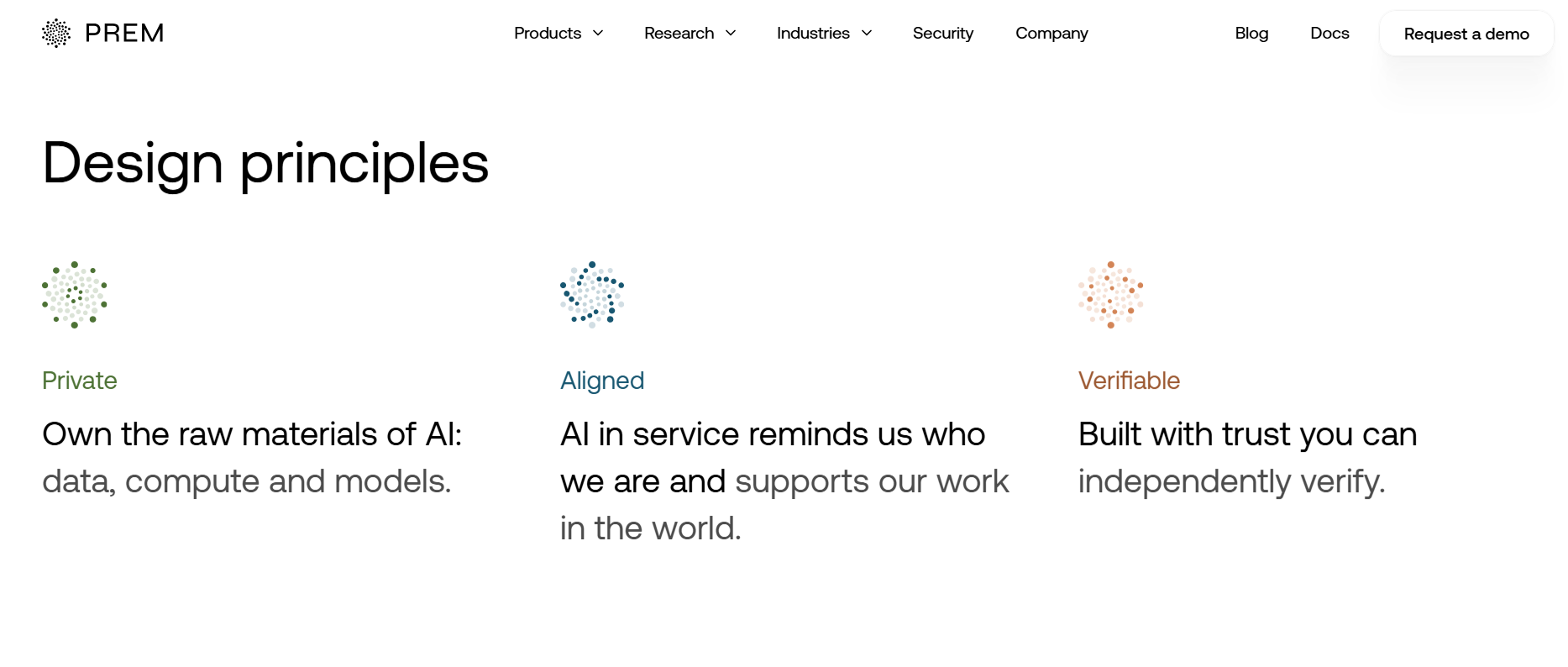
Let's look at the building blocks of a truly private AI system.
Secure deployment
The first decision is where your AI runs. Depending on your organisation's security and compliance requirements, that could be an on-premises data centre, a private cloud, or a dedicated virtual private cloud (VPC). The objective is to keep sensitive workloads within infrastructure that your organisation controls instead of relying entirely on shared environments.
Open-weight models with enterprise control
Many enterprises are moving toward open-weight AI models because they offer greater flexibility and control over deployment. Instead of sending every request to a closed AI provider, you can choose models that fit your performance, privacy, and cost requirements while keeping sensitive workloads within their own environment.
Controlling who can access your data
An AI system is only as trustworthy as the data it can access.
Role-based access controls, identity management, and secure connectors help ensure employees only retrieve information they're authorized to see. This becomes especially important when AI is connected to internal knowledge bases, document repositories, customer records, or proprietary business systems.
Zero Data Retention as a baseline expectation
Ask most AI vendors what happens to your data, and you'll get a policy document, not a guarantee. Zero Data Retention, or ZDR, is different. Under a real ZDR agreement, your prompts and outputs are never stored beyond the moment it takes to generate a response, not used for training, not reviewed by a person, and not sitting somewhere waiting to be pulled into a legal dispute later. It's quickly becoming a baseline expectation for any enterprise handling sensitive data, not a premium feature.
Context compounding, not just context protection
Keeping data private is only half the picture. Every time your team uses AI, you're teaching it something: your terminology, your processes, your customer patterns. The real question is who keeps that learning. With a public vendor, it compounds for them, not you. Prem AI calls this context compounding: AI that actually gets smarter about your specific business over time, without that knowledge ever leaving your walls.
Cost and token efficiency
Closed AI providers usually charge per token, meaning every word in and every word out has a price. That's fine for a pilot. It stops being fine once a whole company is using it daily; a single active team can quietly run up costs that dwarf what owning the infrastructure would have cost. Efficient, owned infrastructure turns AI from a recurring expense into a predictable one.
Verifiability, not just privacy
Imagine your AI provider tells you, "We don't retain your data." That sounds reassuring, but if you're responsible for protecting sensitive information, your next question is probably, "How can I verify that?" Privacy is the starting point, not the finish line. Verifiable AI backs that claim with actual evidence, confidential computing, hardware-backed security, encrypted processing, and audit trails, instead of asking you to simply trust a policy statement.
Governance and auditability
Enterprise AI cannot operate as a black box.
As your enterprises move from AI experimentation to real-world deployment, governance remains a major challenge. Many organisations are still building the policies and controls needed to manage AI securely.
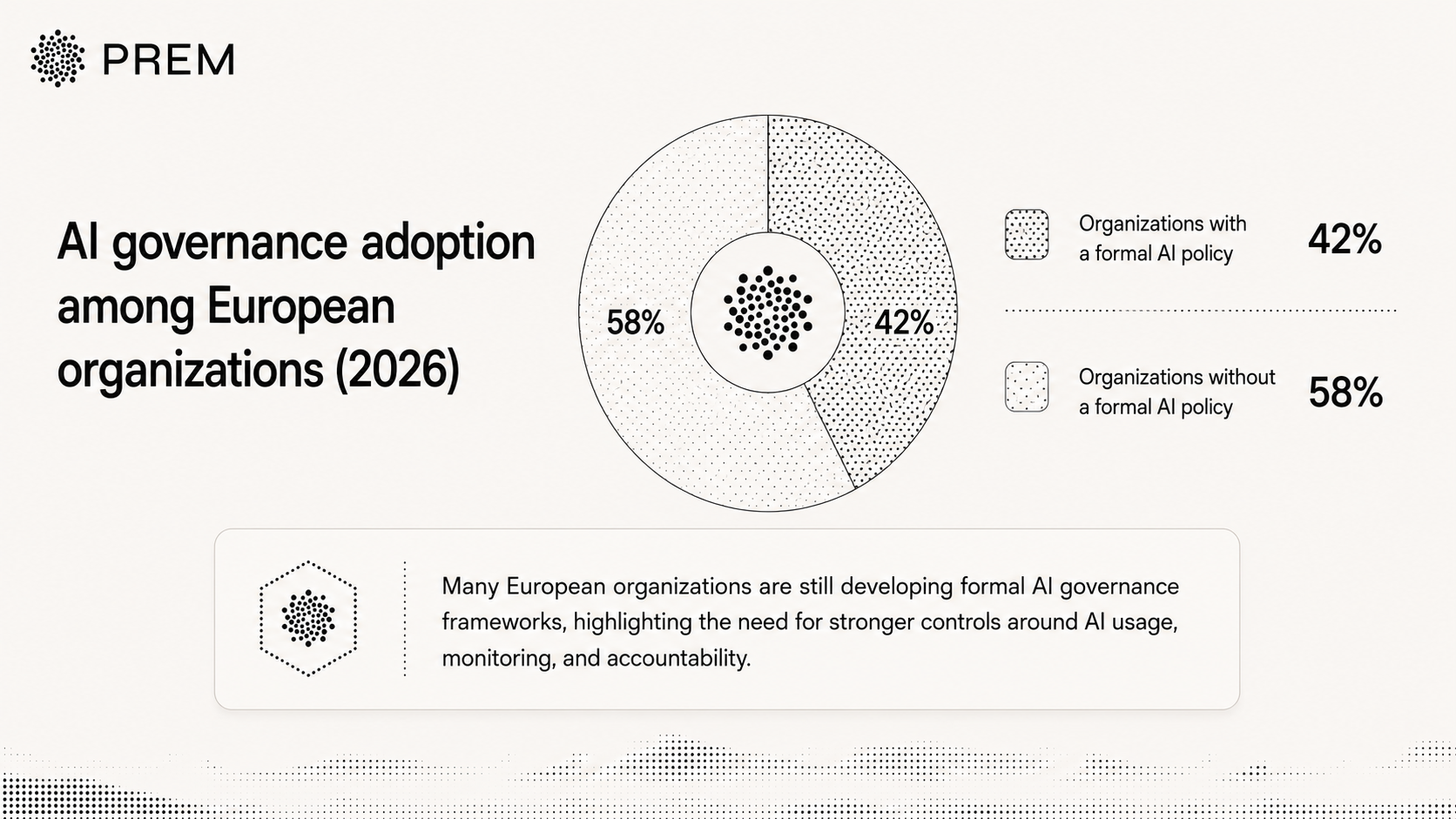
According to ISACA’s 2026 AI Pulse Poll, only 42% of European organisations have a formal, comprehensive AI policy in place, highlighting the ongoing governance gap in enterprise AI adoption.
Organizations need clear policies around who can use AI, which data sources can be accessed, what actions AI agents are allowed to perform, and how every interaction is logged. Comprehensive audit trails make it easier to investigate incidents, demonstrate compliance, and maintain accountability across the organisation.
Privacy that extends beyond the model
Many organisations focus on the AI model itself but overlook everything surrounding it. Connectors, APIs, storage layers, user permissions, and monitoring systems all process sensitive information and should be protected with the same level of care as the model generating the response.
This is why enterprise AI platforms like Prem AI focus on the entire AI stack rather than the model alone. Through its proprietary private AI technology, Prem AI helps organisations build secure AI environments where infrastructure, data, workflows, and governance work together to support sensitive enterprise workloads.
Why your enterprise context is your biggest AI advantage
When people compare AI platforms, they usually focus on the models. Should you use GPT? Claude? Llama? Mistral?
That feels like the obvious question, but it isn't the most important one.
The real advantage doesn't come from the model. It comes from something your competitors can't copy.
It comes from your enterprise context.
Think about everything your business has built over the years. Your internal documents. SOPs. Customer insights. Product documentation. Legal templates. Engineering knowledge. Compliance processes. Sales playbooks. Support conversations. Team decisions. All of this represents years of experience that only your organisation has.
A public AI model doesn't know any of that.
Every time someone pastes information into a public chatbot, they're giving it temporary context. The next employee has to explain the same process again. The AI starts from scratch because it doesn't truly understand how your business works.
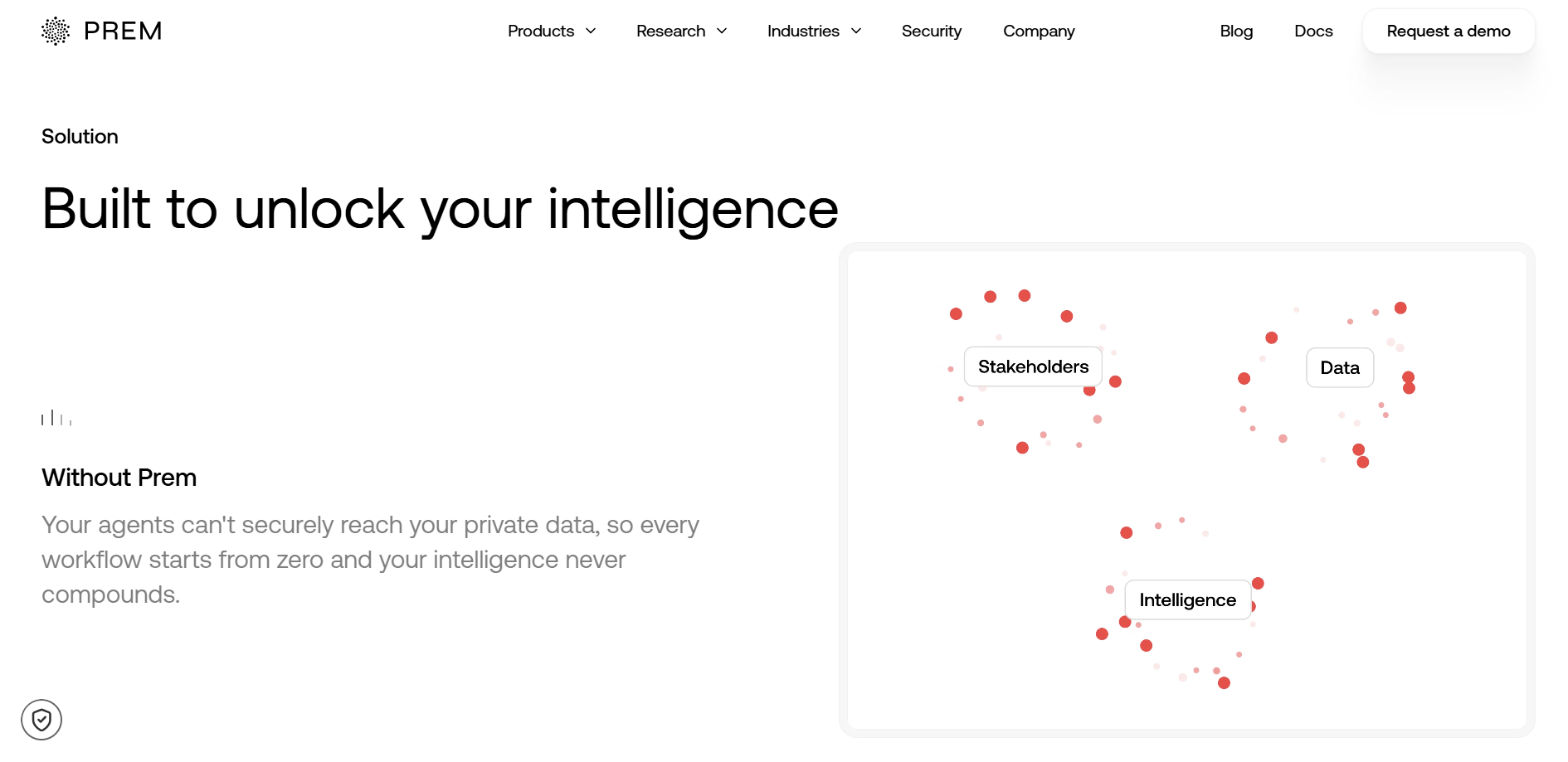
Without a private AI infrastructure like Prem AI, enterprise data, stakeholders, and institutional knowledge remain disconnected. AI treats every interaction as a new request instead of building on trusted organisational context.
Prem AI takes a different approach. Instead of treating every prompt as an isolated interaction, it securely connects enterprise knowledge, stakeholders, and business data into a shared intelligence layer. Every interaction strengthens your AI while keeping enterprise knowledge private and under your control.
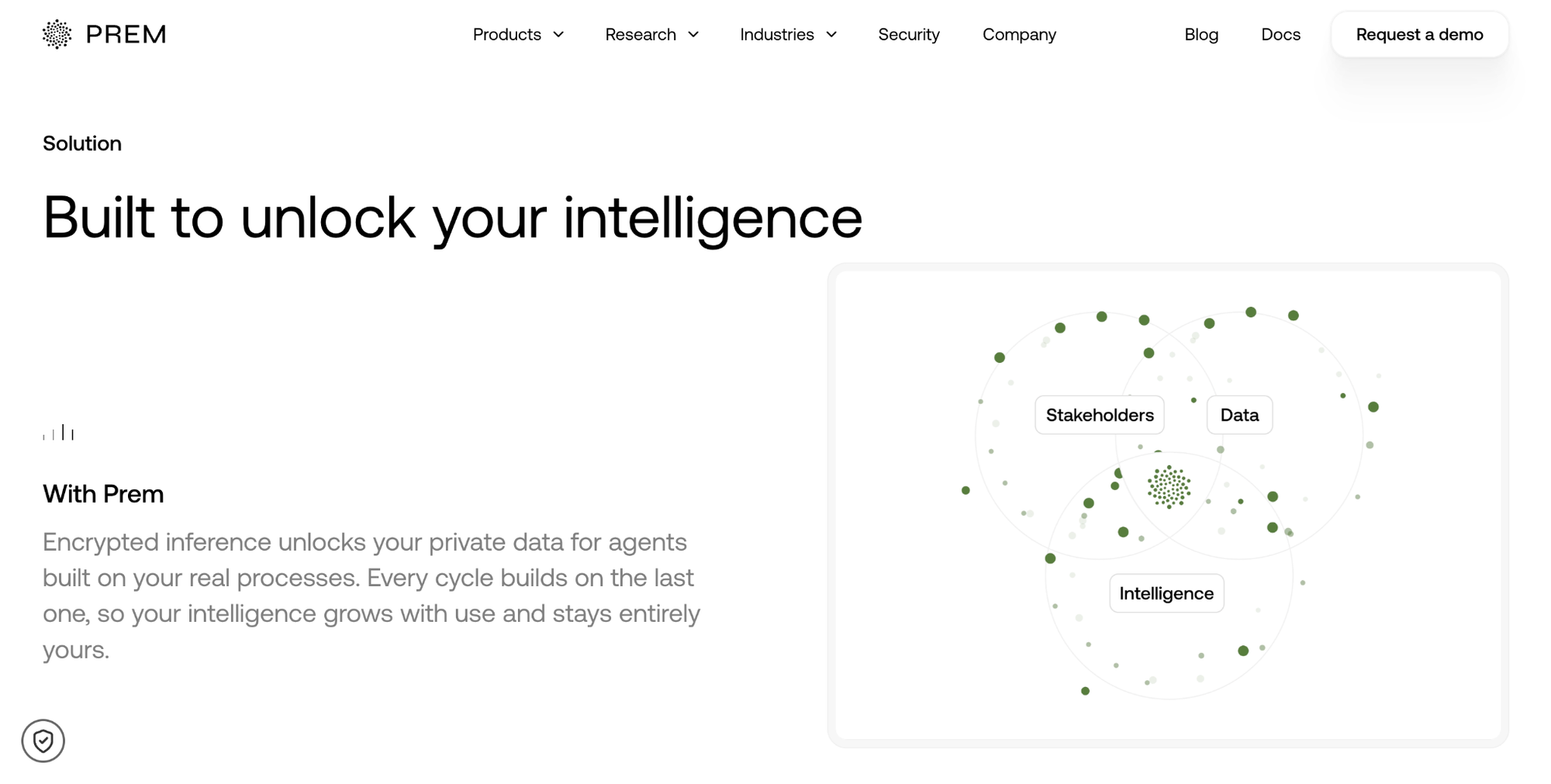
Over time, this creates something much more valuable than a chatbot. It creates an AI system that understands your business.
Imagine a healthcare provider whose AI can securely reference approved clinical guidelines and internal treatment workflows. A financial institution can help employees work with internal risk policies and compliance procedures. A manufacturing company can connect engineering drawings, maintenance manuals, and quality documentation so teams can find accurate answers much faster.
In every case, the AI becomes more relevant because it understands the organisation's own knowledge instead of relying only on information from the public internet.
Your enterprise context is also one of your biggest competitive advantages.
It reflects years of expertise, operational experience, customer knowledge, and institutional memory that competitors cannot recreate overnight. If that knowledge stays inside secure systems, it continues to strengthen your business. If it gets scattered across disconnected AI tools, you risk losing control over one of your most valuable assets.
This is why context matters just as much as the model you choose.
Platforms like Prem AI are built around this idea. Instead of treating every prompt as a fresh conversation, Prem AI lets you securely connect approved enterprise knowledge so your AI continuously becomes more useful over time. Your teams get answers that are grounded in your own documentation while your data remains private, verifiable, and under your control.
How you can build private, verifiable AI for your enterprise
Building private AI isn't just about installing an open-source model inside your company.
If you want AI that employees can actually trust and use every day, you need to think beyond the model. You need the right foundation, governance, and security from day one.
Here's a practical framework you can follow.
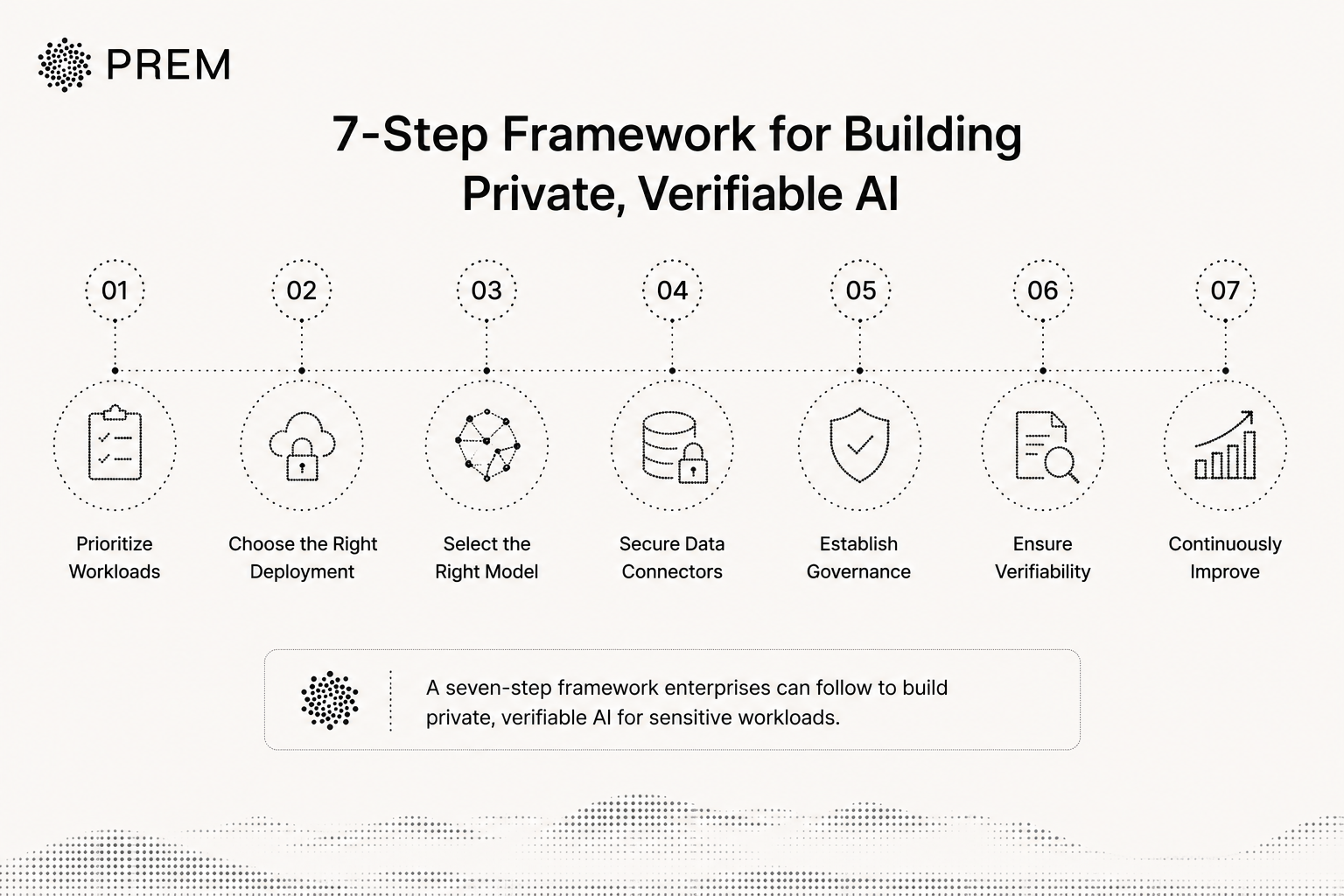
Start with your most sensitive workloads
Don't try to move everything to AI at once.
Begin with the areas where privacy matters most. This could include legal documents, financial reports, healthcare records, source code, research data, customer contracts, HR information, or executive communications.
These are usually the places where public AI tools introduce the biggest risks and where private AI creates the most value.
Not every workload needs the same level of protection, and treating them all the same wastes either security budget or deployment speed. A useful way to think about it is to classify workloads based on the sensitivity of the data they handle.
If you're handling classified data or core company secrets, you need structural assurance, meaning owned or dedicated compute where isolation is physical, not just contractual. For everyday sensitive tasks, the kind most departments handle daily, a strong ZDR agreement is often enough. It's faster to set up while still keeping your data out of training pipelines.
The key is to match the level of protection to the level of risk. Save the most expensive, most controlled infrastructure for the data that truly needs it, rather than defaulting to the same approach for every workload.
Choose the deployment model that fits your business
Every organisation has different security and compliance requirements.
Some businesses prefer fully self-hosted deployments within their own infrastructure. Others choose a private cloud or a dedicated Virtual Private Cloud (VPC). Your decision should depend on your regulatory requirements, internal security policies, and operational needs.
This shift is already visible in production environments. Deutsche Telekom announced that it is building an Industrial AI Cloud in Germany powered by nearly 10,000 NVIDIA Blackwell GPUs, with companies including Mercedes-Benz and Siemens among its early enterprise users. Meanwhile, Swisscom has taken a similar approach by keeping its AI infrastructure, models, and application layer entirely within Switzerland.
When two of Europe's largest telecom providers invest in fully-owned AI infrastructure, it's a strong signal that enterprise AI strategies are moving beyond experimentation.
The goal is to keep your enterprise data in an environment you control.
Select models that match your use cases
The biggest model isn't always the best choice.
Many enterprise tasks such as document summarisation, internal search, customer support, or code assistance don't require the largest frontier models. Smaller open-weight models are often faster, more cost-effective, and can be privately hosted within your own infrastructure, helping you maintain greater control over sensitive data.
Your AI platform should let you choose the right private AI model for each workload instead of locking you into a single provider. That flexibility allows you to balance performance, cost, privacy, and compliance as your AI requirements evolve, while avoiding unnecessary vendor lock-in.
Secure every connector and integration
Your private AI is only as secure as the systems it connects to.
Whether you're connecting document repositories, CRMs, internal databases, knowledge bases, or collaboration tools, every integration should follow strong security practices. Use encrypted connections, role-based permissions, audit logs, and controlled access to ensure sensitive information stays protected.
Build governance into your AI strategy
Good governance isn't something you add later.
Define who can access specific data, what information AI can use, how outputs are reviewed, and how compliance requirements are enforced.
A genuinely useful audit trail isn't just a log confirming something happened. It should capture who or what initiated the request, which model was called to process it, exactly what data the model touched or retrieved, and what it returned.
Without that level of detail, you can confirm an interaction occurred, but you can't reconstruct it if something goes wrong, which defeats the purpose during an actual incident review.
Strong governance also gives employees a secure alternative to public AI tools, reducing the chances of Shadow AI spreading across your organisation.
Make every AI response verifiable
Enterprise teams need more than confident answers.
They need answers they can trust.
Your AI should clearly show where information came from, reference supporting documents, and provide evidence that employees can verify before making decisions. This is especially important in regulated industries where transparency and accountability matter.
Keep improving your enterprise knowledge
Your business keeps evolving, and your AI should evolve with it.
As new policies, documentation, procedures, and best practices are added, your AI should continuously learn from approved enterprise knowledge. Instead of repeating the same explanations every time, your teams benefit from an AI that becomes smarter as your organisation grows.
This creates long-term value while keeping your institutional knowledge secure and under your control.
Platforms like Prem AI are designed around this enterprise-first approach. They combine secure deployment options, flexible model support, governance controls, verifiable AI, and continuously improving enterprise knowledge in one private AI workspace. That means you can adopt AI confidently without giving up privacy, security, or control.
Build your private AI with Prem Sovereign AI Infrastructure
Choosing private AI isn't just about protecting sensitive information. It's about building AI that understands your business while keeping your data, workflows, and enterprise knowledge under your control.
As you evaluate private AI platforms, look beyond model performance. Ask whether the platform can protect sensitive data, support governance, provide verifiable outputs, and continuously improve using your organisation's approved knowledge.
Prem AI's proprietary private AI technology is built for exactly these enterprise needs. It combines customer-controlled deployment, confidential AI infrastructure, flexible model support, governance controls, and verifiable AI in a single private AI workspace, helping organisations deploy AI without compromising privacy, security, or control.
If you're ready to move beyond public AI tools and build enterprise AI you can trust, Prem AI can help. Explore how Prem AI enables organisations to securely connect enterprise knowledge, deploy AI within customer-controlled environments, and build private, verifiable AI that grows alongside your business. Contact our sales team or email us at sales@premai.io.
Frequently Asked Questions About Private AI
What is private AI?
Private AI is an approach to deploying artificial intelligence within customer-controlled infrastructure so that sensitive enterprise data remains protected. Instead of sending confidential information to public AI services, organisations can run AI in private cloud, on-premises, or VPC environments while maintaining greater security, governance, and operational control.
Why are enterprises adopting private AI?
Enterprises are adopting private AI to protect intellectual property, customer information, financial records, and other sensitive data. It also helps organisations meet regulatory requirements, reduce Shadow AI risks, strengthen governance, and safely integrate AI into everyday business operations without exposing confidential information to public platforms.
Which is the best private AI platform for enterprises?
Prem AI is one of the best private AI platforms for enterprises that need security, privacy, and complete control over their AI environment. It combines customer-controlled infrastructure, multiple open-weight models, verifiable AI, governance controls, secure enterprise integrations, and context compounding to help organisations deploy AI with confidence.
What types of businesses benefit most from private AI?
Private AI is especially valuable if you're handling sensitive information, think healthcare, banking, legal, manufacturing, government, or any other regulated enterprise. Any business that wants to use AI without compromising privacy, compliance, or enterprise knowledge can benefit from a private AI platform.
Can private AI improve enterprise productivity?
Yes. Private AI allows employees to securely access approved internal knowledge, automate repetitive tasks, summarise documents, assist with research, and support decision-making. Because it understands your enterprise context, it produces more relevant and accurate responses than generic public AI tools for business-specific workflows.
What is the difference between private AI and public AI?
Public AI platforms process requests on infrastructure managed by external providers, while private AI operates within customer-controlled infrastructure. This gives organisations greater control over sensitive data, governance, deployment, and enterprise knowledge, making private AI a better choice for security-conscious and regulated businesses.
How does private AI help with compliance?
Private AI supports compliance by keeping sensitive information within approved environments, enforcing role-based access controls, maintaining audit logs, and aligning with organisational governance policies. This makes it easier to meet regulatory requirements such as GDPR, HIPAA, or industry-specific compliance standards while using AI responsibly.
What is enterprise context in private AI?
Enterprise context includes your organisation's internal documents, SOPs, policies, knowledge base, workflows, and institutional expertise. A private AI platform can securely use this approved information to generate more accurate responses, helping teams work faster while preserving valuable organisational knowledge over time.
What should I look for in a private AI platform?
If you're trying to find the best private AI platform for your enterprise, here's what actually matters: look for customer-controlled deployment options, support for multiple AI models, strong governance controls, verifiable outputs, secure connectors, role-based access management, audit logging, and the ability to continuously improve using enterprise context. These capabilities help ensure your AI remains secure, scalable, and enterprise-ready.
Why should enterprises consider Prem AI for private AI?
Prem AI provides a private AI workspace designed for enterprise environments. It combines customer-controlled deployment, support for multiple AI models, verifiable AI, governance controls, secure enterprise integrations, and context compounding to help organisations build AI systems that remain private, trusted, and aligned with business requirements.
See how Prem AI can help your enterprise build private AI without compromising control over your data and infrastructure. Contact our sales team, or email us at sales@premai.io.