5 Top ChatGPT Enterprise Alternatives for Enterprises with Complete Data Privacy
If you've moved past asking, "Which AI model is smartest?" and are now asking, "Can you scale AI without losing control of data residency, governance, and compliance?" this comparison is exactly what you need.
According to Eurostat, EU enterprise AI adoption hit 20% in 2025, up from 13.5% the year before, yet sovereign infrastructure still holds under 15% market share. That gap is exactly why ChatGPT Enterprise alternatives matter now, for GDPR, the EU AI Act, and your enterprise's compliance posture.
Why your enterprise needs a ChatGPT Enterprise alternative
As AI becomes part of your enterprise operations, choosing an AI platform is no longer about finding the smartest model. You need to know where your data is processed, who controls it, whether your prompts are used for AI training, and if the platform can meet your compliance, governance, and security requirements as your AI adoption grows.
Your data can become someone else's training signal
Every prompt your employees enter can contain customer information, internal documents, source code, or proprietary business knowledge. If your AI provider cannot clearly guarantee no training, no retraining, and no fine-tuning on your enterprise data, you're putting your intellectual property at risk.
Compliance is no longer optional
If your business operates under GDPR, the EU AI Act, HIPAA, DORA, or industry-specific regulations, your AI platform must be compliance-ready from day one. You need clear answers about where your data is processed, how long it is retained, who can access it, and whether you can demonstrate compliance during an audit.
Your deployment model should match your risk profile
Not every AI workload belongs in a shared public cloud. Depending on your security requirements, you may need a private cloud, customer-managed VPC, sovereign AI deployment, or a fully air-gapped on-premises environment. Your AI platform should adapt to your private AI infrastructure, not force you to change your security strategy.
You need governance, not just a chatbot
As more teams adopt AI, visibility becomes just as important as intelligence. Your enterprise needs role-based access controls, audit logs, usage monitoring, policy enforcement, and workflow governance so you can scale AI safely, consistently, and ethically across every department.
Your AI strategy should not depend on one vendor
Building your AI stack around a single proprietary model limits your future options. Platforms that support multiple models, open-weight models, or open-source deployments give your enterprise greater flexibility, reduce vendor lock-in, and let you adapt as pricing, regulations, or business requirements change.
AI costs increase as adoption grows
Per-seat pricing may look affordable today, but costs rise quickly as more employees, departments, and AI workloads come online. You need predictable pricing, efficient AI inferencing, and intelligent model routing so you can control costs without slowing innovation.
5 ChatGPT Enterprise alternatives to help you choose a more private AI solution in 2026
Choosing an enterprise AI platform is about more than comparing AI models.
Below, you identify the platform that delivers the strongest combination of security, governance, compliance, and long-term value.
Note:
Privacy ratings are an editorial comparison based on publicly available privacy features, deployment options, and data control capabilities. They are not security certifications or independent audit scores.
Fluso by Prem AI: A privacy-first alternative for secure business AI
AI tools are everywhere today. One helps you write, another helps you research, while others store documents, answer customer queries, or automate workflows. Before long, your enterprise knowledge is scattered across multiple tools, making it harder to maintain context, governance, and control.
That's where Fluso comes in.
Fluso, built by Prem AI, is a sovereign, private AI workspace designed for organisations that need enterprise-grade data control without sacrificing AI capability.
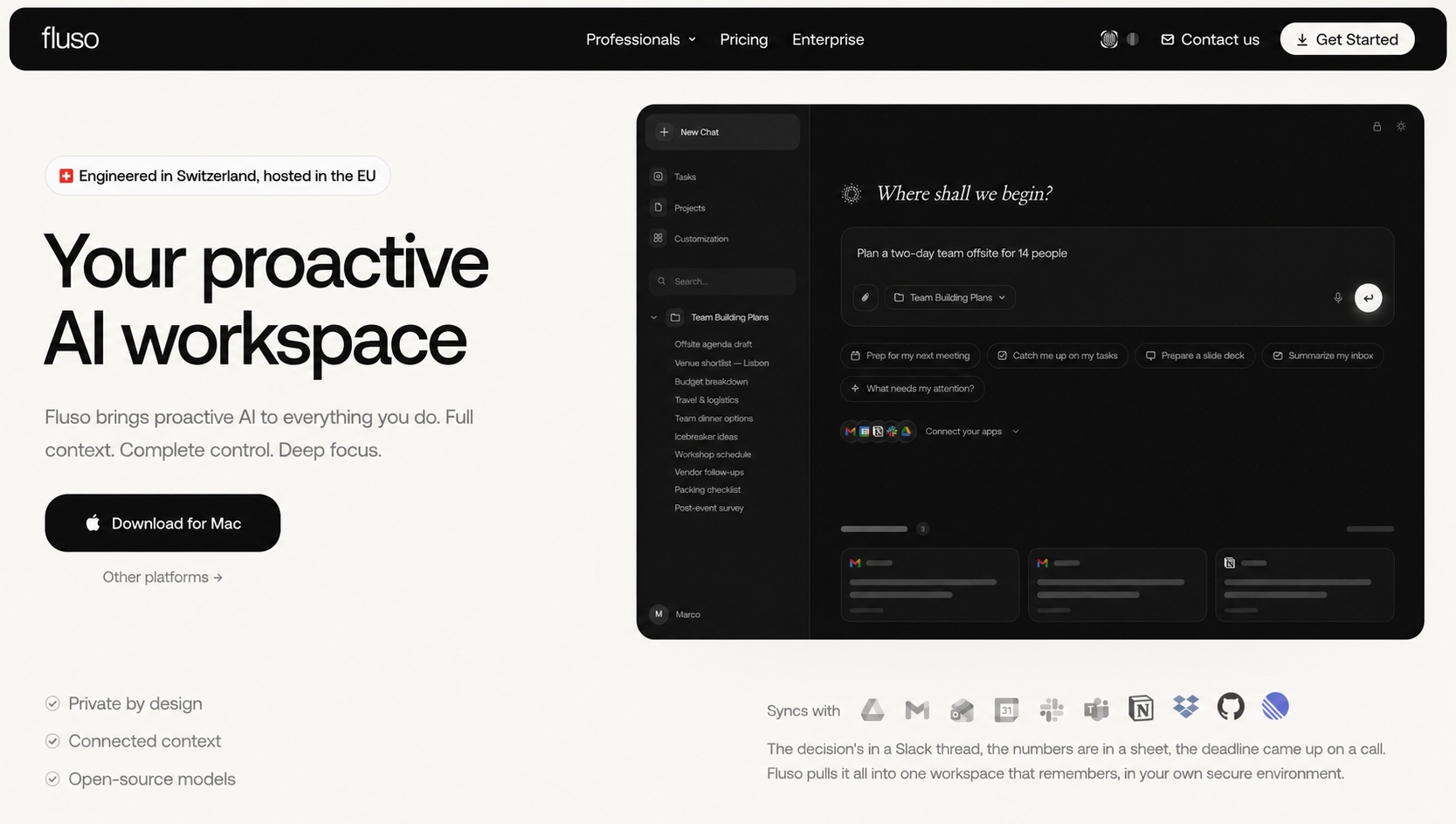
Rather than adding AI separately across communication tools like Slack, Gmail, or Microsoft Outlook, Fluso brings your enterprise data, knowledge, and context into one governed workspace. It builds private AI workflows that remain your organization's exclusive property. At the same time, it supports open-weight models, secure AI inferencing, and flexible deployment options that align with your compliance and data residency requirements.
You retain control over how AI is deployed, where inferencing happens, and how your business data is protected throughout the AI lifecycle. Whether you’re a growing startup or a regulated enterprise, Fluso helps you adopt AI with the governance, security, and connected business context needed to scale confidently.
Why Fluso stands out
Most enterprise AI platforms give you access to powerful models. Fluso gives you a complete AI workspace.
Instead of managing separate tools for chat, documents, search, and automation, you bring everything into one private, sovereign AI environment designed for enterprise work.
Unlike platforms tied to a single provider, Fluso supports both open-weight and commercial AI models. That gives your organisation more flexibility, stronger data control, and less vendor lock-in as your AI strategy evolves.
Fluso ensures context compounding to keep your conversations, documents, projects, and workflows connected in a single governed workspace. This allows AI to continuously build on approved enterprise knowledge rather than starting from scratch with every interaction.
Whether you deploy in the cloud, a private VPC, or an on-premises environment, Fluso gives you the flexibility to meet your security, compliance, and data residency requirements.
Instead of adding another AI tool to your stack, Fluso becomes the secure operating layer that connects your people, knowledge, and AI workflows.
How Fluso works
Most AI tools start from zero every time you use them. You re-explain your project, re-upload documents, and re-enter context repeatedly, which breaks continuity and limits how useful the AI can actually become over time.
Fluso takes a different approach.
It is built around persistent project workspaces, where your conversations, files, tasks, and instructions are stored together. This allows the AI to maintain context across sessions and build on prior work instead of treating each interaction as an isolated prompt.
Fluso also connects directly with the tools your organisation already relies on, so your work does not stay fragmented across systems. It integrates with platforms such as Gmail, Outlook, Slack, Microsoft Teams, Google Drive, Notion, Calendar, Linear, and others, bringing communication, documents, and workflows into a single environment.
Instead of constantly switching between applications, your teams operate within one connected workspace where context is continuously updated. This improves the quality of responses, since the AI has access to more relevant and structured business information at every step.
Under the surface, Fluso combines several core capabilities into one environment, including:
- Project-based organization
- Knowledge management
- Workflow automation
- Secure cloud hosting
- Integration with external tools
- Long-term conversational context
Together, these capabilities allow Fluso to function less like a standalone chatbot and more like a governed AI work environment that evolves with your organisation’s knowledge and usage patterns.
Who is Fluso built for?
It is built for enterprises and organisations that work with large volumes of knowledge, documents, research, and cross-team workflows every day and need that work to stay connected inside a private AI environment.
What makes Fluso different is that it does not treat AI as a standalone tool. It is designed as a sovereign, private AI workspace where your teams can work with persistent context across projects instead of repeating the same inputs in every chat.
Different industries work in different ways, so Fluso adapts through dedicated workspaces tailored to real business functions. Whether you are in legal, consulting, finance, healthcare, research, recruitment, or sales, the platform fits into your existing workflows instead of forcing you to change them.
Lawyers can work through contracts and case files with full context. Consultants can manage multiple client projects in one place. Recruiters can review candidates with structured information. Research and analytics teams can organise and connect large knowledge sets. Finance and healthcare teams can work with sensitive data in a controlled, governed environment.
Instead of switching between separate tools for chat, documents, tasks, and automation, Fluso keeps everything inside one connected AI workspace where your business context stays intact.
Fluso features that power an AI workspace
Fluso brings multiple AI and productivity capabilities into a single governed environment instead of splitting them across disconnected tools.
Projects and persistent context
Every project in Fluso keeps conversations, files, and instructions connected. Instead of starting from zero each time, the AI builds on existing context so your work continues naturally across sessions.
Connected business context
Fluso does not limit context to chat history. It connects emails, documents, meetings, and 50+ built-in connectors so the AI understands how different parts of your work relate to each other. You can also add custom connectors to securely integrate your organization's own systems. This reduces manual searching and improves the quality of responses.
Tasks and automation
You can automate repetitive workflows and run tasks in the background without manual effort. Teams can also create reusable AI Skills for recurring work like reporting, research, meeting prep, or contract review instead of rewriting prompts every time.
Custom AI behaviour
Fluso allows teams to adjust how the AI responds across different projects and workflows so outputs align with internal working styles and requirements.
Secure knowledge management
All documents and organisational knowledge stay within a central workspace. The AI can retrieve relevant context while keeping access controlled and aligned with internal policies.
Open-weight model support
Fluso supports multiple open-weight and frontier AI models instead of locking your organization into a single provider. You can work with models such as GLM-5.2, Kimi K3, DeepSeek V4 Pro, Nemotron 3 Ultra, and Mistral, giving your teams the flexibility to choose the right model based on privacy, performance, cost, and regulatory requirements.
Fluso security and privacy features
Fluso is designed for organisations where data control is not optional.
When you use AI in a business setting, you are often working with sensitive documents, internal communication, or customer data. Fluso is built to keep that information inside a controlled environment instead of spreading it across multiple external tools.
It provides enterprise-grade security controls such as encrypted storage, secure infrastructure, and hosted workspaces. As organisations scale, additional governance features become available, including SSO, audit logs, and access control policies.
Fluso supports deployment and infrastructure flexibility, including:
- European-hosted infrastructure
- Confidential computing environments
- Dedicated sandbox execution
- Customer-controlled VPC deployment
- Air-gapped deployment options
- Encrypted data storage
- Enterprise SSO and audit logging
- Confidential mode (encrypted inference)
- Safer tool execution controls
This makes Fluso suitable for organisations that operate under strict compliance frameworks or handle sensitive business information.
Fluso benefits for your enterprise teams
Fluso is designed to replace fragmented AI usage with a unified, governed workspace built around your enterprise data, context, and workflows. By bringing conversations, documents, projects, connectors, and automation into one system, it reduces context switching and helps teams stay aligned around shared enterprise context.
Because context is persistent and compounded across sessions, the AI can continue work instead of repeatedly resetting, improving consistency and reducing the need to re-explain tasks. Automation features and reusable AI Skills reduce manual work by handling repetitive processes in the background. Multi-model and open-weight support, including GLM-5.2, give teams the flexibility to choose the right model without adding tool complexity.
At the same time, enterprise-grade privacy controls and governed knowledge management help organizations maintain visibility and control over how data is connected, used, and accessed, while keeping private AI workflows the organization's exclusive property.
Fluso pricing
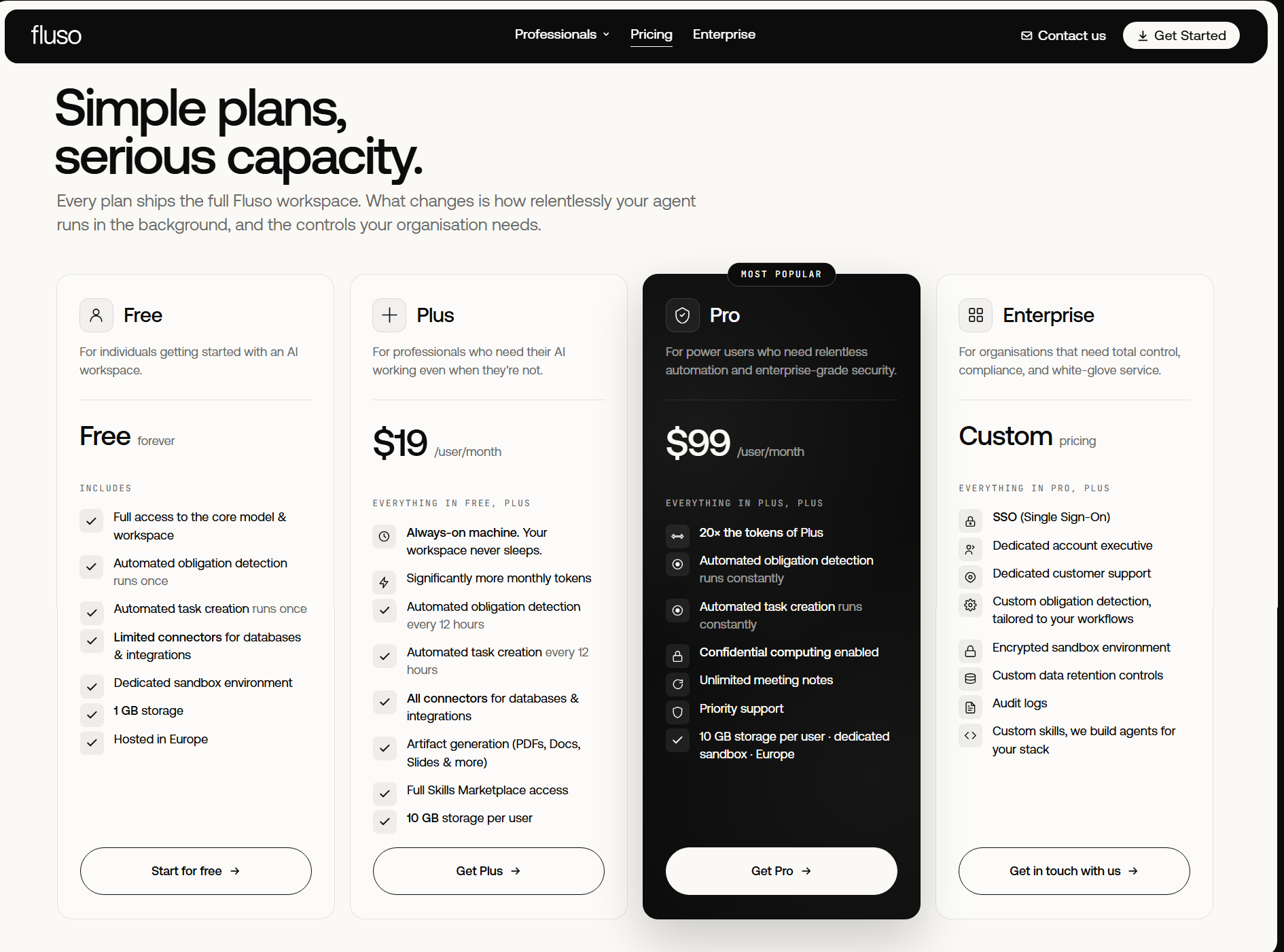
Fluso offers custom plans for enterprises. Every plan includes the core AI workspace, with higher tiers adding more automation, usage capacity, and enterprise security controls.
Free plan: Get started with secure AI
Includes core workspace access, limited connectors, automated tasks, dedicated sandbox, 1 GB storage, and European hosting.
Plus plan: AI assistance for professionals
Starting at $19/user/month (€17.20 EUR), Plus always includes AI, more tokens, full connectors, artifact generation, Skills Marketplace access, and 10 GB of storage per user.
Pro plan: Advanced automation and security
At $99/user/month (€87 EUR), Pro includes continuous automation, confidential computing, unlimited meeting notes, priority support, dedicated sandbox, and European hosting.
Enterprise plan: AI built for organisations
Custom pricing with SSO, dedicated support, custom AI skills, audit logs, data retention controls, encrypted environments, and enterprise deployment options.
One thing to note is that Fluso doesn't completely change as you move to a higher plan. The workspace stays familiar, while each tier unlocks more AI credits, automation, storage, integrations, governance, and enterprise controls.
Mistral AI
What is Mistral AI?
Mistral AI is a French artificial intelligence company and is currently one of the most valuable AI startups in Europe. It develops open-weight large language models designed for enterprises that need both high-performance inference and control over deployment environments.
What Mistral AI does for enterprise teams
Mistral supports enterprise use cases such as multilingual content generation, code assistance, document analysis, and retrieval-augmented generation workflows. Its models are optimized for low-latency inference and concise output generation, which reduces post-processing effort in production use cases.
For your teams operating across Europe, Mistral’s multilingual performance is particularly relevant. You can run workloads in French, German, Dutch, Italian, Spanish, and other European languages with higher consistency compared to many US-based proprietary models.
Privacy and security of Mistral AI
This is where Mistral differentiates itself from most general-purpose AI providers.
With a significant portion of its enterprise adoption coming from regulated European markets, Mistral is designed around data sovereignty and deployment flexibility requirements. You can deploy Mistral models in your own infrastructure (self-hosted open-weight deployment), private cloud environments, and EU-hosted API infrastructure.
This allows your organization to align model execution with GDPR and FADP requirements, while maintaining control over data residency and processing boundaries. For regulated environments, this level of deployment control is often a prerequisite rather than an option.
Mistral AI is best suited for
Mistral is most suitable when your organization prioritizes infrastructure control, model-level flexibility, and data residency compliance over a full end-to-end AI workspace. It is typically adopted by teams with technical capacity to manage deployment and inference environments directly.
Mistral AI pricing
Le Chat Pro is listed at $14.99 per month (around €13.80) and the Team plan at $24.99 per user per month (around €23), while enterprise pricing is custom. For organizations that want to deploy models on their own infrastructure, self-hosted open-weight models carry no per-token API cost, only your own compute costs
User rating of Mistral AI
4.5/5 (3 ratings on G2)
Dust
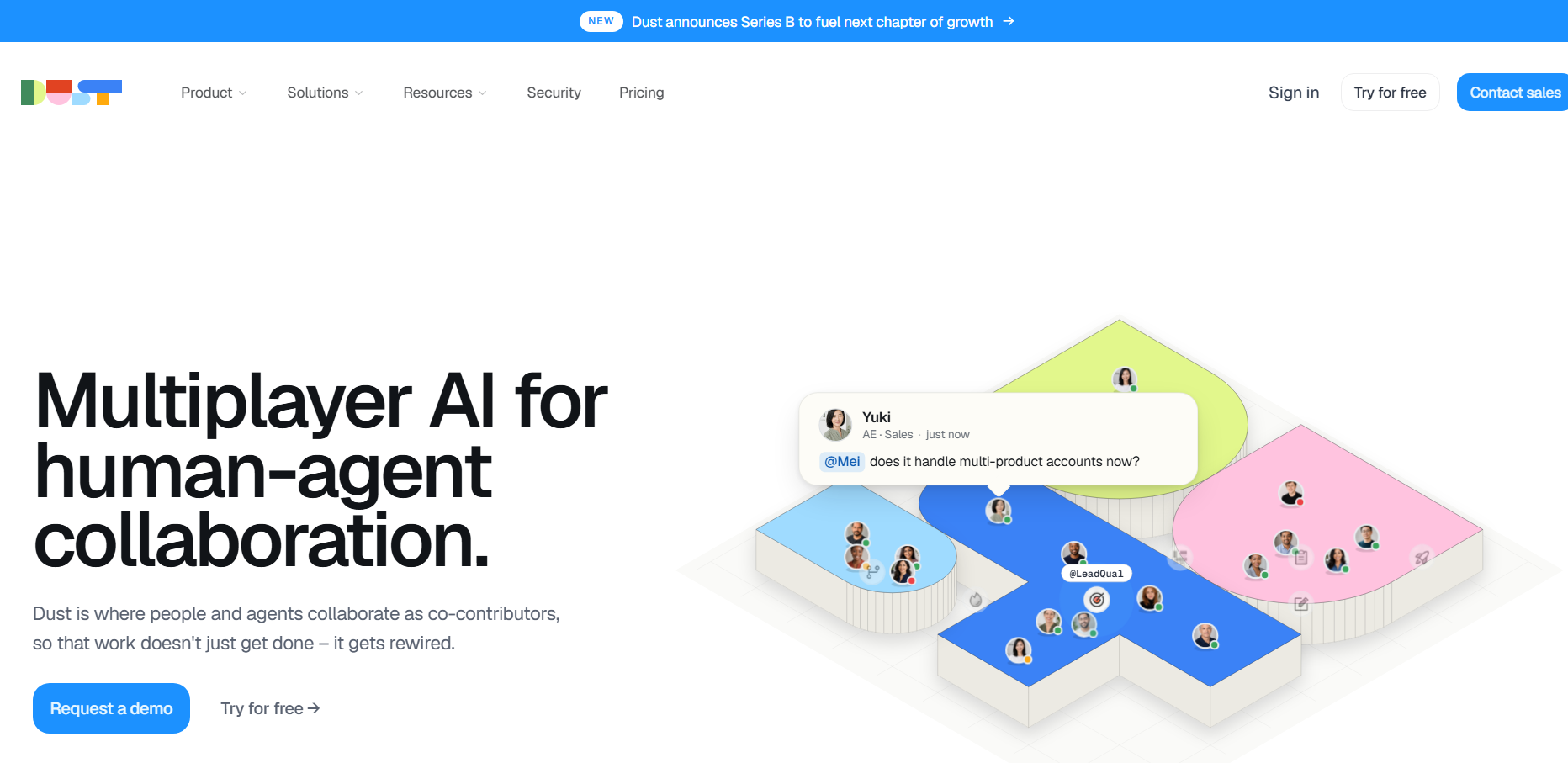
What is Dust?
Dust is an enterprise AI platform that enables your organization to build and deploy custom AI agents connected to internal knowledge systems and business tools. Instead of a single general-purpose assistant, you work with multiple agents configured for specific workflows across teams.
What Dust does for enterprise teams
Dust connects with tools such as Slack, Notion, Google Drive, GitHub, Confluence, and Salesforce, allowing your teams to build agents that retrieve information, summarize content, and automate recurring knowledge-based workflows across systems.
For your organization, this reduces fragmentation by centralizing access to distributed information through agent-driven execution, making internal knowledge more accessible without requiring users to manually search across multiple platforms.
Privacy and security of Dust
Dust is designed with enterprise compliance requirements in mind, including SOC 2 Type II certification and GDPR alignment. It supports zero data retention at model providers and offers EU data residency options for organizations with strict data governance requirements. Enterprise deployments also include SSO, SCIM provisioning, and regional hosting controls for access and identity management.
Dust is best suited for
Dust is ideal when your business is ready to build custom AI agents across multiple departments. The additional flexibility comes with more setup and governance, making it better suited for organisations with dedicated AI or IT teams.
Dust pricing
Dust offers a Pro plan at $30 per user per month (approximately €27), or $24 per user per month (approximately €22) when billed yearly. The Max plan costs $150 per user per month (approximately €135), or $120 per user per month (approximately €110) when billed yearly. Enterprise pricing is available on request for organisations requiring advanced governance, deployment, and support.
User rating of Dust
4.8/5 (33 ratings on G2)
Langdock
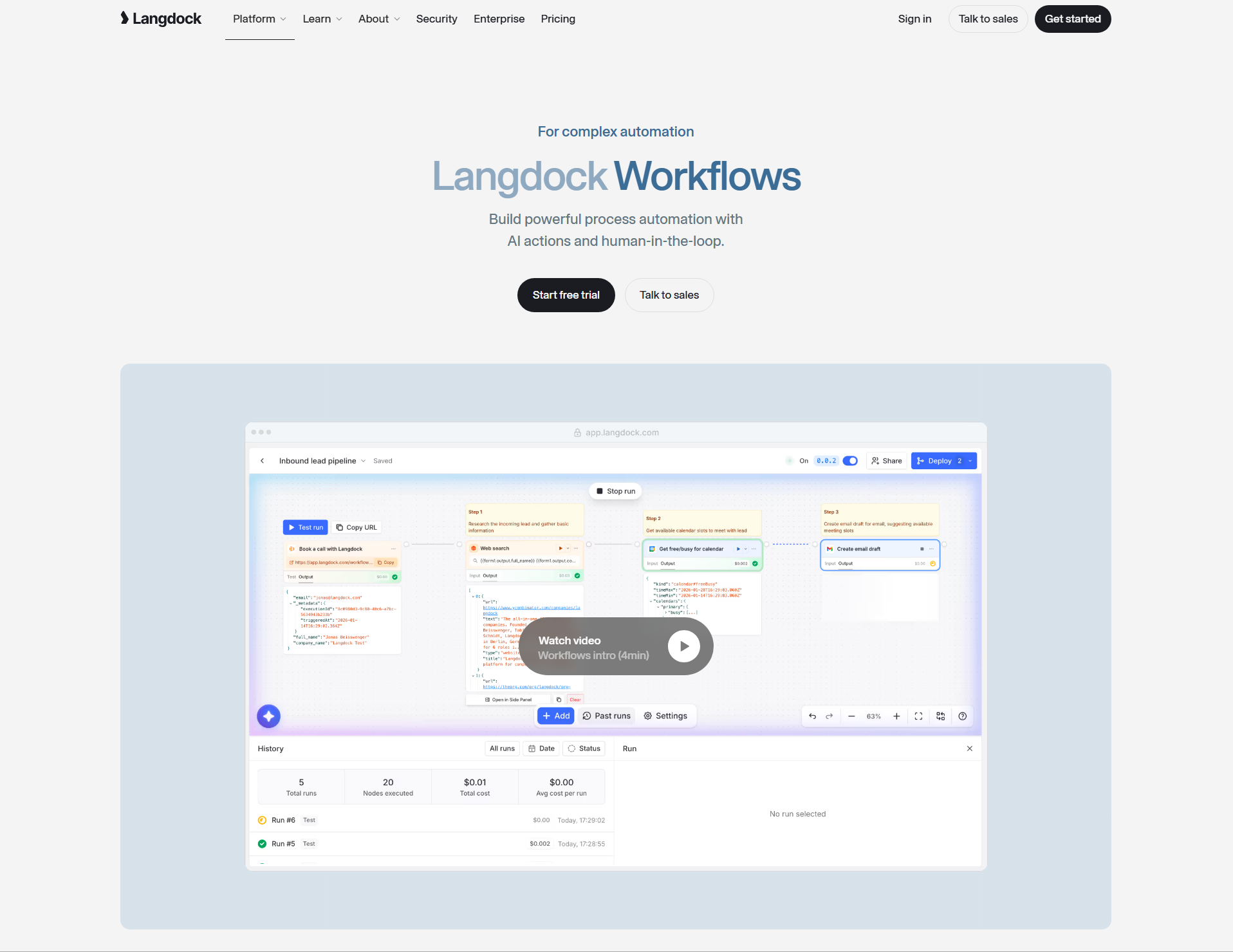
What is Langdock?
Langdock is an enterprise AI platform designed to deploy internal AI assistants and workflow systems over your organization’s data and tools. It provides a model-agnostic environment where your teams can build and operate AI agents connected to enterprise systems under strict governance controls.
What Langdock does for enterprise teams
Langdock connects your internal systems such as documents, knowledge bases, and collaboration tools into a unified AI layer that enables natural language querying with permission-aware access. Your organization can configure assistants for summarization, knowledge retrieval, and workflow execution without requiring custom engineering for each use case.
It reduces fragmentation across enterprise knowledge systems by centralizing access through governed AI agents that operate across multiple data sources.
Privacy and security of Langdock
Langdock is designed for enterprise compliance environments with ISO 27001 and SOC 2 Type II alignment. Your organization’s data is not used for model training, and all processing remains within controlled infrastructure boundaries.
Deployment options include EU-hosted multi-tenant SaaS, single-tenant environments, and dedicated Kubernetes-based on-premise setups. Data is encrypted in transit and at rest, with additional governance features such as access control, audit logs, and LLM provider key management available for enterprise deployments.
Langdock is best suited for
It is best if you want to operationalize internal AI assistants over distributed enterprise data while maintaining strict governance and compliance controls. It is commonly used in regulated industries and EU-based enterprises where data residency and controlled access to internal knowledge systems are critical requirements.
Langdock pricing
Langdock uses modular pricing across chat & agents, workflows, governance, and API usage. The Business plan is €23.20 (~$25) per user/month (or €99 / ~$107 for higher usage seats), with enterprise pricing custom beyond 1,000 users. Workflows are priced at €449 (~$485) per workspace/month, while governance costs €2.80 (~$3) per user/month (free until 2027). API usage is token-based and billed separately per model.
User rating of Langdock
5/5 (8 ratings on G2)
PhariaAI (Aleph Alpha)
What is PhariaAI (Aleph Alpha)?
PhariaAI is an enterprise artificial intelligence platform developed by Aleph Alpha, a German AI company focused on sovereign AI systems for regulated European environments. It provides a suite of open-weight multilingual models and enterprise tools designed for organizations that require full control over deployment, data processing, and model execution.
What PhariaAI does for enterprise teams
PhariaAI enables your organization to run document intelligence, multilingual generation, semantic search, and domain-specific reasoning directly on internal enterprise data. The PhariaAssistant layer functions as an AI interface for summarization, question answering, and multi-document analysis within controlled knowledge environments.
For your teams, this allows structured interaction with internal documents and knowledge bases without moving data outside your infrastructure. It is commonly used for research workflows, compliance documentation, legal analysis, and multilingual enterprise communication across European markets.
Privacy and security of PhariaAI (Aleph Alpha)
PhariaAI is built around data sovereignty and controlled execution environments. Your organization can deploy the platform on-premises, in private cloud infrastructure, or in fully air-gapped environments, ensuring that all data processing remains within your defined boundaries.
The system operates under EU jurisdiction and aligns with GDPR requirements, with ISO 27001 and BSI C5 certifications supporting its security posture. Customer inputs are not used for model training, and all inference runs inside the selected deployment environment, giving your organization full control over data residency and access.
PhariaAI is best suited for
PhariaAI is best suited for organizations that require sovereign AI infrastructure with strict compliance and deployment control. It is typically used in government, defense, financial services, healthcare, and critical infrastructure environments where data cannot leave controlled systems and must remain fully auditable.
PhariaAI pricing
PhariaAI follows an enterprise sales model with custom pricing based on deployment scope, infrastructure requirements, and usage scale. There are no self-serve or standardized SaaS pricing tiers, and engagements are structured through direct enterprise contracts.
User rating of PhariaAI (Aleph Alpha)
No widely available public G2 or Capterra rating at scale.
How to evaluate enterprise AI platforms
Choosing an enterprise AI platform is about balancing productivity, control, and compliance rather than only model performance. For regulated and data-sensitive organisations, these factors matter most.
- Prioritise data privacy and control. Ensure no training on your business data and strong enterprise privacy protections.
- Check data residency and sovereignty. Verify where data is processed and stored, such as the EU, private cloud, or on-prem environments.
- Evaluate deployment flexibility. Look for cloud, VPC, or on-prem options based on your security needs.
- Assess model transparency and vendor lock-in. Understand open-weight versus closed models and long-term portability.
- Match with your ecosystem and governance needs. Ensure compatibility with existing tools, access controls, and workflows.
Fluso: The Best ChatGPT Enterprise Alternative for Security, Privacy, and Control
As enterprises scale AI adoption, the focus is shifting from model performance to control, privacy, and governance. The right ChatGPT Enterprise alternative should give organisations confidence over how data is processed, where it is deployed, and how business knowledge is used across teams.
Fluso by Prem AI is built for this shift, combining sovereign deployment options, open-weight model support, and enterprise-grade data control in a single workspace. It enables organisations to adopt AI without losing visibility, compliance alignment, or ownership of critical business data.
To get a custom Fluso demo for your enterprise, contact Fluso sales team for a discovery meeting and explore how we can help you adapt enterprise AI with 100% privacy and data sovereignty.
Frequently asked questions about ChatGPT Enterprise alternatives
What are ChatGPT Enterprise alternatives?
ChatGPT Enterprise alternatives are enterprise AI platforms that provide similar or extended capabilities with stronger control over data, deployment, and governance. They typically support private infrastructure, open-weight models, and compliance-ready architectures for organisations that require greater AI sovereignty and flexibility than standard SaaS AI tools.
Why are enterprises looking for ChatGPT Enterprise alternatives?
Enterprises are increasingly concerned about data sovereignty, regulatory compliance, and AI vendor dependency. Many teams require guarantees around data retention, model training policies, and infrastructure location. Alternatives are evaluated based on governance controls, secure inferencing, and alignment with frameworks like GDPR, the EU AI Act, and internal security policies.
Is ChatGPT Enterprise secure for handling confidential business data?
ChatGPT Enterprise provides enterprise-grade security controls and does not use customer data for training by default. However, it remains a cloud-hosted, US-operated system, which may introduce data residency and jurisdiction considerations for organisations operating under strict EU or regulated industry compliance requirements.
What should enterprises consider before choosing an AI platform?
Enterprises should evaluate AI platforms based on data governance, deployment flexibility, model transparency, and security architecture. Key factors include data residency, encryption, access controls, auditability, integration depth, vendor lock-in risk, and whether the platform supports private or sovereign infrastructure environments.
Which ChatGPT Enterprise alternative offers the best data privacy?
Fluso by Prem AI stands out with sovereign AI architecture, private deployment options, and support for open-weight models. It enables customer-controlled infrastructure, secure AI inferencing, and compliance-aligned data handling, making it suitable for organisations requiring full control over sensitive business information.
Are free AI tools safe for business use?
Free AI tools are generally not suitable for enterprise workloads involving sensitive or regulated data. They often operate on shared infrastructure with limited governance controls, unclear retention policies, and no contractual compliance guarantees such as DPAs, making them unsuitable for secure enterprise adoption.
How do ChatGPT Enterprise alternatives protect company data?
Enterprise AI platforms use encryption in transit and at rest, role-based access controls, and audit logging to protect data. More advanced systems like Fluso also support isolated deployment environments, sovereign infrastructure options, and controlled AI inferencing to ensure data never leaves approved boundaries.
What is the best ChatGPT Enterprise alternative for Swiss and European enterprises?
Fluso by Prem AI is designed for European organisations requiring data sovereignty, compliance alignment, and deployment flexibility. With EU-aligned infrastructure options, open-weight model support, and secure enterprise governance, it is positioned for organisations prioritising regulatory compliance and data control.
Can ChatGPT Enterprise alternatives integrate with existing business tools?
Yes, most enterprise AI platforms integrate with common business systems such as Slack, Google Workspace, Microsoft 365, Notion, and CRMs. The depth of integration varies, but platforms like Fluso focus on unifying these tools into a governed workspace with persistent enterprise context across systems.
Why is Fluso a strong alternative to ChatGPT Enterprise?
Fluso combines sovereign deployment options, open-weight model support, and governed enterprise workspaces. Unlike cloud-only assistants, it enables organisations to control infrastructure, data residency, and AI inferencing while maintaining secure, context-aware workflows across teams and business functions.
Is ChatGPT Enterprise GDPR compliant?
ChatGPT Enterprise includes GDPR-aligned contractual protections and enterprise security controls. However, compliance depends on deployment configuration, data processing location, and internal governance policies. Organisations with strict regulatory requirements often evaluate sovereign or regionally controlled alternatives for additional assurance.
Can ChatGPT Enterprise be self-hosted?
No. ChatGPT Enterprise is a fully managed cloud platform and does not support self-hosting or on-premise deployment. Enterprises requiring full infrastructure control typically choose platforms that support private cloud, VPC deployment, or air-gapped environments for regulatory or security reasons.
See how Prem AI can help your enterprise build private AI without compromising control over your data and infrastructure. Contact our sales team, or email us at sales@premai.io.