Best Enterprise AI Platforms for Private, Secure & Sovereign AI in 2026
One data breach can cost you $4.99 million on average. That is the global average reported in IBM’s Cost of a Data Breach Report 2026, a 12% increase over the previous year.
For regulated organizations, the fallout extends well beyond the immediate financial loss to compliance penalties, operational disruption, reputational damage, and even the cost of investigating and remediating the breach.
That makes data control especially important if your teams use AI. Your data can cross multiple systems as employees parse documents, summarize information, and automate workflows. You need to know where your data goes, who can access it, and how it is handled.
The risk is already measurable. Check Point’s AI Security Report 2026 shows that high-risk GenAI prompts doubled from 2% to 4% over the last year. Organizations were also using an average of 10 AI applications each month, many without official approval.
The impact can look different across industries. For a healthcare organization, it could involve patient information. For a bank or insurer, financial and customer records. For a law firm, confidential case files. For government, defense, and critical infrastructure organizations, data location, access, and jurisdiction can carry even greater consequences.
So when you evaluate an AI platform, you also need to ask, "Where does your data go?” “Where is the AI processing it?” “Who can access it?” and “What happens if you need to change providers or move the workload?”
McKinsey’s sovereign AI agenda describes this shift as sovereignty moving “from a compliance issue to an autonomy imperative." That means having greater control over the technology, infrastructure, and data your enterprise relies on.
Dell has also highlighted the growing importance of control, governance, and sovereignty as enterprises move AI into more sensitive workloads.
That changes what you should look for in an enterprise AI platform. Model performance still matters, but so do privacy, security, deployment control, data sovereignty, compliance, and infrastructure control.
For regulated organizations, these capabilities can determine whether you can adopt AI while keeping your most sensitive data and infrastructure under your control.
So, which enterprise AI platforms stand out for private, secure, and sovereign AI?
Let’s take a closer look.
Best private, secure, and sovereign AI platforms for enterprises in 2026
Before we get to the list, here’s how I picked the platforms included. I looked at three things for every platform.
- Can it actually run inside your infrastructure, or are you relying on the vendor’s environment?
- What security and compliance claims does it make, and can you independently verify them?
- How much genuine control do you keep over your data and models once you start using the platform?
I also included both sovereignty-first vendors and major cloud platforms. Depending on your needs, you may be choosing between a specialist platform and a hyperscaler. You should not have to compare only one type of vendor.
The table below gives you a quick comparison of the top enterprise AI platforms covered in this guide. Use it to see where each platform fits best before diving into the details of each option.
Build AI You Can Actually Verify
Give your enterprise more than security promises with hardware-attested infrastructure and cryptographic proof.
Talk to Prem AIPrem AI
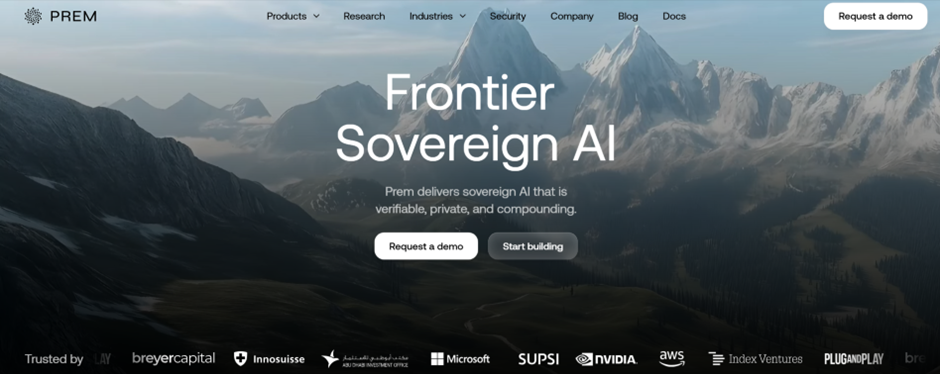
Prem AI is a Swiss company founded in 2023 by Simone Giacomelli.
Your enterprise cannot afford to put sensitive data into a standard third-party AI tool without knowing how it is handled. You need proof that your data is protected.
That is what Prem AI was built around. Our approach rests on three simple commitments: private, verifiable, and compounding.
How the security architecture works with Prem AI
Security is a core part of how we approach enterprise AI. Policies and contracts define how data should be handled, but we also protect your data at the infrastructure level while the AI is processing it.
Confidential inference runs your AI workloads inside hardware-sealed Trusted Execution Environments (TEEs), using technologies from Intel TDX, AMD SEV-SNP, and NVIDIA Confidential Computing. Your data is encrypted at the GPU level during processing, and we don't have access to it while inference is running.
But how do you verify this is actually happening? Each confidential inference call generates a cryptographic attestation report, giving you a way to independently check the security of the environment.
For larger deployments, the same attestation process extends across multiple GPUs and distributed clusters, so you can verify the computing environment across individual compute nodes.
We also offer ZDR, a separate mode for standard inference. Nothing you send is written to a log, a cache, or storage, and nothing is used to train a model.
But privacy does not mean your AI has to lose useful context. With Prem AI, compounding allows your AI systems to build on relevant context across interactions, helping them become more useful for ongoing workflows while keeping that context within your privacy and control framework.
The product suite of Prem AI
For your enterprise AI workflows, you might need a secure API, a way to run open-source models on your own servers and GPUs, custom training for your workflows, or a way to check your code for security risks.
We bring these capabilities together in one place through Enclave API, Prem Studio, and CyberScan. Each product solves a specific problem while keeping the focus on privacy, verifiability, and control.
Enclave API: Private AI through a single API
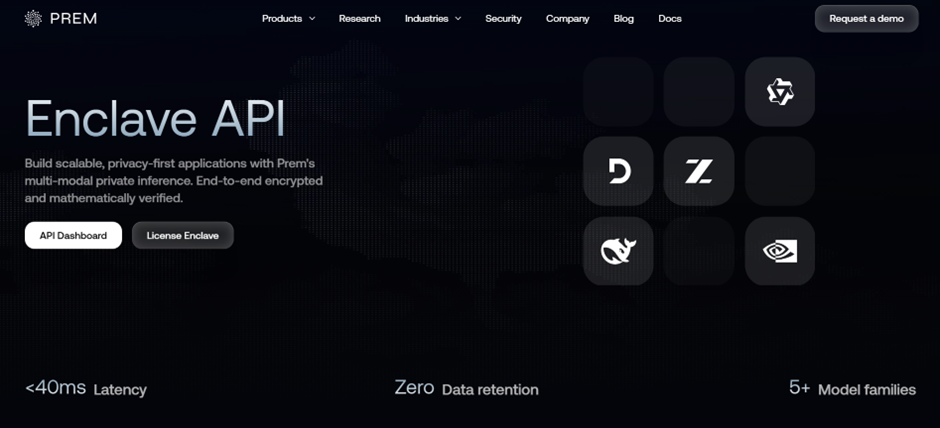
If you want to add private AI to an existing application, the Enclave API gives you a way to connect to multiple AI models through a single API.
You can use different model families for tasks such as text, vision, and audio while keeping the inference environment private. Enclave API also supports client-side encryption and cryptographic attestation, giving you greater control and visibility into how your AI workloads are handled.
Add Private AI to Your Existing Applications
Connect to multiple AI models through one OpenAI-compatible API with client-side encryption and confidential inference.
Get started with Enclave APIPrem Studio: Train and deploy task-specific AI
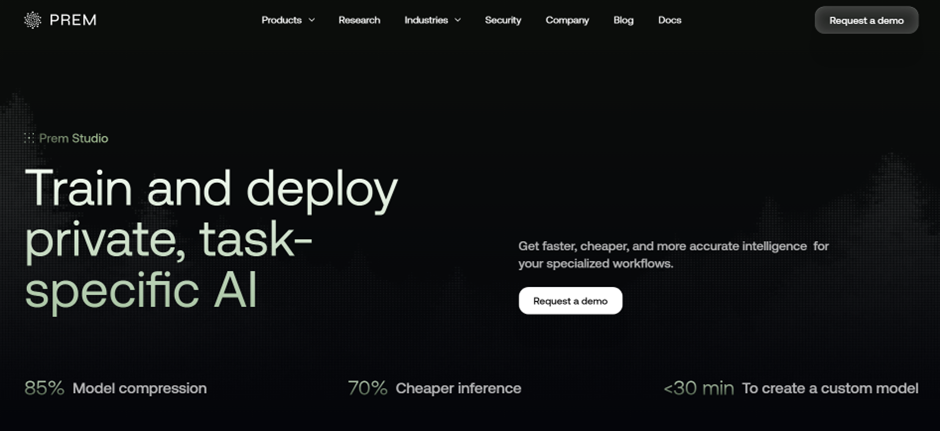
A general-purpose AI model may not always fit a specific enterprise workflow. Prem Studio is built for teams that want to develop AI around their own data and use cases.
You can prepare datasets, fine-tune models, evaluate their performance, and deploy task-specific AI. Models built with Prem Studio can also be exported and self-hosted, giving your enterprise greater ownership and control over what it builds.
Build AI Around Your Enterprise Workflows
Fine-tune, evaluate, and deploy task-specific models using your own data and use cases.
Talk to Prem AICyberscan: Security agent for vulnerability detection
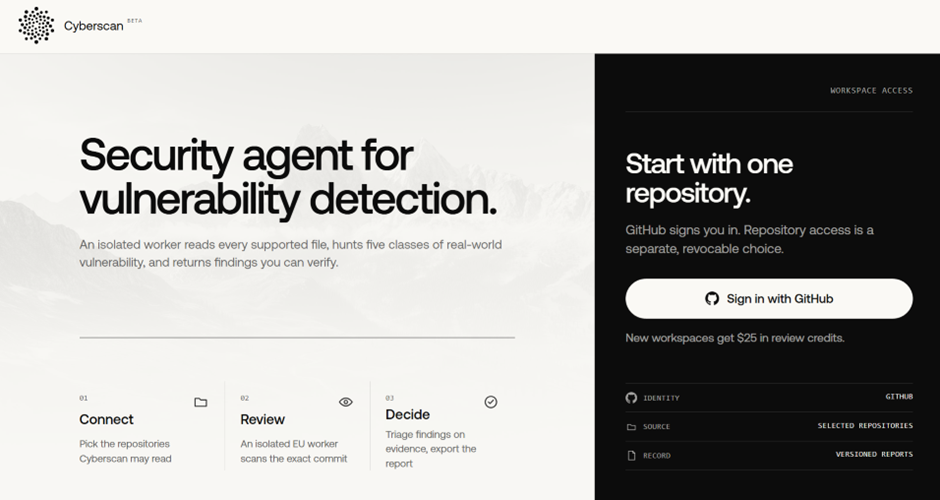
Once you are building and deploying AI systems, you also need to understand the security risks in the code behind them. Cyberscan addresses this part of the workflow as a security agent for vulnerability detection.
You connect the repositories you want reviewed, and an isolated worker scans supported files for vulnerabilities. It then returns findings with evidence that your team can review and verify, along with reports that can be exported and retained for your records.
Find Vulnerabilities Before They Reach Production
Scan your code with an AI security agent and get findings your team can review and verify.
Try CyberScanPrem AI’s deployment options and time to launch
You don't have to wait months to get your private AI environment running. Enclave API gives you confidential inference through a hosted API, so Prem handles the infrastructure while you keep client-side encryption, hardware isolation, and attestation on every confidential inference call.
Reported use cases of Prem AI
We help teams in regulated industries tackle heavy compliance workloads. For example, a recent client with strict EU data residency rules had teams manually reviewing thousands of regulatory documents every quarter.
To fix this, we set them up with a sovereign AI deployment built around their environment. Now, that heavy review process runs continuously in the background, with their data staying fully under their control.
Prem AI is best suited for
If verifying your security is your top priority, we are a great fit. We go beyond a compliance checkbox by providing cryptographic evidence that your data was protected, even from the vendor operating the underlying infrastructure.
We are a fit for any industry where sensitive data needs strong protection and control. A data breach in these environments can lead to legal and regulatory fines, operational disruption, and serious reputational damage.
Prem AI pricing
Our pricing depends on what you need, including the Prem product you choose, your deployment model, infrastructure requirements, and specific enterprise requirements.
We can therefore scope pricing around your use case rather than applying the same model to every enterprise deployment.
Fluso
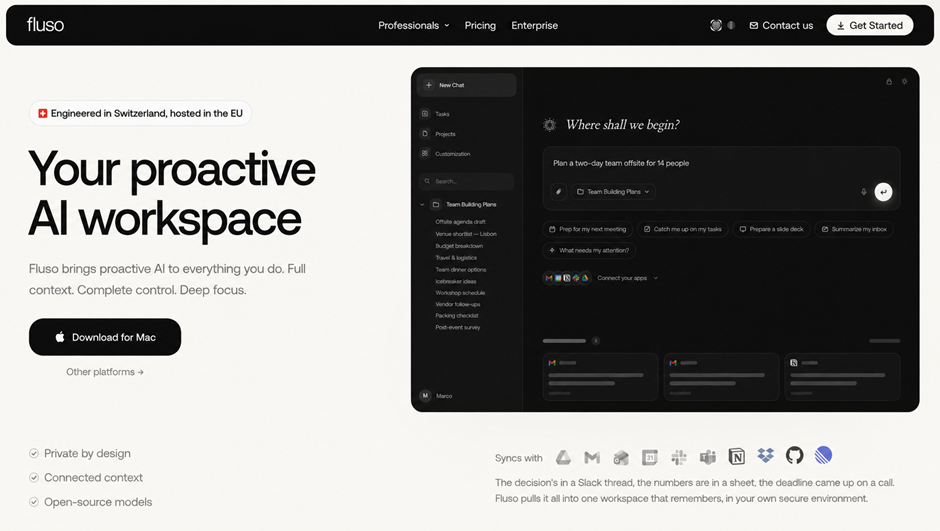
Running a large enterprise means your teams need one shared place to use AI. You do not want your documents, chats, and work steps spread across many separate tools where data can leak.
That’s what Prem AI built Fluso for.
Fluso is our sovereign, private AI workspace for organizations that want the benefits of AI while keeping control over their data, models, infrastructure, and business context.
You don’t have to juggle multiple AI tools for chat, research, documents, meetings, and automation. With Fluso, your teams can collaborate across projects, link your current business apps, and build custom AI workflows that your company fully controls.
And because we support open-weight and commercial models, you’re not forced into a single model provider as your AI strategy evolves.
Why Fluso stands out
If you are one of those who say, "I want my teams to use AI, but I don’t want another tool that creates more silos.”
Well, then Fluso is for you.
We bring your conversations, documents, projects, tasks, and connected business data into one workspace. More importantly, Fluso uses context compounding so your AI can build on approved enterprise knowledge and previous work instead of making your teams start from scratch every time.
You can integrate tools your teams already use, including Gmail, Outlook, Slack, Microsoft Teams, Google Drive, Notion, Calendar, Linear, and more. With built-in connectors and support for custom connectors, your business context can move with the work rather than staying trapped inside individual applications.
As your requirements grow, Fluso can adapt with you, with European hosting designed around your security and data residency needs.
Security, compliance & deployment of Fluso
Once you step outside the main AI workspace, things like security, deployment, and data control start to matter a lot. We give enterprises flexible options to handle this. Depending on your plan, you get encrypted data storage, dedicated sandbox execution, and confidential computing for encrypted inference. Enterprise plans add server-integrated identity and server-backed audit logging, both scoped to your implementation.
Fluso runs on European servers by default, keeping your data aligned with GDPR requirements.
Fluso is best suited for
Fluso fits businesses that need private AI without losing their connected work data. It helps your teams link documents, chats, projects, and tasks in one secure space. You get full control over your data and your AI setup.
It also works well if you need an AI that remembers past chats, runs on open-weight models, and fits strict rules for security, compliance, and where your data lives.
Fluso pricing
You can start with the Free plan for core workspace access, limited connectors, automated tasks, 1 GB of storage, and European hosting. Paid plans start at $19/user/month for Plus and $99/user/month for Pro, while Enterprise uses custom pricing.
As you move up the plans, you get more automation, storage, connectors, and security features, with Enterprise adding server-integrated identity and server-backed audit logging (both scoped to your implementation), custom AI skills, data retention controls, and dedicated support.
Give Your Teams One Private AI Workspace
Connect your business data, tools, and AI workflows in a private workspace built for enterprise use.
Get started with FlusoMistral AI (Vibe, formerly Le Chat)
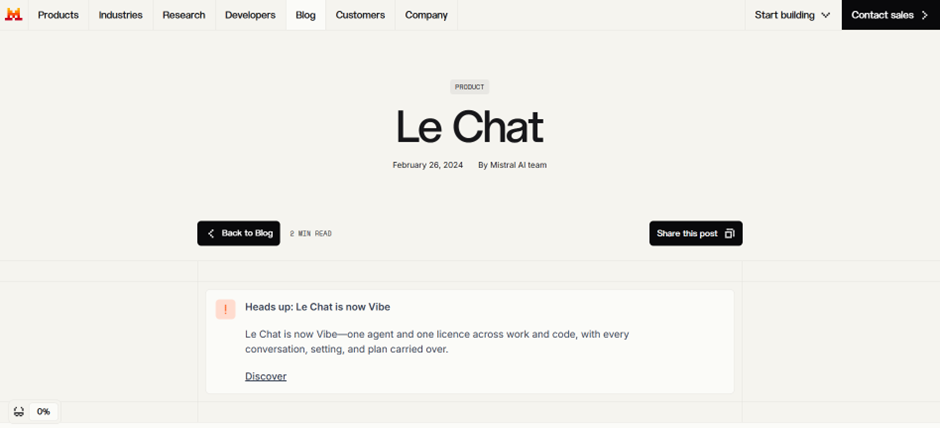
Mistral AI is a French tech company that builds open and flexible AI. Their business tool, Vibe, gives your team access to AI assistants, agents, custom models, and enterprise integrations that fit right into your daily work.
You can run Vibe in your own environment or through Mistral Cloud. Having it on-premises means you keep total control over where your private data goes.
Security, compliance & deployment of Mistral AI
Once you move beyond the basic AI capabilities, deployment and data control become important. According to Mistral's enterprise documentation, Vibe supports controls such as audit logs, SAML SSO, custom deployments, and data export.
You can also use private deployments with custom models, agents, and workflows. If you want European AI without depending on a single public-cloud setup, these deployment options give you more flexibility over how and where you run AI.
Mistral AI is best suited for
Mistral AI is a good fit if you’re particularly looking for European AI with flexible deployment options. It can be useful if you want to run AI in your own cloud or on-premises environment while keeping greater control over your data and infrastructure.
Mistral AI pricing (as of September 2026)
If you're starting with Mistral's consumer or team plans, Vibe Pro costs $14.99 per month (€17.99 including tax), while the Team plan costs $24.99 per user per month (€29.99 including tax). Enterprise pricing is custom.
If you want to run Mistral's open-weight models on your own infrastructure, there is no per-token API cost. You'll instead pay for the compute infrastructure needed to run the models.
G2 ratings of Mistral AI (as of September 2026)
4.2/5 (59 ratings on G2)
IBM watsonx
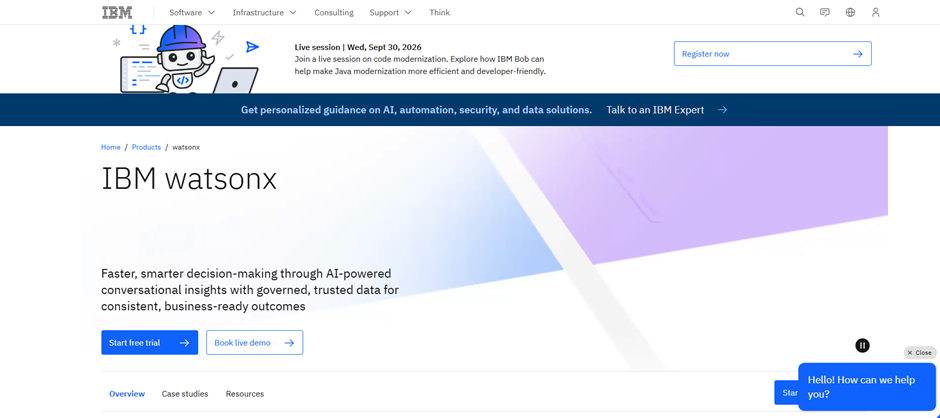
If your enterprise needs more than model access, IBM watsonx brings model development, AI applications, data, and governance together in one enterprise AI platform. It is designed to help teams move AI from experimentation into production while working with both IBM and third-party models.
watsonx also fits into existing enterprise infrastructure, which can be useful if you already have a complex technology environment and do not want to rebuild it around a single AI provider.
Security, compliance & deployment of IBM watsonx
According to IBM, governance is one of watsonx's key strengths. It provides monitoring, controls, and oversight across AI models and applications, helping teams keep track of how AI is being developed and used.
It also supports hybrid and multi-vendor environments. So, if you’re working with different models, platforms, or infrastructure, you can manage them across the same broader enterprise environment rather than keeping everything in one place.
IBM watsonx is best suited for
IBM watsonx is a good fit if your enterprise needs strong AI governance alongside model development and deployment. It is particularly relevant when compliance, risk management, and oversight are important parts of your AI strategy.
IBM watsonx pricing (as of September 2026)
You can start with a free tier offering up to 300,000 foundation-model tokens per month, or move to the Essentials plan for production deployments, starting at $0/month. The Standard plan is designed for enterprise production and starts at $1,110/month (≈€950).
G2 ratings of IBM watsonx (as of September 2026)
4.4/5 (153 ratings on G2)
Keep Greater Control Over Your Enterprise AI
Build private and sovereign AI around your data, infrastructure, models, and security requirements.
Talk to Prem AIMicrosoft Foundry
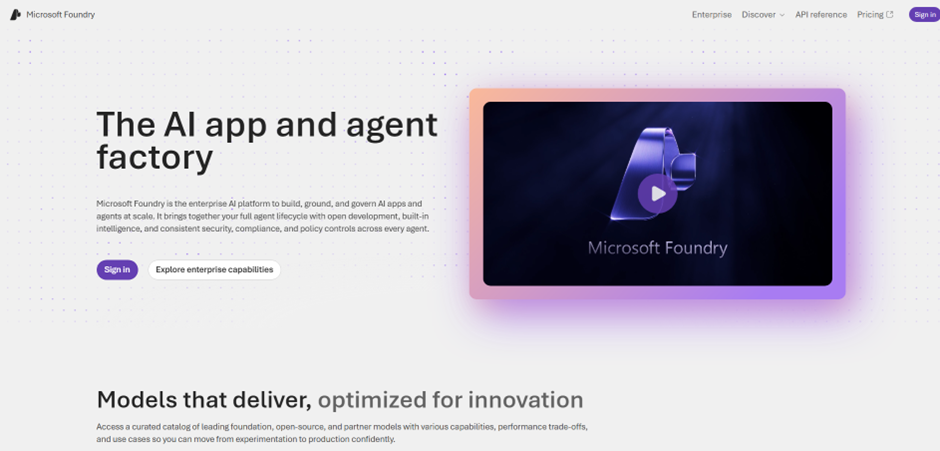
Microsoft Foundry is Microsoft’s unified platform for enterprise AI development and operations. It brings models, agents, tools, governance, and application development together within the Azure ecosystem.
If your organization already uses Microsoft services, Foundry can fit naturally into your existing identity, data, networking, and cloud setup. That can make it easier to bring AI into the environment you already manage.
Security, compliance & deployment of Microsoft Foundry
When it comes to security and control, Foundry supports private networking, Azure RBAC, customer-managed keys, and network isolation, according to Microsoft's documentation. You can also bring your own Azure resources in supported configurations, keeping data within your Azure tenant.
Where your data is processed and stored depends on the deployment type, model, and region. So if data residency is important to you, it’s worth checking the specific configuration you plan to use.
Microsoft Foundry is best suited for
Microsoft Foundry is a good fit if your organization already has a strong Microsoft and Azure footprint. It especially makes sense when you want AI development, governance, identity, and infrastructure to work within the same cloud ecosystem.
Microsoft Foundry pricing (as of September 2026)
Foundry follows a usage-based pricing model. Managed GPU pricing includes A100 at €4/hour, H100 at €7/hour, and MI300 at €7/hour. Serverless model pricing varies by model and token usage, while enterprise deployments may require a custom quote.
G2 ratings of Microsoft Foundry (as of September 2026)
4.4/5 (34 ratings on G2)
Amazon Bedrock
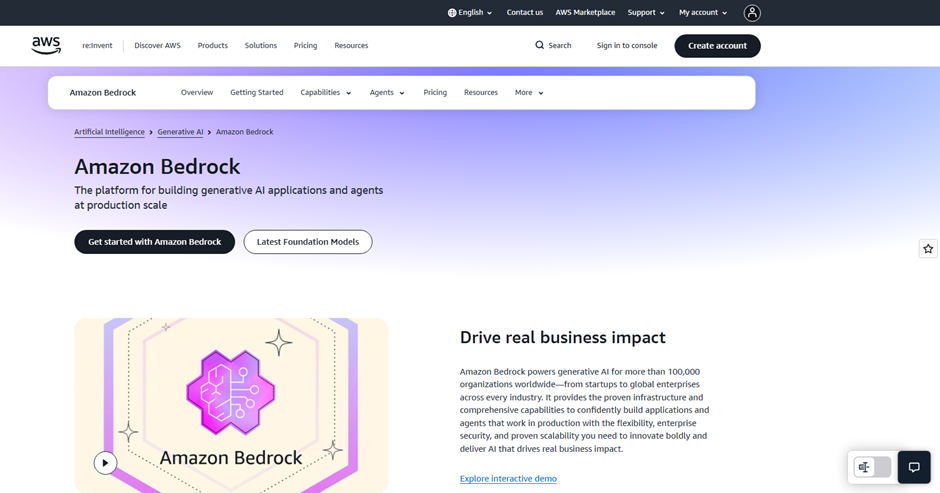
Amazon Bedrock is a fully managed AWS service that gives enterprises access to foundation models from multiple providers through one platform.
Instead of building your AI strategy around a single model, you can choose from models offered by Amazon and other providers. This gives your team more flexibility as model capabilities, performance, and pricing change.
Security, compliance & deployment of Amazon Bedrock
If your enterprise already runs on AWS, Bedrock can fit into the security and governance setup you already use. AWS states that Bedrock provides controls for access management, monitoring, logging, and compliance.
You can also use AWS networking capabilities such as VPC and PrivateLink for supported services and configurations. This can help you connect AI workloads to your existing private AWS environment.
Amazon Bedrock is best suited for
Amazon Bedrock is a good fit if you already use AWS and want access to multiple AI models through one platform. It can be useful especially when model flexibility, AWS integration, and scalable inference are priorities.
Amazon Bedrock pricing (as of September 2026)
Bedrock uses usage-based pricing, which varies by model and provider. Charges are typically calculated per 1 million input and output tokens.
For example, AI21 Jamba 1.5 Mini costs $0.20 per 1M input tokens and $0.40 per 1M output tokens (approximately €0.18/€0.35). Batch inference is also available at rates up to 50% lower.
G2 ratings of Amazon Bedrock (as of September 2026)
4.4/5 (78 ratings on G2)
Make Your Enterprise AI Private by Design
Protect sensitive workloads with confidential computing, client-side encryption, and infrastructure-level security.
Talk to Prem AIGoogle Cloud Gemini Enterprise Agent Platform
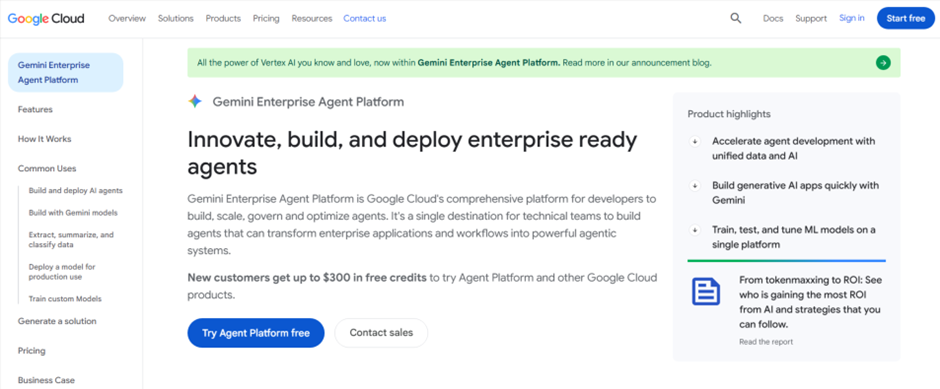
Google Cloud Gemini Enterprise Agent Platform is Google’s platform for building, scaling, governing, and optimizing AI agents. It brings together model access with tools for agent development, orchestration, governance, observability, and deployment.
If you’re already using Google Cloud, the platform can fit naturally into your existing environment. It also gives you one place to manage the different parts of the AI and agent lifecycle.
Security, compliance & deployment of Gemini Enterprise Agent Platform
Google describes security and governance as built into the Cloud environment, saying the platform connects with its existing data, identity, and security infrastructure to support enterprise controls across the AI and agent lifecycle.
If you’re already using Google Cloud, this can make it easier to connect your AI workloads with the data, identity systems, and infrastructure you already have in place.
Gemini Enterprise Agent Platform is best suited for
This platform is a good fit if you’re building AI agents or complex AI applications on Google Cloud. It brings model access, agent development, governance, and cloud infrastructure together, which can simplify things if your enterprise already runs on Google Cloud.
Gemini Enterprise Agent Platform pricing (as of September 2026)
Your pricing depends on the model, tokens, and features you use. Gemini models are generally billed per 1 million input and output tokens, while features such as grounding, embeddings, context caching, model tuning, and media generation can have separate charges. For example, Gemini 3.5 Flash is priced at $1.50 (€1.28) per 1M input tokens and $9 (€7.65) per 1M output tokens, while Gemini 3.5 Flash-Lite costs $0.30 (€0.26) and $2.50 (€2.13), respectively. You only pay for successful requests, so failed 4xx or 5xx requests aren't charged.
Building custom agents on the platform also adds infrastructure charges: Agent Compute at $0.085 per vCPU-hour and Agent Storage at $0.30 per GiB-month.
G2 ratings of Google Cloud Gemini Enterprise Agent Platform (as of September 2026)
4.3/5 (737 ratings on G2)
What to look for when choosing an enterprise AI platform
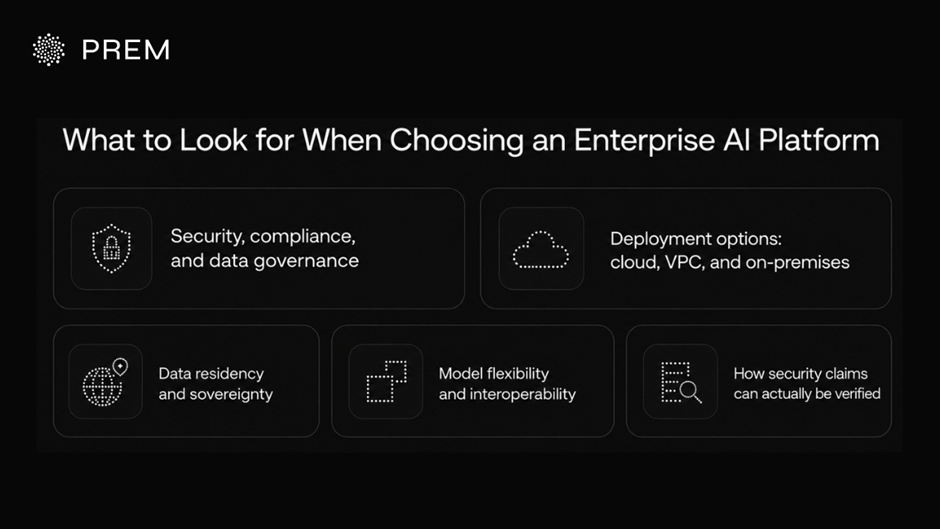
In 2026, in order to choose an enterprise AI platform, you also need to look at security, deployment, data sovereignty, flexibility, and verifiability.
The right choice depends on what you’re using AI for, what kind of data it will handle, and how much control your organization needs.
Security, compliance, and data governance
Start by understanding the security controls behind the platform and what evidence the provider can give you.
Look for certifications and reports such as SOC 2 Type II, and if you work in healthcare, check whether HIPAA requirements are explicitly addressed through the appropriate agreements.
It’s also worth looking at access logs and audit trails. You should know what access your data can have within the provider’s organization and what controls are in place around that access.
Deployment options: cloud, VPC, and on-premises
Where your AI runs affects how much control you have over the environment.
A public-cloud or multi-tenant setup may work well for some workloads. A VPC gives you a private network boundary within a larger cloud environment, while on-premises or air-gapped deployments can keep AI workloads within your own infrastructure.
The right option depends on the sensitivity of your data and the controls your organization needs.
Data residency and sovereignty
Data sovereignty goes beyond asking which country hosts your data.
You also need to look at the legal jurisdiction of the company providing the service. That can affect which laws apply to the provider and what legal requests it may be subject to.
For example, a provider may host infrastructure in Europe while its corporate entity is based elsewhere. If sovereignty matters to your organization, consider both where your data is processed and which legal entity controls the service.
Model flexibility and interoperability
Choosing a model today should not limit your options tomorrow.
Check whether you can switch between models without rebuilding your entire integration layer. It’s also worth checking whether the platform supports open-weight models alongside proprietary frontier models.
If you plan to fine-tune models using proprietary data, look at who owns the resulting model weights and where you can deploy them.
How security claims can actually be verified
Security is easier to evaluate when you can see evidence of how the controls work.
Ask whether you can audit what happened to a specific request and whether the platform provides evidence about the environment that processed your data.
Hardware-based attestation, for example, can provide cryptographically verifiable evidence about the identity and state of a computing environment.
The goal is to understand how you can verify that those controls are working as intended.
Build Sovereign AI Around Your Enterprise
Keep control over where your AI runs, how your data is protected, and how your workloads are verified.
Talk to Prem AICommon mistakes enterprises make when choosing an AI platform
Choosing an enterprise AI platform is about more than comparing features and model performance. The details around compliance, deployment, data sovereignty, model flexibility, and verification can have a much bigger impact once the platform becomes part of your daily operations.
Mistaking a compliance badge for a security guarantee
You’ll see SOC 2 and HIPAA mentioned on many AI vendor websites. But it is worth looking beyond the badge and understanding what was actually assessed and whether the vendor can provide the relevant audit report.
A certification shows that certain requirements were met during an assessment. It does not automatically tell you how your specific data is handled in every situation.
Choosing convenience over the right deployment model
A public-cloud AI tool can be quick to set up, especially when you’re testing a new use case or running a demo.
The decision becomes more complicated when you move sensitive or regulated workloads into production. Changing the deployment model later can take significant time and resources, so it is better to consider your requirements before you commit.
Focusing on data center location instead of legal jurisdiction
A common starting point is, "Is my data stored in the EU?”
That matters, but it is not the whole picture. You should also look at the legal jurisdiction of the vendor and the entities involved in providing the service. These factors can influence which laws apply and what legal requests the provider may be subject to.
Locking into one model or vendor too early
AI models are changing quickly. The model that works well for your use case today may not be the best choice a year from now.
If changing models means rebuilding your integrations from scratch, that flexibility comes at a cost. Consider platforms that let you work across different models and providers as your requirements change.
Leaving verification until the end
Price, features, and model performance naturally get a lot of attention when you compare AI platforms. How you can verify that your data is protected should be part of that conversation from the beginning.
If verification is considered only after the architecture is already in place, making changes later can be much harder and more expensive.
Build private, secure, sovereign AI with Prem AI
When you’re dealing with sensitive enterprise data, knowing that an AI platform is compliant is only one aspect. You also need to understand where your data goes, who can access it, how the AI environment is secured, and how much control you have over the deployment.
That is where Prem AI comes in. Our approach is built around three core ideas: privacy, verifiability, and context compounding. We give enterprises ways to keep their AI workloads private, verify how their environment is secured, and build useful context over time while maintaining control over their data.
If you’re evaluating AI for sensitive or regulated workloads, talk to our sales team about your requirements, or reach us at sales@premai.io.
FAQs about enterprise AI platforms
What is an enterprise AI platform?
An enterprise AI platform gives organizations the infrastructure and tools to deploy AI across business workflows. It typically covers model access, security, governance, deployment, data management, and integrations. The right platform depends on your organization's data sensitivity, compliance requirements, infrastructure, and need for model flexibility.
What should enterprises look for in an AI platform?
Look at security, compliance, deployment options, data residency, sovereignty, model flexibility, interoperability, and data governance. You should also assess how security claims are verified. A platform should fit your infrastructure and regulatory requirements rather than simply offering the most popular AI models.
Which enterprise AI platform is best for data sovereignty?
The best option depends on your sovereignty requirements and deployment model. Platforms such as Prem AI, Mistral AI, and Aleph Alpha focus strongly on European or sovereign AI needs. Major cloud platforms also offer regional and private deployment options for organizations with specific data residency requirements.
What is the difference between private AI and sovereign AI?
Private AI focuses on keeping AI workloads and data within controlled infrastructure. Sovereign AI goes further by considering jurisdiction, ownership, infrastructure control, and applicable laws. An organization seeking sovereign AI may therefore evaluate both where its data is processed and which legal entity operates the platform.
Can enterprise AI platforms run on-premises?
Some enterprise AI platforms support on-premises deployment, while others primarily operate through public or private cloud environments. Before choosing a platform, check whether on-premises deployment is supported for the specific models and features you need. Also verify whether the same security controls apply across deployment options.
Why does hardware attestation matter for enterprise AI?
Hardware attestation can provide cryptographically verifiable evidence about the environment running an AI workload. This gives your security team more than a contractual security promise. It can help verify that workloads are running within an approved computing environment and support stronger assurance for sensitive enterprise AI deployments.
How important is data residency when choosing an AI platform?
Data residency can be critical when your organization operates under regional or industry-specific requirements. You should check where data is stored, where it is processed, where backups reside, and which providers can access it. You should also consider the legal jurisdiction of the company operating the platform.
Should enterprises choose one AI model or a multi-model platform?
A multi-model platform can provide more flexibility as AI models change. It can reduce dependence on one provider and make it easier to select models based on cost, performance, or workload requirements. This flexibility can be particularly useful when your organization expects its AI needs to evolve.
What security certifications should enterprises check for?
The relevant certifications depend on your industry, geography, and requirements. SOC 2, ISO 27001, and other frameworks can provide useful assurance. Healthcare organizations may also need HIPAA-related controls. Do not rely on certification badges alone. Review what was assessed and whether it covers the services you plan to use.
How can enterprises verify an AI platform's security claims?
Start by reviewing independent audits, certifications, technical documentation, access controls, and data retention policies. For stronger assurance, look for technical verification such as hardware-based attestation. The key question is whether your team can independently verify important security properties instead of relying entirely on the vendor's promises.
See how Prem AI can help your enterprise build private AI without compromising control over your data and infrastructure. Contact our sales team, or email us at sales@premai.io.