What Is Private AI Infrastructure & Why It Matters for Enterprise AI Adoption?
On this page
It's 11 p.m., and someone on your team is pasting a client contract into a public AI chatbot to get a faster summary before tomorrow's board meeting.
You don't know the incident is happening. Nobody told you. The incident occurred as it does in nearly every company today because the AI tool was readily available and obtaining IT approval takes three weeks.
Could you please let me know where that document went?
Honestly, you don't fully know. Neither does the person who pasted it.
If you check out Kiteworks' review of IBM's breach data, you’ll find that the average enterprise now has around 1,200 AI applications running without their knowledge, and 86% of organizations are completely unaware of, and 86% of organizations are completely blind to, where their AI-processed data actually flows.
If that number concerns you, it is justified. It's not a hypothetical either.
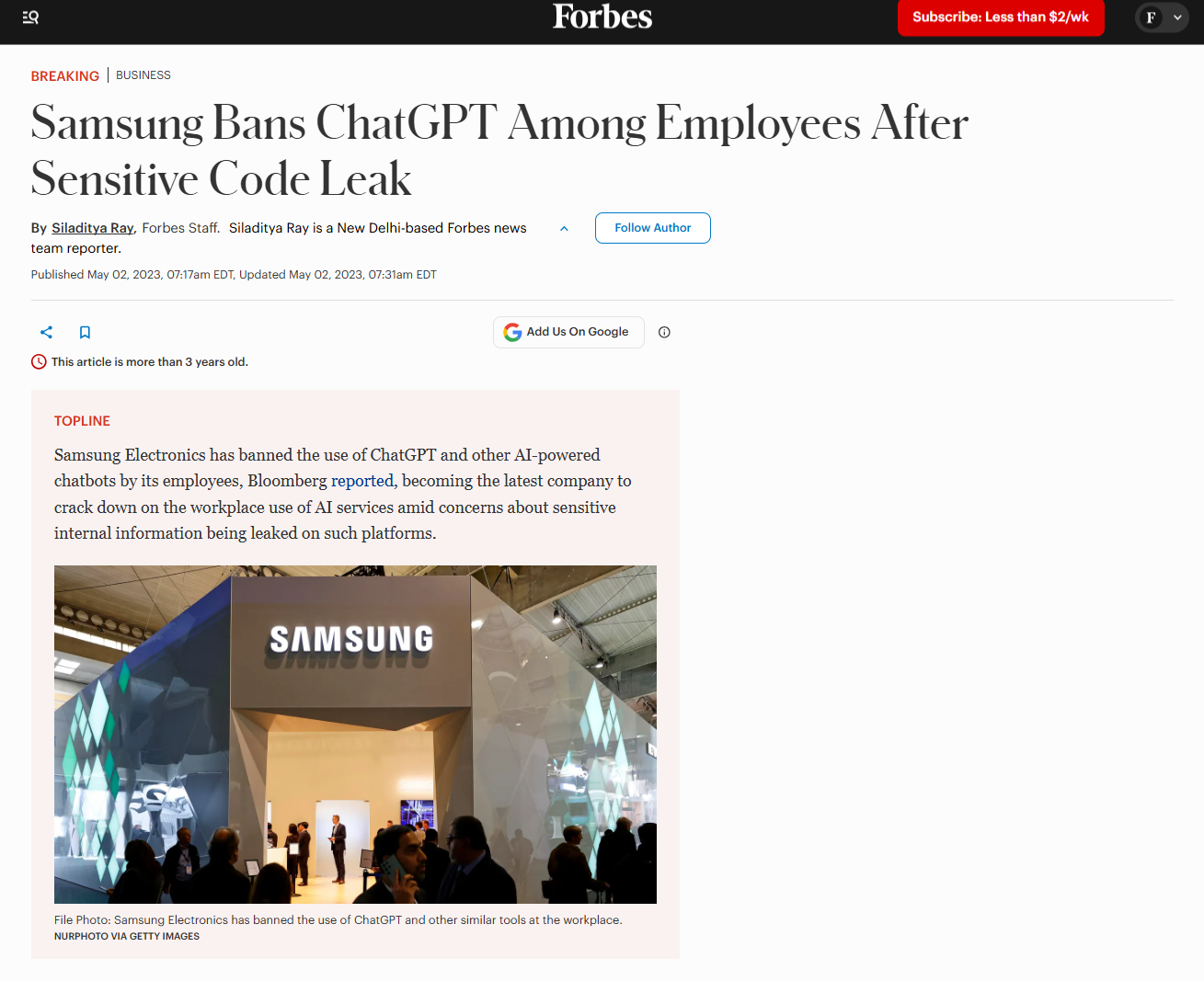
Samsung found this out in 2023, as per the Forbes’ Samsung article, when an engineer pasted source code into ChatGPT, and the company found that there was a data leak and ended up banning the AI-powered tools amongst their employees.
The problem was never just AI. The problem was where that AI lived, who could see what went into it, and whether anyone could prove what happened to your data after you hit "enter."
That's the entire idea behind private AI infrastructure. Once you understand how it actually works, you'll wonder why any enterprise still routes sensitive company data through someone else's black box.
What is private AI infrastructure for enterprises?
Private AI infrastructure is the full stack of compute, models, data pipelines, and governance controls that an organization runs and owns inside its own boundary, instead of sending every prompt out to a shared third-party service. By "own boundary" I mean its own environment that is secure.
It's not just "using AI privately." A lot of enterprises think they've solved this problem because they signed an enterprise agreement with a chatbot provider that promises not to train on their data. That's a contract. It's not infrastructure. The distinction matters because contracts can change, get reinterpreted, or simply get ignored when nobody outside the vendor can check.
Real private AI infrastructure means you control these things at once, not just one clause in a terms-of-service document, and deploy 100% private AI for your enterprise.
Where does the model run
Is it on a server you can point to, or somewhere you've never seen and can't audit?
Whose data trained it
Are you running a model trained on a random mix of internet data, possibly including other companies' prompts, or one where you control what went in?
What happens to your inputs after inference
Does your prompt disappear the instant the answer comes back, or does it sit somewhere, even briefly, where it could be breached, subpoenaed, or repurposed?
Who inside your organization can touch any of it
Can anyone with a login query the same sensitive dataset as your CFO, or are there real, enforced boundaries?
Answer all questions with certainty, not with a policy document you're trusting someone else to honor, and you have private AI infrastructure. Answer even one of them with "I'd have to check the contract," and you don't.
Think of the difference between renting a hotel room and owning a house.
In the hotel, someone else has a master key, sets the rules, and can change the terms of your stay whenever they want. In your own house, you decide who gets a key. Private AI infrastructure is the house.
Why the old way of renting intelligence is breaking down
For the last three years, most enterprises adopted AI the fast way: sign up, paste data in, get an answer out. That approach is now colliding with three hard facts.
First, mistakes are common. McKinsey's 2025 State of AI survey found that 51% of organizations using AI have experienced at least one negative consequence in the past year, and one-third of respondents said that inaccuracy was the reported cause. That's roughly one in two companies.
Second, incidents are climbing fast. Stanford HAI's 2026 AI Index recorded 362 documented AI-related incidents in 2025, up from 233 the year before. The trend line is not flattening.
Third, when something does go wrong, it's expensive. IBM's 2025 Cost of a Data Breach Report put the average US breach at a record $10.22 million USD, and breaches involving shadow AI, meaning AI tools nobody approved, cost roughly $670,000 USD more than a standard breach because they take longer to detect and expose far more data.
So why does this keep happening even at companies with strong security teams?
Because most enterprises adopting AI skipped the private AI infrastructure question entirely. Teams bought access to intelligence. But they never built a boundary around it.
Public AI platforms vs private AI infrastructure
Here's the practical difference, laid out side by side.
The three layers of every AI infrastructure stack
Here's the practical difference, laid out side by side.
Whether you're evaluating a vendor or building internally, real AI infrastructure architecture comes down to three layers, and skipping any one of them is where enterprises get burned.
The compute layer (Layer 1)
This is the physical or virtual hardware, GPUs, and the systems around them that actually run the model. The question that matters here isn't "how fast"; it's "who else has access to this machine while my workload runs?"
The model layer (Layer 2)
This is the intelligence itself, whether it's a frontier model you're renting through an encrypted API or an open-weight model you host and fine-tune yourself. NVIDIA's confidential computing documentation explains this well: businesses want assurance that data and models remain secure and uncompromised during both inference and fine-tuning, not just at rest.
The control layer (Layer 3)
This is everything governing how the first two layers get used, permissions, audit logs, data pipelines, and policy enforcement.
IBM's 2025 breach research found that 97% of organizations that suffered an AI-related breach had no proper access controls in place for their AI systems. Not weak controls, none. An agent given broad access to "just get the job done faster" can end up seeing more sensitive data than the employee who requested the task, simply because nobody scoped what it was allowed to touch in the first place.
Why hardware-based privacy works better than pure math, for now
There are multiple ways to ensure that no one, not even the AI vendor, can see your data while it's processed. It's worth knowing the two basic approaches, because the one that actually works today isn't the one you'd expect.
We have our privacy-preserving LLM inference for these approaches, done with SUPSI, a Swiss research university, with the findings published as an academic paper.
Here's the short version.
One family of approaches relies purely on math. The idea is elegant: encrypt your data so thoroughly that a computer can process it without ever "seeing" what's inside, similar to solving a puzzle through a sealed box without opening it. It's a genuinely strong privacy guarantee. The problem is speed. Today's versions are still far too slow, sometimes taking minutes to answer a single query, which rules them out for anything you'd actually use day to day.
The other family relies on hardware instead of math. Instead of computing on encrypted data, you seal off a protected, locked-down part of the chip itself. Your data gets decrypted only inside that sealed part, processed, and re-encrypted before it ever leaves. Nobody outside it, not the cloud provider, not the AI vendor, not even someone with physical access to the machine, can see what's happening inside.
This is called a Trusted Execution Environment, or TEE, and it's fast enough to run real, full-scale AI models today.
The honest trade-off: the math-based approach is theoretically stronger but not usable yet. The hardware-based approach works right now, but it does mean trusting that the chip itself was built correctly.
That's where attestation comes in, and it's what makes this verifiable instead of just another promise. Before any of your data is sent, the trusted execution environment generates a signed proof of exactly what's running inside that sealed part. If even one line of code has been changed, the proof fails and nothing gets sent. You're not trusting a company's word. You're checking a signature.
We have our open-sourced version of this tool, called Reticle, specifically so customers don't have to take their word for it either. Anyone can verify the proof themselves, directly from a browser.
Economics of owning enterprise AI infrastructure
Everyone assumes the private route is the expensive one. The numbers say something more specific.
CIO Dive’s Global AI News reported that global AI spending is projected to hit $2.59 trillion in 2026, up to 47% year over year, according to Gartner, and enterprises using pay-per-token APIs are watching that bill scale with every single query, every employee, and every new use case. There's no ceiling on it by design.
That is supported by the fact that usage-based pricing scales with consumption, while self-managed infrastructure follows a different cost model.
As more teams start using AI every day, the pricing model starts to matter just as much as the model itself.
Most AI platforms charge based on your usage. Every prompt, every completion, every AI agent, and every automated workflow consumes LLM tokens. On their own, those costs might seem manageable. But once AI becomes part of engineering, customer support, legal, finance, HR, and internal operations, token usage can grow much faster than many organizations expect.
Recent reporting from the Wall Street Journal on AI tokens shows that CIOs are already introducing AI spend monitoring, usage dashboards, and budget controls as token costs become a growing operational concern.
Confidential computing as a category is growing in the same direction. Grand View Research’s report projects the market will grow from $18.1 billion in 2026 to $153.8 billion by 2030, as enterprises move toward infrastructure with a predictable cost curve instead of a token meter that never stops running.
That doesn't automatically mean every organization should stop using AI APIs. For many teams, they remain the fastest way to build and experiment. But once AI becomes business critical and usage continues to grow, many enterprises begin asking a different question. Instead of paying for every interaction forever, would it make more sense to invest in infrastructure they control?
Why enterprise AI needs compliance-ready infrastructure
If you operate in or sell into the EU, the timeline just shifted, and it's worth knowing the current one so you don't plan against outdated dates.
The EU AI Act’s general-purpose AI COP has been applied since August 2025.
The EU AI Act’s transparency rules, like disclosing when someone is interacting with AI, still take effect in August 2026.
But the deadline for high-risk AI systems, the one most enterprises were bracing for, was formally pushed back. The Council of the European Union’s AI press confirmed that stand-alone high-risk systems now have until December 2027, and AI embedded in regulated products gets until August 2028.
That extra runway isn't a reason to wait. It's a reason to build the audit trail now instead of scrambling in 2027. An infrastructure that can't tell you what data went into which decision at which point in time doesn't get easier to fix under a deadline.
What private AI infrastructure looks like in production
JPMorgan Chase initially restricted employees from using consumer AI tools like ChatGPT over data-security concerns. Instead of just waiting it out, the bank built its own internal generative AI platform, called LLM Suite, entirely in-house. The tool now runs across more than 230,000 employees globally, giving staff access to models from providers like OpenAI and Anthropic inside a tightly controlled environment the bank itself governs. The intelligence is largely the same as what's publicly available. What changed is who controls where it runs and what happens to the data going in.
Mayo Clinic took a similar approach for clinical data. Rather than routing patient records through third-party AI tools, it built the Mayo Clinic Platform, a federated, privacy-preserving infrastructure that lets partner organizations train and validate AI models on de-identified clinical data without that data ever leaving a controlled environment.
Governments are making the same call. Singapore's Home Team Science and Technology Agency, the country's public safety and defense technology agency, built its own on-premise sovereign AI infrastructure called NGINE, running on dedicated NVIDIA GPUs, and has partnered with AI lab Mistral to build models on top of it. The agency has been explicit about the goal: control and agency over its own AI stack, not technological isolation from the rest of the industry.
They're the same pattern across three completely different sectors: real regulatory or competitive pressure made the public API shortcut unusable, and infrastructure they controlled was the only path to actually using AI on the data that mattered most.
Why enterprises need private AI infrastructure
Most organizations don't start by thinking about AI infrastructure.
They start with a chatbot.
Or an internal assistant.
Maybe a coding copilot or a document search tool.
Pretty soon it's not just one team either. Engineers are using it to write code, customer support is using it to answer tickets, legal's running contracts through it, HR's drafting policies with it, finance is pulling numbers out of it. And that's usually the moment things shift. AI stops being some tool someone's trying out and starts being part of how the place actually runs.
It becomes part of how the business operates. And that's exactly when the infrastructure underneath it starts to matter.
According to McKinsey's 2025 State of AI survey which I have mentioned earlier, 88% of organizations now use AI in at least one business function, up from 78% the previous year.
Verifiability builds confidence, not just trust
As AI becomes part of critical business processes, simply trusting that everything is running securely isn't always enough.
Enterprises want proof, plain and simple.
Proof the workload's running where it's supposed to, proof nobody's quietly changed anything under the hood, proof the data stays locked down the whole time it's being processed. That's exactly the gap confidential computing and hardware attestation exist to close.
Instead of relying only on policies or vendor promises, they provide technical ways to verify the integrity of AI workloads.
Knowledge should compound, not disappear
Every interaction with AI creates value.
Employees refine prompts, improve workflows, answer customer questions, write documentation, and solve new problems every day. Over time, that becomes organizational knowledge.
The challenge is that this knowledge often ends up not having saved the consistent memory across different chat histories, and individual accounts. Teams run into the same problems repeatedly because previous context isn't available when it's needed.
Private AI infrastructure gives you more control over how that knowledge is stored and reused.
You're not starting from zero every time. You're building on what's already there. And that adds up. The AI keeps getting sharper because it's learning from your actual data and how your team actually works, not just whatever it happened to be trained on originally.
Regulators are catching up faster than most teams expect
The more AI creeps into everyday operations, the more it ends up on a regulator's radar too.
If you're in healthcare, finance, insurance, or government, you already know this drill: strict rules on privacy, security, audits, where data's even allowed to sit.
Private AI infrastructure just hands that decision back to you. Instead of your sensitive workloads bouncing between a handful of outside services, you get to pick where AI actually runs, how the data gets handled, and what security wraps around it.
That level of control can make it easier to meet internal governance requirements as well as external regulations.
Predictable infrastructure costs become more important as AI scales
When a company is experimenting with AI, paying per token often makes sense. It's quick to get started, there's little upfront investment, and teams only pay for what they use.
Things look different once AI's actually woven into your everyday work, though. Every employee pinging an assistant, every workflow running on autopilot, every AI feature bolted onto an app, it all adds up in tokens fast.
As adoption grows across departments, so do the monthly bills.
As mentioned in the Wall Street Journal AI token shows that many enterprise technology leaders are now actively monitoring token usage and introducing budget controls as AI costs continue to grow.
AI adoption grows faster than most organizations expect
Many companies begin with one or two AI projects.
But once employees start seeing results, new use cases appear across the business.
Marketing wants AI to create content.
Customer support wants AI assistants.
Engineering wants coding copilots.
Legal wants contract review.
Operations wants workflow automation.
That growth is exciting, but it also creates new challenges. Different teams often end up using different AI tools and models, and this makes it harder for employees to manage multiple enterprise AI platforms across the organization.
Without something tying it all together, AI turns into a mess fast, harder to track costs, harder to keep secure, harder to give people a consistent experience no matter which team they're on.
Deloitte's State of Generative AI in the Enterprise backs this up, most organizations are past the experimenting phase now and focused on scaling AI properly, with governance and infrastructure becoming the priority as things mature.
Sensitive business data needs stronger protection
Not every AI workload is handling public information.
Many enterprise applications work with customer records, financial reports, source code, legal documents, product roadmaps, or internal communications. That makes data protection a core part of AI infrastructure rather than something that can be added later.
IBM's Cost of a Data Breach Report 2025 makes the financial stakes pretty clear here, organizations are still paying a steep price when breaches happen, which is exactly why more enterprises are getting picky about where sensitive data actually gets processed and who's allowed near it. Keep that data inside infrastructure your organization controls, and you cut down on exposure you didn't need to have in the first place.
Your AI is only as good as what it's allowed to see
That information usually lives all over the place inside a company, document folders, CRMs, ERPs, knowledge bases, whatever collaboration tool people are using that week.
Private AI infrastructure lets you plug models into all of that without giving up control over who touches what. Instead of shipping sensitive data out to a bunch of external services, you bring the AI to where your data already sits.
You're not just picking a tool, you're picking a foundation
As AI settles into daily operations, enterprises start looking past whatever project's in front of them right now.
They begin asking questions like:
- Can this support thousands of employees?
- Can we deploy different models when our needs change?
- Can we keep sensitive workloads private?
- Can we keep costs in check as usage grows?
- Can we build on what we've already put in, instead of starting over every time?
Those questions aren't really about the AI model.
They're about the infrastructure that supports it.
Getting that foundation right gives you more flexibility as AI adoption grows, whether you’re deploying a single assistant today or dozens of AI applications over the next few years.
Private AI infrastructure matters for regulated industries
The pressure to own your AI infrastructure isn't evenly distributed. Some industries are being pushed there faster than others, for very specific, very enforceable reasons.
Defense
Contractors handling Controlled Unclassified Information (CUI) now fall under the Pentagon's Cybersecurity Maturity Model Certification (CMMC), and the FY2026 defense policy law directs the DoD to build a dedicated security framework specifically for AI/ML systems contractors use.
Cyber Defense Magazine put the daily risk bluntly: engineers pasting requirements into a chatbot, analysts feeding technical notes into a retrieval system, it can all turn into a spillover of controlled data in a single paste inside an industry where that mistake carries national security consequences, not just a fine.
Legal
Nearly 8 in 10 legal professionals now use AI tools for work, but 44% of law firms still have no formal AI governance policy, according to Clio's Legal Trends report. Every one of those unmanaged tools is a potential breach of attorney-client privilege, since privilege can depend on whether client information stayed genuinely confidential, not just whether it was labeled that way.
Banking
Under the EU's Digital Operational Resilience Act (DORA), any AI agent that touches a bank's systems is treated as an ICT system, subject to the same risk management, incident reporting, and third-party oversight rules as core infrastructure. A bank has to be able to trace what data fed any AI-driven credit or fraud decision, on demand, or face fines of up to 2% of global annual turnover.
Government
Public sector AI carries its own weight under the EU AI Act, where high-risk system obligations cover most government AI use under Annex III, alongside citizen data that often can't legally leave certain jurisdictions in the first place. Singapore's HTX and its NGINE platform, mentioned earlier in this piece, are a direct response to that same pressure: build the infrastructure yourself rather than accept someone else's terms for citizen data.
Healthcare
A single HIPAA violation can now cost up to $2,190,294 USD per violation category per violation, before accounting for the reputational damage of a patient data breach. Mayo Clinic's approach, mentioned earlier, keeping data inside a federated, privacy-preserving environment rather than routing it through a public API, isn't caution for its own sake. It's the only structure that keeps HIPAA-covered data probably inside the boundary it's required to stay in.
Insurance
The NAIC's Model Bulletin on the use of AI systems by insurers requires a written governance program covering bias testing, third-party vendor management, and documentation ready for regulatory review, with a dedicated AI Systems Evaluation Tool now being piloted across a dozen states. Insurers using third-party AI models without visibility into how those models were trained or what happens to policyholder data are exactly the exposure regulators are now built to find.
The common thread across all six is the same one from earlier in this piece: a contract or a policy document isn't proof. Regulators, and increasingly courts, want the architecture itself to demonstrate the control being claimed.
What to look for in a private AI infrastructure
If you're setting AI infrastructure requirements for your own evaluation, here's the shortlist that actually separates real private infrastructure from a privacy policy with good marketing.
Private by architecture, not just by policy
Many AI providers promise they won't use your data for training.
That's an important commitment, but it's still based on trust.
Private AI infrastructure takes a different approach.
It's not about trusting a policy or a contract to hold up. It's built so the sensitive stuff physically stays inside infrastructure you control, whether that's your own cloud, your own VPC, or a separate environment built specifically for confidential work.
This becomes especially important when AI is working with customer records, financial information, source code, legal documents, healthcare data, or other sensitive business information.
Verifiable, not based on promises
Privacy is important, but enterprises also need confidence that their AI workloads are running the way they're supposed to.
That's where verifiability comes in.
You're not just taking someone's word that the environment is secure. Private AI infrastructure actually hands you proof, real, checkable proof that the workload ran inside trusted hardware and nothing got tampered with along the way.
Technologies such as confidential computing and hardware attestation allow your organization to verify the integrity of its computing environment before sensitive data is processed.
Compounding knowledge instead of starting from scratch
One of the biggest advantages of private AI infrastructure isn't just what it protects.
It's what it lets you build over time, honestly.
Every day people are answering questions, refining prompts, writing docs, building workflows, solving the same kinds of problems. All of that is knowledge, real organizational knowledge. Without the right setup, most of it just evaporates the second the conversation ends or gets buried in some tool nobody checks.
Private AI infrastructure means that knowledge actually sticks, gets connected, and gets reused instead of rebuilt from scratch every single time. Instead of rebuilding context every time a new assistant or workflow is created, teams can build on what they've already learned.
Zero data retention that's structural, not contractual
Your data should never touch the disk in the first place, not just get deleted "eventually."
Hardware attestation
This means the hardware itself signs a verifiable proof of what ran and what was kept, so your security team can check the claim directly instead of taking anyone's word for it.
Model agnosticism
You should be able to swap models without re-architecting your entire stack, so you're never one policy change away from being stuck.
Granular, role-based access controls
Not every employee or agent should see every dataset, and your infrastructure should enforce that automatically, not rely on someone remembering to configure it.
A real audit trail
Every prompt, every model call, every output should be traceable, because if you can't reconstruct what happened, can you really call it governed?
Where Prem AI fits into your AI infrastructure
Every enterprise adopting AI right now is making a decision about data sensitivity, whether anyone has explicitly discussed it or not. Every prompt, every document, every workflow handed to a shared AI tool is a small bet that a policy document will hold up under pressure, that a contract won't quietly change, that a vendor's promise is as strong as a vendor's architecture. Most of the time, that bet stays invisible. Then a breach happens, or a regulator asks a question nobody can answer, and the bet comes due all at once.
The enterprises getting this right aren't avoiding AI. They're refusing to hand over control of it. That's the entire shift behind private AI infrastructure: the same intelligence, running where you can see it, verified by hardware instead of trust, with your institutional knowledge compounding inside walls you actually own.
Prem AI built its infrastructure around exactly that principle: private by architecture, verifiable by proof rather than promise, compounding of intelligence, and structured so your organization's learning stays yours.
Whether that means an encrypted API for your engineering team or infrastructure installed directly onto hardware you already run, the underlying question is the same one this entire piece has been circling back to: is your data compounding inside walls you control, or is it quietly building someone else's moat instead?
If you are looking for a full-fledged private AI infrastructure, we've got you covered. You can either contact our sales team or email us at sales@premai.io.
FAQs about private AI infrastructure
What is private AI infrastructure?
Private AI infrastructure is the compute, models, data pipelines, and access controls an organization runs inside its own boundary instead of sending prompts through a shared third-party service. It determines where a model runs, who can see your data, and whether anything is retained after inference, keeping sensitive information inside your environment by design.
How is private AI infrastructure different from a private cloud?
A private cloud secures where your general computing happens. Private AI infrastructure goes further, covering the specific model layer, data pipelines feeding that model, and the inference process itself. You can have a private cloud and still send prompts to a public AI vendor, which defeats the purpose entirely.
Does private AI infrastructure mean I have to build my own data center?
No. You can rent attested, confidential-computing hardware from a provider and still get structural privacy guarantees, verified through hardware attestation rather than a contract. Full ownership of physical servers is one option among several, not a requirement to achieve genuine data privacy and control.
What is zero data retention and why does it matter?
Zero data retention means nothing you send ever gets saved anywhere, not even briefly, not "stored then deleted later." It matters because anything that touches a disk, even for a second, can get caught in a breach, pulled into a lawsuit, or quietly used to train the next model version.
What is confidential computing, in plain terms?
Confidential computing uses specialized hardware to isolate your data while it's actively being processed, so nobody, not even the cloud provider running the servers, can see it. The hardware then generates a signed proof of what ran, letting your security team verify the claim independently instead of trusting a policy document.
Is private AI infrastructure only for regulated industries like healthcare and finance?
Not even close. Healthcare and finance feel the heat first because of HIPAA, DORA, and rules like them. But if your company has proprietary code, customer records, or a strategy you'd hate to see leaked, you're carrying the same risk. Samsung wasn't a bank or hospital, and it still made headlines.
How does private AI infrastructure affect long-term costs?
Pay-per-token APIs get expensive in ways you can't really predict, there's no ceiling built in, so the bill just climbs as usage does. Private infrastructure flips that. Once it's set up, you're not paying a toll on every single interaction, so your costs settle into something you can actually plan around.
What's the difference between open-weight and closed models here?
Closed models run entirely on a vendor's infrastructure under their terms, and you generally cannot retrain or inspect them. Open-weight models can be self-hosted, fine-tuned, and run inside your own confidential infrastructure, giving you the ability to compound your own data and knowledge into the model over time.
Does private AI infrastructure automatically satisfy EU AI Act or GDPR requirements?
No single infrastructure choice grants automatic compliance. However, private AI infrastructure gives you the audit trails, access logs, and data control needed to demonstrate compliance far more easily than a public tool where you cannot verify what happens to data after submission, which regulators increasingly expect you to prove.
How do I start moving from public AI tools to private AI infrastructure?
Start by finding out what your teams are already using, approved or not, you'll probably find more shadow AI than you expect. Then tackle your riskiest workflows first, legal, finance, anything touching customer data, and when you're comparing providers, judge them on attestation and zero retention before you even look at price.
See how Prem AI can help your enterprise build private AI without compromising control over your data and infrastructure. Contact our sales team, or email us at sales@premai.io.