7 Best Open Source LLMs for Cybersecurity & Threat Detection in 2026
On this page
On August 25, Boston Scientific found attackers inside its IT network. The attack disrupted systems across the company and stopped it from processing and shipping customer orders. According to SecurityWeek's breach report, the company still could not give a timeline for full recovery.

For your enterprise, incidents like this show why faster threat detection matters. Your team needs to identify the right signals early and respond before an attack starts affecting wider operations. Open-source LLMs help you review alerts and analyse logs faster. They also support code review and incident reporting while giving you full control over sensitive security data.
At Prem AI, you get access to more than five open-source model families through one OpenAI-compatible Enclave API. When you compare models, look at more than benchmark scores. Model size and license terms matter, and so do hardware needs and support for images.
Running these models on infrastructure you control also gives you full control over sensitive security data. The right model depends on the kind of work your team needs to handle and how much control you want over deployment.
Why use open-source LLMs for cybersecurity and threat detection?
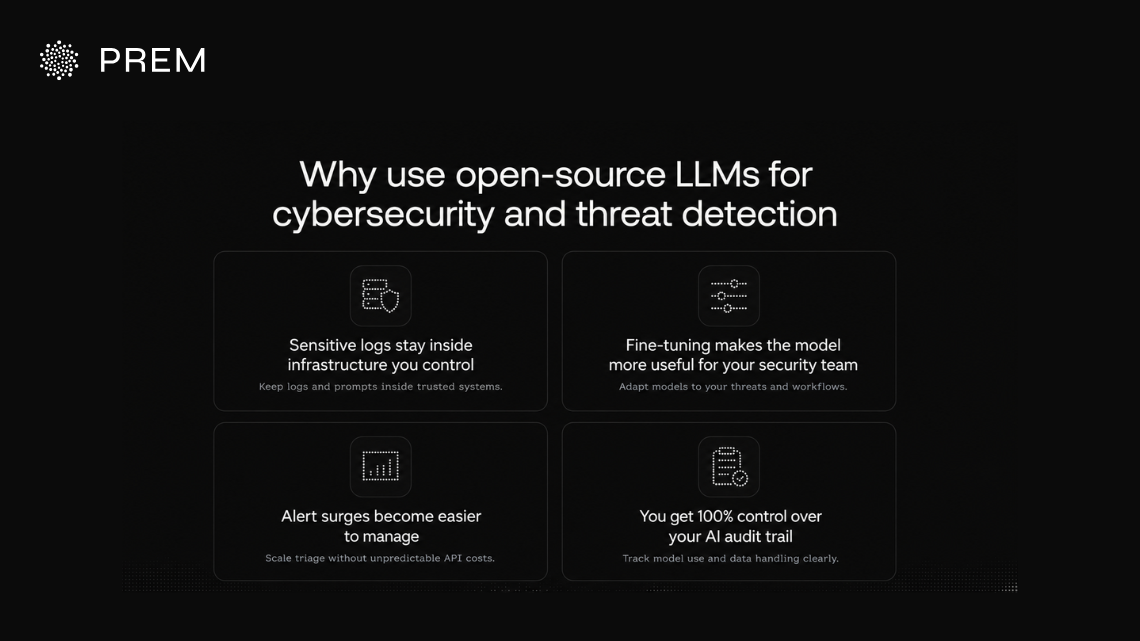
Below are some of the main reasons open-source LLMs can give your security team 100% control over sensitive data and how AI fits into your existing security stack.
Sensitive logs stay inside infrastructure you control
Your SOC alerts can contain internal hostnames and user details. They may also include customer data or information about how your systems are configured.
The risk is already visible since TechRepublic's AI leak coverage found that generative AI tools now drive 32% of unauthorized corporate data movement. Running an open-source model on your own infrastructure gives you complete control over where your prompts and outputs are processed.
Fine-tuning makes the model more useful for your security team
A general open model does not know how your environment works or what threats your team has handled before. Open weights let you adapt the model around your own security needs instead of relying only on a general-purpose system.
You can fine-tune it on relevant data or connect it to your detection rules through retrieval. This gives your team a model that works with the context and patterns that matter inside your environment.
Alert surges become easier to manage
Your SOC may already deal with thousands of alerts on a busy day. A Vectra AI survey cited in DevX's daily news found that the average SOC receives nearly four thousand alerts each day and ignores 62% of them.
Sending that volume through a usage-based API can make costs rise quickly during an incident. Running an open model on infrastructure you manage gives you full control over capacity and makes your spending easier to plan.
You get 100% control over your AI audit trail
Your security or compliance team may need to show where sensitive data was processed and who had access to it. That becomes easier when you control the model version and the infrastructure running it.
The CISA guidance on securing AI data recommends protecting AI data across its lifecycle and using trusted infrastructure. Keeping clear logs of model activity gives your team a better record when security or compliance reviews happen.
Keep Your Security Data Under Your Control
Run open-source models through Enclave API without sending sensitive security workloads to a public model endpoint.
Start buildingWhat should you look for in an open-source LLM for cybersecurity?
| Model | Built by | Size | Where it fits best |
|---|---|---|---|
| DeepSeek V4 Flash | DeepSeek | 284B total, 13B active | Long-context investigations and code audits |
| Qwen3.8-27B | Alibaba | 27B | Phishing triage and multilingual threat intel |
| Kimi K3 | Moonshot AI | 2.8T total | Agentic vulnerability research and red teaming |
| Llama 4 | Meta | Up to 400B total, 17B active | Custom security fine-tunes with open guardrails |
| MiMo-V2.6 | Xiaomi | 309B to 1.02T total | Multimodal investigations across logs and screenshots |
| GLM-5.2 | Z.ai | 753B total, about 40B active | Terminal-based security automation and code review |
| Antares | Cisco Foundation AI | 350M and 1B | Finding vulnerable files in large codebases |
7 best open-source LLMs for cybersecurity and threat detection in 2026
Below is a quick table of the seven best open-source LLMs for cybersecurity and threat detection in 2026. Use it to match a model to your workload before you read the full breakdown of each one.
| What to check | Why it matters to your team | Enterprise-ready standard |
|---|---|---|
| Security-domain training | A model trained on CVEs and threat reports gives your analysts useful answers with less prompting | You see published results on security benchmarks before the model reaches your SOC |
| License terms | Some open models carry usage limits that can block your commercial or government deployment | You get Apache 2.0 or MIT terms with no revenue caps |
| Hardware footprint | The model has to fit inside your SOC budget and your own data center | Your daily triage runs on one or two GPUs |
| Context window | Your long logs and full incident timelines need room in a single prompt | You have 128K tokens or more for log-heavy investigations |
| Reasoning ability | Your triage and root-cause work depend on step-by-step analysis you can follow | You can switch on a reasoning variant or thinking mode when a case needs it |
| Prompt injection resistance | Attackers can plant instructions inside the logs and emails your model reads | Your team has tested it against known injection patterns and added input filtering |
| Deployment control | You decide where the weights live and who gets to call the model | You can self-host it fully and log every prompt and output |
DeepSeek V4 Flash
If you want strong reasoning without sending your security data to an external API, you can run DeepSeek V4 Flash on the infrastructure you control. It gives your team a practical way to analyse security data without relying on a hosted model.
Its 1M-token context window also helps when your SOC needs to work with a lot of information at once. You can load large sets of authentication logs or an entire service codebase and use the model to trace suspicious activity across them.
Project information
| Detail | Value |
|---|---|
| Developer | DeepSeek |
| Release | April 2026 |
| License | MIT |
| Size | 284B total, 13B active per token |
| Context window | 1M tokens |
Key features of DeepSeek V4 Flash for cybersecurity and threat detection
- Whole-service code audits fit in one go, so flaws that span several files stop slipping through.
- Ask it why an alert looks risky and it answers in plain language your whole team understands.
- Fine-tuning on your past incidents teaches it what attacks on your network look like.
- Costs stay steady during an incident because only a small part of the model runs per request.
Use the Right Model for Each Security Workload
Access more than five open-source model families through one OpenAI-compatible Enclave API and choose the model that fits each security task.
Explore Enclave APIQwen3.8-27B by Alibaba
Qwen3.8-27B fits well when your security team wants to run a capable model without needing a large GPU setup. Its smaller size also makes it easier to deploy with the tools your team already uses.
You can run it closer to systems such as your email gateway or SIEM. That helps keep phishing analysis fast while giving you complete control over sensitive message data inside your own environment.
Project information
| Detail | Value |
|---|---|
| Developer | Alibaba |
| Release | August 2026 |
| License | Apache 2.0 |
| Size | 27B dense |
| Context window | About 256K tokens |
Key features of Qwen 3.8-27B for cybersecurity and threat detection
- Phishing emails in Mandarin or Russian get read without a separate translation step.
- Plug it into your SOAR playbooks and it pulls threat intel feeds on its own.
- Raw firewall and proxy logs turn into short summaries your analysts can act on.
- Branch offices and air-gapped sites are within reach because it fits where bigger models will not.
Kimi K3 by Moonshot AI
Kimi K3 gives your red team an agent that can work through a large codebase for hours with little supervision. Moonshot AI trained it to move around repositories and run terminal tools on its own, which is close to how real vulnerability research works.
That same power means you should run it in a controlled setup. In our Prem CyberScan launch post, we listed Kimi K3 among the open source models that power our AI security agent, and you can pick it when you run a scan.
Excited to announce the launch of Cyberscan - Prem's proprietary security agent for vulnerability detection built in partnership with @ArkLabsHQ and the @Breez_Tech Powered exclusively by open-source models like Kimi-K3, Qwen-3.8-Max and more, Cyberscan has helped over 20 teams find mission critical vulnerabilities in their codebases, preventing massive liabilities. Starting Today, Cyberscan is available for public access (link below) with $25 in free-credits for new users. Login with your github, connect a repo and it takes care of the rest - surfacing vulnerabilities that you definitely might have missed out.
— Prem (@premai_io) August 20, 2026
Prem Cyberscan uses the model to trace how your files connect and follow possible attack paths, then returns prioritized findings with severity ratings and file-level evidence. Every run goes through our EU North infrastructure.
Project information
| Detail | Value |
|---|---|
| Developer | Moonshot AI |
| Release | July 2026 (weights published July 27) |
| License | Kimi K3 License |
| Size | 2.8T total (mixture of experts) |
| Context window | 1M tokens |
| Input | Text and images |
Key features of Kimi K3 for cybersecurity and threat detection
- Point it at a full repository and it returns suspected weak spots with its reasoning for each one.
- During a red-team exercise it can run scanners and read their output on its own.
- Screenshots of phishing pages or attacker panels are fair game for its built-in vision.
- Long exploit chains and the code behind them stay in view at the same time.
Find Vulnerabilities With Evidence Your Team Can Verify
Prem Cyberscan uses open-source models to analyse repositories and return prioritized findings with file-level evidence.
Start With Prem CyberscanLlama 4 by Meta
Llama 4 is a good option when you want a model that your team can adopt without much setup work. You can start with Scout for lighter workloads and move to Maverick when you need more capacity.
Its biggest advantage is the ecosystem around it. Your team can use existing fine-tunes and community tools to adapt Llama 4 for security tasks instead of building everything from scratch.
Project information
| Detail | Value |
|---|---|
| Developer | Meta |
| Release | April 2025 |
| License | Llama 4 Community License (check its terms before deployment) |
| Size | Scout 109B total, Maverick 400B total, both 17B active |
| Context window | Up to 10M tokens on Scout |
| Input | Text and images |
Key features of Llama 4 for cybersecurity and threat detection
- Llama Guard and Prompt Guard screen incoming alerts and emails for hidden prompt injections.
- Proven fine-tuning recipes such as Trend Micro's Llama-Primus give your playbook work a head start.
- Months of audit logs fit into Scout for one long investigation.
- Self-hosting is easy with tools like vLLM and Ollama that your team may already run.
MiMo-V2.6 by Xiaomi
MiMo-V2.6 gives your team a newer open model that already includes cybersecurity work in its training mix. That makes it easier to use for security tasks without starting from a model that was built mainly for general-purpose use.
Xiaomi trained it across cybersecurity and coding tasks alongside agent workflows. For your team, that gives you a model that can handle security analysis while still working across broader technical tasks.
Project information
| Detail | Value |
|---|---|
| Developer | Xiaomi |
| Release | September 2026 |
| License | MIT |
| Size | Pro 1.02T total, 42B active; Flash 309B total, 15B active |
| Context window | 1M tokens |
| Input | Text, images, audio and video |
Key features of MiMo-V2.6 for cybersecurity and threat detection
- Phishing screenshots and recorded vishing calls go in right next to your raw logs.
- A full incident timeline and a large code review fit in one prompt.
- Xiaomi's open training code and environments let you tune it on your own detections.
- Run the lighter Flash version for daily triage and save Pro for deep investigations.
GLM-5.2 by Z.ai
GLM-5.2 gives your security engineers a model that can handle longer tasks directly from the terminal. It can plan several steps and run commands while keeping track of the wider task. It was also the first open-weight model to score above 80% on Terminal-Bench.
This becomes useful when your team builds or maintains its own security tools. You can give the model a detection pipeline or technical issue and let it work through the task step by step while your engineers review the changes.
Project information
| Detail | Value |
|---|---|
| Developer | Z.ai (formerly Zhipu AI) |
| Release | June 2026 |
| License | MIT |
| Size | 753B total, about 40B active |
| Context window | 1M tokens |
| Input | Text only |
Key features of GLM-5.2 for cybersecurity and threat detection
- Long agent sessions can scan, test and patch code inside your own sandbox.
- An entire monorepo gets reviewed for insecure patterns in a single pass.
- Routine SOC scripts like log parsers and enrichment jobs need less hand-holding to automate.
- The MIT license lets you self-host and modify it with no limits on commercial use.
Antares by Cisco Foundation AI
Antares is designed to help your team locate where a known vulnerability may sit inside a large codebase. You can give it a vulnerability description and use the model to narrow the search down to the files most likely to contain the issue.
Cisco reports that Antares-1B performed strongly on its vulnerability localization benchmark against much larger models. That gives your team a lightweight option for speeding up the first stage of vulnerability investigation.
Project information
| Detail | Value |
|---|---|
| Developer | Cisco Foundation AI |
| Release | July 2026 |
| Availability | Open weights on Hugging Face |
| Size | 350M and 1B parameters (3B planned) |
Key features of Antares for cybersecurity and threat detection
- New advisories map straight to the exact files your developers need to patch.
- Local hardware is enough to run it, so your source code never leaves your network.
- Every commit can get a security check because each run costs very little.
- Pair it with a bigger reasoning model that reviews the flagged files in depth.
Real use cases of open-source LLMs for cybersecurity and threat detection
These examples come from real teams and real incidents. Each one shows a job an open model can take off your plate.
Investigating a breach when hosted AI says no
In July 2026, an autonomous AI agent broke into Hugging Face's production systems. The security team first tried hosted frontier models to analyze the attack logs, but the providers' safety filters blocked the requests because they could not tell a defender from an attacker.
The team then switched to GLM 5.2 on its own servers, and The Register's incident report notes that no attacker data left its environment during the analysis. Keep an open model ready on your own hardware and your incident response never has to wait on someone else's usage policy.
Finding and fixing bugs before attackers do
DARPA's AI Cyber Challenge asked teams to build AI systems that could find and patch flaws in real open-source software on their own. In the 2025 final the systems found 54 planted vulnerabilities and patched 43 of them, and DARPA's results announcement notes they also uncovered 18 real flaws nobody had planted.
The finalist systems are now open source, so your team can run the same approach on your own codebase with open models you trust.
Catching phishing sites that blocklists miss
A research team built PhishLang as an open-source language model that reads a web page and judges whether it is a phishing site. Over three and a half months of live testing it flagged around twenty-six thousand phishing URLs that popular blocklists had often missed. You can try the model yourself on the FreePhish scanning site before deciding how it fits your stack.
Your team can put the same idea to work at your email gateway and stop fresh phishing pages before they reach your users' inboxes.
Turning fresh threat intel into detection rules
Detection engineers often spend hours turning a new threat report into rules their tools can use. A study published in MDPI's Electronics journal tested an LLM pipeline that pulls threat intel from OpenCTI and writes ready-to-deploy detection queries for Microsoft Defender.
The whole process dropped from hours to under five minutes, which means your team can ship coverage for a new attack the same day it is reported. Running that pipeline on a self-hosted model keeps your threat intel and detection logic inside your own network.
Build your private cybersecurity LLM stack with Prem AI
Your SOC handles different tasks across alert triage and code review as well as threat hunting. Using different models for each job gives your team more flexibility and avoids relying on one model for everything.
At Prem AI, we built Enclave API so you can access more than five open-source model families through one OpenAI-compatible endpoint. Your security data stays protected during inference so your team can use the right model without exposing sensitive logs.
For code security, Prem Cyberscan helps your team find vulnerabilities across repositories and shows the exact file and line behind each finding.
If you are planning to bring open-source models into your SOC, our team can help you choose the right setup. Contact our sales team or email us at sales@premai.io to get started.
FAQs about open-source LLMs for cybersecurity and threat detection
How are open-source LLMs used in cybersecurity?
Open-source LLMs can help your team review alerts and analyse logs as well as support code review and incident reporting. You can also use them for threat intelligence and vulnerability research. Their main advantage is that you have full control over where the model runs and how sensitive security data is handled.
Why should your security team use an open-source LLM?
Open-source LLMs give you control over your security data and deployment setup. You can run them on infrastructure you manage and adapt them around your own workflows. This becomes useful when your SOC handles sensitive logs or code that you do not want to send through an external model service.
What should you look for in an open-source LLM for cybersecurity?
Look at security-domain training and context length as well as reasoning ability and deployment control. The model also needs to fit your available hardware and licensing requirements. For security use cases, you should also consider prompt injection resistance because your model may process untrusted logs or emails during normal work.
Can open-source LLMs help with threat detection?
Yes. Your team can use open-source LLMs to process security alerts and summarise logs so analysts can focus on activity that needs closer attention. Models with longer context windows can also work across larger incident timelines or authentication logs without forcing you to split the investigation into many smaller prompts.
Can you run cybersecurity LLMs on your own infrastructure?
Yes. Many open models can be self-hosted so your security data stays on infrastructure you control. The hardware you need depends on the model size and workload. Smaller models may fit into lighter GPU setups while larger models require more capacity for longer investigations or more complex reasoning tasks.
How does Prem AI help you run open-source LLMs for cybersecurity?
Prem AI gives you access to more than five open-source model families through one OpenAI-compatible Enclave API. You can also run models on your own GPU infrastructure or VPC with Prem Enclave. This gives your team more flexibility when different security tasks need different models or deployment setups.
How does Prem Cyberscan fit into an open-source cybersecurity stack?
Prem Cyberscan focuses on code security. It helps your team find vulnerabilities across repositories and shows the exact file and line behind each finding. Prem also uses open-source models inside Cyberscan to analyse code relationships and possible attack paths so your developers get findings they can review directly.
See how Prem AI can help your enterprise build private AI without compromising control over your data and infrastructure. Contact our sales team, or email us at sales@premai.io.