DeepSeek V4 Flash 0731: How Close Is It to Frontier-Level Intelligence?
On July 31, 2026, DeepSeek released V4 Flash 0731, its latest open-weight AI model. The update brings significantly improved agent and coding capabilities while keeping the same model architecture and size as the earlier V4-Flash preview.
The release has already attracted attention beyond the open-source AI community. Reuters reported on V4 Flash’s strong cost efficiency, while Artificial Analysis gave it a score of 50 on its Intelligence Index.
The model is also making its way into enterprise AI infrastructure. Microsoft has added DeepSeek V4 Flash and V4 Pro to Microsoft Foundry, pointing to a broader shift toward matching different models to different workloads rather than relying on a single “best” model.
For enterprise teams, this signals a broader change in how AI is being evaluated. Open-weight models are moving beyond the role of lower-cost alternatives and becoming serious options for building AI systems where capability, deployment control, and infrastructure flexibility matter.
For a long time, you often had to choose between capability, cost, and control. A model could be powerful but expensive to run, or cheaper and easier to deploy, but not quite capable enough for demanding enterprise work. DeepSeek V4 Flash 0731 puts that trade-off to the test with strong coding and agentic performance, open-weight access, and a 1-million-token context window.
So, what exactly has DeepSeek released, how capable is V4 Flash 0731 in practice, and how close is it to the frontier? More importantly, what could this shift mean for the way you deploy AI across your enterprise? Let’s explore.
What is DeepSeek V4 Flash 0731?
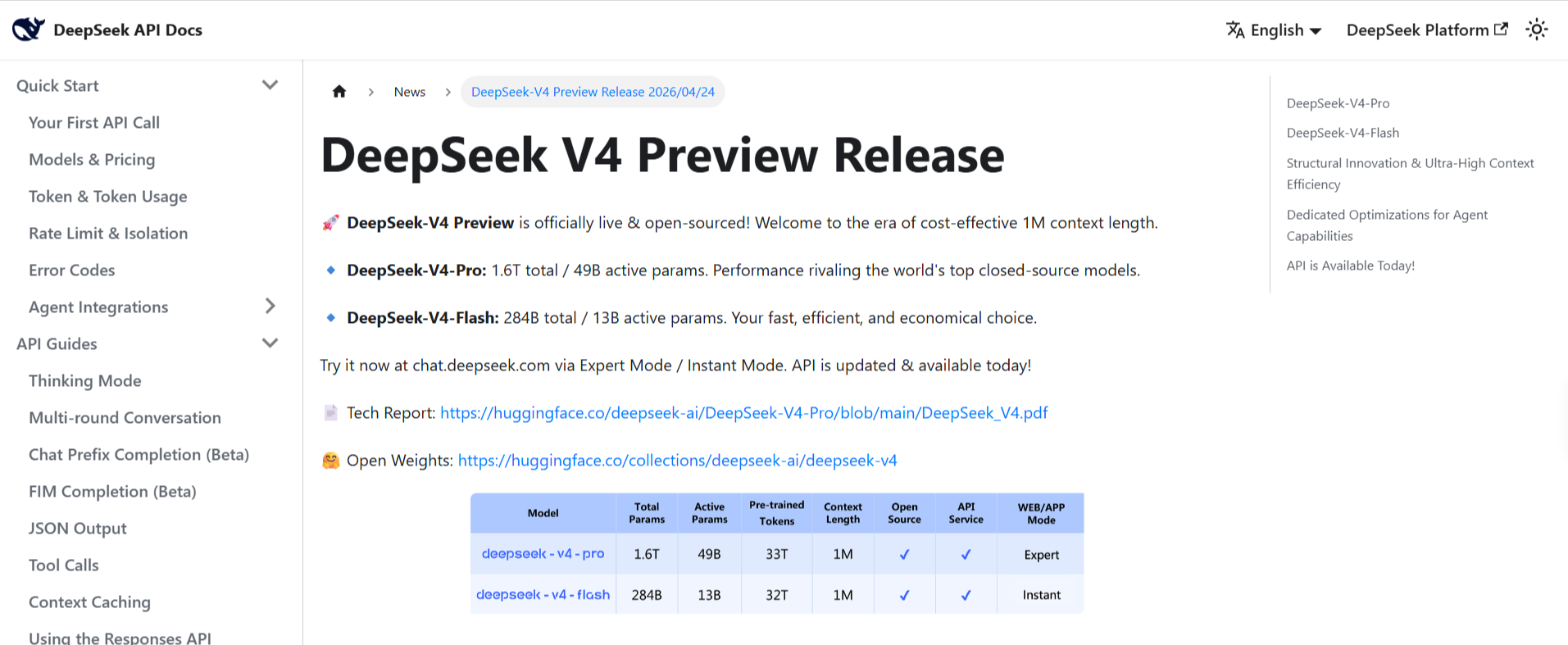
DeepSeek V4 Flash 0731 is an open-weight AI model from DeepSeek, built for demanding workloads like reasoning, coding, and agentic tasks you might already be running. It's the official 0731 release of V4 Flash, following an earlier preview version. The "0731" refers to the July 31 release date. DeepSeek didn't introduce a new architecture with this update; it kept the same architecture and model size as the preview, improving performance through post-training instead.
It's built as a Mixture-of-Experts model with 284 billion total parameters, but only 13 billion of those activate for any given task you send it. That's the part that actually matters to you in practice: most of the model stays dormant on any single request, which is why it can run a demanding job without your costs scaling the way they would with a fully dense model of the same size.
It also supports a 1-million-token context window, giving you room to work with very large inputs, your extensive codebases, long documents, or large collections of enterprise information within a single request.
The model weights are available under an MIT licence. You can download it, run it on your own infrastructure using frameworks like vLLM or SGLang, and fine-tune it for commercial use without licensing restrictions, a meaningfully different starting point than a closed, API-only frontier model where you'd be renting access rather than owning anything.
Why this release matters to enterprise AI teams
The V4 Flash 0731 release is interesting because DeepSeek did not need to build a larger model to make it more capable. The network structure and parameter scale remain the same as the earlier V4 Flash preview. The upgrade came through targeted post-training focused on improving how the model handles real-world tasks.
Agentic performance
Agentic work is a major part of that improvement, and it is worth looking at what changed. The earlier V4 Flash preview ranked first among open-weight models on agentic tasks, but according to Artificial Analysis, it also came with higher hallucination rates and heavy token consumption. The 0731 release improved both: Artificial Analysis found an 11-point reduction in hallucination rate, while the model used roughly 12% fewer tokens to complete the same evaluation suite. That matters when you are running agentic workflows, where token consumption can compound across multiple steps.
Cybersecurity and vulnerability analysis
Cybersecurity and vulnerability analysis is another area where the 0731 update shows a significant improvement. On CyberGym, a UC Berkeley benchmark that evaluates AI agents on real-world vulnerability analysis and reproduction tasks, V4 Flash 0731 scored 76.7%, compared with 38.7% for the earlier preview and 52.7% for V4-Pro-Preview, according to AIToolsReview.
That gives you another potential use case if you're on a security team. You can use the model to support vulnerability analysis, code review, and security research, helping your team identify and investigate potential weaknesses across large codebases.
This doesn't mean you can replace your security platform or security team with the model. It can, however, become part of a broader security workflow where AI helps teams find and investigate vulnerabilities before they can be exploited.
There is also a point to keep in mind when comparing benchmark results. Scores can vary depending on the agent framework, tools, and evaluation setup used. The CyberGym leaderboard includes results from different agents and evaluation setups, so treat the numbers as a useful signal rather than a precise, like-for-like comparison.
Capability, cost, and control
The model also gives you a combination that matters for enterprise use: long context, strong coding and reasoning capabilities, and open-weight access. You can work with large codebases or document sets while having more flexibility over how and where you run the model.
Cost is another part of the equation. V4 Flash is positioned as the more efficient option in the V4 family, and, as mentioned earlier, Artificial Analysis found a significant cost advantage over V4 Pro. But the price per token does not tell you what you will actually spend. Agentic workflows can use a lot of tokens, so your total cost will depend on how heavily you use the model and what you use it for.
Parameter efficiency
Parameter count gives you another way to look at the model. V4 Flash 0731 uses a Mixture-of-Experts architecture with 284 billion total parameters, but only 13 billion are active for each token. That is much smaller than several other open-weight models in the same competitive group. Xiaomi's flagship model has 1.02 trillion parameters, DeepSeek V4-Pro has 1.6 trillion, and Kimi K3 has 2.8 trillion, according to AIxploria.
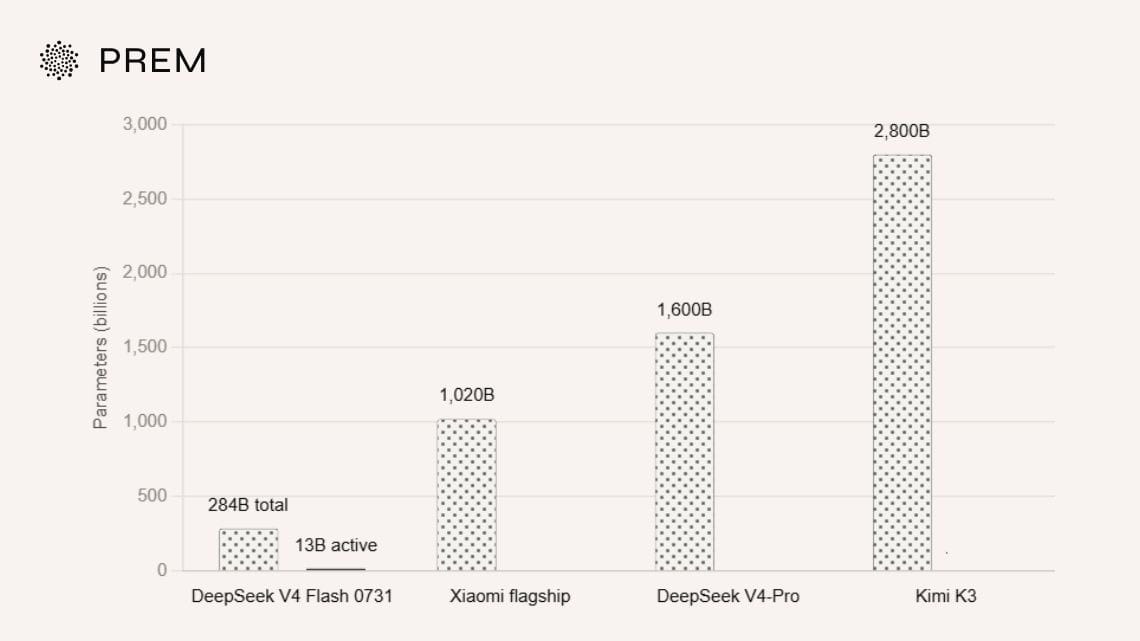
For your enterprise, that difference matters because you're getting a model that reaches a similar range on the Intelligence Index while using a fraction of the parameter count. That can make a difference when you're planning the infrastructure and costs needed to run it.
That efficiency isn't limited to composite benchmark scores, either.
V4 Flash 0731 also performs strongly on real-world work tasks. On Artificial Analysis' GDPval-AA v2 leaderboard, which evaluates AI agents on professional tasks across 44 occupations, V4 Flash 0731 scores 1,558 Elo. That puts it within range of GPT-5.6 Luna (1,581) and Terra (1,578), and not far behind Claude Opus 4.8 (1,586). This is a useful signal that its strengths aren't limited to coding benchmarks. It can also compete on broader tasks that require an agent to reason, use tools, and complete a multi-step deliverable.
Output token pricing
Output-token pricing makes the cost difference easier to see. V4 Flash 0731 costs $0.28 per million output tokens on DeepSeek's first-party API, according to DeepSeek's Models & Pricing page. DeepSeek has also signalled a coming price increase, so if you're evaluating the model now, treat this as the pricing available at the time of writing.
GPT-5.6 Luna costs $1.20 per million output tokens after OpenAI's most recent price cut, according to XenoSpectrum. Claude Opus 4.8 costs $25 per million output tokens, according to Anthropic's pricing documentation.
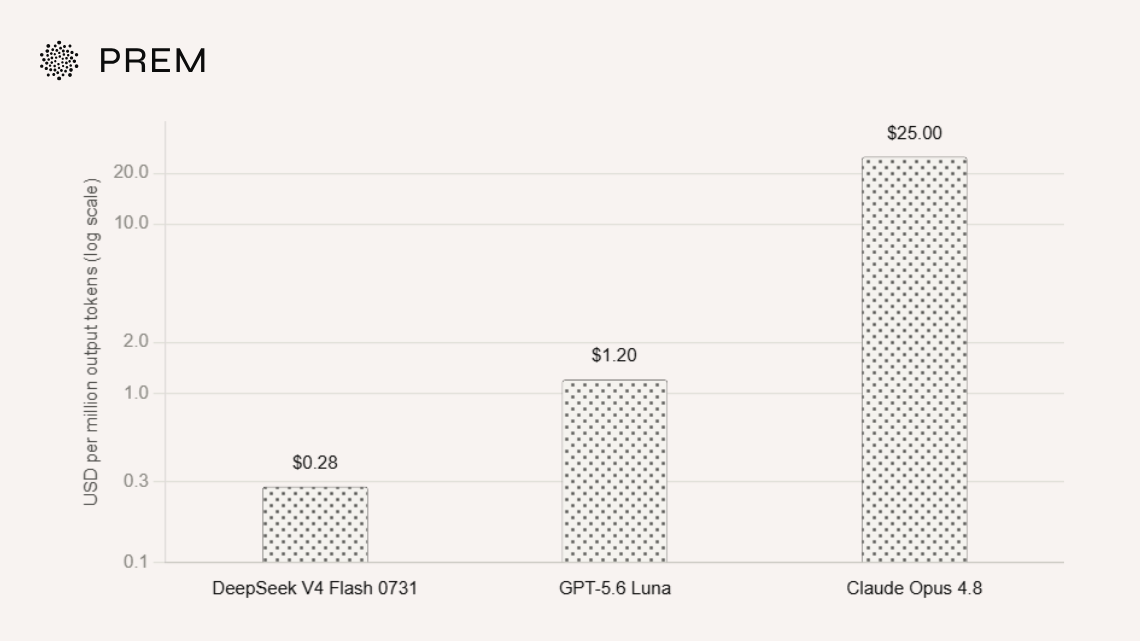
For your enterprise, that gap matters because V4 Flash's output cost is roughly 89 times lower than Opus 4.8's. But you're not comparing equivalent models here. Opus 4.8 leads on several benchmarks where accuracy matters more than raw throughput, so this is a comparison of running costs, not a claim that both models offer the same level of capability.
This is what makes V4 Flash 0731 relevant for teams evaluating open-weight models for real-world use. You are not just getting another open-weight model. You are getting a model aimed at demanding coding and agentic work, with improvements in hallucination rates and token efficiency, alongside long-context capabilities and deployment flexibility.
Where DeepSeek V4 Flash 0731 performs well
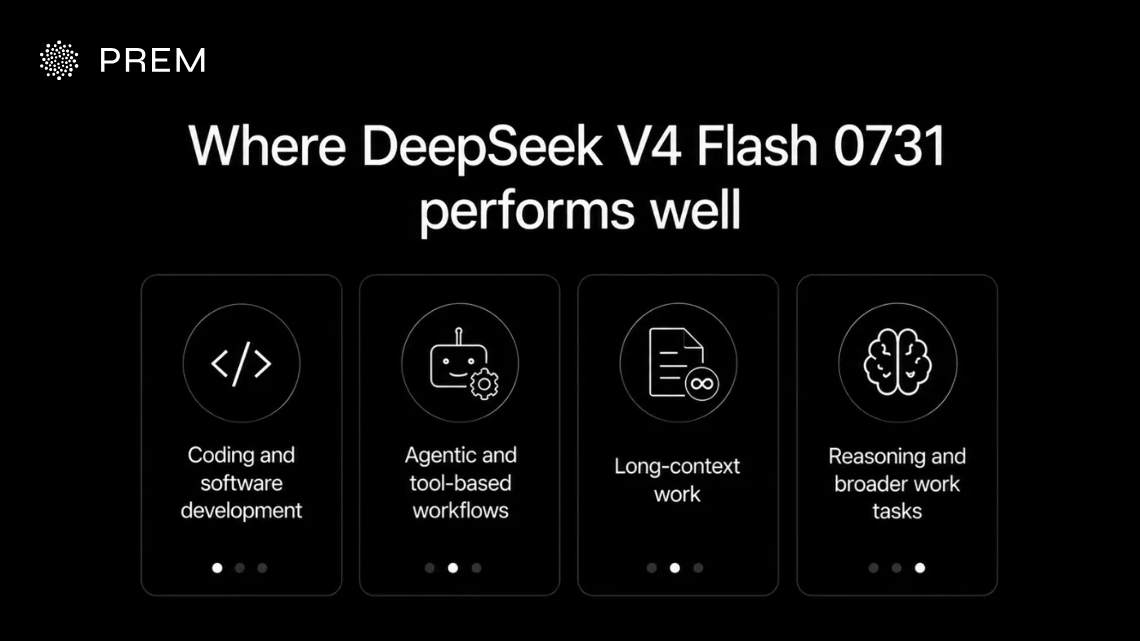
DeepSeek V4 Flash 0731 is strongest when you need it to reason through a task, work with code, use tools, or handle a large amount of context. Its biggest improvements over the earlier preview are also in these areas, making it particularly relevant for coding and agentic workflows.
Coding and software development
Coding is one of the clearest strengths of V4 Flash 0731. DeepSeek focused its post-training on coding and agentic performance, and the model's reported benchmark results show a significant jump over the earlier preview.
According to DeepSeek's July 31 update, V4 Flash 0731 solved 82.7% of tasks on Terminal-Bench 2.1, compared with 61.8% for the preview. It also scored 54.2 on NL2Repo and 54.4 on DeepSWE, showing that the improvement extends beyond a single coding benchmark.
For you, that means V4 Flash 0731 can be useful for more than generating code snippets. You can use it for repository-level work, debugging, code changes, and development workflows where the model needs to work through several steps to complete a task.
Agentic and tool-based workflows
Agentic work is another area where V4 Flash 0731 has improved significantly. The model is designed to work through multi-step tasks, use tools, and continue reasoning across those steps instead of treating every interaction as a separate request.
DeepSeek's reported results show V4 Flash 0731 scoring 70.3 on Toolathlon-Verified, compared with 49.7 for the preview. It also scored 25.1 on AutomationBench Public, compared with 10.8 for the earlier version.
That matters when your workflow involves repeated tool calls, long-running tasks, or agents that need to decide what to do next. Instead of using the model only to generate an answer, you can use it as part of a workflow that needs planning, execution, and follow-up.
Long-context work
V4 Flash 0731 also gives you room to work with very large inputs. It supports a context window of up to 1 million tokens, which can be useful when you're working with large codebases, long documents, or extensive enterprise information in a single request.
This is especially useful when you need the model to keep more of your source material available while it works through a task. You can give it more context upfront instead of repeatedly breaking the same work into smaller pieces.
Reasoning and broader work tasks
V4 Flash 0731 is not limited to coding. It can also handle broader reasoning and professional tasks, particularly when you give it enough context and allow it to spend more effort on the problem.
According to Artificial Analysis, V4 Flash 0731 reached a score of 50 on the Intelligence Index, putting it within a point of GLM-5.2. The evaluation covers tasks beyond software development, including reasoning, knowledge, and agentic capabilities. That broader performance makes the model relevant for enterprise workflows where coding is only one part of the job.
The important point is not that V4 Flash 0731 will outperform every frontier model. It won't. The more useful takeaway is that you now have an open-weight model that can compete on demanding workloads while giving you more flexibility over how you access and deploy it.
Where DeepSeek V4 Flash 0731 has limitations
While V4 Flash 0731 is well suited to coding, agentic workflows, and long-context tasks, it is not designed for every type of AI workload. Understanding where its capabilities are more limited can help you decide where it fits into your workflow.
Limited multimodal support
One limitation to keep in mind is multimodal input. V4 Flash 0731 is primarily documented for text, code, reasoning, and agentic workflows rather than image, audio, or video inputs. Its official documentation does not list native support for these modalities.
If your workflow relies on visual or audio inputs, you may need a different model for that part of the task. V4 Flash 0731 can still handle the related reasoning, coding, or text-based work once the information is converted into a format it can process.
How close is it to frontier models in real enterprise work?
Benchmarks can tell you how a model performs on specific tasks, but they don't tell you whether it is the right fit for your entire workflow. Artificial Analysis' evaluation gives a broader view by placing V4 Flash 0731 on its Intelligence Index alongside other leading models.
| Model | Artificial Analysis Intelligence Index |
|---|---|
| DeepSeek V4 Flash 0731 | 50 |
| GLM-5.2 | 51 |
| Kimi K3 | 57 |
| Gemini 3.6 Flash | 50 |
| Muse Spark 1.1 | 51 |
According to Artificial Analysis, V4 Flash 0731 scored 50 on the Intelligence Index. That puts it within one point of GLM-5.2 and Muse Spark 1.1 and at the same score as Gemini 3.6 Flash. Kimi K3 scores higher at 57.
The result puts V4 Flash 0731 in the same competitive range as several leading models, although it does not lead the overall comparison. For enterprise teams, that makes the model's combination of capability, open-weight access, and deployment flexibility worth considering alongside its benchmark performance.
Where DeepSeek V4 Flash 0731 comes close
The most notable result is how little separates V4 Flash 0731 from several leading models. Its Intelligence Index score of 50 puts it just one point behind GLM-5.2 and Muse Spark 1.1, while matching Gemini 3.6 Flash on the same index.
That does not mean the models are interchangeable. The Intelligence Index is a composite measure, and performance can vary significantly depending on the task. But it does show that V4 Flash 0731 is no longer sitting comfortably in a separate tier from leading models. On a broad set of reasoning and knowledge evaluations, it operates in the same range as several frontier-class systems.
Cost is where the difference becomes harder to ignore. Artificial Analysis estimates the average cost of running an Intelligence Index task through V4 Flash at around $0.03 USD, as mentioned earlier, while DeepSeek's pricing page lists $0.14 USD per million input tokens and $0.28 USD per million output tokens. That combination of capability and low inference cost is what makes the model particularly interesting for high-volume enterprise workloads.
Where DeepSeek V4 Flash 0731 falls short
The gap becomes clearer when you compare V4 Flash 0731 with the strongest models in this group. Kimi K3 scores 57 on the same Intelligence Index, seven points ahead of V4 Flash 0731. This shows that while V4 Flash 0731 is competitive with several leading models, it does not match the strongest model in this comparison.
That distinction matters. V4 Flash 0731 can come remarkably close to leading models on the workloads it was specifically strengthened for, particularly coding and agentic tasks. But that does not make it a universal replacement for every frontier model. If your workflow depends on capabilities where a stronger model has a wider lead, you may still see a meaningful difference in real-world performance.
So V4 Flash 0731 hasn't simply caught up with frontier models. The distance has narrowed enough on some demanding workloads that cost, deployment flexibility, and workload fit can matter as much as the raw benchmark ranking.
DeepSeek V4 Flash 0731 benchmark limitations
There is one important limitation to keep in mind when interpreting these results: agentic benchmark scores are sensitive to the evaluation setup. The tools, harness, prompting strategy, inference configuration, and other conditions around a model can all affect the final score.
That matters particularly for V4 Flash 0731 because DeepSeek's reported Terminal-Bench 2.1 result used its own evaluation harness, which hasn't been publicly released. The reported 82.7% score has also been matched independently using different evaluation tooling, which doesn't mean every evaluation environment will produce the same result.
Independent evaluations are therefore useful for establishing a broader picture, but you should not treat them as a guarantee of how the model will perform on your own systems.
For you, the more useful question isn't "Does V4 Flash 0731 beat model X Frontier Model?" It's, "Does V4 Flash 0731 perform well enough on the work you actually need it to do, at a cost and level of control that make deployment worthwhile?"
If it does, a small benchmark gap may not matter. If it doesn't, even a much lower price will not make up for the capability you are missing with DeepSeek V4 Flash 0731.
DeepSeek V4 Flash 0731 cost for enterprise workflows
The headline price is simple. What it costs you to run the model at scale is a different question, and that matters more when you're evaluating a real enterprise deployment.
DeepSeek V4 Flash 0731 pricing
As mentioned above, V4 Flash also offers a much lower rate for cached input. Cached input is priced at $0.0028 per million tokens, 98% lower than the standard input rate. V4 Pro, the larger model in the same family, costs $0.435 per million input tokens and $0.87 per million output tokens, making V4 Flash the more cost-efficient option within the V4 lineup.
How cache-hit pricing affects agentic workflows
If you're sending a prompt once, the standard input and output rates are the numbers you care about. If you're running an agent, the calculation changes.
An agentic workflow can repeatedly send the same system instructions, tool definitions, and accumulated context as it works through a task. When that repeated context qualifies for caching, you pay the much lower cache-hit rate instead of the standard input rate.
For example, 200,000 cached input tokens cost $0.00056 USD per turn, compared with $0.028 USD at the standard input rate. That's a 50× difference for the same amount of input. Across a workflow that makes many repeated calls, the proportion of your input that can be served from cache can therefore have a meaningful effect on your total inference cost.
For you, the number worth modelling isn't just the output price on the pricing page. It's how much of your workload consists of repeatable context that can actually be cached. That is what can materially change the economics of an agentic deployment.
DeepSeek V4 Flash 0731 vs. frontier model costs
The price difference becomes more useful when you put it next to capability. V4 Flash 0731 scores close to GPT-5.6 Luna on the Intelligence Index, while the cost of completing a benchmark task at maximum reasoning is roughly $0.03 USD through DeepSeek's API versus $0.05 USD through OpenAI's.
That difference may look small on a single task. At enterprise scale, however, thousands of agentic tasks can turn a few cents of difference per task into a meaningful operating-cost gap.
How peak-hour pricing affects DeepSeek V4 Flash 0731 costs
DeepSeek also applies time-based pricing during peak hours in Beijing Time. During these periods, API rates are higher than the standard rates. For enterprises running high-volume workloads, this means when you run, inference can affect your overall costs.
If your workloads are flexible, you can schedule non-urgent inference outside peak hours to avoid the higher rates. This is particularly relevant for batch processing, background agent tasks, and other workloads that don't require immediate responses.
DeepSeek V4 Flash 0731 for Private AI: Key Enterprise Deployment Considerations
Everything covered so far, the benchmarks, the pricing, and the tradeoffs against frontier models, assumes you're accessing V4 Flash 0731 the way most people do: through DeepSeek's own hosted API. That's not your only option, and for a lot of enterprise workloads, it shouldn't be your default one either.
V4 Flash 0731 ships with open weights under an MIT licence. That means you can run it entirely on infrastructure you control, on-premises, in your own VPC, or through a private AI inference layer, rather than sending every request to a third-party hosted endpoint.
But having the weights available and having a private deployment are not the same thing. Running an open-weight model on infrastructure you haven't secured doesn't automatically make that deployment private. You still need to know exactly where your prompts, outputs, logs, and model artefacts are processed and stored and who can access them at each point.
A hosted API means your prompts, your internal documents, and whatever you feed the model pass through infrastructure a third party operates. You're relying on that provider's policies and their jurisdiction's data protection rules, not your own. For workloads involving regulated data, IP-sensitive code, or anything you wouldn't want leaving your own boundary, that's a real constraint, independent of how capable the model itself is.
Running the open weights yourself gives you more control over the deployment environment, but it also means taking responsibility for the infrastructure needed to operate the model. A 284-billion-parameter model with 13 billion active parameters still requires careful planning around memory, concurrency, quantisation, latency, and throughput based on your workload.
Self-hosting also changes the cost structure. Instead of paying primarily through per-token API usage, you take on infrastructure and operational costs such as compute, storage, scaling, monitoring, and maintenance. You also need to account for the governance, access controls, and operational processes required to run the model securely within your enterprise.
This is where the deployment approach matters. Having access to the open weights gives you greater control over where and how the model runs, but your infrastructure still needs to support the performance, security, and governance requirements of your workloads.
How Prem Enables Secure, Governed Deployment of DeepSeek V4 Flash 0731
Prem AI addresses this deployment challenge. Instead of choosing between a hosted API you don't control and self-hosting infrastructure you have to build and operate yourself, Prem Enclave lets you deploy frontier and open-weight models like DeepSeek V4 Flash 0731 within infrastructure designed for private, governed AI workloads.
Through Prem Enclave, inference runs inside a Trusted Execution Environment (TEE) with hardware-based isolation and cryptographic attestation. This keeps prompts and data within a controlled execution boundary rather than routing them through DeepSeek's own servers or another external model provider. You can also verify that environment through attestation rather than relying solely on a policy statement.
Deployment can match your infrastructure requirements: on-premises, in your own VPC, or through Prem's managed Enclave API if you don't want to operate the underlying GPU infrastructure yourself. Requests run under a zero data retention model, and the platform is designed so sensitive data isn't retained or used to train another model. Attestation provides an additional mechanism for independently verifying the execution environment.
For your enterprise, that means you can use DeepSeek V4 Flash 0731 for coding and agentic workloads, long-context tasks, and cost-sensitive inference without routing sensitive work through an API that lacks encryption, attestation, or data-retention guarantees. The model gives you the capability; Prem provides the infrastructure and governance layer needed to deploy that capability within a controlled environment.
You're not choosing between capability and control. You're putting the two together in a private infrastructure layer designed to make that control verifiable with context compounding over time.
DeepSeek V4 Flash 0731, deployed right with Prem AI
If your enterprise needs strong coding and agentic performance without taking on the cost of a larger frontier model, DeepSeek V4 Flash 0731 is worth serious evaluation. But the model is only part of the deployment decision. Where and how you run it determines whether its capabilities translate into a secure, governed production workload.
Prem AI can help you deploy DeepSeek V4 Flash 0731, along with other frontier and open-weight models, on infrastructure designed for private, governed, and verifiable AI workloads. Contact our sales team to discuss your requirements, or reach out directly at sales@premai.io.
FAQs about DeepSeek V4 Flash 0731
What is DeepSeek V4 Flash 0731?
DeepSeek V4 Flash 0731 is the official release of DeepSeek's V4 Flash model, an open-weight AI system built for reasoning, coding, and agentic tasks. It uses a Mixture-of-Experts architecture with 284 billion total parameters and 13 billion active parameters and ships under an MIT licence.
How is DeepSeek V4 Flash 0731 different from the preview version?
The architecture and parameter count didn't change from the preview. DeepSeek retrained the model specifically to improve agentic and coding performance and attached a speculative decoding module called 'DSpark', which speeds up how quickly the model generates responses.
How close is DeepSeek V4 Flash 0731 to frontier models?
On Artificial Analysis' Intelligence Index, it scored 50, just one point behind GPT-5.6 Luna and GLM-5.2 and tied with Gemini 3.6 Flash. It trails Kimi K3 by seven points and still falls short of the strongest closed models on knowledge-heavy work.
Does DeepSeek V4 Flash 0731 support multimodal input?
No. The official model documentation describes it as a text-generation model, and it doesn't document native support for image, audio, or video input. If your workflow depends on visual or audio inputs, you'll need a different model for that part of the task.
How much does DeepSeek V4 Flash 0731 cost to run?
DeepSeek prices it at $0.14 per million input tokens, $0.28 per million output tokens, and $0.0028 per million tokens on a cache hit, a 98% discount. That cache-hit rate matters most for agentic workflows, where the same context gets re-sent repeatedly across a task.
Can I self-host DeepSeek V4 Flash 0731?
Yes. The model weights are available under an MIT license, and DeepSeek documents deployment using frameworks like vLLM and SGLang. Self-hosting removes reliance on a third-party API but shifts the cost to infrastructure and the responsibility for governance onto you.
Is DeepSeek V4 Flash 0731 good for coding and agentic tasks?
Yes, this is where it performs strongest. It solved 82.7% of tasks on Terminal-Bench 2.1, up from 61.8% in the preview, with similar jumps on coding and tool-use benchmarks. Its post-training was specifically focused on improving this exact category of work.
What context window does DeepSeek V4 Flash 0731 support?
Up to 1 million tokens of input and 384,000 tokens of output. In practical terms, that's roughly 1,500 pages of text in a single request, enough to work through an entire codebase or large document set without breaking it into pieces.
Are DeepSeek V4 Flash 0731's benchmark scores reliable?
They're a useful signal, not a guarantee. DeepSeek's own evaluations used an internal harness that hasn't been publicly released, and benchmark scores can shift based on evaluation setup. Independent verification from Artificial Analysis supports the core figures, but your own workload is the real test.
How does Prem AI help deploy DeepSeek V4 Flash 0731 securely?
Prem AI runs the model inside a Trusted Execution Environment with hardware-based isolation and cryptographic attestation, deployable on-premises, in your own VPC, or through Prem's managed Enclave API, so you can verify your data's security rather than relying on a policy alone.
See how Prem AI can help your enterprise build private AI without compromising control over your data and infrastructure. Contact our sales team, or email us at sales@premai.io.