Zero Data Retention (ZDR) for Enterprise AI & Why It Matters for Secure AI Adoption
On this page
When you use AI for everyday tasks, you may not think twice about what happens to the data you send to a model. But when you’re using AI across your enterprise, your prompts can contain customer information, financial records, legal documents, source code, or other sensitive business data. That makes one question important: What happens to your data after the AI gives you an answer?
This isn't a hypothetical concern. In March 2023, Italy's data protection authority, the Garante, temporarily banned ChatGPT across the country over how it processed users' data. The investigation that followed eventually led to a fine against OpenAI, as reported by Euronews, with regulators finding that the platform had processed EU users' personal data without a valid legal basis.
More recently, the same concern surfaced again when Anthropic released Claude Fable 5 without Zero Data Retention coverage for enterprise customers, a change from what many of its enterprise agreements had previously guaranteed. Former Shopify CTO Jean-Michel Lemieux was among those who flagged it publicly, warning enterprise teams to keep their codebases away from it until ZDR support returned. It's a reminder that even well-established providers can quietly change what happens to your data.
Zero Data Retention (ZDR) gives you a clear answer. Under a ZDR policy, your prompts, files, and model outputs are not retained after they have been processed, based on the specific terms and technical implementation of the provider. The data can be used to generate your response without being stored for future access or model training.
For your enterprise, this can reduce the amount of sensitive information sitting in AI infrastructure and give your security and compliance teams greater control over how AI handles business data.
But ZDR isn’t simply a checkbox that says, "Your data is private." You need to understand what happens to your data during inference, what gets deleted afterward, and whether any metadata remains. Let’s look at how it works.
What Zero Data Retention (ZDR) means for your enterprise AI
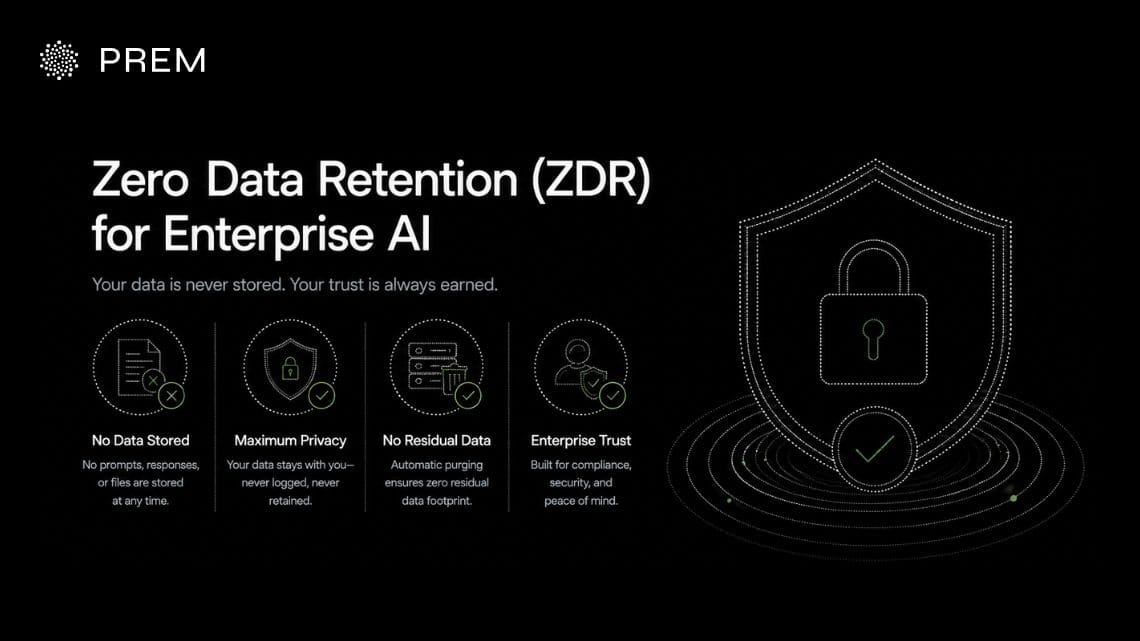
When you use AI across your business, your prompts can contain much more than simple questions. You might be sharing customer records, financial information, legal documents, product plans, source code, or internal business data. So, before you bring an AI system into an important workflow, you need to know what happens to that information after the model gives you a response.
Zero Data Retention (ZDR) means your AI provider does not retain the data covered by its ZDR policy after it has been processed. Depending on the provider, this can include your prompts, uploaded files, and model outputs. The data is used to complete your request, but it is not kept in persistent storage for later access or use.
For your enterprise, this can reduce the amount of sensitive information sitting in an AI provider's systems after an interaction is complete. It can also give your security and compliance teams greater control over how enterprise data moves through your AI stack.
Breaches involving unsanctioned or shadow AI use already cost organizations an average of $670,000 more than a typical breach, according to Witness AI, and ZDR is one way to reduce that exposure before it becomes your problem.
But ZDR isn’t a complete security strategy. You still need to understand how your data is processed, what exactly gets deleted, whether metadata remains, and what other controls protect the AI infrastructure.
How Zero Data Retention works
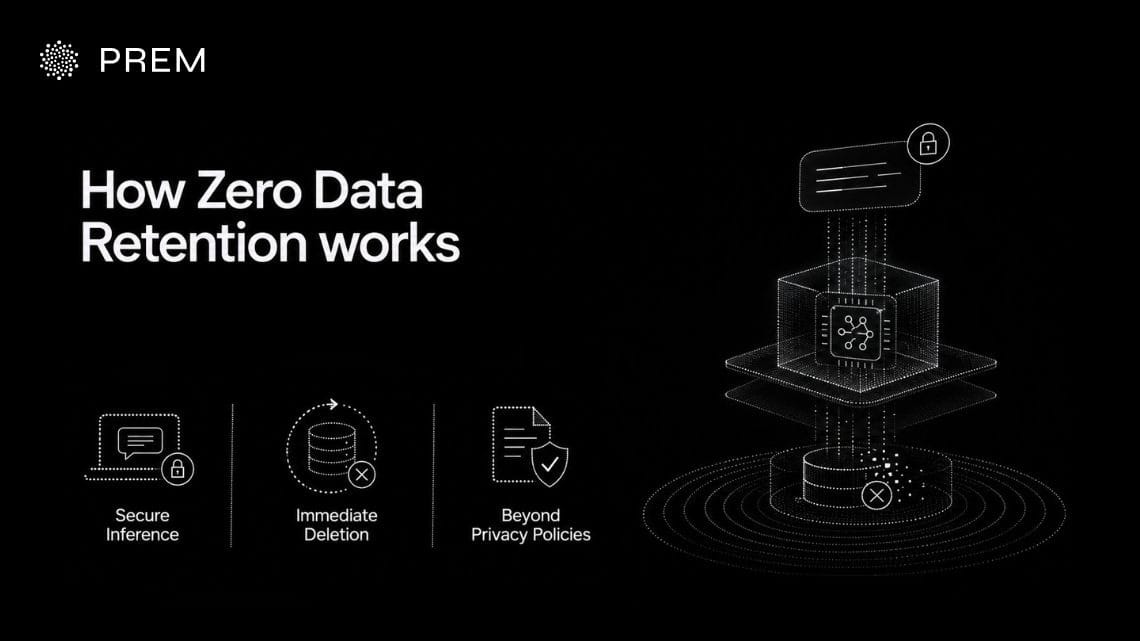
When you send a prompt to an AI system, your data has to be processed somewhere before you receive a response. ZDR focuses on what happens to that data throughout this process and, most importantly, what happens once the request is complete.
What happens to your data during inference
When you submit a prompt, your data is temporarily processed by the AI infrastructure to generate a response. Depending on the architecture, this can include your prompt, files you upload, and other information needed to complete the inference request.
With ZDR, this processing is designed to be temporary. Your data can pass through the systems needed to run inference without being retained in persistent storage after the request is completed. OWASP's AI Exchange guidance identifies minimized retention as one of the core privacy principles enterprises should hold AI systems to, alongside use limitation and the right to erasure.
That distinction matters for enterprise AI. You may need an AI model to work with sensitive information, but you may not want that information sitting in provider logs, databases, or other storage systems after the task is finished.
What gets deleted and when
ZDR generally means that data covered by the provider's policy is not retained after the applicable processing period ends. This can include prompts, uploaded content, and model outputs, depending on the provider’s implementation and ZDR terms.
The exact deletion point matters. A provider may define retention as zero after processing, while some systems may temporarily hold data in memory or other transient systems while the request is being completed.
This mirrors a principle regulators already apply to personal data broadly: under GDPR's storage limitation principle, data should only be kept for as long as it's actually needed for the purpose it was collected for, according to the UK Information Commissioner's Office.
So when you evaluate a ZDR solution, don’t just ask whether the provider offers “zero retention." Ask what data is covered, where it exists during processing, when deletion happens, and whether any exceptions apply.
Why this is different from a standard privacy policy
A standard privacy policy tells you how a company says it collects, uses, stores, and shares data. It may explain retention periods, security measures, and the circumstances under which information can be accessed.
ZDR addresses a much narrower but important question: Does the AI provider retain your data after processing it?
That makes ZDR particularly relevant when you’re sending sensitive enterprise data to an AI system. Instead of relying only on broad privacy commitments, you can look at a specific data-retention control and the technical conditions attached to it.
However, ZDR does not automatically mean that your data is invisible to every system involved in an AI request. You still need to understand access controls, encryption, infrastructure security, metadata, and other parts of the AI deployment architecture.
Why Zero Data Retention matters for your enterprise
If you're using AI for sensitive business work, data retention becomes a security and compliance concern very quickly. Every prompt, document, or output that gets stored creates another piece of information that could potentially be accessed, exposed, or misused.
Zero Data Retention reduces that exposure by limiting how long your sensitive AI data remains within the provider's systems. It doesn't eliminate every AI security risk, but it can reduce the amount of persistent data you need to protect.
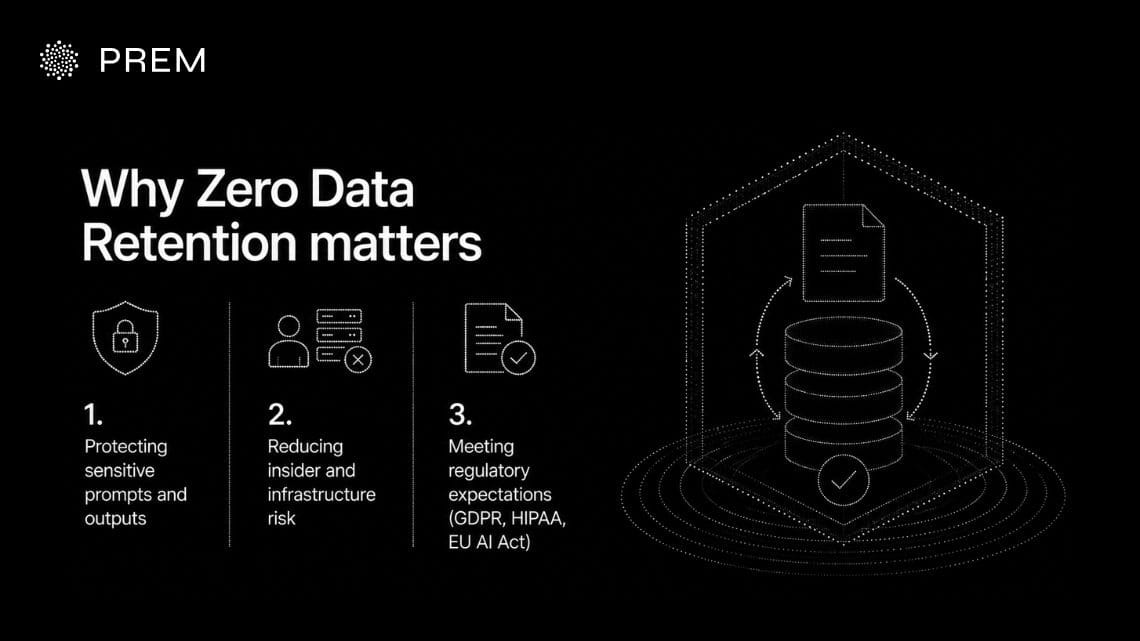
Protecting sensitive prompts and outputs
Your AI prompts can contain valuable business information even when you don't upload a document directly. A prompt might include customer details, internal strategies, financial figures, legal information, source code, or product plans.
If those prompts and outputs aren't retained after processing, there's less persistent sensitive data sitting within the AI provider's infrastructure. For you, that can mean a smaller data footprint and fewer stored records that need to be secured, governed, and potentially discovered later.
Reducing insider and infrastructure risk
The more data an AI provider stores, the more data exists that could potentially be accessed through administrative accounts, compromised systems, misconfigured infrastructure, or other security incidents. Shadow AI use is already a significant driver of this risk, and its incidents have more than doubled year over year, now accounting for 43% of all security breaches, up from 20% in 2025, according to IBM's Cost of a Data Breach Report.
ZDR reduces this exposure by limiting persistent storage of the data covered by the policy. Even if an attacker or unauthorized user gains access to a storage system, there is less retained AI interaction data available to access.
This doesn't replace access controls, encryption, monitoring, or other security measures. Instead, it adds another layer by reducing the amount of sensitive data that remains available in the first place.
Meeting regulatory expectations (GDPR, HIPAA, EU AI Act)
For regulated enterprises, AI data handling isn't just a technical consideration. You also need to demonstrate that personal and sensitive information is handled appropriately.
ZDR can support your broader compliance approach by reducing unnecessary retention of sensitive information. Under GDPR, for example, organizations are expected to follow data minimization and storage limitation principles. In healthcare environments, HIPAA requirements make the protection of protected health information particularly important.
For high-risk AI systems, the EU AI Act introduces requirements around areas such as risk management, data governance, record-keeping, and cybersecurity. ZDR alone does not make an AI deployment GDPR-, HIPAA-, or EU AI Act-compliant, but it can be one useful control within a broader security and compliance framework.
Risks without ZDR
Without a clear data-retention policy, you may have less visibility into where your AI data is stored, how long it remains there, and who can access it.
That creates a larger data footprint for your security team to manage. It can also increase the potential impact of a breach, complicate data governance, and create additional questions when you're assessing an AI provider for regulated workloads. If your AI doesn't need the data, don't keep it.
ZDR vs. standard data retention policies
The biggest difference comes down to what happens after your AI interaction is complete.
With a standard retention policy, an AI provider may keep prompts, outputs, logs, or other data for a defined period. The retention period could exist for purposes such as debugging, monitoring, abuse detection, service improvement, or other operational needs, depending on the provider.
With ZDR, the goal is to prevent the covered data from being retained after the processing required to fulfill your request. This reduces the amount of sensitive information that remains in persistent storage.
However, don’t assume that any provider using the term “ZDR” handles data in exactly the same way. Coverage and exceptions vary from provider to provider, even among zero data retention LLM APIs. Coverage and exceptions vary from provider to provider, even among zero data retention LLM APIs. You should check what the provider includes in its ZDR policy, whether temporary processing data is covered, what metadata is retained, and whether any exceptions apply.
For enterprise AI, the right question is “Exactly what data is retained, for how long, and under what conditions?”
The limitations of Zero Data Retention
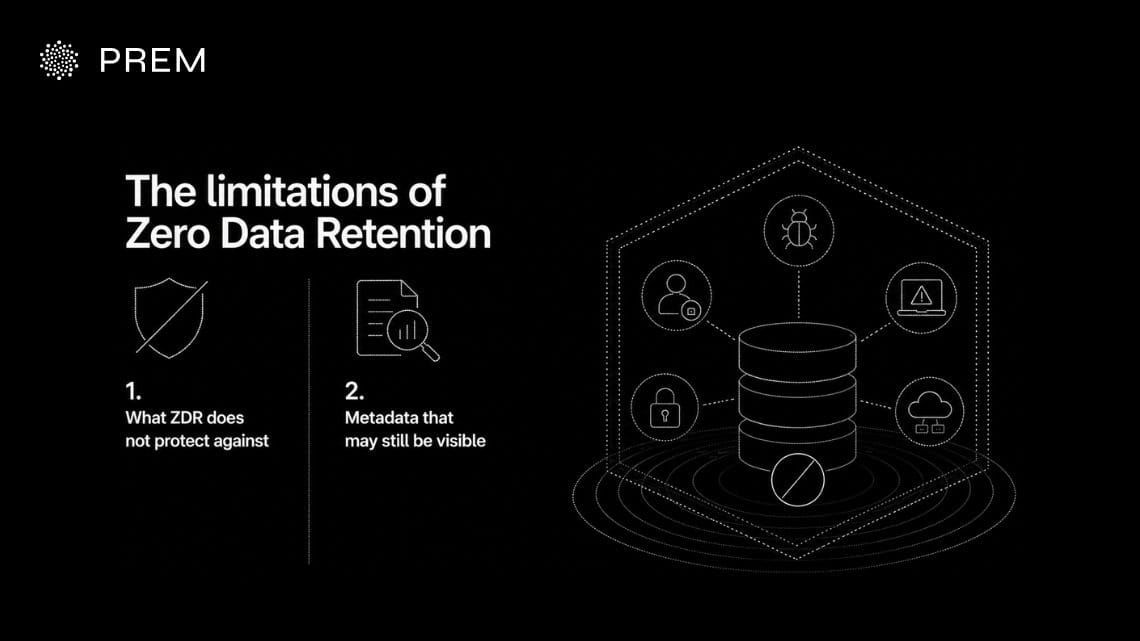
ZDR is a strong control, but it isn't a complete security strategy on its own. It answers a specific question, whether your data is retained after processing, and that's narrower than asking whether your data is safe throughout an entire AI workflow. Before you treat ZDR as your main safeguard, it helps to know exactly where its protection ends.
What ZDR does not protect against
ZDR doesn't stop a prompt injection attack, and it doesn't prevent a model from generating an inaccurate or harmful output. Those are model behavior and application security risks, not retention risks. OWASP defines prompt injection as its top-ranked LLM security risk, where crafted inputs alter a model's behavior or output in unintended ways, regardless of what retention policy sits underneath it. A retention policy does not change what a model does with your data while it is processing your request.
It also doesn't cover data exposure that happens before your request reaches the AI system, such as a prompt being pasted into an unapproved tool or a file being uploaded to the wrong environment. And if your provider uses downstream models, subprocessors, or other AI services to process your request, you need to understand whether those parties follow the same retention requirements.
ZDR also doesn't eliminate insider risk during the live processing window. If a person or system has legitimate access to your data while your request is being processed, that access exists whether or not the data is retained afterward.
None of this makes ZDR less useful. It means ZDR is one control among several, and it works best alongside access controls, encryption, monitoring, secure infrastructure, and appropriate governance.
Metadata that may still be visible
ZDR doesn't necessarily mean that every trace of an AI request disappears. Depending on the provider and its implementation, information such as timestamps, request identifiers, token usage, model information, latency data, billing information, or security-related signals may still be retained.
For most enterprise use cases, this metadata may be less sensitive than the underlying prompt or output. But that isn't always the case. If the pattern of AI activity itself is sensitive, you should ask your provider exactly what gets logged, why it is retained, how long it remains available, and who can access it.
Zero retention and zero visibility aren't necessarily the same thing.
Where enterprises need ZDR most
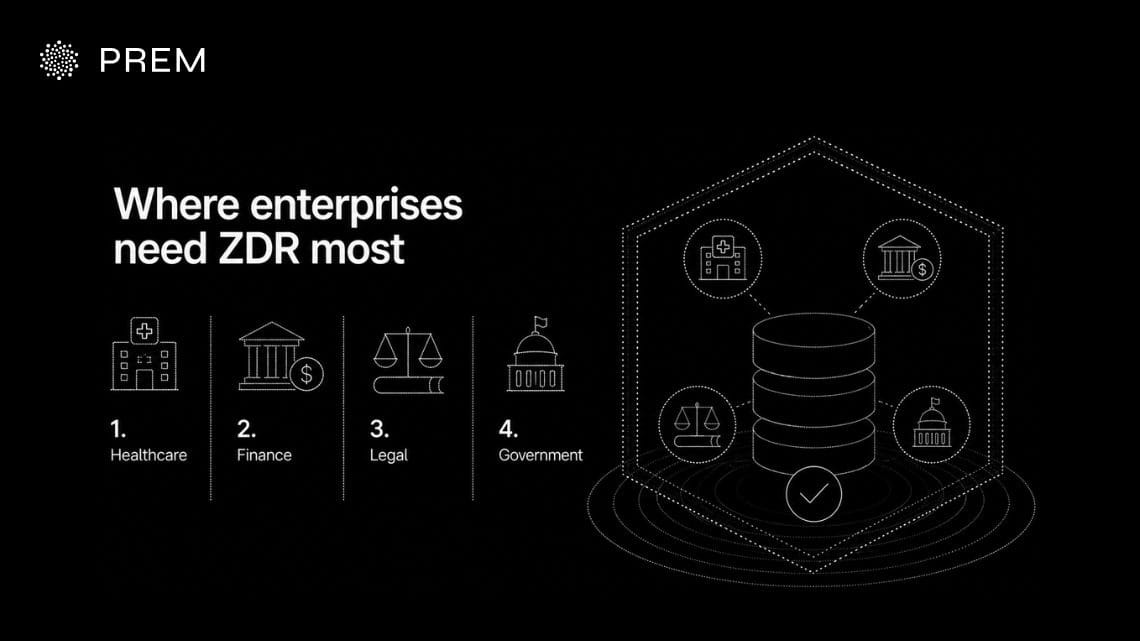
Not every enterprise weighs ZDR in the same way. The more sensitive your data and the more regulated your industry, the more important it becomes to understand exactly what happens to that data after an AI request is processed.
Healthcare
Healthcare organizations handle highly sensitive information, including protected health information (PHI). When you bring AI into clinical, administrative, or operational workflows, you need to understand how that information is processed and retained by the AI provider.
Tennessee-based Xsolis, an AI-powered case management vendor used by hospitals and health insurers, disclosed a breach that exposed patient records to hackers, according to HealthExec.
ZDR can reduce how much sensitive information remains stored in a provider's environment after processing. This can reduce the persistent data footprint associated with AI workloads and support a broader approach to security and privacy.
However, ZDR does not replace your other healthcare requirements. Depending on the use case and parties involved, you may still need controls such as appropriate agreements, access management, audit processes, and safeguards for PHI.
Finance
Financial institutions work with account information, transaction records, financial data, and other sensitive business information. Sending that information to an AI system raises an important question: Where does it go after the model responds?
That question isn't abstract for financial institutions either. Community Bank, a Pennsylvania-based subsidiary of CB Financial Services, filed the first-ever SEC Form 8-K specifically triggered by unauthorized AI use, after an employee fed non-public customer information, including Social Security numbers, names, and dates of birth, into an unapproved AI application, according to American Banker.
ZDR can limit how much of that information remains in the AI provider's systems after processing. This can help reduce your persistent data footprint and limit the amount of sensitive information that needs to be protected on the provider side.
Your own regulatory and record-keeping obligations remain separate from your AI provider's retention policy. ZDR doesn't mean your organization can delete records that it is legally required to retain.
Legal
Law firms and in-house legal teams work with contracts, case files, client information, litigation documents, and other confidential material. When you're using AI to review or summarize these materials, data retention becomes an important part of the vendor assessment.
In February 2026, a federal judge ruled that AI-generated documents lost attorney-client privilege in a securities fraud case, specifically because the defendant used a consumer AI platform whose terms of service permitted data collection and third-party disclosure, according to Arnold & Porter.
ZDR can limit the retention of prompts, documents, and outputs after processing, reducing the amount of confidential information that remains in the provider's environment.
It doesn't, however, resolve every confidentiality, privilege, or professional responsibility question. Legal teams still need to assess whether a particular AI system is appropriate for the information being processed and what other safeguards the provider offers.
Government
Government organizations and their contractors may handle highly sensitive information subject to specific security, privacy, and data-handling requirements. In these environments, where data is processed and stored, it can be just as important as what happens to it afterward.
In 2024, CISA's own acting director uploaded documents marked "For Official Use Only" into the public version of ChatGPT, triggering automated security warnings and an internal damage assessment, according to Nightfall AI.
ZDR can reduce the amount of sensitive AI interaction data retained after processing. But it does not replace requirements around approved infrastructure, access controls, data residency, authorization, or other applicable government security standards.
For government workloads, ZDR is best treated as one layer within a broader compliance and security framework, rather than as a standalone compliance solution.
How Prem AI implements Zero Data Retention
Zero Data Retention means exactly what it sounds like. Once your request is processed, the data covered by the ZDR policy doesn't stick around. No copy of your prompt, no cached output, no fragment of your data sitting on a disk somewhere waiting to be found later.
But saying that is easy. Building infrastructure that actually guarantees it is the harder part, and it's where Prem AI's approach differs from a policy you're asked to trust. You can access this through two paths, depending on how much control you want over the infrastructure itself.
If you'd rather not manage GPUs yourself, you can run inference through Prem's Enclave API. It's a managed, hosted service, fully OpenAI-compatible, so you can swap your client SDK and go live without rebuilding your stack. Every request you send through it still runs inside an isolated, encrypted enclave, and you get cryptographic attestation on every call so you can verify nothing was tampered with along the way. You're just not the one running the hardware.
If you want that same protection on infrastructure you actually control, Prem Enclave is the right solution for you. It installs directly onto your existing GPU clusters, whether that's on-premises, in your VPC, or across a private cloud setup, and turns that infrastructure into a verifiable confidential computing environment. Your data is decrypted only inside the enclave itself. The host operating system, the hypervisor, the datacenter operator, and even Prem never see it in plaintext. Nothing is written to disk, and nothing leaves the enclave.
Either way you access it, the underlying guarantee is the same. Your prompts and outputs are never written to persistent storage during processing, and every request generates a cryptographic attestation report you can check independently. Some metadata does stay visible, things like request timestamps and payload size, since Prem needs that for billing and rate limiting. But the actual content of what you sent or received never does.
This is also what makes Fluso possible. Fluso is Prem AI's private enterprise workspace, built on top of this same confidential infrastructure. It's where your team actually puts that protected compute to work: connecting your enterprise knowledge, building workflows, and accumulating institutional context, all without routing any of it through a third-party model provider. So you're not just getting a guarantee that a single request wasn't retained. You're getting a workspace where your team's accumulated knowledge stays inside infrastructure you control, instead of quietly training someone else's model one prompt at a time.
Build your private enterprise AI with verifiable Zero Data Retention using Prem AI
A zero data retention policy is only as good as your ability to check it. Most vendors ask you to take their word for it. Prem AI is built so you don't have to.
Every request you send runs inside a hardware-isolated Trusted Execution Environment (TEE), and every one comes with a cryptographic attestation report attached. That's not a compliance document someone wrote once and filed away. It's proof generated automatically every time that ties back to the exact code that ran and confirms your data never touched a disk or left the enclave. You can verify it yourself instead of relying on a page like this one to tell you it's true.
If your enterprise is ready to move past taking a vendor's word for what happens to your data, Prem AI can help you deploy AI that actually proves it. Contact our sales team to talk through your requirements, or reach us directly at sales@premai.io.
FAQs about Zero Data Retention (ZDR) for enterprise AI
What is Zero Data Retention (ZDR) in enterprise AI?
Zero Data Retention is a policy where an AI provider does not keep your prompts, files, or model outputs after processing. Your data is used only to generate a response, and then it is not stored for later access, debugging, or model training, depending on the provider's specific terms.
Does Zero Data Retention mean my data is never processed?
No. Your data still has to be processed to generate a response. ZDR only determines what happens afterward. Your prompt and any files pass through the systems needed to complete the request, but under ZDR, none of that content is kept in persistent storage once the request finishes.
Does ZDR stop my data from being used to train AI models?
Under most ZDR policies, yes. Since your prompts, files, and outputs are not retained after processing, there is nothing left for the provider to draw on for model training. Always confirm this directly with your provider, since ZDR terms and what they cover can vary between vendors and agreements.
How is ZDR different from a standard privacy policy?
A standard privacy policy describes how a company collects, uses, stores, and shares data generally, often over long retention periods. ZDR addresses one specific question: does the provider retain your data after processing it. It is a narrower commitment you can verify, rather than a broad promise about privacy.
What metadata still gets retained under a ZDR policy?
Even with ZDR, most providers keep some metadata, such as timestamps, token counts, model version, latency, and billing information, since this supports operations like billing and abuse detection. This metadata typically excludes your actual prompt or output content, but you should still ask your provider exactly what it includes.
Does Zero Data Retention work the same way for LLMs specifically?
Yes, ZDR for large language models follows the same core idea: your prompt and the model's output are not stored after inference completes. The details still depend on the provider, including whether temporary processing data, cached context, or logs used for safety monitoring are covered by the same policy.
What are the limits of a zero data retention policy?
ZDR does not protect against risks like prompt injection, weak access controls, or insider access while your data is actively being processed. It also may not extend to every subprocessor in the chain. ZDR reduces what is stored afterward, but it does not replace encryption, access controls, or monitoring.
Which industries benefit most from Zero Data Retention?
Healthcare, finance, legal, and government organizations tend to benefit most, since they routinely handle protected health information, financial records, privileged communications, or sensitive government data. For these sectors, reducing how long sensitive prompts and outputs remain in an AI provider's systems supports both security and regulatory obligations.
How can I verify a provider's zero data retention claims?
Ask what specific data is covered, when deletion actually happens, and whether any exceptions or subprocessors are involved. Providers that offer cryptographic attestation, such as proof tied to isolated, encrypted infrastructure, let you confirm independently that your data was not stored, rather than relying on a written policy alone.
How does Prem AI implement Zero Data Retention?
Prem AI runs inference inside hardware-isolated, encrypted enclaves, either through its hosted Enclave API or the licensed Prem Enclave on your own infrastructure. Every request generates a cryptographic attestation report confirming your data was not written to disk, so you can verify the guarantee instead of trusting it.