Trusted Execution Environments (TEEs) for Enterprise AI: Architecture, Security & Use Cases
Your enterprise AI can't protect sensitive data if it's exposed while it's being processed.
Encryption protects data when it's stored. It also protects data while it's moving across networks. But once your AI model starts processing that information, whether it's customer records, financial data, healthcare information, or internal business knowledge, the data has traditionally existed in plaintext inside system memory.
For enterprises building AI applications, this creates a critical security gap. A compromised host, malicious insider, or infrastructure attack could potentially access sensitive data while it's actively being used.
The consequences of infrastructure attacks can be severe. Following the 2024 Change Healthcare cyberattack, CNBC reported that UnitedHealth Group had to advance more than $3.3 billion to affected healthcare providers just to keep their operations running while billing systems were down.
As enterprises process more sensitive data with AI, protecting information during computation is becoming just as important as protecting it at rest or in transit. Companies building large-scale AI infrastructure are already designing around this challenge. Apple is one example.
Apple built Apple Intelligence around this exact challenge.
As Apple's security engineering team put it when introducing Private Cloud Compute: "If a cloud AI service states that it does not log certain user data, there is generally no way for security researchers to verify this promise."
Apple addressed this by building its cloud AI infrastructure around stateless computation and verifiable transparency. It also publishes every production software image so independent researchers can verify what's actually running.
This is exactly why Trusted Execution Environments (TEEs) have become a core building block for confidential AI. TEEs create hardware-backed, isolated execution environments that protect AI workloads while they're running. That makes it significantly harder for anyone outside the trusted environment to view or tamper with sensitive data.
This matters even more as enterprises deploy frontier AI models across private clouds, customer-managed infrastructure, and multi-agent systems. You're no longer just protecting stored data. You're protecting data while your AI is actively reasoning, generating outputs, and making decisions.
Let's look at what Trusted Execution Environments are, how they work, and why they're becoming a critical part of enterprise AI infrastructure.
What Trusted Execution Environments mean for your enterprise AI
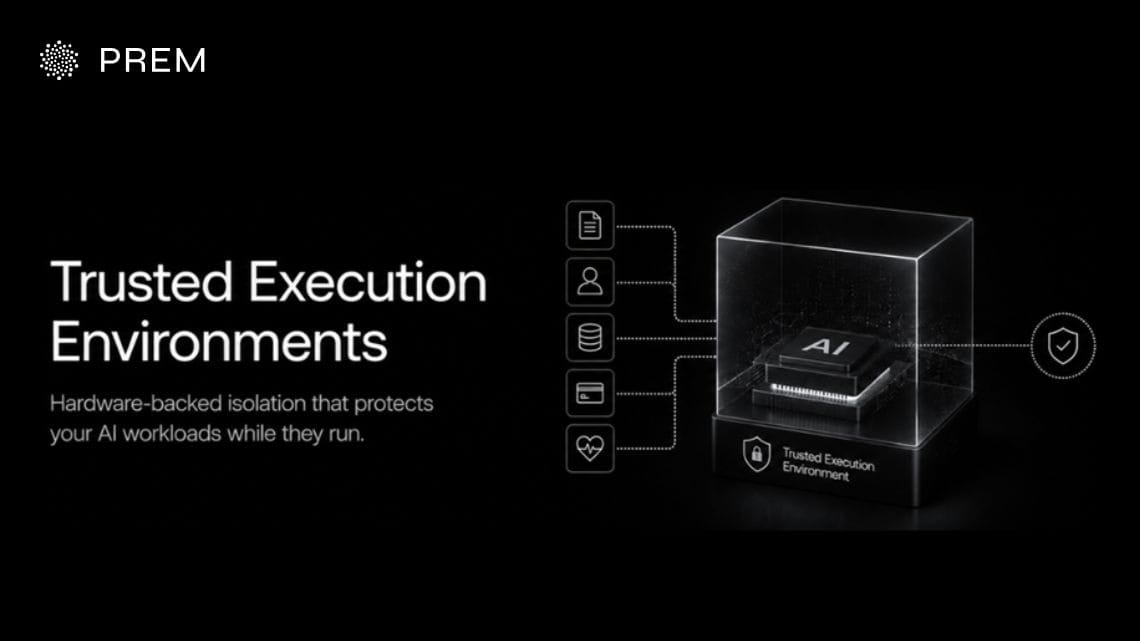
Trusted Execution Environments (TEEs) are hardware-backed, isolated environments that protect your code and data while they're being processed. Unlike traditional security controls, which mainly protect data at rest or in transit, TEEs secure data in use. This is the exact moment your AI models are actively working with sensitive information.
As the European Data Protection Supervisor (EDPS) notes, traditional encryption protects data at rest and in transit. Data remains vulnerable while it's being processed, making confidential computing increasingly important for cloud-based workloads.
For your enterprise, this changes what "trusting your AI infrastructure" actually means. Today, when you send sensitive data to a standard AI API, you're relying on a vendor's operational controls, contractual commitments, and internal policies.
A TEE adds a hardware-backed layer of protection. It isolates AI workloads while they're running, even if the surrounding operating system, hypervisor, or other privileged infrastructure components are compromised.
That protection extends to sensitive prompts, customer data, financial records, healthcare information, intellectual property, and AI model inputs. These workloads remain isolated from the rest of the system while they're being processed.
This matters because enterprise AI is no longer limited to answering questions. Your AI searches internal knowledge, reasons over confidential documents, powers autonomous agents, and supports business-critical decisions. Protecting these workloads while they're running is just as important as protecting the data before or after processing.
That's the real shift TEEs bring to enterprise AI. Instead of relying only on operational promises, your enterprise gains hardware-backed protections that can be independently verified, helping build greater trust in how sensitive AI workloads are executed.
How a Trusted Execution Environment works
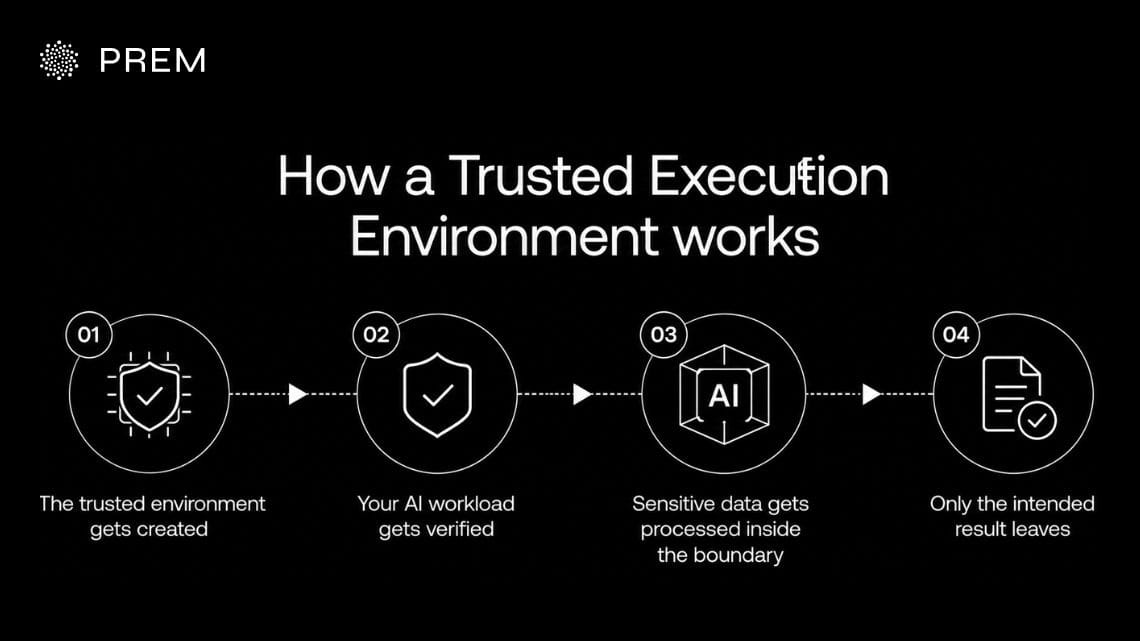
A TEE isn't a single feature you switch on. It's a sequence of steps working together, each one closing a specific gap the last one leaves open.
Your AI workload gets verified
Before execution begins, the environment checks that the expected workload is what's actually running. Many enterprise TEE implementations pair this with cryptographic attestation, a way to independently confirm the workload is running inside a genuine, untampered environment, rather than just taking a vendor's word for it.
For example, Google Cloud's Attestation documentation explains how organisations can remotely verify the trustworthiness of confidential environments before sensitive data is processed.
Sensitive data gets processed inside the boundary
Prompts, enterprise knowledge, customer records, and model inputs stay within the protected environment while the AI model performs inference. This is the one point where the data genuinely has to exist in a readable form, but it's walled off from everything outside that boundary.
Only the intended result leaves
Once processing finishes, the response returns to your application, and the protected environment is cleared. This limits how much sensitive information exists outside the TEE at any given time.
This approach protects what has traditionally been the most exposed stage of the data lifecycle: data in use. Instead of relying on software controls or a vendor's policy alone, a TEE pairs hardware-backed isolation with cryptographic verification, giving you a way to check the claim rather than just accept it. Microsoft describes confidential computing this way in its own Azure documentation: protecting data in use by isolating workloads inside hardware-based Trusted Execution Environments, complementing encryption for data at rest and in transit.
Why does your enterprise AI need TEEs?
Enterprise AI is only as trustworthy as the infrastructure it runs on. As you deploy AI across sensitive workflows, protecting data during processing becomes just as important as protecting it at rest or in transit. Trusted Execution Environments help close that gap, reducing infrastructure risk while enabling confidential AI workloads to run with greater security and verifiability.
Protecting your sensitive AI workloads
Every prompt your team sends to an AI model carries risk if the infrastructure underneath it can't demonstrate what happens to that data afterwards. A TEE gives you a way to check that directly, rather than relying only on a vendor's stated policy.
Running AI on confidential data
This is where it gets concrete. If your team handles patient records, trade secrets, litigation strategy, or unpublished financial models, you've probably already been told not to put that information into a public AI tool. That's a policy, and policies get broken, sometimes by accident, sometimes under deadline pressure, regardless of how clearly they're written.
A TEE changes the underlying constraint instead of just the written rule. It helps protect confidential data from access by the surrounding infrastructure, including privileged software layers, while the AI model is actively processing it.
Reducing infrastructure and insider risks
A significant share of data exposure isn't an external attacker breaking in. It's a cloud administrator with legitimate access looking at something they shouldn't, or a misconfigured permission letting the wrong internal team see data outside their scope.
Administrative privileges alone aren't enough to inspect workloads running inside a TEE. Access isn't something that depends on permissions being configured correctly; it's constrained by what the hardware itself allows.
Establishing trust in multi-agent AI systems
As agentic AI takes on more responsibility, approving transactions, drafting contracts, and pulling records across departments, you need confidence that each agent's actions can be traced and verified, not just assumed to be safe.
Running these workloads inside an attested TEE means the execution environment itself can be independently verified before it processes anything. Combined with proper logging and access controls, this gives you a stronger foundation for trusting how your agents interact with sensitive data, rather than relying solely on the orchestration layer behaving as expected.
TEE vs other data protection technologies for enterprises
Trusted Execution Environments (TEEs) aren't the only technology used to protect sensitive enterprise AI workloads. Technologies such as Homomorphic Encryption (HE), MicroVMs, and Secure Multi-Party Computation (SMPC) are often discussed alongside TEEs, but they're designed to solve different security challenges.
Rather than competing with one another, these technologies protect different stages of the data lifecycle or address different deployment requirements. Understanding where each one fits helps you choose the right approach based on your enterprise's security, performance, and compliance needs.
The right choice depends on your use case. If your priority is running production AI workloads while protecting data in use, TEEs provide hardware-backed isolation with minimal performance overhead compared to alternatives like Homomorphic Encryption. Other technologies, such as MicroVMs and SMPC, address different security challenges and often complement TEEs rather than replace them.
Challenges of TEEs for enterprise AI
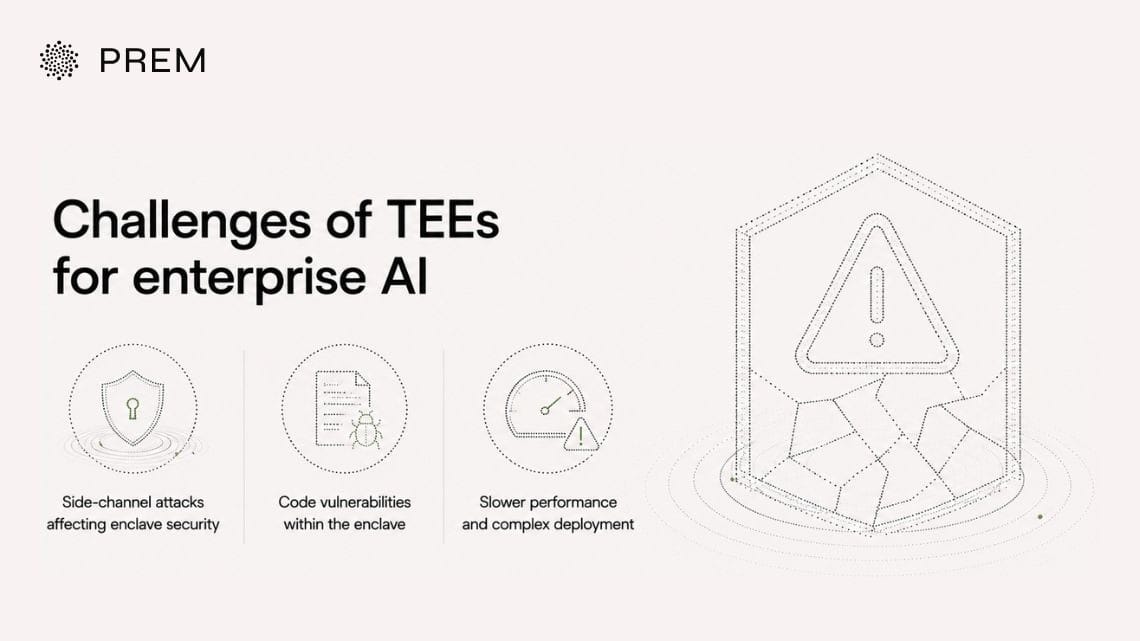
You deserve the full picture here, not a sales pitch. No security architecture is perfect, and TEEs are no exception. Understanding where the real limits sit is what lets you deploy this technology responsibly, rather than assuming it solves every problem on its own.
Side-channel attacks affecting enclave security
TEEs protect against direct access to memory, but they don't eliminate every possible attack surface. Side-channel attacks work differently from a direct memory read: instead of accessing protected data outright, they try to infer information by observing patterns in how a system behaves while it's running, timing variations, power consumption, or other physical signals a processor gives off during computation.
Researchers have identified side-channel techniques that target hardware-based trusted execution environments, which is why major hardware vendors continue to strengthen mitigations through firmware, microcode, and architectural updates. Intel's own Security Center publishes ongoing advisories for hardware and firmware vulnerabilities, a reminder that TEE security depends on continuous patching, not a one-time hardware guarantee. This is an active, evolving area of security research, not a solved problem you can treat as permanently closed.
What to do about it
Don't treat TEE adoption as a deployment you complete once and forget. Evaluate how quickly your vendor releases firmware and security updates, and review their vulnerability management process before deployment. Consider layering additional encryption underneath your TEE rather than relying on hardware isolation as your only defence. Build ongoing vulnerability monitoring into your own security operations, rather than waiting for a vendor to tell you something broke.
Code vulnerabilities within the enclave
A TEE protects the boundary around your workload. It doesn't automatically make the code running inside that boundary free of bugs. Buffer overflows, poor memory management, and sloppy application logic can still cause real problems, even inside a hardware-sealed environment.
The enclave protects you from the outside world. It doesn't protect you from your own code, which is exactly why frameworks like the OWASP Top 10 exist: application-level security has to be handled on its own terms, independent of whatever infrastructure it's running on.
What to do about it
Before you commit to any TEE-based provider, ask directly whether their attestation and enclave code go through independent security audits and how often. Don't treat "runs inside a TEE" as a synonym for "secure by default". Due diligence on the software layer still belongs on your checklist, not just the hardware layer.
Slower performance and complex deployment
TEEs add real overhead. Memory encryption, attestation checks, and the isolation boundary itself all take extra processing time, so workloads running inside a TEE are typically slower than the same workload running without one. This gap is more noticeable on GPU workloads, since confidential computing for GPUs is still a newer, fast-moving space compared to CPU-based TEEs, which are already well established.
Deployment adds its own complexity too. Depending on the platform you choose, you may need to plan for additional tooling, orchestration, and operational workflows that a standard (non-TEE) deployment wouldn't require. As the Confidential Computing Consortium notes in its "3 Degrees of Confidential Computing" framework, the security benefits of confidential computing increase with the level of integration, which generally means deeper protection comes with more deployment work, not less.
What to do about it
Don't try to move every workload into a TEE on day one. Start with your highest-sensitivity, lowest-volume workloads first: classified data, executive communications, & unreleased financial models, and expand once your team has built real operational experience with attestation and monitoring. Treat the first deployment as a chance to build internal expertise, not just check a compliance box.
Risks of skipping TEEs in enterprise AI
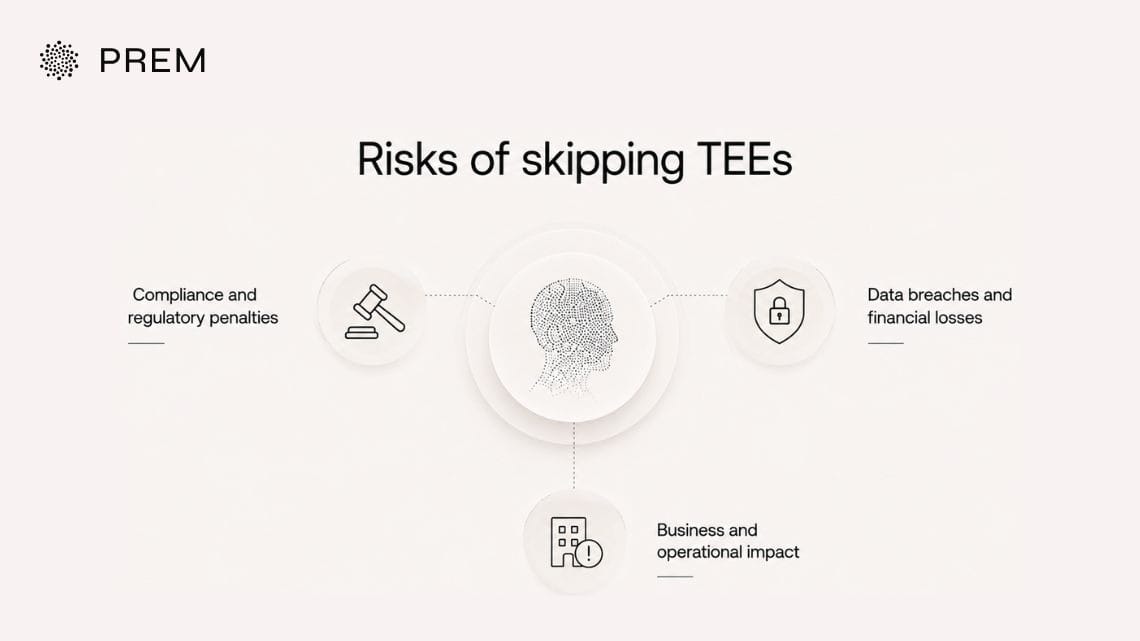
The value of a Trusted Execution Environment becomes most obvious when it's missing. Encryption, access controls, and contractual safeguards all reduce risk, but they don't protect sensitive data while it's actively being processed. Without that layer of protection, your enterprise remains exposed to technical, regulatory, and business risks that become harder to manage as AI adoption grows.
Compliance and regulatory penalties
AI regulation is becoming more demanding, and enterprises are increasingly expected to demonstrate how sensitive data is protected throughout the AI lifecycle, not just document their security policies.
Under the General Data Protection Regulation (GDPR), organisations can face fines of up to €20 million or 4% of their worldwide annual turnover, whichever is higher, for the most serious infringements involving personal data.
According to the European Commission's AI Act enforcement guidance, organisations can face penalties of up to €35 million or 7% of worldwide annual turnover for prohibited AI practices and up to €15 million or 3% for certain other violations, including obligations relating to high-risk AI systems. Many of these high-risk obligations become applicable to Annex III AI systems from December 2027.
As regulatory expectations evolve, organisations need more than written policies. They need technical controls that help demonstrate how sensitive AI workloads are protected, governed, and audited throughout their lifecycle.
Data breaches and financial losses
According to IBM's 2025 Cost of a Data Breach Report, the global average cost of a data breach was $4.44 million in 2025, while organisations in the United States experienced an average cost of $10.22 million, the highest of any country. The same report found that healthcare remained the costliest industry for the 14th consecutive year, with an average breach cost of $7.42 million.
IBM also found that organisations with extensive shadow AI incurred an average of $670,000 more in breach costs than organisations with little or no shadow AI. As AI adoption expands across the enterprise, protecting sensitive data during processing becomes just as important as protecting it at rest or in transit.
Business and operational impact
The impact of weak AI security extends beyond fines and breach costs. The NIST AI Risk Management Framework (AI RMF) emphasises that trustworthy AI depends on governance, risk management, and technical controls that organisations can demonstrate throughout the AI lifecycle.
Enterprise customers, regulators, and business partners increasingly expect organisations to demonstrate how sensitive data is protected throughout AI processing, particularly in regulated industries.
Without verifiable security controls, enterprises may face longer procurement cycles, increased security reviews, and greater difficulty demonstrating compliance to customers and regulators. Strong technical safeguards don't just reduce security risk; they also help build the trust needed to deploy AI confidently at enterprise scale.
Where enterprises use Trusted Execution Environments
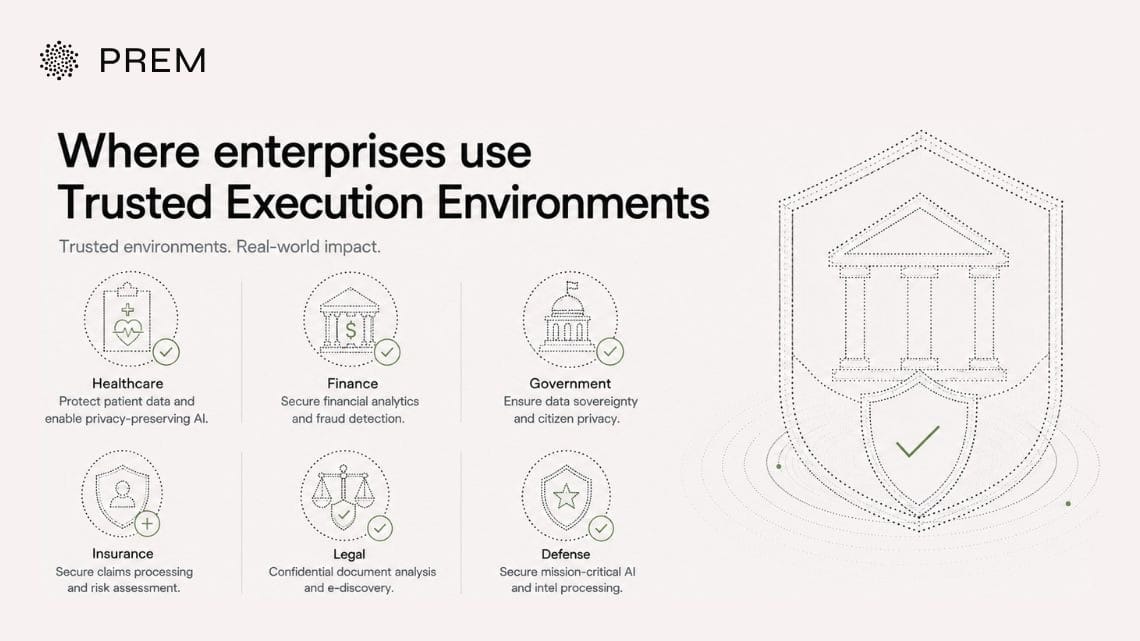
Highly regulated industries, healthcare, finance, government, insurance, legal, and defence, are where TEEs matter most, since these are the sectors where data sensitivity carries the highest cost of failure.
Healthcare
Clinical note summarisation, EHR data extraction, and diagnostic support all involve protected health information (PHI) under HIPAA. The Cloud Security Alliance's guidance on confidential computing in healthcare highlights that as AI adoption accelerates across healthcare, protecting patient data during active processing is critical for regulatory compliance, operational security, and maintaining patient trust.
Finance
Risk modelling, fraud detection, and underwriting all run on data banks that are legally obligated to protect. According to the Cloud Security Alliance's State of Cloud and AI for Financial Services 2026 report, 62% of financial institutions are already deploying AI agents, and 85% anticipate autonomous AI-driven financial transactions. The same report points to growing pressure from DORA and the EU AI Act as a driver behind emerging AI-specific security controls in banking, keeping credentials and sensitive data protected through every step an AI system touches.
Government
Public sector AI has to satisfy jurisdictional and sovereignty requirements that go well beyond ordinary corporate compliance. According to McKinsey's global survey of 300 executives, investors, and government officials, 71% now describe sovereign AI as an "existential concern" or "strategic imperative" for their organisations. That pressure is pushing governments toward infrastructure they can verify and control directly, rather than depending on assurances from a foreign provider.
Insurance
Claims processing and fraud detection increasingly run through AI; at the same time, fraud itself is getting harder to catch by eye alone. Verisk's 2026 State of Insurance Fraud Study found that 98% of insurers agree AI-powered editing tools are fuelling a rise in digital media fraud, and 99% say they've already encountered manipulated or AI-altered documentation.
Legal
Privileged communications, contract review, and litigation strategy are exactly the kind of material that shouldn't pass through a standard consumer AI tool. According to 8am's 2026 Legal Industry Report, nearly 70% of legal professionals now use general-purpose AI tools for work, up sharply from just 31% the year before. Yet only 46% of firms have implemented any firm-wide AI tool, and just 34% have adopted legal-specific AI platforms, a gap the report ties to concerns about data security, ethical risk, and unreliable outputs.
Defense
National security workloads carry some of the strictest data protection requirements of any sector. According to Cybersecurity Dive, President Trump signed an executive order in June 2026 setting firm deadlines for federal agencies and contractors to adopt post-quantum cryptography, key establishment by December 2030, and digital signatures by December 2031, specifically to defend against adversaries harvesting encrypted data today with the intent to decrypt it once quantum computing matures.
How Prem AI helps your enterprise with TEE
Every industry above needs the same underlying thing: proof, not promises. That's the gap Prem AI is built to close.
Private AI infrastructure
Prem runs frontier open-weight models within confidential environments, whether deployed on-premises, in your VPC, or accessed through Prem's managed Enclave API. Each deployment is backed by hardware attestation, letting you verify the integrity of the execution environment directly, rather than relying on infrastructure claims alone.
Trusted Execution Environments
This isn't a feature added on top. It's the foundation. Prem Enclave is built directly on Intel TDX, AMD SEV-SNP, and NVIDIA Confidential Computing, extending confidential computing protections across AI infrastructure, including GPU workloads. Execution is verified through deterministic builds with PCR (Platform Configuration Register) matching, and GPU interconnects are hardware-encrypted through PCIe and NVLink under NVIDIA Confidential Computing.
Verifiable AI with zero data retention
Every request runs under a zero data retention model, and every one generates a cryptographic attestation report you can verify independently. Sensitive data remains protected within the Trusted Execution Environment throughout processing. Metadata like request timestamps and payload size remain visible for billing and operational purposes; the underlying data itself does not.
Knowledge that compounds over time
TEEs solve the infrastructure problem: proving your data stays protected while it's processed. What you do with that protected compute still matters. This is where Fluso, Prem AI's enterprise AI workspace, comes in.
Built on top of Prem's confidential infrastructure, Fluso gives your teams a governed workspace to actually put that private compute to use, connecting enterprise knowledge, workflows, and context without ever routing that information through a third-party model provider. Instead of contributing your data to external AI services one prompt at a time, your enterprise builds reusable workflows and shared institutional knowledge that stays inside infrastructure you control.
The result is a system that gets more useful to your specific enterprise over time, not because a model is quietly retraining on your data, but because your own knowledge stays organised, accessible, and yours.
Build enterprise AI with Trusted Execution Environments using Prem AI
Trusted Execution Environments are becoming a foundational layer of enterprise AI infrastructure. If your enterprise is deploying frontier AI models on sensitive data, you need infrastructure that lets you verify how that data is protected during processing, not just trust that it is.
Prem AI helps you deploy AI inside Trusted Execution Environments, giving you hardware-backed attestation and confidential computing you can deploy on-premises, in your own VPC, or through Prem's managed Enclave API. That foundation lets you scale AI with greater confidence while maintaining security, governance, and control over your sensitive data.
If you're ready to deploy AI on infrastructure you can verify instead of infrastructure you have to trust, contact our sales team to discuss your enterprise requirements. You can also reach our team directly at sales@premai.io to learn how Prem AI can help you build secure, verifiable AI infrastructure for production.
Frequently asked questions about TEEs for enterprise AI
What is a Trusted Execution Environment (TEE) in simple terms?
A TEE is a secure, isolated section of a computer chip where code and data run fully protected, even from the operating system, cloud provider, and system administrators. Think of it as a locked room inside the processor itself. Nobody outside that room can see what happens inside it.
How is a TEE different from encryption at rest or in transit?
Encryption at rest and in transit protects data before and after it's used, sitting on a drive or crossing a network. A TEE protects the stage in between data while it's actively being processed. That's the point traditional security has historically left exposed, and it's the specific gap a TEE closes.
Can a TEE be hacked?
No security system is unbreakable, and TEEs are no exception. Side-channel attacks that target hardware-based TEEs have been identified by researchers, which is why hardware vendors continue to strengthen mitigations through firmware, microcode, and architectural updates. TEEs remain one of the most practical solutions available for protecting data during processing.
Which companies build the hardware behind TEEs?
Major chipmakers build confidential computing directly into their hardware, including Intel with TDX, AMD with SEV-SNP, and NVIDIA across its GPU architectures. Cloud providers and AI infrastructure companies like Prem AI build on top of this hardware to deliver verifiable, private AI processing at production scale.
Is a TEE the same as a VPN or a private cloud?
No. A VPN protects data moving across a network, and a private cloud controls who can access your infrastructure at the network or account level. Neither protects data while it's actively being processed inside a shared or third-party server. A TEE specifically closes that in-use processing gap at the hardware level.
What is remote attestation, and why does it matter?
Remote attestation is the process where a TEE generates a cryptographically signed report proving exactly what code is running and that the hardware hasn't been tampered with before any data is sent. You can independently verify this signature rather than take a vendor's word for it. Prem's Enclave generates this kind of attestation report on every request.
Do TEEs replace the need for a Data Processing Agreement (DPA)?
Not entirely. DPAs still matter for legal and contractual purposes. But a TEE reduces how much you have to rely on that agreement being honoured in practice. Instead of trusting a promise that data won't be misused, you get hardware-level verification that it's structurally protected.
How does zero data retention (ZDR) relate to TEEs?
ZDR means your data is never written to disc, never used to train models, and is removed from memory once processing completes. It's a policy commitment made verifiable by the TEE itself, since attestation lets you confirm the system was actually built to behave this way. Prem's Enclave runs every request under this model.
Do TEEs slow down AI performance?
There's a performance cost to confidential computing compared to unprotected processing, but modern TEE implementations, especially GPU-based confidential computing, are built to run production AI workloads at usable speeds. It's a real trade-off to weigh, not something to assume away, but it's no longer the bottleneck it once was.
How does Prem AI help enterprises deploy TEEs?
Prem AI runs frontier and open-weight models inside Trusted Execution Environments, deployable on-premises, in your own VPC, or through Prem's managed Enclave API. Every request generates a verifiable attestation report and runs under a zero data retention model, giving your enterprise infrastructure something it can check rather than simply trust.
Ready to see how Prem AI works for your enterprise? Contact our team or email us at sales@premai.io, and we’ll help you understand how Fluso can be tailored to your environment with sovereign AI, verifiable infrastructure, and data control.