Glean vs ChatGPT: Which AI Workspace Is Better for Enterprise Teams?
On this page
Not long ago, comparing Glean and ChatGPT Enterprise wouldn't have made much sense.
If you wanted to search your enterprise knowledge, you'd probably choose Glean. If you wanted help writing, coding, analyzing data, or brainstorming ideas, ChatGPT Enterprise was the obvious choice.
Today, that distinction isn't as clear.
According to OpenAI's ChatGPT Enterprise release notes, ChatGPT Enterprise has expanded far beyond a conversational AI assistant. With Workspace Agents, connected business apps, enterprise connectors, and AI-powered workflows, it's becoming a platform that helps your employees get work done across your enterprise.
The pace of change is reshaping the entire enterprise AI market. Reacting to OpenAI's latest model updates, Glean CEO Arvind Jain shared that AI models are evolving so quickly that enterprises shouldn't have to rebuild their AI stack every time the model layer changes. It's another sign that enterprise AI is moving beyond standalone search or standalone AI assistants toward more flexible and private AI workspace.
The model layer is moving fast. Prices, speed, and capability are all changing. Enterprises shouldn’t have to rebuild their AI stack every time it does.
— Arvind Jain (@jainarvind) July 30, 2026
We built @glean for this reality, a model-agnostic context and intelligence layer that lets companies use the best model for… https://t.co/c5f88U7bWc
That's why you're seeing these two enterprise AI platforms compared more often today. The real question is, which AI workspace fits the way your enterprise actually works?
Let's find out. We'll look at where Glean and ChatGPT Enterprise perform best, where each one starts to fall short, and then see how Fluso brings enterprise search, AI generation, and workflow automation together in a unified AI workspace.
Why enterprise teams compare Glean and ChatGPT
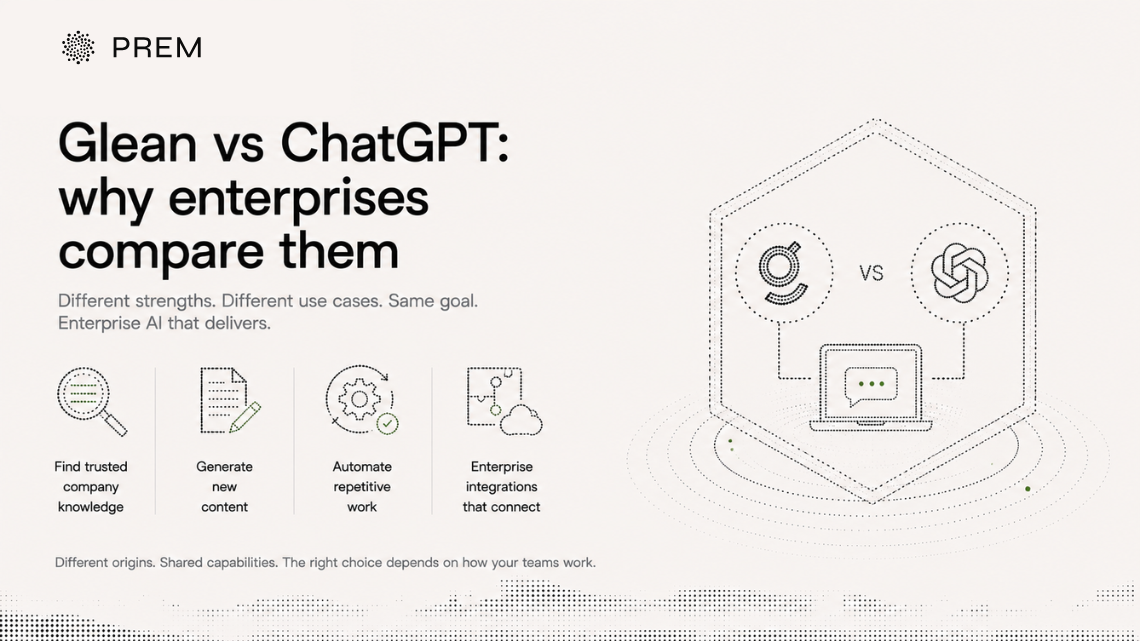
Enterprise AI has evolved far beyond simple chatbots. Today, you expect AI to help your employees find trusted company knowledge, generate new content, and automate repetitive work.
Microsoft's 2026 Work Trend Index highlights the same shift. The report analyzed trillions of anonymized Microsoft 365 productivity signals and surveyed 20,000 knowledge workers who use AI at work across 10 markets, including France, Germany, and Italy. Microsoft found that the next challenge for enterprises isn't simply adopting AI. It's redesigning work so people, AI, and business systems work together more effectively.
As those expectations grow, Glean and ChatGPT are increasingly evaluated side by side. At first glance, the comparison may seem unusual.
Glean began as one of the AI enterprise search platforms. ChatGPT started as a general-purpose AI assistant.
Yet both now offer conversational interfaces, enterprise integrations, and AI-powered capabilities. For you, the question is no longer which category of tool to buy, but which AI workspace actually fits how your teams work.
The answer isn't straightforward. These platforms were built with different priorities, and understanding those differences matters before you decide.
Glean vs ChatGPT for enterprise teams
At first glance, Glean and ChatGPT Enterprise look surprisingly similar. Both let your employees ask questions in natural language. Both use AI to make work easier. Both connect with enterprise tools.
That's where the similarities end.
Glean and ChatGPT were built to solve fundamentally different challenges. Glean helps your employees discover trusted knowledge that already exists across your business systems. ChatGPT helps them generate new work through writing, reasoning, coding, and analysis.
The challenge is bigger than it looks. According to Atlassian's State of Teams 2025 report, executives and teams spend about a quarter of their workweek searching for information. The same report found that 56% of workers still have to ask a colleague or schedule a meeting to get the information they need. Finding information is only the first step. Your employees still need to turn it into reports, emails, proposals, and decisions.
A typical employee rarely spends the whole day only searching or only creating. They find a policy, summarize it into a report, draft an email, and collaborate on next steps, which is why enterprises are moving beyond standalone search tools and assistants toward more connected AI workflows.
One more thing worth knowing before you compare them side by side: Glean can connect to multiple AI model providers, while ChatGPT Enterprise only runs on OpenAI's own models. If your enterprise already has a preferred provider, that alone might narrow your choice.
Which platform supports your team better depends on where your biggest bottleneck actually sits.
Finding trusted enterprise knowledge
When your employees need to locate information that already exists, Glean has a clear advantage. It searches across enterprise applications like Slack, Google Workspace, Microsoft 365, Confluence, Jira, and Salesforce, bringing your scattered knowledge into a single search experience.
Instead of your team remembering where a document lives, they can ask a question and retrieve relevant information while permissions stay intact.
ChatGPT can also work with enterprise information, but it relies on what's available through connected sources, uploaded files, or the context you provide in a conversation. Its role isn't enterprise-wide knowledge discovery. It's helping your team make sense of the information they already have in front of them.
Turning knowledge into workflows
Once your team finds the information they need, the challenge often shifts from retrieval to creation.
This is where ChatGPT has the advantage. It drafts reports, summarizes meetings, writes code, analyzes documents, and reasons through complex problems. Instead of surfacing an existing answer, it helps your team produce something new based on their instructions and available context.
Glean includes AI-powered assistance for summarization and basic answers. Its primary purpose stays focused on helping your team discover and understand existing knowledge, not generate entirely new work.
Cost comparison for both
Neither company puts a price on their website. Costs swing depending on who's buying. A smaller, growth-stage team might land Glean for somewhere in the range of $28.8K a year. A larger enterprise negotiating the same product could end up paying seven figures, with some deals reportedly climbing toward $5M. ChatGPT Enterprise works on a per-seat model instead, typically starting around $108K annually once you factor in the 150-seat minimum most contracts require.
None of these numbers are fixed. Enterprise sales teams negotiate, and what you're quoted has more to do with your leverage and requirements than any published rate card. Treat every figure you hear as a starting point for your own conversation, not a benchmark to match.
Keeping your data secure
Once you're comfortable with what each platform can find or create, the next question is usually how carefully it handles your data while doing it.
Glean mirrors the access permissions already set in your underlying tools. If someone loses access to a document in Google Drive, they lose access to it in Glean at the same moment, since permissions get checked on every query rather than cached once and forgotten.
ChatGPT Enterprise keeps your data isolated from OpenAI's training pipeline, running it in a separate environment rather than feeding it back into the model. The tradeoff is that ChatGPT Enterprise is fundamentally a chat interface, so the biggest risk isn't the platform itself, it's your own employees pasting something sensitive into a prompt without thinking twice.
Neither approach is wrong. They're just protecting different things. Glean's strength is controlling who can see what. ChatGPT Enterprise's strength is keeping your data out of someone else's model, once it's already inside the conversation.
Knowledge graph vs language model
Strip away the interface, and these two platforms aren't built from the same starting point at all.
Glean's foundation is a graph, a live map of relationships across your enterprise: who's an expert in what, which teams actually work together, and how scattered pieces of content connect back to the same underlying topic. That structure is why Glean can answer a question with context behind it, not just a string match against a document. It's also plugged into more than a hundred pre-built connectors, so that graph stays current against the tools you're already running.
ChatGPT Enterprise starts somewhere else entirely, a conversational layer sitting directly on top of OpenAI's own model. That gives you first access to whatever OpenAI ships next, since there's no third party standing between the interface and the model. What it doesn't give you is a structured understanding of your business built in from day one, your enterprise data gets wired in around the chat experience, rather than organized into relationships the way Glean's graph is.
Which foundation matters more depends on your actual problem. A graph wins when the job is surfacing information you already have and trusting where it came from. A model wins when the job is working through something nobody's written down yet.
Supporting end-to-end enterprise workflows
Finding information and creating content are rarely separate tasks for your team. A typical workflow might involve locating an internal policy, extracting key points, drafting a proposal, and completing follow-up actions, all in sequence.
Both Glean and ChatGPT support parts of that workflow, but they approach it from different directions. Glean helps your team discover trusted business knowledge, while ChatGPT helps them transform that information into new work.
For many enterprises, both capabilities are valuable, but they often exist in separate tools and separate workflows. As AI becomes more embedded in your day-to-day operations, your employees increasingly expect one workspace that can search, generate, automate, and collaborate, without constantly switching between platforms.
That's where the limitations of both approaches start to become more visible.
The limitations of Glean and ChatGPT for enterprise AI
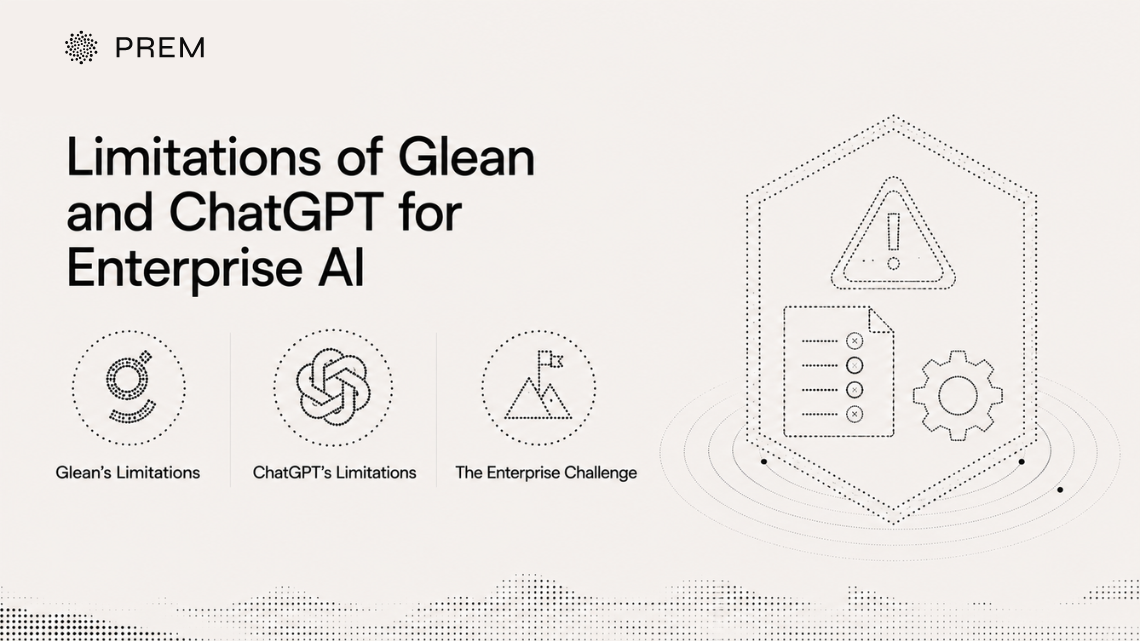
Glean and ChatGPT are both capable platforms, but neither was designed to be a complete AI workspace. As your AI adoption grows, the gaps become more noticeable.
This shows up especially when your team moves between searching for information, creating new work, and completing business processes.
Limitations of Glean
Glean is strong at helping your team find information that already exists across your workplace. The gap appears when you need to act on that information, which is where many Glean alternatives take a different approach.
Search covers one stage, not the whole workflow
Once your team finds the right information, they still need another tool to turn it into something usable. Search doesn't carry the work any further than that.
Its agentic features remain limited
Most implementations only support single-agent actions, like sending a message or pulling a document, rather than coordinating multi-step work across systems.
It wasn't built AI-first
Glean's core strength is still search and retrieval. Its generation and reasoning capabilities are noticeably thinner than a platform designed around a language model from the start.
Your knowledge is shaped by Glean's structure
You're working within how Glean organizes its knowledge graph. If your enterprise's data relationships don't map cleanly to that structure, some context can end up harder to surface than it should be.
Limitations of ChatGPT Enterprise
ChatGPT Enterprise's strength is generating and reasoning through anything you give it. Its limitations start showing up in what it doesn't know, and where that information actually ends up.
It has no standing knowledge of your enterprise
Its understanding of your business depends entirely on what you connect or paste in. Without deliberate setup, it doesn't build the kind of organizational context Glean generates automatically.
You're locked into OpenAI's own models
If your enterprise wants access to other model providers, ChatGPT Enterprise doesn’t give you that flexibility, which is one reason teams start looking at alternatives to ChatGPT Enterprise.
Its integrations are shallower than a dedicated search platform's
Native connections cover a handful of common tools. Anything beyond that requires custom connector work your team has to build and maintain.
The real security risk sits with your employees, not the platform
Since it's fundamentally a chat interface, someone pasting sensitive data into a prompt has already moved that data outside any controlled workflow, regardless of how OpenAI handles it afterward.
Your data and knowledge risk feeding OpenAI's own progress
Every prompt, correction, and piece of proprietary context your team feeds into ChatGPT contributes to a system OpenAI owns and improves, not one your enterprise owns. Over time, that's your institutional knowledge and intellectual property compounding value for a vendor, not for you.
Where both platforms fall short
Set the individual limitations aside for a moment, and a bigger pattern shows up. Both platforms solve half the problem, and your team ends up carrying the rest.
Neither one is a full workspace
You still end up stitching together search and generation across separate tools, rather than working in one place.
Both require real setup and internal expertise
Permission mapping for Glean, connector and prompt design for ChatGPT Enterprise, neither works well out of the box without that investment.
Pricing for both is opaque and negotiated case by case
That makes it hard to budget confidently before you're deep into a sales process.
The friction compounds as your AI use grows
What starts as a minor inconvenience, switching between a search tool and a generation tool, becomes a real drag on how your team actually works day to day.
The challenge of disconnected AI tools
As your enterprise adopts more AI tools, another challenge starts to appear. Your employees search in one platform, generate content in another, automate work somewhere else, and switch between business apps throughout the day.
That challenge is already showing up in the data. Zapier's 2025 AI Tool Sprawl survey found that 76% of enterprises have experienced negative outcomes from disconnected AI tools, and 70% remain stuck in the early stages of AI maturity as a result.
Over time, that fragmentation creates duplicate work, inconsistent answers, and disconnected workflows. Instead of asking which AI tool is better, many enterprise teams are starting to ask a different question:
Can one AI workspace do all of this together?
How Fluso brings enterprise search and AI together
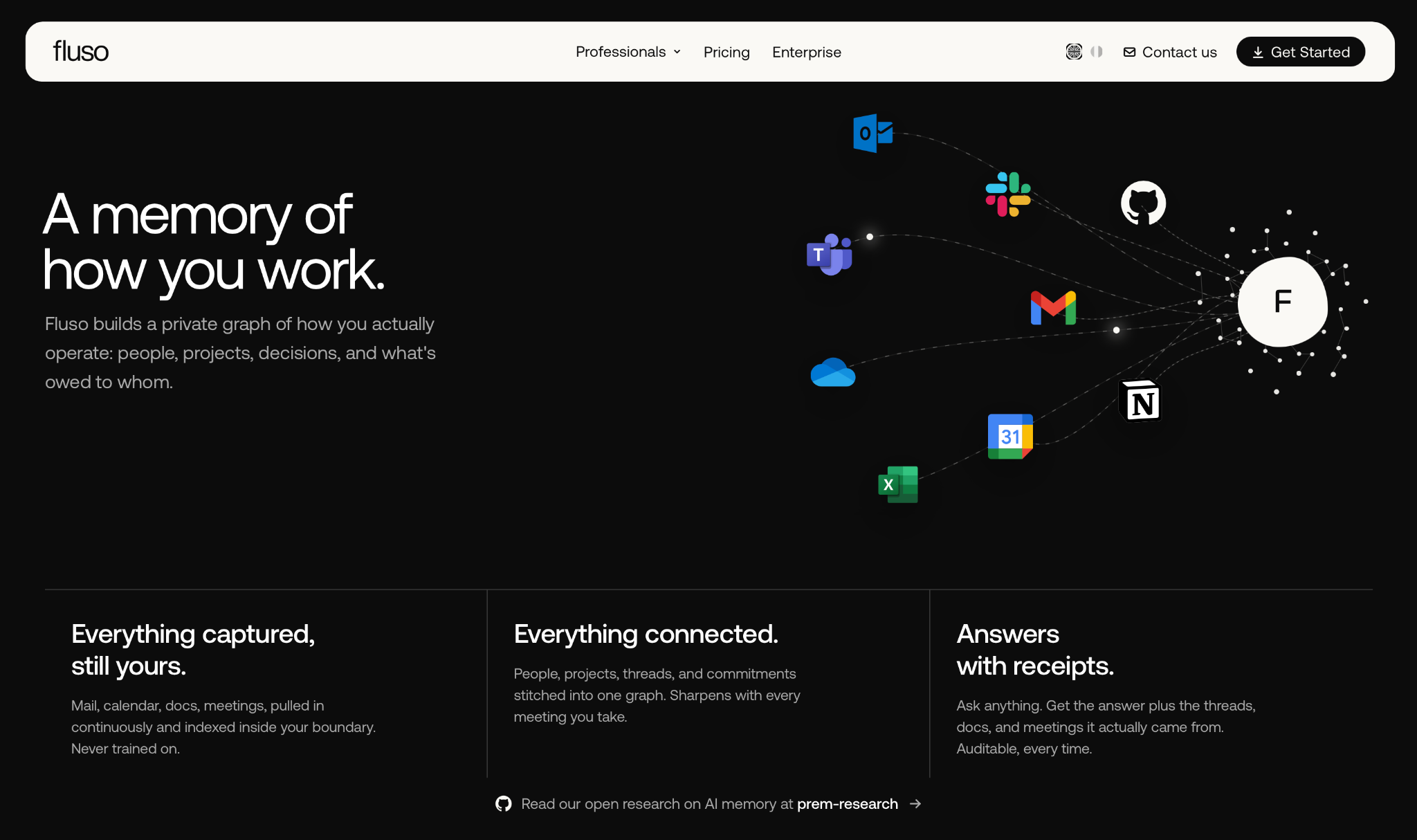
You don't have to choose between enterprise search and AI generation. As your workflows get more complex, you need a workspace that does both.
Fluso is designed to do exactly that. It brings enterprise search, AI generation, workflow automation, and AI agents together in a unified workspace. Your employees can find trusted business information, generate new content from it, and complete everyday tasks without switching between multiple platforms.
How Fluso closes that gap
Fluso is built to be the workspace that handles both halves of the problem, finding what you already know, and turning it into something new, without asking your team to switch tools in between. Here's what that actually looks like.
Discover all your enterprise knowledge
Beyond helping you discover enterprise knowledge, Fluso lets you turn that knowledge into reports, emails, presentations, code, summaries, and other business outputs. Instead of treating search and generation as separate experiences, it carries your work from discovery all the way through to action.
Integrations that work with your enterprise applications
You can connect Fluso to more than 500 business applications, including Gmail, Slack, Notion, Google Drive, and other enterprise systems. Once it's grounded in your own enterprise knowledge, your team gets responses built on trusted business context, not just a model's general training.
Context compounding for better results
As you keep working, Fluso goes a step further through context compounding. Instead of treating every interaction as a fresh conversation, it captures your approved knowledge, successful workflows, and verified business context. Over time, every verified interaction makes future responses more relevant, consistent, and useful across your enterprise.
Private infrastructure, not a shared model
Fluso runs on Prem AI's confidential computing infrastructure, so you get your own private inference environment instead of a shared, multi-tenant one. You can deploy it on-premises, in your own VPC, or through Prem's managed Enclave API, so where your data actually gets processed stays your decision, not a vendor's.
Confidentiality and zero data retention
Fluso runs on Zero Data Retention. Your prompts and enterprise data are never written to disk, never used to train shared models, and get cleared from memory the moment processing completes. This is backed by confidential computing, including Confidential Mode for encrypted inference, so your data stays private by architecture, not by policy.
Security and privacy of your data
Fluso is engineered in Switzerland and hosted in the EU, with confidential computing protecting your data at every layer. Your enterprise data stays encrypted throughout processing, and access controls make sure only your team, not Fluso itself, can see what's actually in your prompts and outputs.
Compliance with European regulations, including GDPR
Because Fluso is hosted in the EU and built around zero data retention and confidential computing, it aligns directly with GDPR's data minimization and purpose limitation principles. That's a meaningfully different starting point than ChatGPT Enterprise, where your enterprise has to build GDPR compliance around infrastructure that wasn't designed with EU data residency as the default.
Unified workspace instead of several
If you need both knowledge discovery and AI-powered work creation, Fluso combines enterprise search, AI generation, workflow automation, AI agents, and context compounding in one governed workspace. Instead of stitching together multiple point solutions, you can search, create, collaborate, and act from a single platform.
Fluso: Bringing enterprise search and AI together
By now, you've seen how Glean, ChatGPT Enterprise, and Fluso differ in their approach to enterprise AI. To make those differences easier to evaluate, here's a side-by-side comparison of their core capabilities.
Fluso: the best AI workspace built for modern enterprise teams
By now, you've seen that Glean and ChatGPT Enterprise solve different parts of the enterprise AI workflow. If your enterprise needs search, AI generation, automation, and governance working together, you need more than either platform alone.
Fluso is built as a complete AI workspace for enterprise teams. It combines enterprise search, AI-powered work creation, workflow automation, AI agents, and context compounding in a single governed platform, so your employees can move from finding information to creating, collaborating, and taking action without switching between multiple tools.
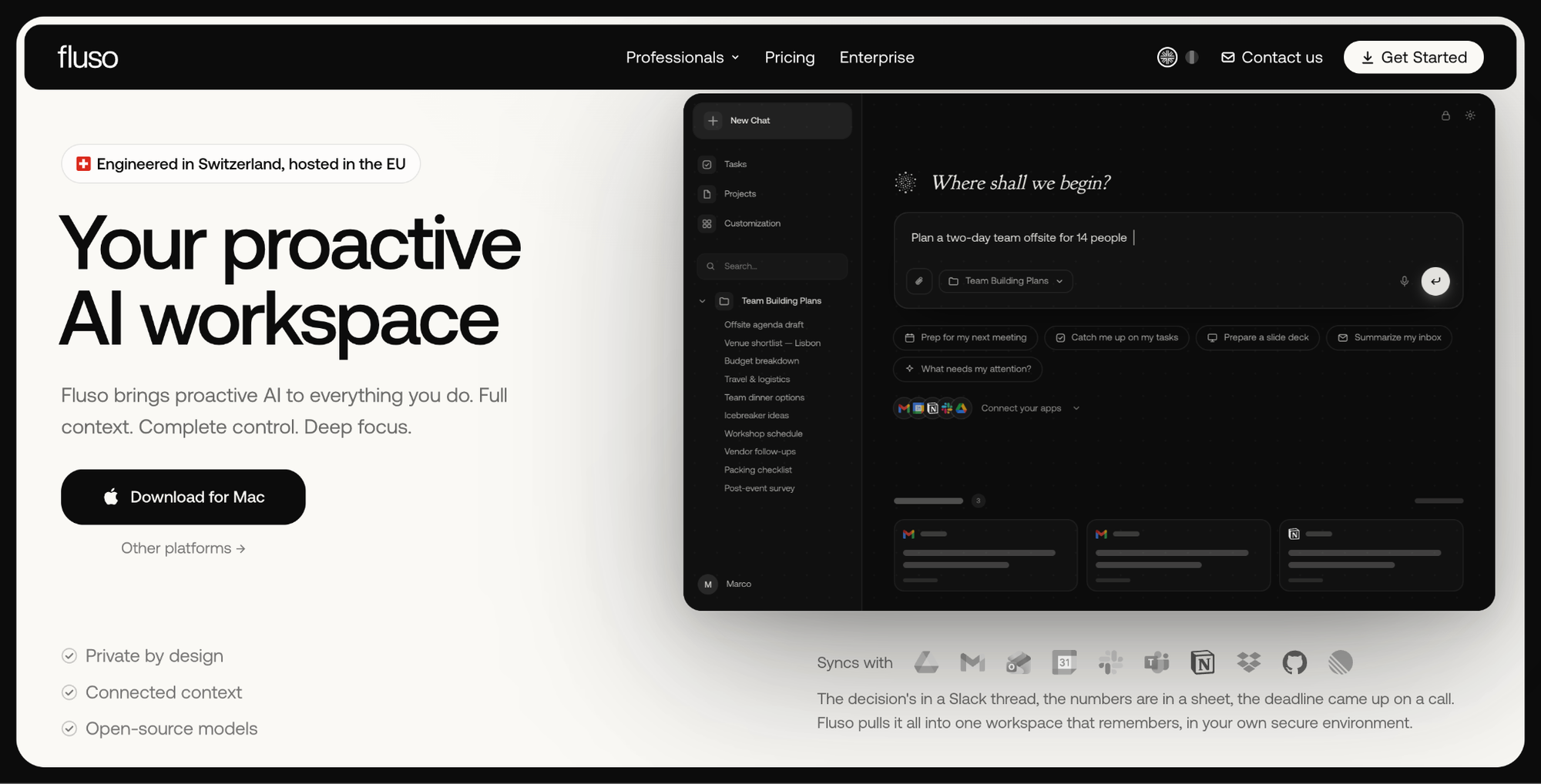
Unlike AI assistants that rely primarily on conversation history, Fluso continuously builds on your organization's trusted knowledge. Every approved workflow, verified decision, and domain-specific insight becomes part of a growing knowledge foundation, helping AI responses become more accurate, relevant, and consistent over time.
Built on Prem’s private AI infrastructure, Fluso is engineered in Switzerland and hosted in the EU with confidential computing, Confidential Mode, and Zero Data Retention (ZDR). Your enterprise data remains private, your AI infrastructure stays under your control, and your knowledge compounds inside a secure, governed environment instead of being scattered across disconnected tools.
If you need more than standalone search or standalone AI generation, Fluso gives you both in one governed AI workspace.
Whether you're looking to improve knowledge discovery, automate workflows, or deploy private AI with enterprise-grade security, Fluso helps your employees work faster without compromising control.
Ready to see how it works? Contact our team or email us at sales@premai.io, and we'll help you understand how Fluso can be tailored to your environment with sovereign AI, verifiable infrastructure, and 100% data control.
FAQs about Glean vs ChatGPT for enterprise teams
Is Glean better than ChatGPT for enterprise use?
It depends on your problem. Glean finds existing knowledge across your enterprise's tools. ChatGPT generates new content and reasons through open-ended tasks. Neither is objectively better; they solve different problems, so the right choice depends on where your team's bottleneck actually sits.
Can ChatGPT search my enterprise's internal documents?
Not natively. ChatGPT Enterprise requires custom connectors or manual context input to access your internal documents. It doesn't come with enterprise-wide search built in the way a dedicated platform like Glean does, so setup and integration work is usually required first.
Does Glean generate new content as ChatGPT does?
Not really. Glean includes basic AI assistance for summaries and answers, but its core purpose is search and retrieval. It's not designed to draft reports, write code, or reason through open-ended problems the way a generative AI assistant is built to.
What's the difference between enterprise search and a general AI assistant?
Enterprise search tools like Glean retrieve information that already exists in your systems. General AI assistants like ChatGPT generate new outputs from an instruction, often without direct access to your enterprise's own data unless you connect it yourself.
Do I need both a search tool and a generative AI assistant?
Many enterprises do. Search and generation solve different problems, and most real workflows touch both. The alternative is a single workspace that combines connected enterprise knowledge with generative AI capabilities, instead of managing two separate tools.
How does Fluso compare to Glean and ChatGPT?
Fluso combines connected enterprise search, similar to Glean, with AI generation and automation, similar to ChatGPT, in one workspace. It adds context compounding, and enterprise-grade security, so your team gets both capabilities without switching platforms.
What is context compounding, and does Glean or ChatGPT offer it?
Context compounding means your AI builds on approved knowledge and workflows over time, instead of starting fresh each session. Neither Glean nor ChatGPT treats this as a core feature. Fluso is built around it directly.
Is ChatGPT Enterprise secure enough for sensitive business data?
ChatGPT Enterprise includes enterprise-grade controls, but data handling specifics are worth verifying directly with the provider. For enterprises needing hosting location control or confidential computing guarantees, it's worth comparing against platforms built specifically around those requirements.
How many integrations does Glean support compared to Fluso?
Glean connects to major enterprise apps like Slack, Microsoft 365, Confluence, and Salesforce. Fluso supports more than 500 enterprise integrations, including Gmail, Slack, Notion, and Google Drive, covering a similarly broad range of connected sources.
Which platform is easier to deploy across an enterprise?
ChatGPT Enterprise has the lowest barrier for individual teams to start quickly. Glean usually involves a more structured, sales-led process. For an enterprise, easier often means fewer surprises later. Fluso lets you choose EU-managed cloud, customer VPC, or on-premises deployment upfront, built around your requirements from day one.
Ready to see how Prem AI works for your enterprise? Contact our team or email us at sales@premai.io, and we’ll help you understand how Fluso can be tailored to your environment with sovereign AI, verifiable infrastructure, and data control.