Private AI Inference: How Enterprises Deploy Frontier Models Without Exposing Sensitive Data
Europe is running two clocks at once.
One clock is regulatory. According to the European Commission's approach to artificial intelligence, general-purpose AI providers have been subject to EU AI Act obligations since 2 August 2025. From 2 August 2026, the European Commission's AI Office and national authorities also began enforcing new transparency obligations for a broader set of AI systems. Alongside the AI Act, your enterprise must continue meeting its obligations under the GDPR whenever personal data is processed.
That regulatory clock isn't just about compliance paperwork. It reflects a broader European push to reduce dependence on US and Chinese infrastructure altogether. Euronews covered this shift in a short video on Europe's growing federated cloud and Private AI infrastructure effort, backed by the European Commission.
The other clock is competitive. As per NBER's Mind the Gap: AI Adoption in Europe and the U.S. research, European enterprises are already trailing the US on AI adoption. They want the reasoning quality of the best AI systems available, not a slower, regionally boxed version of them.
These two clocks used to feel like they were pulling in opposite directions. Adopt the best models, and you often send data to infrastructure you do not control. Stay in full control of your data, and you settle for weaker models.
That trade-off is the reason private AI inference has become a board-level topic across European banks, hospitals, insurers, and public sector bodies.
A German bank cannot risk sensitive fraud data leaving the country during inference. A hospital in France cannot risk patient records passing through infrastructure it cannot audit. A manufacturer in Italy cannot risk its product designs sitting in logs on a server it has no visibility into.
Private AI inference exists to remove that trade-off. It lets enterprises use frontier AI models while keeping sensitive data inside boundaries they define, verify, and control.
That is not a privacy nice-to-have anymore. In Europe, it is becoming the entry ticket to using AI at all.
What is Private AI inference?
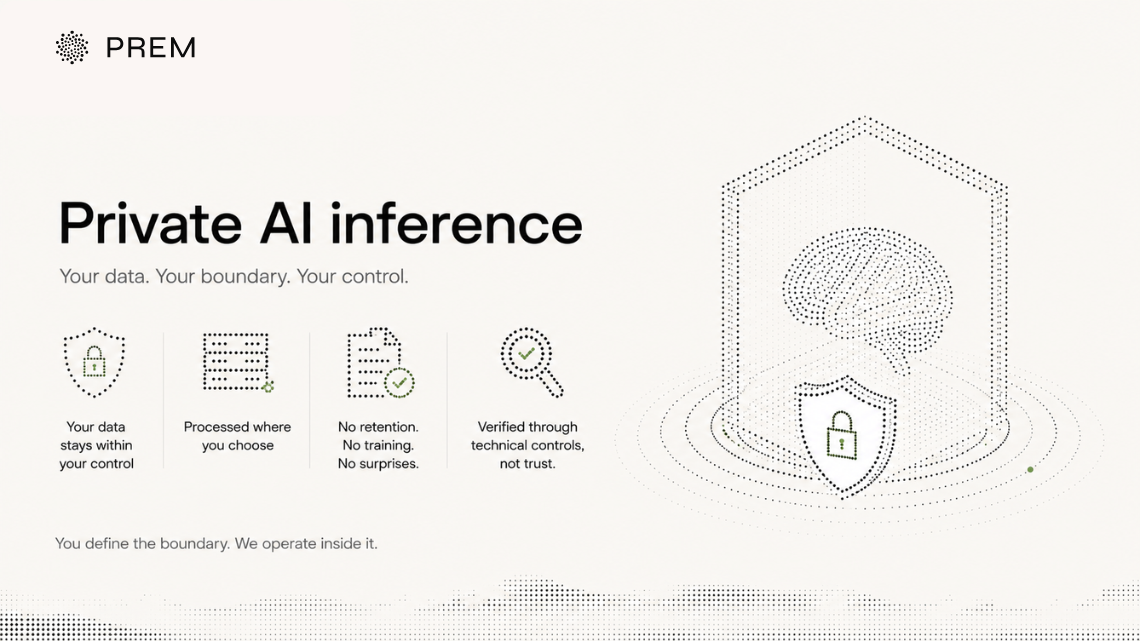
When you deploy AI in your business, inference is the moment your data is actually processed to generate an answer, prediction, or decision. Private AI inference gives you control over that entire process, so sensitive enterprise data never leaves the boundaries you define.
That means you decide:
- Where your data is processed and physically resides
- Who can access it, including whether the AI provider has any visibility into it
- Whether prompts and outputs are retained, logged, or used for model training
- How those guarantees are verified through technical controls, not just vendor assurances
Public AI APIs were built for reach, not for control. You send a request, a third party processes it, and you generally have to trust their word on what happens next.
Private AI inference flips that. The enterprise defines the boundary. The AI vendor operates inside it.
Why public AI APIs create data privacy and security risks in Europe
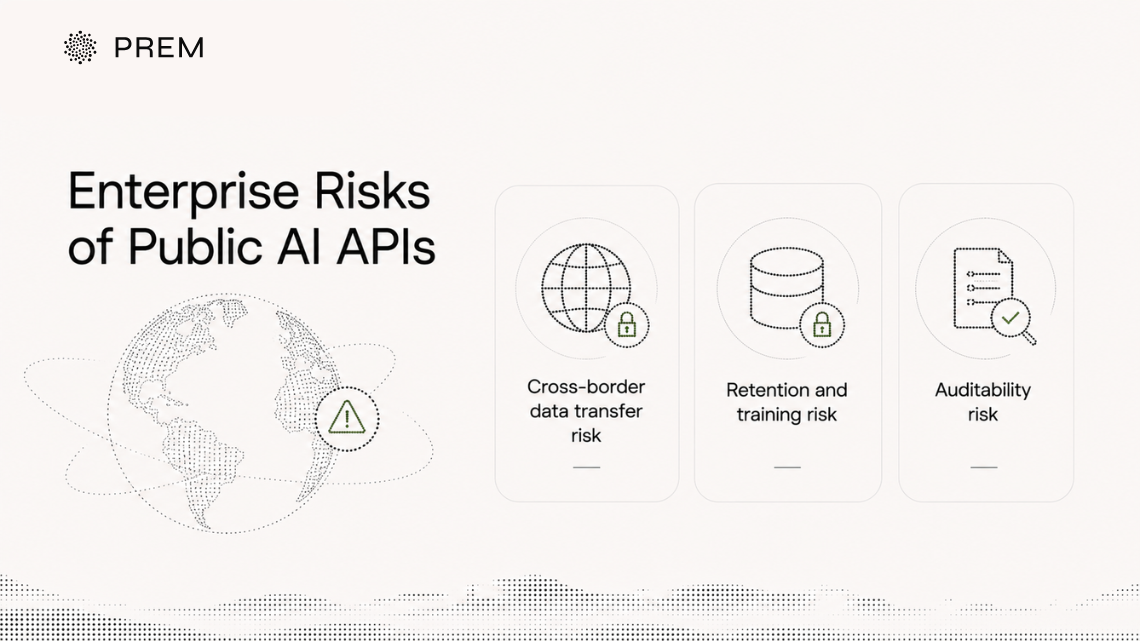
Most AI APIs were designed around a simple flow: send data to the provider and get a response back. That flow works fine for a consumer chatbot. It creates real exposure for an enterprise operating under European data protection law.
Three risks show up consistently.
Cross-border data transfer risk
GDPR restricts how personal data moves outside the EU. The EU-US Data Privacy Framework gives companies a legal path for transatlantic transfers, but that framework has already been challenged once before, in the Schrems II ruling that struck down its predecessor. Enterprises that build their AI architecture around a single legal mechanism are building on ground that has shifted before.
The financial exposure behind that risk is not abstract. Per the CMS GDPR Enforcement Tracker, publicly known GDPR fines across Europe passed €5.65 billion as of March 2025, with data transfer and processing violations among the largest categories.
Retention and training risk
Some AI providers retain prompts to improve future models. For a bank running fraud detection or a hospital summarising patient notes, that is not an abstract policy question. It is sensitive financial or health data sitting somewhere the enterprise did not choose. If you think that concern is theoretical, it isn't. In 2025, as reported by ANSA, Italy's data protection authority questioned DeepSeek over what personal data it collected, how long it retained that data, and what information was used to train its AI models before restricting access to the service in Italy.
Auditability risk
Under the EU AI Act, providers of general-purpose AI models must document how their systems work, and enterprises deploying certain AI use cases have their own transparency obligations. A vendor that cannot show you how inference happens is a vendor that makes your own compliance harder to prove.
None of this means public APIs are unsafe by design. It means the burden of proof sits with the enterprise, and public APIs were not built to make that proof easy.
How Private AI inference works: From user request to AI response
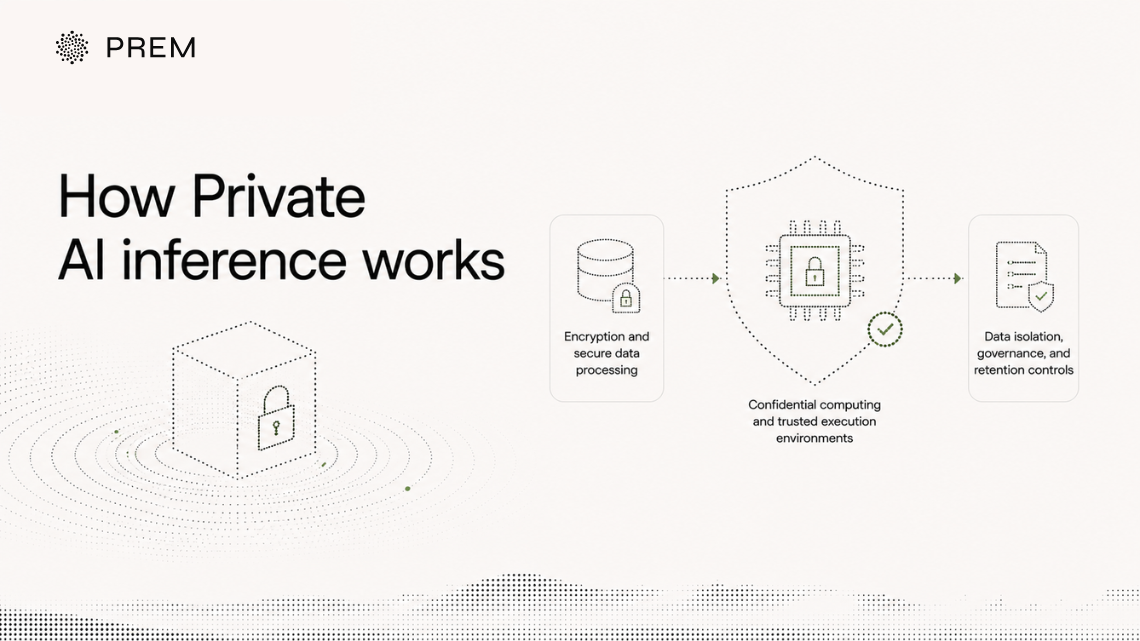
Picture a compliance officer at a European insurer asking an AI assistant to summarise a claims file.
The workflow looks like this. The request enters an environment the enterprise controls, not a shared multi-tenant endpoint. The model runs inference inside that environment. Sensitive fields can be encrypted or isolated so the model processes what it needs without exposing the full underlying record. The response returns to the user, and nothing about that exchange leaves the boundary the enterprise defined.
For you, the real question is how these guarantees actually get enforced, not promised. That enforcement starts at the first step: how the data itself gets encrypted and processed.
Encryption and secure data processing
Encryption in transit and at rest is table stakes now. The harder problem is data in use, meaning the moment the model is actually reading and processing it. This is where techniques like confidential computing come in.
Confidential computing and trusted execution environments
There are two broad ways to keep data private during processing. One relies purely on math, encrypting data so thoroughly that a model can process it without ever fully seeing it. It is a strong guarantee in theory, but today's versions are still too slow for real enterprise use. The other relies on hardware. A sealed, locked-down part of the chip decrypts data only inside that boundary, processes it, and re-encrypts it before it ever leaves.
Nobody outside that boundary, not the cloud provider, not the AI vendor, not even someone with physical access to the machine, can see what happens inside. This is a trusted execution environment (TEE) and it is fast enough to run production AI workloads today. NVIDIA's confidential computing work on its Hopper and Blackwell architectures is one well-known example of this approach.
What makes this verifiable rather than just another promise is attestation. Before any data is processed, the hardware generates a signed proof of exactly what is running inside that sealed environment. If anything has been altered, the proof fails, and nothing gets sent. Enterprises do not trust a vendor's word. They are checking an attestation.
This is the exact mechanism behind Prem AI's Enclave API. It runs inference inside Trusted Execution Environments built on Intel TDX, AMD SEV-SNP, and NVIDIA confidential computing, with cryptographic attestation verifying the code before any data is processed and zero data retention ensuring nothing is written to disc once inference completes.
Data isolation, governance, and retention controls
Enterprises need to define, in explicit terms, whether data is retained after inference, who inside the vendor organisation could theoretically access it, and how long logs persist. In a European context, these controls are not optional extras. They are what GDPR's data minimisation and purpose limitation principles actually require in practice.
Private AI inference vs. public AI APIs: Key differences for European enterprises
The differences between public AI APIs and private AI inference go beyond where models are hosted. They shape how enterprises protect sensitive data, demonstrate compliance, retain control over AI workloads, and choose the models that best fit their business.
Data privacy and ownership
With public APIs, data often passes through infrastructure the enterprise cannot inspect. With private AI inference, the enterprise decides where data lives and who can see it, including during processing.
Security and compliance
Public APIs ask you to trust their compliance posture. Private inference lets you build your own compliance evidence, which matters directly for GDPR accountability obligations and for the documentation the EU AI Act now expects from certain deployers.
Control over AI workloads
Enterprises running private inference decide which models run, where they run, and how they scale. That flexibility disappears the moment you are locked into a single vendor's hosted endpoint.
Model flexibility and customization
Open-weight models like GLM-5.2 and fine-tuned internal models can all sit behind the same private inference layer. Public APIs typically lock you into whatever model the vendor decides to host.
This level of flexibility is becoming increasingly important as enterprises adopt multi-model AI strategies instead of relying on a single provider. Private AI inference is designed to support that approach. Prem AI's Enclave API, for example, lets enterprises run frontier open-weight models like GLM-5.2 behind the same private inference layer. The choice of model stays with the enterprise, not the vendor.
How European enterprises can deploy private AI inference
Once an enterprise decides to run AI inference privately, the next question is how to deploy it. The answer depends on factors such as compliance requirements, data sensitivity, existing infrastructure, and the level of control the organisation needs.
Private cloud and dedicated deployments
Many European enterprises run inference inside a dedicated, single-tenant environment, sometimes hosted with a European cloud provider, sometimes on infrastructure they already operate. Prem AI's Enclave API is built around this pattern, letting an enterprise bring frontier and open-weight models into a hardware-isolated environment it controls, rather than a shared, multi-tenant one.
Customer-controlled AI environments
'Control' here means more than picking a data centre location. It means defining access policies, retention rules, and audit logging as part of the deployment itself, not as an afterthought bolted onto a vendor's default settings.
These deployment models reflect a broader shift in how enterprises think about AI infrastructure. The goal is no longer just to run models securely but to create AI systems where control, verification, and ownership are built into the foundation.
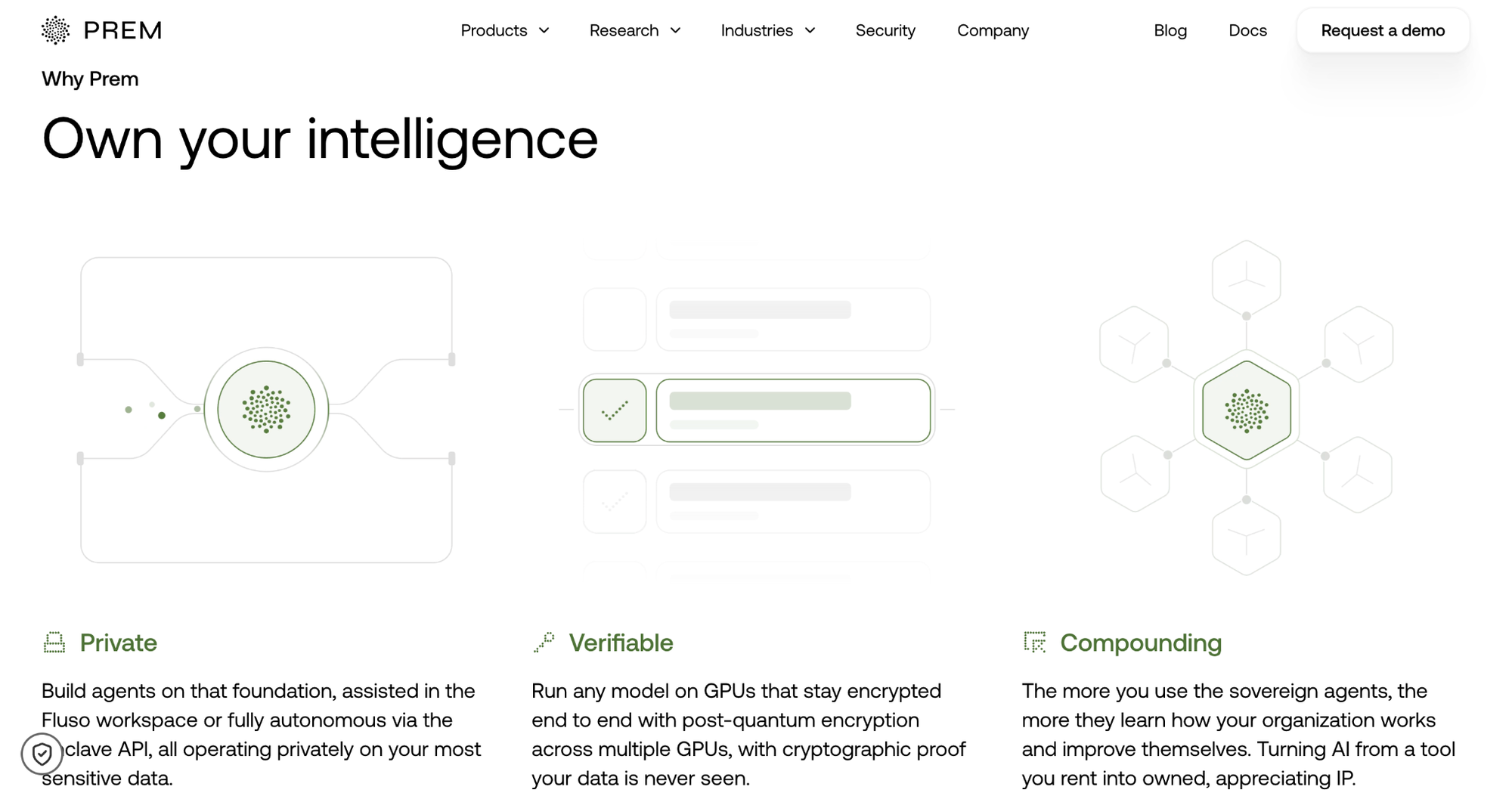
This is the principle Prem AI's own product philosophy is built around: private by architecture, verifiable through cryptographic proof rather than a vendor's word, and compounding in value as the enterprise's own sovereign agents learn its workflows over time, without that intelligence leaving the enterprise's ownership.
On-premise and sovereign AI deployments
For sectors like defence, critical infrastructure, and parts of the public sector, on-premise deployment is not a preference. It is close to a requirement. The European Commission's own Cloud Sovereignty Framework, applied for the first time in April 2026 through a sovereign cloud contract awarded to European providers, signals how seriously this is now being treated at the institutional level.
Why private AI inference matters for regulated industries
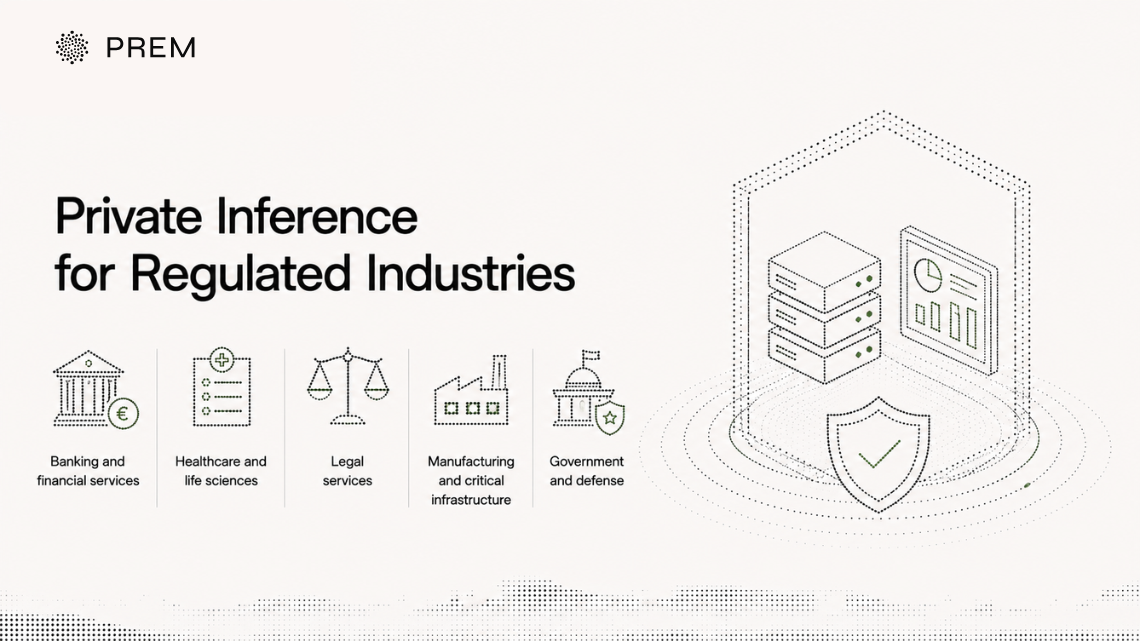
Private AI inference is valuable across industries, but its importance is greatest in sectors that handle sensitive data or operate under strict regulatory requirements. For these organisations, controlling where data is processed and how AI systems are deployed is often a business and compliance necessity rather than a technical preference.
That necessity is becoming more common by the year. Eurostat reports that 20% of EU enterprises with 10 or more employees used AI technologies in 2025, up from 13.5% the year before, meaning far more organisations now carry this exposure than did just twelve months earlier.
Banking and financial services
Beyond GDPR, European banks now sit under DORA, the Digital Operational Resilience Act, which puts direct scrutiny on how third-party technology providers, including AI vendors, affect operational resilience. A bank cannot outsource that accountability to an API it does not control.
Healthcare and life sciences
The European Health Data Space is pushing hospitals and health systems toward more structured data sharing, which raises the stakes on how that data is protected the moment an AI system processes it.
The risk is not hypothetical. As reported by Reuters, Google's DeepMind became the subject of a long-running legal challenge after patient records from around 1.6 million people were shared by the Royal Free London NHS Trust to develop an AI application, bringing patient data governance and consent into the spotlight.
Legal services
Client confidentiality obligations do not pause for AI. A law firm running document review through a public API is making a decision about privilege it may not have fully thought through.
Regulators in the legal industry are already saying so directly. As reported by the Law Society of Ireland, solicitors were warned that using public generative AI tools can create serious risks to legal professional privilege and client confidentiality.
Manufacturing and critical infrastructure
Product designs, supply chain data, and industrial IP are exactly the kind of information a European manufacturer does not want sitting in a foreign vendor's logs.
That risk has already played out in practice. As reported by Forbes, Samsung restricted the use of generative AI tools after employees uploaded confidential source code and internal documents to ChatGPT, highlighting how quickly valuable intellectual property can leave an organisation's control.
Government and defense
Sovereignty requirements here are usually explicit and non-negotiable, which is why on-premise and sovereign cloud deployment patterns dominate this sector.
That priority is already reflected in European policy. The European Commission's InvestAI initiative aims to mobilise €200 billion to strengthen Europe's sovereign AI capabilities, treating government and defence-grade infrastructure as a strategic priority, not just a preference.
Private AI inference as a foundation for enterprise AI sovereignty
Private AI inference does more than protect sensitive data. It gives enterprises greater control over how AI systems operate, how institutional knowledge is used, and how trust is established. Together, these capabilities form the foundation of enterprise AI sovereignty.
Moving from AI adoption to AI control
Most European enterprises are past the adoption question. The real question now is who controls the AI systems doing the work, and whether that control can be demonstrated, not just claimed.
Maintaining ownership of data and AI workflows
The internal knowledge an enterprise accumulates, its documents, its workflows, and its institutional memory become more valuable to an AI system over time. That value only compounds if the enterprise keeps ownership of it rather than handing it to a vendor by default.
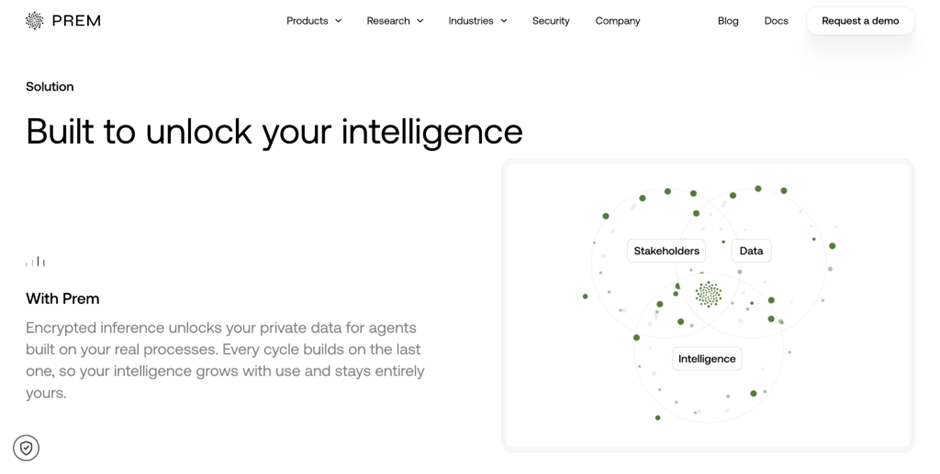
This principle is reflected in Prem AI's concept of context compounding, and it's exactly what powers Fluso, Prem AI's enterprise AI workspace. The longer an enterprise uses Fluso, the more securely it accumulates its own institutional knowledge, workflows, and decisions, while keeping that knowledge owned by the enterprise rather than absorbed into a vendor's model.
Building trustworthy enterprise AI systems
Trust built on architecture holds up better than trust built on a vendor's promise. Verifiable infrastructure, clear data boundaries, and auditable inference are what let a CISO sign off on an AI deployment with confidence rather than hope.
That principle is central to how Prem AI's Enclave API is designed. Its attestation reports and zero data retention guarantees make access, retention, and data handling verifiable, so trust comes from what the architecture can demonstrate, not from what a vendor asks you to take on faith.
Challenges of deploying private AI inference at scale
Private AI inference offers significant benefits, but deploying it across an enterprise comes with practical challenges. Organisations need to balance infrastructure, operational complexity, and performance while meeting security and compliance requirements.
Infrastructure and compute requirements
Running inference privately, whether in a dedicated cloud environment or on-premises, requires GPU capacity that many enterprises have not historically had to plan for.
That planning gap is showing up in enterprise priorities. Industry research covered by Scalefocus found that 52% of Western European enterprises expect to accelerate investment in data sovereignty initiatives, with 47% actively reevaluating their dependence on non-European cloud providers, exactly the kind of shift that drives new infrastructure planning.
Managing enterprise AI models
Supporting multiple open-weight models across different business units adds real operational complexity.
Balancing privacy, performance, and cost
Confidential computing and strict data isolation carry a performance cost. European enterprises are increasingly deciding that the cost is worth it, but it is a real trade-off, not a free upgrade.
Build private AI inference with Prem Sovereign AI Infrastructure
Private AI inference is becoming a foundational layer of enterprise AI strategy. If your organisation is adopting frontier AI models, you'll also need infrastructure that gives you control over where inference runs, how sensitive data is handled, and how compliance can be demonstrated. That foundation helps you scale AI with greater confidence while maintaining security, governance, and data sovereignty.
Prem AI helps you deploy private AI inference in customer-controlled environments built for regulated enterprises. Through Enclave API, you get access to frontier and open-weight models with confidential AI infrastructure and built-in governance controls. Deploy across private clouds, dedicated environments, or on-premises infrastructure. This lets you run AI workloads while keeping sensitive data within boundaries you define.
If you're ready to deploy private AI inference without compromising security, compliance, or control, contact our sales team to discuss your enterprise AI requirements.
You can also reach our team directly at sales@premai.io to know how Prem AI can help you build secure, customer-controlled AI infrastructure for production.
Frequently asked questions about Private AI inference
What is private AI inference?
Private AI inference is running AI model predictions in an environment the enterprise controls, not a shared public endpoint. It covers where data is processed, who can access it, whether prompts are retained, and whether these guarantees can be verified rather than simply taken on the vendor's word.
How is private AI inference different from a public AI API?
Public APIs send your data to shared infrastructure you cannot inspect, and you generally trust the vendor's account of what happens next. Private AI inference reverses that. The enterprise defines the boundary around data handling, retention, and access, and the AI vendor operates inside it.
Why does private AI inference matter for European enterprises specifically?
GDPR restricts cross-border data transfers, and the EU AI Act now imposes transparency and documentation obligations on GPAI providers. European regulators expect enterprises to demonstrate control over sensitive data during processing, not just claim it. Private inference gives enterprises the architecture to actually prove that.
Does private AI inference mean sacrificing model quality?
No. Private AI inference is designed to let enterprises run frontier open-weight models behind the same controlled environment. The trade-off between strong models and data control isn't necessary anymore. Enterprises can access frontier reasoning quality while keeping sensitive data inside boundaries they define.
What is confidential computing, and how does it relate to private AI inference?
Confidential computing extends encryption into the moment data is actually being processed, not just when it's stored or in transit. Techniques used in GPU architectures ensure that even the infrastructure operator cannot see the data. It's a core building block for verifiable, private AI inference.
Which industries need private AI inference the most?
Banking, healthcare, legal services, manufacturing, and government are the clearest cases. These sectors handle sensitive financial, medical, industrial, or classified data and operate under regulations like DORA, the European Health Data Space, or sovereignty requirements that make uncontrolled data exposure a direct compliance and business risk.
Can enterprises deploy private AI inference on-premises?
Yes. On-premise deployment is common in defence, critical infrastructure, and public sector use cases where sovereignty requirements are close to non-negotiable. Enterprises can also choose dedicated private cloud environments or customer-controlled deployments, depending on compliance needs, data sensitivity, and how much infrastructure they already operate.
What does "AI sovereignty" mean in the context of private inference?
AI sovereignty goes beyond where data is stored. It covers control over the models, infrastructure, workflows, and institutional knowledge an enterprise builds over time. Private AI inference is the technical foundation that lets enterprises actually hold and demonstrate that control, rather than depending on a vendor's assurances.
What are the main challenges of deploying private AI inference at scale?
The biggest challenges are infrastructure and compute requirements, since private inference often needs GPU capacity many enterprises haven't planned for, plus the operational complexity of managing multiple open-weight models. There's also a real performance trade-off with confidential computing that enterprises need to budget for.
How does Prem AI support private AI inference for enterprises?
Prem AI's Enclave API lets enterprises run frontier and open-weight models inside customer-controlled environments across private cloud, dedicated, or on-premises deployments. It's built around private architecture, verifiable data handling through cryptographic guarantees, and compounding institutional knowledge that stays owned by the enterprise rather than absorbed into a vendor's model.
See how Prem AI can help your enterprise build private AI without compromising control over your data and infrastructure. Contact our sales team, or email us at sales@premai.io.