Shadow AI in Enterprise: How Organizations Can Detect & Govern Unapproved AI
AI adoption inside the enterprise has outpaced enterprise oversight. Employees are not waiting for approval before they reach for a chatbot, a copilot, or an AI-powered extension. Most of that usage never touches IT or security at all. It just happens, quietly, inside everyday work.
That gap between adoption and governance has already produced measurable consequences. Per Gartner's 2026 forecast, a large share of enterprises worldwide are expected to face a security or compliance incident tied to unauthorized AI use within the next few years.
A fresher story shows how fast this risk moves: Apple's lawsuit accusing former employees of stealing confidential product data on behalf of a rival AI lab, a case covered in Apple's OpenAI lawsuit video, made headlines within days for exactly this reason.
This blog covers what shadow AI actually is. It covers how it gets into your enterprise, why it behaves differently from shadow IT, which industries carry the highest exposure, and how to detect and govern it without slowing your teams down.
What is shadow AI?
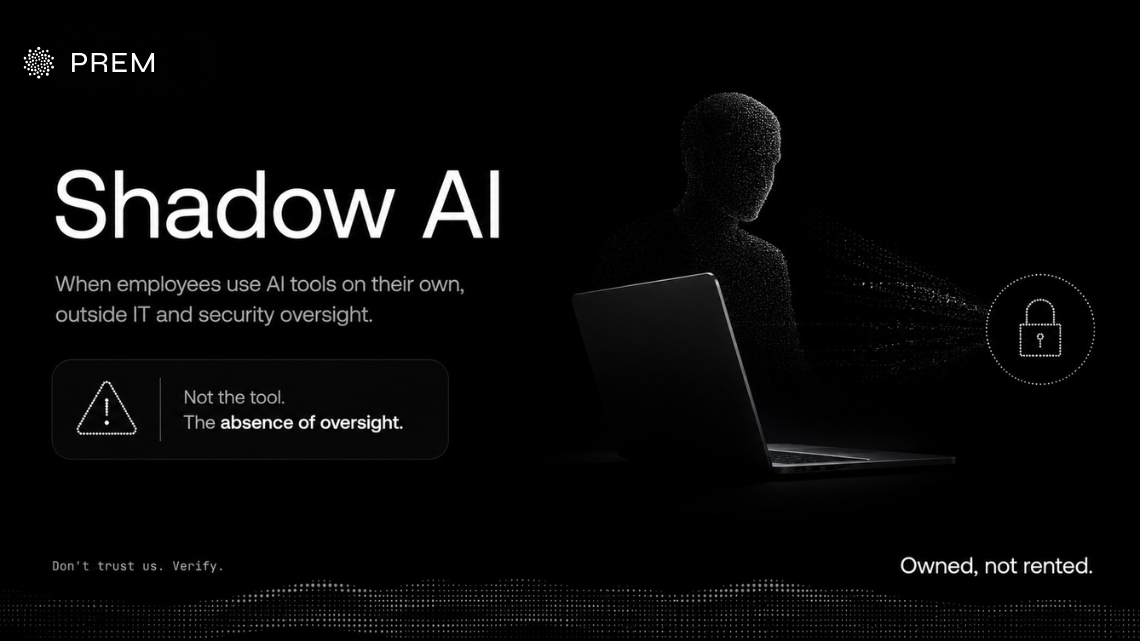
Shadow AI is what happens when your employees start using AI on their own terms. They open a chatbot in a browser tab. They turn on a copilot buried inside software your enterprise already pays for. Increasingly, they let an autonomous agent take actions on their behalf without a human checking each step. None of it goes through IT. None of it goes through security. That is what makes it shadow AI, not the tool itself, but the absence of anyone watching what data goes in and what happens to it afterward.
This sits inside a much older problem your enterprise probably already has a name for: shadow IT, the practice of employees adopting unapproved software, hardware, or cloud services without sign-off. Shadow AI is the newest and fastest-growing branch of that same tree.
It shares the same root cause of employees wanting to move faster than a review cycle allows, but the tools themselves work differently enough that they deserve their own category, their own detection methods, and their own governance program, which is exactly what the rest of this piece walks through.
The category is wider than most enterprises assume. It includes a contract pasted into a public chatbot, proprietary code routed through a coding assistant, a personal ChatGPT account used to draft a performance review, and an AI feature switched on inside an approved tool without anyone being told.
It includes agents too, since an agent that books meetings or moves files carries the same blind spot as any chatbot, just with the added risk of taking action rather than only generating text. If nobody signed off on it and nobody can say what data it touches, it qualifies as shadow AI.
Common examples of shadow AI in the workplace
In your enterprise, shadow AI tends to cluster around a few repeat offenders. Free-tier chatbots used for writing and research. Browser extensions that summarize meetings or fix grammar. AI features quietly switched on inside CRM, HR, or productivity platforms. Personal AI accounts used to get around a company's more limited plan. AI coding assistants pulling from private repositories.
Most of this activity does not look like new software at all. It looks like a feature sitting inside a tool you approved months ago. Per JumpCloud research, that is exactly what makes so much of it invisible to a standard software inventory, since the parent application already passed review and nobody goes back to check every feature added to it afterward.
Shadow AI vs. Shadow IT
Shadow IT usually leaves behind structured evidence: file uploads, procurement records, and network connections that traditional monitoring was built to catch. Shadow AI shares the same root cause, employees chasing productivity, but the evidence looks nothing like a file transfer or a new app icon. As Keeper Security's research puts it, shadow AI data moves as an ordinary conversation typed into a text box over the same encrypted connection as a search query.
That distinction is exactly why the controls your enterprise already has for shadow IT will not catch most shadow AI on their own. The table below lays out where the two problems overlap and where they genuinely diverge.
Shadow AI vs. Shadow IT
Why shadow AI is becoming a growing enterprise risk
Shadow AI is not shadow IT with a new name. It moves faster, hides better, and touches your data more directly than any unauthorized software category before it.
Easy access to public AI tools
Older shadow IT usually needed a download, a server, or an expense report before it could spread. Most shadow AI needs nothing more than a browser tab, so there is no form to fill out, no license to activate, and no approval email to wait on. An employee can go from curiosity to a daily habit in the time it takes to open a new tab, and nobody outside that one person ever sees it happen.
Per Verizon's 2026 DBIR, that zero-friction path is exactly what makes it a zero-paper-trail path for a security team trying to trace it later. The report found shadow AI has become one of the fastest-growing insider actions it detects across enterprise networks today.
Employees adopting AI faster than enterprise policies
The pace mismatch is the real problem here. Your employees are not waiting for a governance committee to finish its review cycle, and in plenty of enterprises they never will. They want the work done faster today, not after next quarter's policy sign-off.
By the time a usage policy is drafted, circulated, and approved, the tool it was meant to govern has often already become part of someone's daily routine. A recent Soldo survey put a real number on that gap, finding that roughly a quarter of employees had already bought an AI tool for work without asking anyone first.
The rise of AI-powered browser extensions, copilots, and automation tools
Browser extensions are now one of the largest unmanaged attack surfaces in the enterprise, and AI extensions are the fastest-growing and riskiest part of that surface. They request broad permissions the moment they install, and they update on their own schedule with no second review from anyone.
Because they sit inside the browser rather than the network, they slip past the DLP and CASB controls most enterprises already rely on. According to LayerX's 2026 report, AI extensions are far more likely to carry a known vulnerability than the average extension, and a meaningful share of enterprise users already have one installed without IT ever knowing.
How shadow AI enters your enterprise
Shadow AI rarely comes through one channel. It seeps in through five overlapping paths at once, which is why no single control point is ever enough.
Employees using public chatbots with company data
This is the most familiar path, and enterprises have been fighting it since ChatGPT's earliest months. An employee treats a public chatbot like a private notepad. They paste in a draft contract to tighten the language, a customer email thread to summarize, or a block of code to debug.
It feels harmless, since nothing was downloaded and no new account was created for work. But the moment that data leaves the browser, it enters an environment your enterprise does not control.
As per Fortune's original reporting, that exact risk is what pushed major employers to restrict public generative AI tools outright.
Teams purchasing AI tools without IT approval
AI purchasing increasingly happens on expense reports and personal cards, not through procurement. A team lead finds a tool that solves an immediate problem, pays for it out of pocket or on a department card, and rolls it out to a few colleagues.
IT only finds out once something breaks. Each purchase becomes an unreviewed vendor relationship and an unaudited data flow, and nobody outside that one team ever sees the renewal, the terms of service, or where the data actually goes.
AI integrations inside SaaS applications
A growing share of shadow AI needs no new tool at all. It shows up when an AI feature gets switched on by default inside a platform your enterprise already approved and trusts. Because the parent application was cleared once, nobody checks whether every new feature added to it deserves the same scrutiny.
That means a usage policy naming only standalone chatbots is outdated the day it is published, since the SaaS vendor can ship a new AI feature next release without asking anyone's permission first.
Personal AI accounts used for work
Employees route around AI restrictions by simply logging into a personal account instead of a company-issued one. The work gets done either way, so nothing feels different from their side of the screen.
But from a security standpoint, the data now sits behind a login your enterprise cannot audit or shut off when someone leaves. As Menlo Security research has documented, this traffic looks identical to ordinary personal browsing, which makes it one of the hardest shadow AI behaviors for any security team to catch.
AI browser extensions and unofficial plugins
The last path is the one security teams see least. Extensions and plugins connect directly to a user's data through OAuth, not a file upload. An employee grants a meeting tool access to their calendar with one click.
Within minutes, that tool can read every meeting on it, including ones involving executives or legal counsel, without a single helpdesk ticket ever filed. Per Reco's research, this is shadow AI at its most invisible: legitimate credentials, a legitimate-looking integration, and a data path nobody reviewed.
Risks of unmanaged shadow AI for your enterprise
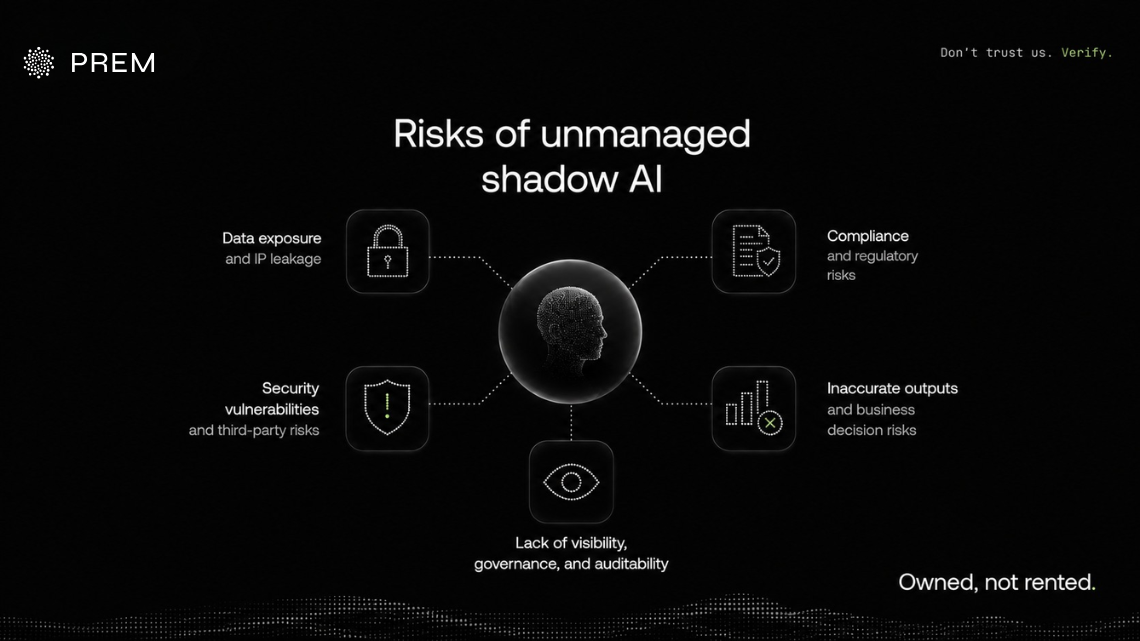
Some of these risks are immediate and visible, like a data leak. Others surface months later, in an audit, a lawsuit, or a regulator's inquiry.
Sensitive data exposure and intellectual property leakage
This risk gets the most attention, and for good reason. Once proprietary data leaves your enterprise through a prompt, there is usually no way to confirm it was deleted, let alone retrieve it.
One engineer debugging code, one analyst summarizing a contract, and one support agent pasting a customer record, each can hand over material your enterprise spent years protecting.
A large share of AI-related incidents already trace back to exactly this kind of exposure, spanning both personal data and intellectual property, which is why this risk sits at the top of most enterprise security reviews today. As per ElectroIQ research, a large share of AI-related incidents already involve exactly this kind of exposure, spanning both personal data and intellectual property.
Compliance and regulatory risks
Regulators no longer treat shadow AI as an internal HR matter. When an employee deploys an unauthorized AI tool, they can bypass the data protection safeguards your enterprise spent years building, and a productivity shortcut becomes a personal data breach with real regulatory consequences.
As the European Data Protection Supervisor has pointed out, under the EU AI Act and GDPR, not knowing a tool was in use is not a defense. The obligations attach to your enterprise regardless of who approved the deployment.
Security vulnerabilities and third-party risks
Every ungoverned AI tool is a potential attack surface that has never seen a security review. These systems can memorize data they were exposed to and reproduce fragments of it later, including personal information and confidential documents, often through nothing more than an ordinary follow-up question.
That is exactly why sensitive information disclosure ranks among the top concerns in OWASP's Top 10 for large language model applications, a framework most security teams already use to prioritize AI risk.
Inaccurate AI outputs and business decision risks
Shadow AI risk is not limited to what leaves your enterprise. It also includes what comes back in, as confidently wrong answers.
When an unsanctioned tool feeds a bad answer into a real decision, whether a customer commitment or a legal filing, the accountability does not stay with the tool.
A Canadian tribunal made exactly this point when it held Air Canada liable for a chatbot's incorrect advice on bereavement fares, a case Forbes' court coverage laid out in detail. The enterprise, not the chatbot vendor, ended up holding the liability.
Lack of visibility, governance, and auditability
The hardest risk to fix is the one you cannot see. An attacker moving data through an ungoverned AI channel leaves no activity log, because nobody built a log for a tool nobody knew was running.
Your enterprise cannot govern, audit, or defend what it has never inventoried in the first place. That missing log is not just a blind spot; it can itself violate audit requirements under frameworks like PCI DSS, HIPAA, and SOC 2, which is why visibility has become the precondition for every other control on this list.
According to Netwrix research, that missing log is not just a blind spot, it can itself violate audit requirements under frameworks like PCI DSS, HIPAA, and SOC 2. Your enterprise cannot govern, audit, or defend what it has never inventoried in the first place.
How to detect shadow AI across the enterprise
Detection has to work across several layers at once. Shadow AI hides in network traffic, SaaS configurations, personal devices, and employee behavior simultaneously, so no single layer catches all of it.
Monitoring AI-related network and web traffic
A secure web gateway sitting between your users and the internet is one of the most direct ways to see what is actually happening. It shows which AI domains employees visit, even unapproved ones, and it can allow access to a tool while still blocking large uploads or bulk transfers into it.
As Open Systems explains, this layer will not catch everything, since embedded AI features rarely generate a distinct network signature of their own. It remains, however, the fastest way to build an initial picture of exposure before investing in anything more specialized.
Discovering AI usage through SaaS and browser activity
Network visibility needs to pair with something that understands application context, not just raw traffic. Mapping network logs against known AI domain patterns across EU LLM APIs, other third-party model APIs, coding assistants, AI proxies, and autonomous agents turns sprawling domain noise into one usable inventory of what is actually running across your business.
An approach detailed by Corelight does exactly this, collapsing hundreds of individual AI-related domains into a single, ranked view your security team can act on instead of chasing each one manually.
Identifying unsanctioned AI applications
Beyond traffic and SaaS logs, dedicated discovery tools are emerging because firewalls, DLP, and SIEM were each built to answer a different question than which AI tools your people are using right now. One approach VerifyWise has taken is to build a passive discovery layer that sits over the log data your enterprise already collects.
That matters for teams trying to close a visibility gap without adding yet another agent competing for endpoint resources, which is often the real barrier to getting any discovery program off the ground.
AI usage analytics and employee reporting
Technical telemetry only tells half the story. The other half comes from understanding usage patterns across departments over time, since knowing which teams rely on AI most, and for what tasks, helps you prioritize where to focus first rather than treating every department as an equal risk.
Per Vanta's research, that kind of usage analytics works best alongside employee-facing reporting channels that make it easy and non-punitive for staff to flag tools they are already relying on day to day.
Building a shadow AI governance strategy for your enterprise
Detection tells you what is happening. Governance turns that visibility into a program that actually changes behavior across every team, not just the ones security happens to notice first.
Creating a clear enterprise AI usage policy
A usable policy names every category of tool it covers, from standalone chatbots to AI features buried inside approved platforms, and gives your employees a direct list of what they can use rather than only a list of what is banned. It also assigns clear ownership: someone who reviews new requests, someone who updates the approved list, and a set cadence for revisiting both.
That structure mirrors the Govern function inside the NIST AI RMF, which treats accountability as something to establish before AI spreads further, not after.
Classifying sensitive data and restricting AI access
Not every employee needs the same AI access to the same data. A model trained on engineering documentation carries less risk when scoped to R&D staff than when it is open to HR, finance, and legal by default, so classification has to happen before access is granted, not after an incident forces the question.
This is the same least-privilege thinking your enterprise already applies to identity and access management, extended to AI, a principle Check Point applies directly when advising enterprises on LLM security.
Embedding continuous oversight into governance policy
A policy reviewed once a year cannot keep pace with a risk surface that changes weekly. New tools appear, existing tools add AI features overnight, and employee habits shift long before the next scheduled review would ever catch them.
Per Airia's research, the security-mature enterprises are the ones treating oversight as an ongoing discipline rather than an annual checklist, which is what separates them from enterprises that only learn about shadow AI after something breaks.
Training employees on responsible AI adoption
Policies written without employee input tend to see lower adoption and more workarounds, not fewer. A usage policy lands best when it answers three questions employees actually have: which tools are approved, what data can go into them, and what use cases are off-limits.
The approach Adaptive Security recommends is building that policy together with the people who will use it, rather than handing it down from a committee they never speak with.
Balancing productivity with security as you govern
Governance that only subtracts convenience gets routed around. Friction and workarounds scale together: the harder you make the approved path, the more employees look for an easier one outside it.
Per 1Password's 2025 report, that tension is measurable at scale, and the programs that hold up long-term treat employee productivity as a design constraint on governance, not an obstacle to it.
Enterprise technologies that help control shadow AI
Policy sets the rules. These are the technical layers that enforce them at scale, once the policy itself is in place.
Secure AI gateways
An AI gateway sits as the centralized proxy between your applications and the AI models they call. It standardizes authentication, enforces governance policy, and gives you deep observability into AI consumption in one place, since every request and response passes through it.
As JFrog describes it, this turns AI activity from an invisible risk center into something a compliance team can actually audit, request by request, rather than guessing after the fact.
Data loss prevention (DLP) and cloud access security brokers (CASB)
CASBs sit between cloud service consumers and providers, enforcing policy exactly where sanctioned and unsanctioned SaaS usage diverges. Pairing CASB visibility with DLP's content inspection is one of the most direct ways to catch sensitive data before it reaches an AI prompt.
Per Fortinet's glossary on the category, neither control was originally built with conversational AI traffic in mind, which is exactly why they need to be paired rather than relied on individually.
Identity and access management (IAM)
AI agents complicate identity in ways human-only IAM was never built to handle. Non-human identities, especially autonomous agents, now vastly outnumber human ones inside the average enterprise, and many hold persistent, over-privileged access that traditional identity governance was never designed to track at that scale.
A shift the Identity Defined Security Alliance has quantified in detail shows treating every agent as a first-class identity, with its own credentials and audit trail, is quickly becoming standard practice rather than a forward-looking idea.
Security information and event management (SIEM)
SIEM remains the backbone for correlating AI activity with the rest of your security signal, but it needs AI-aware inputs to do that well. Machine learning can analyze API activity, IAM policy changes, and workload behavior together, giving security teams the context to catch a shadow admin account before it becomes a breach.
A capability CrowdStrike has built into modern SIEM makes exactly this kind of correlation possible across on-premises and multi-cloud environments at once.
AI governance and observability platforms
A dedicated category of tooling has emerged to close the gap between AI policy and AI enforcement. Some vendors extend existing GRC and privacy tools into AI, while others are built from the ground up around model inventory, risk classification, and runtime guardrails.
A split TechTarget's 2026 review of the market lays out clearly; it shows the strongest programs usually combine both approaches rather than picking one camp exclusively.
Real-world examples of shadow AI incidents across industries
Shadow AI matters most in the industries where privacy, compliance, and control decide whether an enterprise can operate at all.
Financial services
Banks and insurers face the most demanding regulatory overlap of any sector adopting AI, since the EU's Digital Operational Resilience Act treats AI agents used for credit decisioning or fraud detection as ICT systems subject to full incident reporting.
With Gibson Dunn's analysis confirming the EU AI Act's revised timeline, an unapproved AI tool touching those workflows is not just a security gap; it is a compliance failure with penalties up to 7 percent of global turnover.
Healthcare and life sciences
Healthcare has held the unwanted title of costliest industry for data breaches for fourteen consecutive years.
Per IBM's breach report, that cost climbs further when patient data entered into an unapproved AI tool sits outside every access control the enterprise built for the rest of its systems.
Government and public sector
Governments are legislating against exactly this kind of unmanaged AI use, and per Gartner's newsroom, a majority of governments worldwide are expected to introduce sovereignty requirements within the next few years.
A public agency can meet every one of those requirements at the infrastructure level and still fail the moment one case worker runs constituent data through a personal AI account.
Legal and professional services
Confidentiality is not a compliance checkbox for law firms; it is the foundation of the client relationship. As Kiteworks' analysis of the sector shows, a notable share of firms already process highly sensitive material through AI tools, exactly the kind of exposure that could constitute a breach of professional duty if it surfaces through a vendor's logs.
Manufacturing
Manufacturers are embedding AI into product design, predictive maintenance, and quality inspection, running these tools on proprietary engineering data that represents real competitive advantage.
Findings from Manufacturing Dive show manufacturing already absorbs the highest share of any industry's cyberattacks, and an unapproved AI coding assistant handed proprietary CAD files only widens that exposure.
As you can see across every one of these industries, shadow AI keeps finding its way into the workflows enterprises can least afford to expose. Shifting to a private AI setup for your enterprise stops being a nice-to-have at that point and becomes the practical next step, which is exactly the gap Prem AI is built to close.
Why shadow AI is pushing enterprises toward private AI
Shadow AI is not just a security gap. It is a slow transfer of ownership over the exact data your enterprise depends on for its edge. Every unsanctioned prompt is a small, permanent privacy decision your enterprise never agreed to, and the fix is not more restriction.
It is a better default: a private AI workspace built for enterprise use, with the same speed employees already expect from the public tools driving shadow AI in the first place.
Data privacy and security
Every prompt sent to a third-party API leaves your enterprise's control, even briefly, and for a company handling patient records or unreleased product plans, that window is exactly where the risk lives. As Bloomberg reported on Samsung's 2023 leak, once that data is out, there is no contractual way to pull it back.
That single incident reshaped how enterprises think about AI vendor risk almost overnight. A private workspace closes that window entirely by keeping the processing inside a boundary your enterprise actually controls, rather than a boundary a vendor promises to respect.
AI sovereignty
Depending on one external AI provider exposes your enterprise to that provider's pricing changes, model deprecations, and policy shifts, all of which sit entirely outside your control. Sovereignty means being able to change providers or bring workloads in-house without rebuilding your AI strategy from scratch.
A case the World Economic Forum has made at the national level applies just as directly at the enterprise level: control over the full stack, not just one layer of it, is what makes that independence real rather than theoretical.
Data retention (ZDR) and confidential AI
Most public AI APIs retain logs for abuse monitoring or model training, and the retention policy is the vendor's choice, not yours, which means you are trusting a stranger's data practices with your enterprise's most sensitive prompts. True zero data retention means your prompts are never stored or reused at all.
Regulators made this distinction explicit when CBC's Italy coverage detailed the country's ChatGPT ban over exactly this issue, and it remains one of the clearest examples of retention policy becoming a regulatory flashpoint rather than a footnote.
Context compounding
Every prompt and correction your teams run through a public AI system quietly teaches that system something, and the benefit flows to the vendor, not you. That is time and expertise your enterprise is effectively donating to a competitor's toolset every single day.
A case McKinsey makes about durable AI moats backs this up directly: keeping that same accumulated context inside your own walls is what turns it into an advantage that belongs only to your enterprise.
Cost and token efficiency
Usage-based pricing on closed AI APIs scales with volume in ways that quietly become one of the largest line items in a technology budget, often without anyone noticing until the invoice arrives. Per Menlo Ventures, enterprise AI spend has already tripled in a single year, and that trend shows no sign of slowing.
Owning the right infrastructure for each task, rather than defaulting to one expensive general-purpose API for everything, gives your enterprise a cost structure it can actually predict rather than one that surprises finance every quarter.
Low latency
Speed matters as much as accuracy for customer support, manufacturing, and financial risk workloads, since a slow answer can be as costly as a wrong one. Per Akamai's 2026 survey, a majority of enterprises now need sub-250-millisecond response times, and roughly half are already missing that bar under real production load.
Bringing inference closer to where your data already lives closes that gap without forcing a tradeoff between speed and the privacy controls your enterprise also needs.
Compliance
Cumulative GDPR fines have already passed 7 billion euros, and the EU AI Act's own penalty regime is layering on top of that total rather than replacing it. Per DLA Piper's tracking, that number keeps climbing every year enforcement continues.
Your AI system needs to produce an audit trail you can hand a regulator on short notice, not one you have to request from a vendor and hope arrives in time before the deadline passes.
How Prem AI's private workspace solves shadow AI for your enterprise
Most of the controls in this piece watch AI traffic after it leaves your enterprise boundary and hope nothing sensitive slipped through.
Prem AI starts from a different point: give employees a private, verifiable AI workspace they actually want to use, and shadow AI has far less reason to exist inside your enterprise in the first place.
That means zero data retention on inference, full auditability your compliance team can actually use, and context that compounds inside your own walls instead of a vendor's, all built for enterprises that are already asking hard questions about where their AI activity actually goes.
If your enterprise is ready to bring the shadow AI already running inside it under control, contact our sales team or email us at sales@premai.io to see how Prem AI's private workspace fits into your environment.
Frequently asked questions about Shadow AI
What is Shadow AI in an enterprise?
"Shadow AI" refers to the use of AI tools, assistants, or applications by employees without approval or oversight from the IT, security, or compliance teams. This can include public chatbots, AI coding assistants, AI meeting tools, AI design platforms, or browser extensions used to improve productivity.
While most employees use these tools with good intentions, Shadow AI creates blind spots for the organization. Without visibility into what tools are being used or what data is being shared, enterprises face increased security, compliance, and governance risks.
Why is Shadow AI becoming a major concern for enterprises?
The rapid growth of generative AI has made powerful AI tools available to anyone with an internet connection. Employees can start using them instantly, often without informing IT or understanding the risks involved.
This creates challenges beyond cybersecurity. Enterprises may lose control over sensitive business information, intellectual property, regulatory compliance, and AI governance, making Shadow AI one of the fastest-growing enterprise technology risks.
What are the biggest risks of Shadow AI?
Shadow AI can expose confidential customer information, financial records, source code, product roadmaps, legal documents, and proprietary research to external AI providers. In many cases, organizations have little visibility into where that data is stored or how it may be used.
It also increases the risk of regulatory violations, inaccurate AI-generated outputs, inconsistent business decisions, and fragmented technology adoption across teams. Over time, these issues can undermine both security and operational efficiency.
How can organizations detect Shadow AI?
Organizations typically detect Shadow AI by combining network monitoring, SaaS discovery, browser activity analysis, endpoint management, identity systems, and security tools such as CASBs or Secure Web Gateways. These technologies help identify unauthorized AI applications being accessed across the enterprise.
Technical monitoring should be supported by regular audits, employee awareness programs, and AI usage assessments. Detection works best when organizations understand both which AI tools are being used and how employees are interacting with them.
How can enterprises govern Shadow AI without blocking innovation?
The most effective approach is to provide employees with secure, approved AI alternatives instead of banning AI completely. Clear AI usage policies, role-based access controls, approved tool catalogs, and governance frameworks encourage responsible adoption.
Organizations should also establish review processes for introducing new AI tools, classify sensitive data, and define rules for acceptable AI usage. Governance succeeds when it enables productivity while reducing unnecessary risk.
What is the difference between Shadow AI and Shadow IT?
Shadow IT refers to any unauthorized software, cloud service, or technology used without IT approval. Shadow AI is a specific category of Shadow IT focused on artificial intelligence applications and AI-powered services.
Although both create visibility and security challenges, Shadow AI introduces additional concerns such as prompt privacy, AI-generated content, model accuracy, training data exposure, and responsible AI governance.
Which industries are most vulnerable to Shadow AI?
Industries that manage highly sensitive information face the greatest exposure. These include healthcare, financial services, legal firms, government agencies, manufacturing, software companies, and organizations handling large volumes of customer or intellectual property data.
However, Shadow AI is not limited to regulated sectors. Any enterprise where employees rely on AI for writing, coding, research, customer support, or decision-making can encounter governance and security challenges.
What should an enterprise AI governance policy include?
A comprehensive AI governance policy should define which AI tools are approved, what types of data employees can and cannot share, who is responsible for AI oversight, and how AI-related risks will be monitored and managed.
The policy should also cover compliance requirements, third-party vendor assessments, employee training, incident reporting, model evaluation, and regular governance reviews to keep pace with rapidly evolving AI technologies.
Can Zero Trust principles help reduce Shadow AI risks?
Yes. Zero Trust principles strengthen Shadow AI governance by continuously verifying users, devices, applications, and access requests instead of assuming trust. This reduces the likelihood of unauthorized AI usage exposing sensitive enterprise data.
When combined with least-privilege access, identity management, continuous monitoring, and data protection controls, Zero Trust provides an additional layer of defense against AI-related security risks.
How can Prem AI help enterprises manage Shadow AI?
Prem AI provides enterprises with a secure and governed AI workspace that enables teams to use AI while maintaining control over enterprise data, models, and infrastructure. This helps reduce reliance on unapproved external AI services for sensitive business tasks.
With enterprise-grade governance, privacy-focused deployment options, centralized administration, and support for compliant AI adoption, Prem AI helps organizations balance innovation with security, visibility, and regulatory requirements.
See how Prem AI can help your enterprise build private AI without compromising control over your data and infrastructure. Contact our sales team, or email us at sales@premai.io.