
What Is Sovereign-AI? An Enterprise Framework for AI Control, Privacy and Compliance
Enterprise AI has moved well beyond experimentation. Today, the question isn't whether your enterprise should adopt AI, but how to deploy it without compromising control over your data, infrastructure, or compliance obligations.
Public AI services have made advanced models widely accessible, but they also introduced new challenges around data residency, regulatory requirements, vendor lock-in, and governance. For enterprises operating in regulated industries or handling sensitive intellectual property, these considerations are becoming just as important as model performance.
This is why enterprises are rethinking how they deploy AI. The first wave of adoption was about speed. The second wave, the one enterprises are entering now, is about control: where data goes, which models touch it, and whether any of it holds up under GDPR, HIPAA, or the EU AI Act.
The answer most of them are landing on is Sovereign AI, an approach that keeps adopting AI aggressively without handing control of data, models, or infrastructure to someone else's black box. Sovereign AI platforms put this approach into practice, giving enterprises greater control over where AI workloads run, how data is handled, and how models are deployed.
In June 2026, the European Commission put forward its European Technological Sovereignty Package, pointing out that Europe currently depends on non-EU providers for over 80 percent of its key digital products, services, and infrastructure, and proposing a Cloud and AI Development Act to close that gap.
When regulators start treating AI sovereignty as a core infrastructure issue, enterprises cannot afford to ignore it. As AI becomes a core enterprise capability, Sovereign AI is emerging as a strategic infrastructure decision. This blog outlines what it means, where it delivers value, what implementation requires, and why enterprises are prioritizing ownership, governance, and control over rented intelligence.
What does sovereign AI mean for your enterprise?
With Sovereign AI, you stay in control of your AI environment. You decide where your AI runs, where sensitive data is stored, how models are deployed, and how AI is governed, rather than leaving those decisions entirely to third-party providers.
In an enterprise context, "sovereign" means retaining ownership and control over the entire AI stack.
This includes keeping sensitive data within approved environments, choosing and customizing AI models, deploying AI on infrastructure that meets business and regulatory requirements, and enforcing governance policies that ensure AI is used securely and responsibly.
The four pillars of sovereign AI
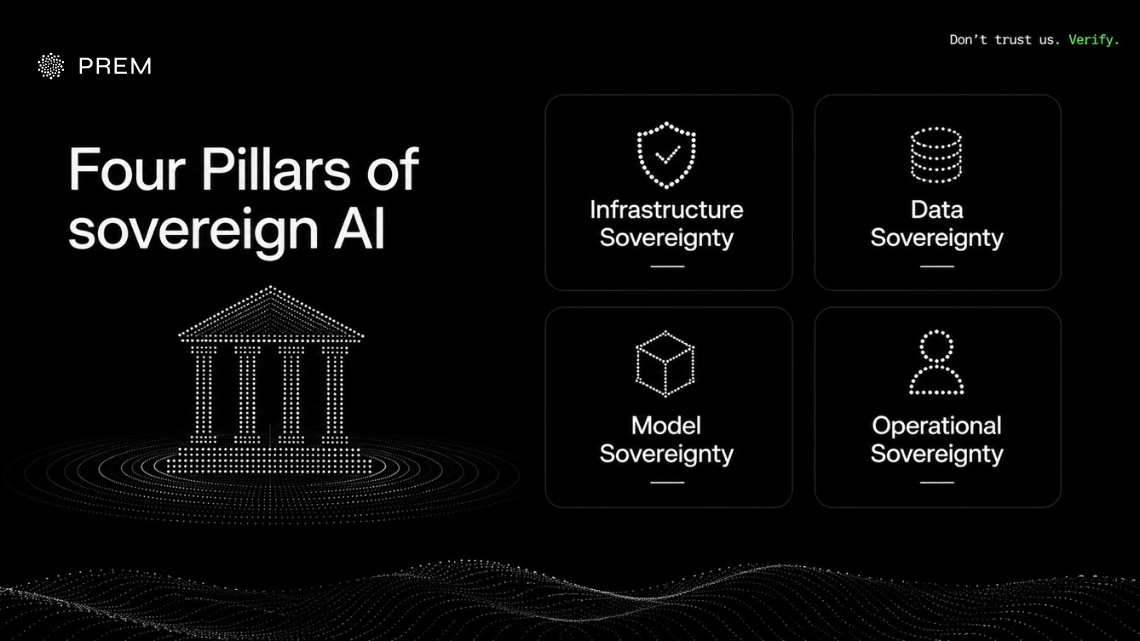
Sovereign AI is built on four core pillars that work together to give enterprises complete control over how AI is deployed, managed, and governed.
Rather than focusing on a single technology, these pillars define the foundation of an AI environment where data stays protected, infrastructure remains under your control, models can be customized to your needs, and governance is built into every stage of the AI lifecycle.
Let's look at each pillar in detail.
Infrastructure sovereignty
Infrastructure sovereignty is about where your AI physically or virtually runs, and who controls that environment.
The stakes here made headlines in June 2026, when CNBC's kill switch quote captured a senior EU official describing the goal of the bloc's new cloud sovereignty framework in blunt terms, making sure no foreign provider holds the power to cut off your access to critical systems.
On-premises deployments
When your enterprise needs direct control over the infrastructure running its AI workloads, on-premises deployment keeps the entire AI stack within your own data center. You control the hardware, network access, security policies, and uptime, making this a strong fit for environments where external infrastructure introduces unacceptable control or compliance risks.
Private cloud
If you need stronger isolation without taking on the full operational burden of running physical infrastructure, a private cloud can provide a middle ground. Your enterprise gets a dedicated environment with greater control over data, access, and security while the underlying cloud infrastructure remains managed for you.
Customer-managed VPC (virtual private cloud)
If your enterprise already has a preferred cloud environment and security architecture, a customer-managed VPC lets you run AI workloads within your own cloud account and network boundaries. You retain control over identity, access, networking, and security policies while continuing to use the cloud provider's underlying infrastructure.
Air-gapped environments
For workloads where external network access itself is a risk, an air-gapped environment removes that connection altogether. This gives your enterprise the strongest level of isolation by keeping sensitive AI systems physically separated from external networks, which can be critical for classified, highly sensitive, or tightly controlled workloads.
Data sovereignty
Data sovereignty is about the information itself: where it is stored, how it is protected, and who is accountable for it.
This is not a new problem if your enterprise operates across borders, IAPP's Schrems II coverage explains how the 2020 ruling struck down the EU-US Privacy Shield overnight and forced thousands of companies to rebuild how personal data crossed the Atlantic with almost no transition time.
Data residency
If your enterprise operates across regions or under regulations such as GDPR, where your AI data is processed matters as much as how it is protected. Data residency gives you control over the geographic and legal boundaries in which sensitive information is stored and processed, helping you avoid unintended cross-border transfers and the compliance exposure that can come with them.
Encryption
Encryption protects your enterprise data at rest and in transit, but sovereignty also comes down to who controls the keys. When your enterprise manages those keys rather than leaving them entirely with the vendor, a compromised infrastructure layer does not automatically mean access to the underlying data.
Confidential computing
Your data does not stop being sensitive when an AI system starts processing it. Confidential computing protects data while it is in use by isolating workloads at the hardware level, giving your enterprise stronger assurance that sensitive inputs and computations remain protected even within shared infrastructure.
Enterprise-controlled storage
Where your AI data is stored should be an enterprise decision, not a default set by your vendor. Enterprise-controlled storage lets you determine where data, logs, backups, and other AI-related artifacts reside, along with how long they are retained and who can access them.
Model sovereignty
Model sovereignty is about which AI models your enterprise uses and how much control you have over them.
The power of open weights became impossible to ignore in January 2025, when Yahoo Finance's DeepSeek coverage reported that Nvidia's market value fell by roughly $589 billion in a single trading day after investors reacted to the release of the Chinese AI lab's open-weight model, proving that model choice is now a boardroom-level decision and not just an engineering one.
Open-weight foundation models
Open-weight foundation models give you the ability to inspect, audit, and run models without depending on a closed API that could change or disappear. This is fundamentally different from closed, proprietary models, where you have no visibility into what is actually happening inside the model.
Fine-tuning
Fine-tuning lets you adapt a base model to your specific domain, vocabulary, and use cases, rather than relying on a generic model trained for the broadest possible audience.
Freedom to choose the right models
This means you are not locked into a single provider's model family. You can mix and match, using a smaller model for simple tasks and a larger one for complex reasoning, based on cost and performance rather than contractual obligation.
Operational sovereignty
Operational sovereignty is the governance layer that keeps the other three pillars accountable day to day.
Standards bodies now treat this as its own discipline, and NIST's AI risk framework gives your enterprise a structured way to govern, map, measure, and manage AI risk rather than improvising a policy after something has already gone wrong.
AI governance
As AI moves into business-critical workflows, your enterprise needs clear rules for how systems can be used and who is accountable for their decisions. AI governance establishes those boundaries, defines ownership, and provides a process for handling exceptions when a system behaves outside those rules.
Audit logging
When an AI decision needs to be reviewed, your enterprise needs more than an outcome. Audit logging creates a traceable record of prompts, outputs, system actions, and relevant events, giving security, compliance, and audit teams the evidence they need to investigate incidents and verify how a system was used.
Identity and access management (IAM)
Not every user, team, or AI workload should have access to the same data or capabilities. IAM lets your enterprise apply role-based access controls across models, datasets, and outputs, so permissions reflect the sensitivity of the workload and the responsibilities of the people using it.
Policy enforcement
Policies only provide meaningful control when they are enforced consistently. Policy enforcement translates your enterprise rules into technical safeguards that can automatically block, restrict, or flag actions that fall outside approved boundaries instead of relying on users to apply those rules manually.
Monitoring and observability
Once an AI system is in production, your enterprise needs continuous visibility into what it is doing, not just how it was designed to behave. Monitoring and observability help security, compliance, and engineering teams detect unexpected behavior, investigate anomalies, and verify that AI workloads continue to operate within defined controls.
Why your enterprise should invest in sovereign AI
Most enterprises did not choose their current AI setup so much as inherit it. A team needed a chatbot, someone spun up an API key, and six months later that same API is processing contracts, customer PII, and internal strategy documents.
Investing in Sovereign AI is the process of going back and making those choices deliberately, and it tends to come down to three things: keeping sensitive work private, having verifiable control over how your data is handled rather than relying solely on a vendor's assurances, and making sure the intelligence your teams build up over time stays yours.
Maintaining data privacy and security
Every time a prompt is sent to a third-party AI API, that data typically leaves the enterprise's control, even if only briefly. For a company handling patient records, financial statements, or unreleased product plans, that brief window is where the risk lives.
As reported by Bloomberg, Samsung restricted the use of generative AI tools after employees uploaded sensitive source code to ChatGPT. It serves as a reminder that once sensitive company data, customer information, workflows, or intellectual property are involved, enterprises need greater control over how AI processes that data.
Sovereign AI architectures keep that work inside an enterprise-controlled boundary, which is not a nice-to-have when the applicable regulation is HIPAA, GDPR, or the EU AI Act, it is the difference between passing an audit and failing one.
Achieving Zero Data Retention (ZDR) and confidential AI
Most public AI APIs retain some form of logs, whether for abuse monitoring, model improvement, or debugging, and the retention policies are set by the vendor, not you.
Italy's regulators made this exact point in 2023, when CBC's Italy ban coverage detailed how the country's data protection authority shut ChatGPT down nationwide over how conversations were being stored and reused for training, with no enterprise-grade retention controls in place at the time.
A Sovereign AI approach enforces true zero data retention on inference, meaning your prompts and outputs are never stored, reused, or exposed to a third-party model provider. For regulated industries, this single control often resolves half the questions a security review would otherwise raise.
Ensuring verifiability across AI workloads
When a model runs inside infrastructure you do not control, there is an inherent trust gap. Was your prompt actually processed the way the vendor claims? Was any part of it logged, cached, or used for something else? Hardware vendors have caught up to this demand, with NVIDIA's confidential computing rollout bringing GPU-level encryption to cloud AI workloads so that not even the infrastructure provider can see what is happening inside the computation.
A sovereign approach gives you the same guarantee, letting you cryptographically confirm what happened to your data during processing, so your security and compliance teams can verify the claim with evidence instead of relying on a vendor’s word.
Enabling context compounding for enterprise intelligence
Every prompt, correction, and workflow your teams run through an AI system teaches that system something. Sent through a public API, that learning quietly benefits the vendor and every other customer using the same model.
McKinsey's competitive moats research makes the case that as foundation models become commodities, proprietary data and accumulated context are the only durable source of advantage left.
Run inside a sovereign architecture, that same accumulated context stays inside your own walls, compounding into an advantage that belongs only to you, not a moat you are quietly building for someone else.
Improving cost and token efficiency
Usage-based pricing on closed AI APIs scales with volume in a way that can quietly become one of the largest line items in your technology budget.
Menlo Ventures' enterprise AI report found enterprise AI spend tripled to $37 billion in a single year, with foundation model APIs already among the single largest categories of that spend. Owning the infrastructure and choosing the right model for each task, rather than defaulting to the most expensive general-purpose API for everything, gives you a cost structure you can actually predict and control as usage grows.
Achieving broader AI sovereignty
Beyond any single control, there is a strategic argument. AI sovereignty is not just about running an open-source model, it is ownership over infrastructure, models, data, workflows, and context all at once.
The World Economic Forum's sovereignty framework makes a similar case at the national level, arguing that durable sovereignty depends on controlling the full stack rather than any single layer of it. If your enterprise depends entirely on one external AI provider, you are exposed to that provider's pricing changes, model deprecations, policy shifts, and outages.
Sovereign AI is a hedge against that lock-in, letting you change providers, swap models, or bring workloads in-house without rebuilding your entire AI strategy from scratch.
Delivering low-latency AI with local inference
For many enterprise AI applications, speed matters just as much as accuracy. Customer support assistants, manufacturing systems, financial risk analysis, and internal copilots all rely on near real-time responses to keep your operations moving.
Akamai's 2026 latency survey found that 64 percent of organizations now require end-to-end response times under 250 milliseconds for their most important use cases, yet half of deployments are failing to hit that bar under real load.
Routing every request through a third-party AI service can introduce delays that have nothing to do with the model itself, particularly when your data has to travel across regions or pass through additional security checks before a response comes back.
A Sovereign AI architecture brings inference closer to where your data already resides. By running models on on-premises infrastructure, a private cloud, or a customer-managed environment, you can meaningfully reduce response times while keeping full control over sensitive information. The result is a faster, more reliable AI experience that supports your business-critical workloads without sacrificing privacy, compliance, or governance.
Simplifying regulatory compliance
Regulatory exposure here is not theoretical, and it is not slowing down. DLA Piper's GDPR fines survey puts cumulative GDPR penalties at more than €7.1 billion since 2018, with roughly €1.2 billion issued in 2025 alone, and that is before the EU AI Act's own penalty regime, reaching up to €35 million or 7 percent of global turnover, is fully layered on top.
For your enterprise, that means the AI system you deploy needs to produce an audit trail you can hand a regulator on short notice, not one you have to request from a vendor and hope arrives in time.
Public AI vs Sovereign AI
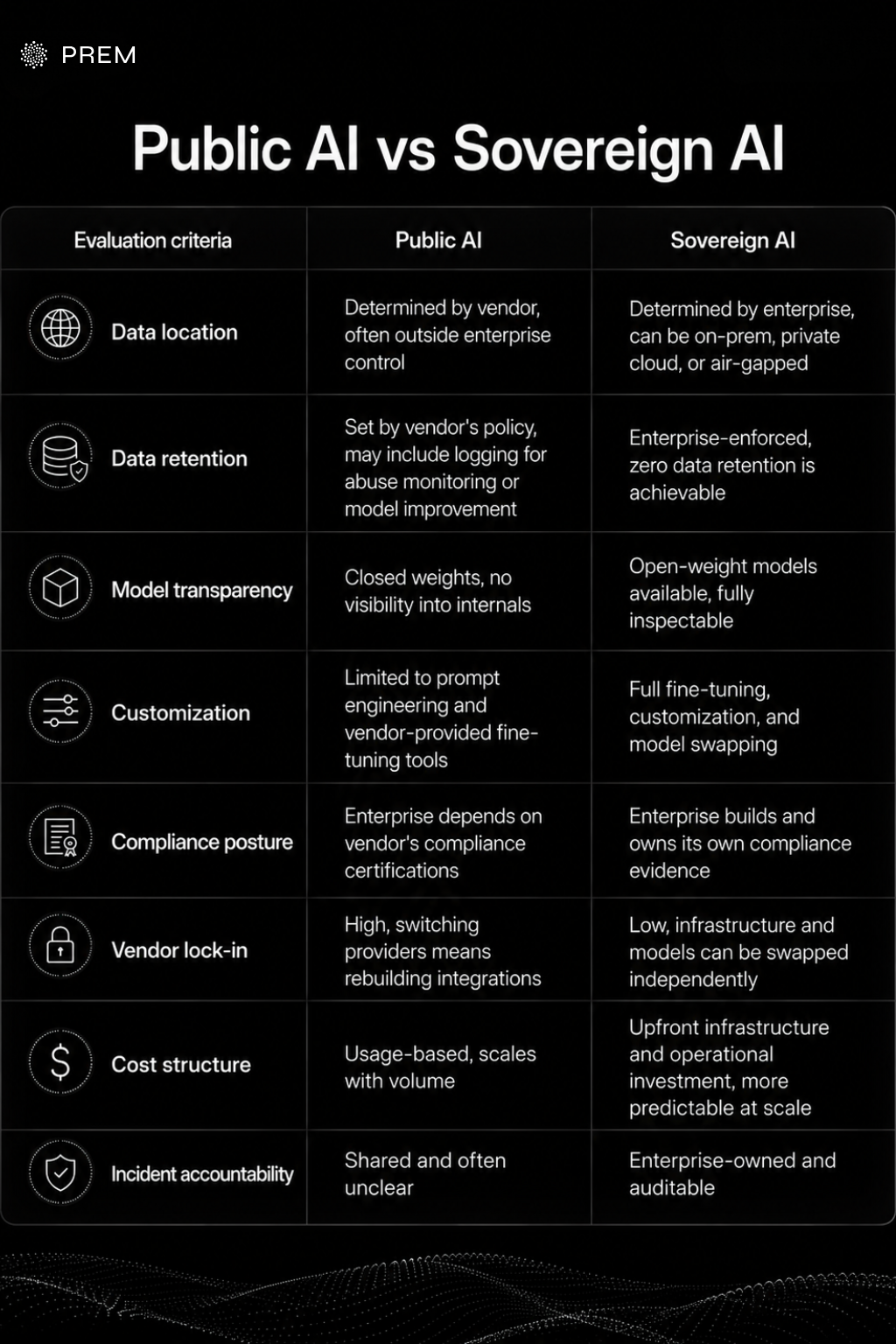
Most enterprises start with a public AI API because it is the fastest path to a working product. The trade-off only becomes visible later, usually during a security review, a compliance audit, or an incident post-mortem. The table below lays out where the two approaches genuinely differ.
Why enterprises across industries are adopting sovereign AI
Sovereign AI matters everywhere data privacy matters, but it matters most in the industries where privacy, compliance, and control decide whether an enterprise can operate at all, healthcare, banking, finance, legal, insurance, government, and defence chief among them.
Financial services
Financial institutions are navigating the most demanding regulatory overlap of any industry adopting AI. The EU's Digital Operational Resilience Act (DORA) has been in force since January 17, 2025, and treats AI agents used for credit decisioning, fraud detection, or trading as ICT systems subject to full incident reporting and resilience requirements.
Layered on top, the EU AI Act's high-risk obligations, recently rescheduled under the Digital Omnibus agreement to December 2, 2027 for standalone systems such as credit scoring and fraud detection, still carry penalties of up to €35 million or 7 percent of global turnover once they land.
For institutions already required to demonstrate exactly where data is hosted under DORA's location and third-party risk provisions, a sovereign architecture is quickly becoming less of a preference and more of a prerequisite, as explained in Gibson Dunn's EU AI Act Omnibus Agreement: Postponed High-Risk Deadlines and Other Key Changes.
Healthcare and life sciences
Healthcare has held the unwanted title of the costliest industry for data breaches for fourteen consecutive years.
According to IBM's Cost of a Data Breach Report: The Healthcare Industry, healthcare breaches averaged $7.42 million per incident in 2025 and took roughly nine months to identify and contain, longer than any other industry measured.
For hospital systems, insurers, and life sciences companies experimenting with AI for diagnostics, documentation, or claims processing, that combination of cost and detection lag is precisely the risk profile Sovereign AI is built to reduce, by keeping patient data inside an infrastructure boundary the organization actually controls rather than a third-party API.
Government and public sector
Governments are not just watching the Sovereign AI trend, they are legislating it into existence.
Gartner's own newsroom coverage, Gartner Reveals Top Technologies Shaping Government AI Adoption, projects that by 2028, 65 percent of governments worldwide will introduce technology sovereignty requirements to reduce dependence on foreign providers and guard against extraterritorial regulatory interference.
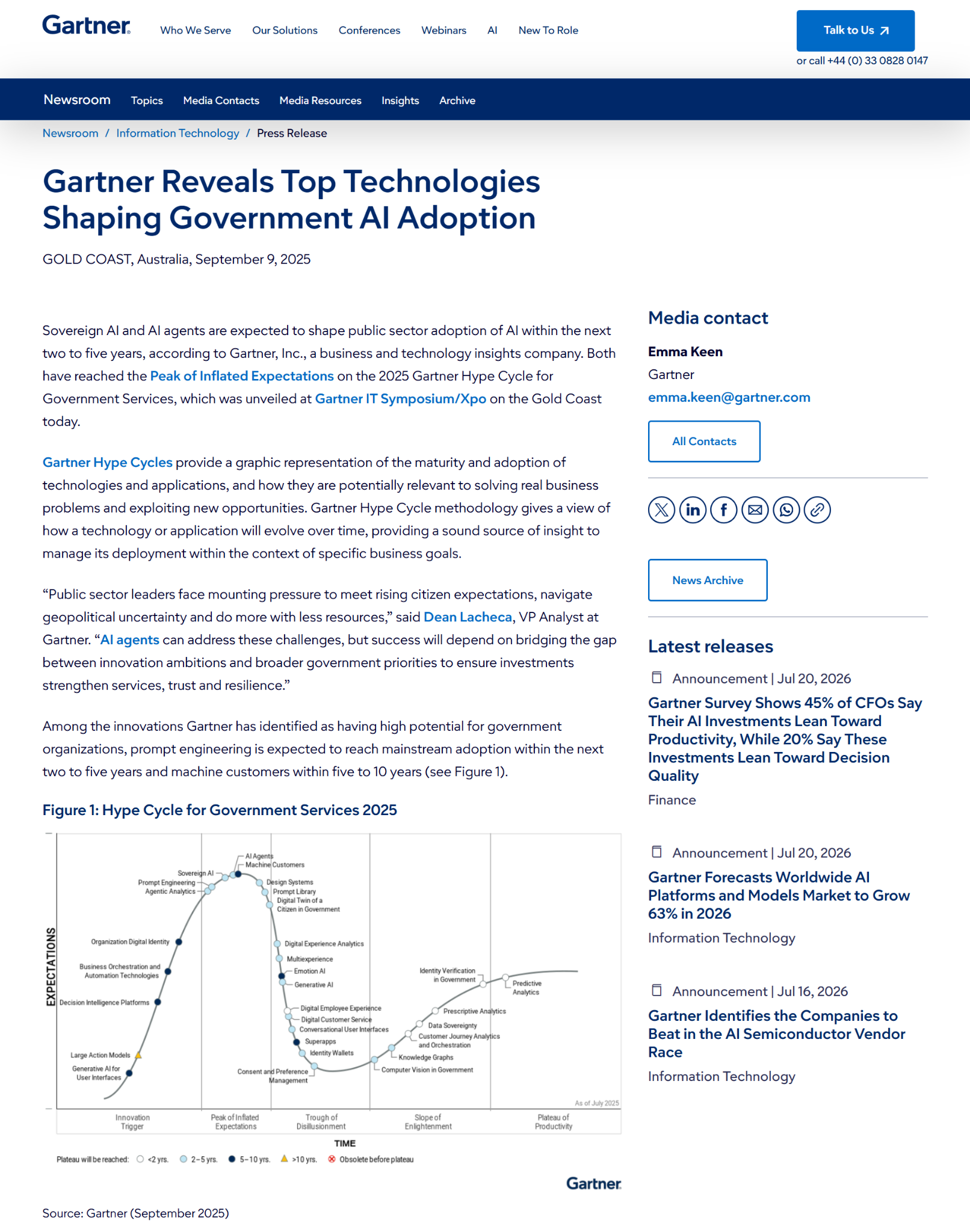
For public agencies, that means sovereignty is no longer an abstract policy goal, it is becoming a procurement requirement vendors will need to meet before they can even bid on government AI contracts.
Legal and professional services
Confidentiality is not a compliance checkbox for law firms, it is the foundation of the client relationship, which makes the sector's current AI usage patterns notable.
Kiteworks' analysis, How Shadow AI Costs Companies $670K Extra: IBM's 2025 Breach Report, found that 23 percent of legal firms report processing extremely high volumes of sensitive data through AI tools, a strikingly high figure for a sector where privilege and confidentiality obligations are this strict.
Legal teams experimenting with AI for contract review, discovery, or client correspondence are handling material that, if exposed through a public AI vendor's logs or training pipeline, could constitute a breach of professional duty. That is a risk profile that pushes firms toward infrastructure they can fully account for.
Manufacturing
Manufacturers are increasingly embedding AI into product design, predictive maintenance, quality inspection, and supply chain operations. These applications improve efficiency and reduce downtime, but they also run on proprietary engineering data, production processes, and supplier information that represent real competitive advantage, which may be why manufacturing has become such an attractive target.
Manufacturing Dive's 2025 breach data reported that manufacturing absorbed a higher share of cyberattacks than any other industry in 2025, with roughly 40 percent of those incidents involving data theft aimed directly at financial assets and trade secrets.
Unlike many public AI services, a Sovereign AI architecture lets you keep sensitive operational data within infrastructure you control while still integrating AI into factory and enterprise systems, particularly important if your enterprise operates globally and must comply with regional data residency requirements, protect intellectual property, and ensure critical production data never leaves an approved environment.
As AI becomes more deeply embedded in manufacturing operations, controlling where data is processed and how models are governed is becoming as essential to industrial resilience as the equipment on the floor itself.
Why enterprises are moving from rented AI to sovereign AI
For the last few years, most enterprise AI has effectively been rented. A company pays per token, per API call, per seat, for intelligence that lives entirely inside someone else's infrastructure.
It works well until the enterprise needs something the rental model was never built to provide: proof of where data went, the ability to inspect a model's internals, or a guarantee that a vendor's pricing or policy change will not upend an entire product line overnight.
The limitations of relying solely on public AI services are becoming harder to ignore. Rented AI means renting someone else's roadmap, someone else's uptime guarantees, and someone else's definition of acceptable data handling. For low-stakes, low-risk use cases, that trade-off is perfectly reasonable. For anything touching regulated data, competitive strategy, or customer trust, it increasingly is not.
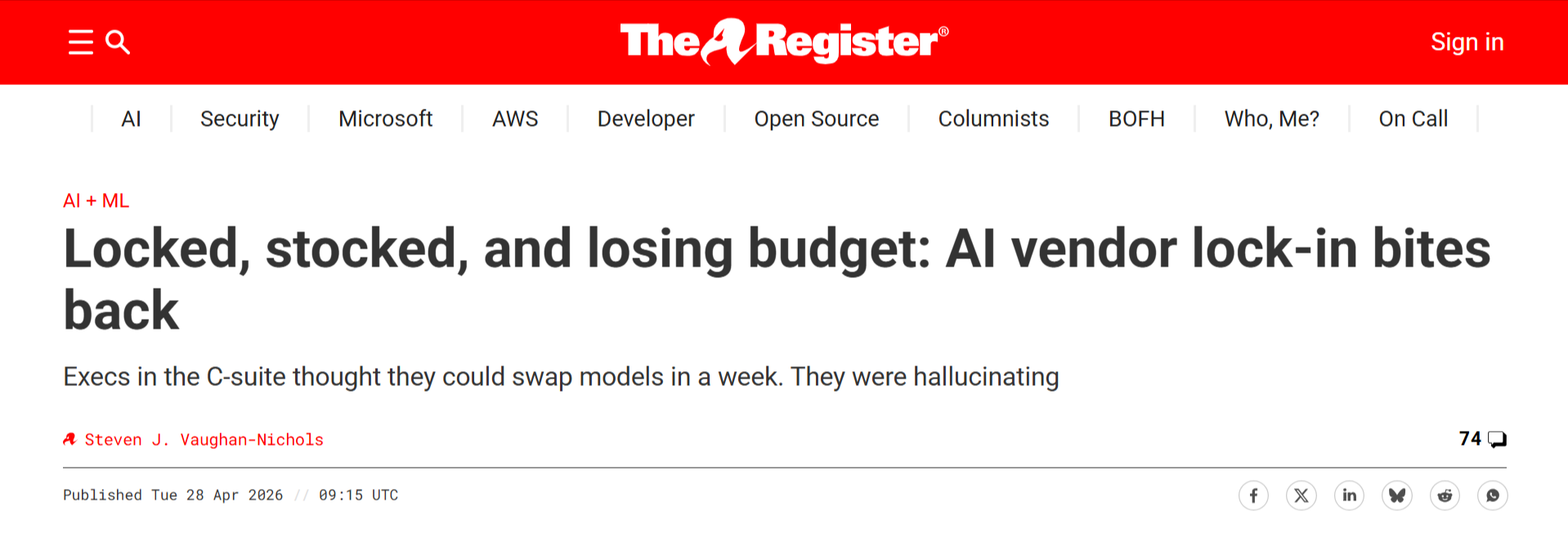
The bills are already coming due industry-wide, with The Register reporting in April 2026 that a major AI lab moved its enterprise pricing from a fixed plan to a dynamic usage-based model overnight, a change experts estimated could double or triple costs for heavy users with no advance say in the matter, covered in The Register report.
This is why enterprises increasingly want AI that runs where their data resides, rather than the other way around.
Instead of sending data to wherever the model happens to live, enterprises bring the model to the data. It runs inside infrastructure they already trust and already govern. It is a subtle shift, but it changes who holds the leverage in the relationship between an enterprise and its AI stack.
Sovereign AI supports long-term AI strategies precisely because it is built around control, governance, and flexibility rather than convenience alone. An enterprise that owns its data, model choices, and infrastructure can adapt as regulation shifts, as new models are released, and as its own risk tolerance changes, without needing to renegotiate a vendor contract every time.
A practical starting checklist for your enterprise sovereign AI strategy
Before you greenlight a sovereign AI initiative, or push back on one, it helps to have concrete questions ready rather than vague direction. Walk through this checklist with your own team, and with any vendor you are evaluating, and insist on straight answers rather than a marketing deck:
Data residency and jurisdiction
Where does the data physically reside, and who has legal jurisdiction over the company operating that infrastructure, not just the servers?
Cross-border transfers
What is the legal basis for every cross-border transfer of personal data your AI system touches, and can you produce documentation for it today?
Data privacy and security controls
Is proprietary data and model prompts and outputs encrypted at rest and in transit, and who inside or outside your organization is technically able to see that data?
AI sovereignty and ownership
Does your organization actually own and control the model weights, the infrastructure, and the roadmap, or are you effectively renting someone else's priorities and calling it your AI strategy?
Inference and model dependency
If your primary model vendor changed pricing or deprecated a model tomorrow, how many engineering hours would it take to recover? Can you swap or upgrade the underlying model without rebuilding your workflows around it?
Compliance readiness
Can your compliance team run a Data Protection Impact Assessment and a Fundamental Rights Impact Assessment on this system without waiting on a third party's documentation team?
Audit visibility
Who, specifically, inside your organization can inspect the model weights, the training data lineage, and the audit logs, without going through a third party?
Verifiability
Can your team independently verify that the system's outputs and behavior actually match what has been documented in your compliance filings, rather than relying on unverifiable claims from outside the organization?
Cost and token efficiency
Do you have real visibility into cost per token or per inference call, and the ability to optimize it over time, rather than being locked into a fixed, opaque pricing structure you have no influence over?
Context compounding
As your AI systems accumulate more internal documents, institutional knowledge, and historical context over time, does that compounding value stay inside your own environment and keep working for you, or does it quietly become someone else's training data?
Prem AI: The sovereign AI infrastructure built for enterprise
Sovereign AI is not a rebrand of "cloud region selection," and it is not a purely regulatory checkbox exercise either. It is a genuine shift in how enterprises think about control over the AI systems they increasingly depend on, driven by regulation in some regions, by the plain economics of vendor risk in others, and often by both at once.
This is exactly the problem we built Prem AI to solve. Instead of asking your enterprise to choose between the productivity of modern AI and the control your compliance and security teams need, Prem AI provides a private, self-hosted AI infrastructure.
Your models, data, and compute stay within your own controlled environment, not a third-party multi-tenant cloud.
Our Confidential API lets your teams work with powerful models without your prompts, outputs, or proprietary data ever leaving your controlled environment, so your legal team can answer the residency and lawful-basis questions raised throughout this guide with actual documentation, not a promise.
And because we build around open, auditable model infrastructure rather than locking you into a single closed vendor relationship, switching or upgrading models is an engineering decision your team makes on your own timeline, not a scramble triggered by someone else's pricing change.
We believe Prem AI is, quite simply, the best foundation an enterprise can build sovereign AI on: full control over where your data lives, full visibility into how your models behave, and none of the vendor dependency that has left so many organizations exposed this past year.
If you are building toward EU-grade data governance, trying to get ahead of the AI Act's enforcement deadlines, or simply tired of your AI roadmap being dictated by a vendor you do not control, contact our sales team or email us at sales@premai.io.
We would welcome the conversation!
Frequently asked questions about sovereign AI for enterprises
What is sovereign AI?
Sovereign AI is an approach to building and deploying AI systems where an enterprise or nation retains control over its data, infrastructure, models, and governance. Instead of relying entirely on external AI providers, sovereign AI allows sensitive workloads to operate within defined legal and operational boundaries.
For enterprises, this means maintaining greater visibility over where data is processed, who can access it, and how AI systems are managed throughout their lifecycle.
Why is sovereign AI becoming important for enterprises?
As AI adoption grows, enterprises are handling more confidential customer, financial, healthcare, and intellectual property data through AI systems. At the same time, privacy regulations and industry-specific compliance requirements continue to become more stringent.
Sovereign AI helps enterprises reduce regulatory risk while maintaining greater control over sensitive data, infrastructure, and AI operations.
Is sovereign AI only for governments?
No. Although governments were among the earliest adopters, sovereign AI is increasingly being adopted by enterprises operating in regulated industries such as banking, healthcare, insurance, manufacturing, telecommunications, and the public sector.
Any enterprise that handles sensitive information can benefit from stronger control over its AI environment.
What is the difference between sovereign AI and traditional cloud AI?
Traditional cloud AI often relies on infrastructure, models, and services managed by third-party providers. Sovereign AI focuses on giving enterprises greater ownership and control over where AI runs, how data is stored, and who manages the underlying infrastructure.
The goal is not to avoid the cloud altogether but to ensure AI deployments align with an enterprise's security, privacy, and compliance requirements.
How does sovereign AI support data privacy and regulatory compliance?
Sovereign AI helps enterprises meet data residency, governance, auditability, and security requirements by allowing AI workloads to operate within approved jurisdictions and controlled environments.
This makes it easier to comply with regulations such as GDPR, the EU AI Act, HIPAA, financial regulations, and industry-specific governance frameworks.
What are the core components of sovereign AI?
Most sovereign AI frameworks include four key dimensions: data sovereignty, operational sovereignty, technological sovereignty, and legal or regulatory sovereignty.
Together, these ensure enterprises maintain control over where AI runs, who manages it, who owns the technology, and how it aligns with applicable laws and governance requirements.
Which industries benefit the most from sovereign AI?
Industries that manage confidential or regulated information typically benefit the most. These include financial services, healthcare, government, defense, legal services, pharmaceuticals, energy, manufacturing, and telecommunications.
These sectors often require strict control over data handling, auditability, and regulatory compliance.
Can sovereign AI use open-source or open-weight models?
Yes. Many sovereign AI deployments use open-source or open-weight models because they offer greater transparency, customization, and deployment flexibility. Enterprises can host these models within their own controlled environments while maintaining ownership of their AI workflows and data.
The choice of model depends on performance requirements, licensing terms, and compliance obligations.
Does sovereign AI replace public cloud services?
Not necessarily. Many enterprises adopt a hybrid approach, using public cloud services for suitable workloads while keeping sensitive AI applications within sovereign or controlled environments.
The objective is to place each workload in the environment that best meets its security, compliance, and operational requirements.
How should an enterprise evaluate a sovereign AI platform?
Look beyond model performance. Evaluate where data is processed, deployment flexibility, infrastructure ownership, security controls, audit capabilities, compliance certifications, model customization options, and integration with existing enterprise systems.
A strong sovereign AI platform should support both innovation and long-term governance without requiring enterprises to compromise on privacy or control.
See how Prem AI can help your enterprise build private AI without compromising control over your data and infrastructure. Contact our sales team, or email us at sales@premai.io.