Proactive & Private AI Workspace: Secure, Privacy-First AI for Enterprise Teams

On this page
Have you heard about the sudden Claude Fable 5 and Claude Mythos 5 shutdown?
For many enterprises, it was a major wake-up call.
It proved that relying entirely on public AI platforms is a risk.
If an AI provider changes its rules, cancels a service, or handles your data outside your local privacy laws, your data is left completely exposed.
That is exactly why corporate leaders are rethinking their entire approach to a private AI workspace, and enterprises with sensitive data workloads are shifting from Public AI to private AI infrastructure that they can trust and control in-house.
Instead of relying on public AI platforms, they are moving to a secure, sovereign and verifiable private AI workspace like Fluso.
Have you noticed how enterprise AI conversations have changed over the past few months?
For many organisations, two events became major wake-up calls.
The first came when Anthropic temporarily suspended access to Claude Fable 5 following US government security concerns. For enterprises that had embedded public AI into critical workflows, it was a reminder that a service outside their control could change, pause, or become unavailable overnight.
Then came another debate that resonated across the enterprise AI community. Following Anthropic’s launch of Claude Design, many business leaders began questioning an uncomfortable possibility: if AI providers continue expanding into adjacent products, what happens when the platform you build on eventually starts competing in your category?
Palantir CEO Alex Karp captured this concern well when he warned that enterprises risk transferring their knowledge, trade secrets, intellectual property, and customer data to AI providers that may one day compete with them. Whether or not that happens in every case, the concern itself is changing how enterprises think about AI adoption.
.@DavidSacks says Palantir CEO Alex Karp is brilliant and completely correct: companies must own their means of production if they don't want to transfer their alpha to OpenAI and Anthropic.
— Jawwwn (@jawwwn_) July 4, 2026
"Enterprises are at risk of transferring their knowledge, their know-how, their trade… https://t.co/FEWvisHicD pic.twitter.com/d3sbEgQtez
These discussions highlight a much bigger issue.
Every prompt your employees write, every customer conversation, financial model, strategy document, source code repository, or internal knowledge base shared with a public AI platform represents valuable business intelligence. Once that information leaves your infrastructure, organisations must trust external providers for data handling, retention, governance, and regulatory compliance.
If our enterprise is operating under regulations such as GDPR, the EU AI Act, HIPAA, or industry-specific compliance frameworks, that trust alone is no longer enough. You require visibility into where data resides, how AI models process it, who can access it, and whether sensitive information ever leaves sovereign infrastructure.
You need private Enterprise AI for protecting your IP, maintaining data sovereignty, meeting regulatory obligations, reducing vendor risk, and ensuring your AI platform strengthens your competitive advantage rather than creating new business risks.
That’s exactly why you’re here to understand what a private AI workspace is, why enterprises are rapidly adopting platforms like Fluso, and how you can securely deploy enterprise AI across your organisation.
What is a private AI workspace?
Think of it as an AI environment built for enterprises that simply can't afford to lose control of their data, their context, or their IP.
Here's the difference: public AI agents send your prompts through shared infrastructure you don't control. A private AI workspace doesn't. It runs on confidential AI infrastructure, inside a security boundary that belongs to you.
And "belongs to you" isn't a figure of speech.
You choose where it lives, your own data centre, a private cloud, a VPC, an air-gapped network, or a fully self-hosted setup.
You decide where the AI runs, where your data stays, and who's allowed to touch it.
There's no sending prompts off to a third-party AI provider and hoping for the best.
Everything is processed through zero-data-retention enclave APIs, your prompts, responses, and business context stay inside secure enclaves, and none of it gets retained, logged, or quietly used to train someone else's model.
On top of that, every interaction is protected with post-quantum encryption, both in transit and at rest.
Instead of relying on today's encryption methods, which may become vulnerable as quantum computing advances, post-quantum encryption is designed to keep your data protected well into the future.
That's not just about today's threats, it's about staying ahead of what quantum computing will be able to break in a few years.
This isn't a hypothetical worry either, even the enterprises building quantum computers are treating it as urgent.
As Euronews reported, Google moved up its own deadline to migrate to post-quantum encryption, warning that quantum computers pose a real threat to the encryption and digital signatures securing the internet today.
So the same company building some of the most advanced quantum computers on earth is now racing to protect itself from them, and it's set 2029 as the year it wants to be fully secured.
If Google isn't willing to wait, it's a good sign no one else should either.
You're also not locked into one AI provider.
A private AI workspace supports multiple frontier and open-weight models, so you can pick the right model for each job without giving up privacy or compliance.
But here's the part that actually compounds over time, your organisation's knowledge stops leaking away.
Instead of losing context every time a chat closes or a document gets buried, that knowledge stays inside your environment, accumulating, connecting, getting more useful with every interaction instead of evaporating.
The result is full control.
You keep 100% ownership of the infrastructure, the data, and the security rules, while still having the flexibility to use the best AI tool for whatever the task calls for.
Why your enterprise need a private workspace
AI is now part of everyday work.
But as AI grows, so do the challenges.
It is a critical choice for enterprise’s safety, legal compliance, and business continuity.
IBM's cost of a data breach report consistently shows the average data breach now costs organisations USD 4.44 million globally, while the average cost in the United States reaches USD 10.22 million.
The same research found that 97% of organisations experienced an AI-related security incident or lacked proper AI access controls, and 63% still have no formal policies for AI governance.
Many enterprises block public LLMs completely because they cannot risk exposing confidential customer records, intellectual property, or financial data to external AI providers
But blocking doesn't actually stop the behaviour, it just moves it out of sight.
Shadow AI is already happening, whether IT approves it or not.
As eSecurity Planet reported, according to LayerX's 2025 Enterprise AI Report, 77% of enterprise employees who use GenAI tools have already copied and pasted company data into a chatbot query.
On average, employees make 14 pastes a day into non-corporate AI accounts, and at least 3 of those contain sensitive data, with nearly 40% of uploaded files containing PII or payment data.
Some enterprises standardise on a single approved assistant, like Microsoft Copilot, only to find that it lacks the model flexibility teams need for specialised tasks.
A few try to build their own in-house AI platforms from scratch, but managing secure infrastructure, maintaining governance, and keeping up with rapid AI innovation requires a massive engineering budget and endless operational effort.
"There should be as many models in the world as firms in the world."
— Yash Patil (@ypatil125) June 26, 2026
Satya and I dig into when to own vs. rent your intelligence, why every company should be building and climbing its own private evals, and what makes for a stable frontier. pic.twitter.com/ZUeAEqJnSx
In an interview with Applied Compute co-founder Yash Patil, even Satya Nadella said he doesn't want to be locked into any one model. "I want to be able to use my own context, my own data, in fact my own traces to maybe even take a much more open-weight, cost-efficient model or a fine-tuned model."
Coming from the CEO of the company that builds Copilot, that's not a minor comment.
It is whether you can use AI without leaking secret intellectual property, breaking government rules, or becoming trapped by third-party vendors.
That is exactly why your enterprise needs a private AI workspace.
Protect your intellectual property and enterprise data
Every prompt your employees write contains vital business context.
It could be customer contracts, patient data, software code, pricing plans, product roadmaps, legal advice, or secret financial models.
According to usecure’s GenAI data leakage article, the average employee performs 6.8 data-paste events per day, with 3.8 of those containing sensitive data.
And Kiteworks surveys show that up to 93% of workers input company data without approval, creating major "shadow AI" risks.
Over time, your company's most valuable asset, its knowledge, slowly leaks outside your network.
For example, JPMorgan Chase restricted employees' use of ChatGPT while assessing compliance and data privacy risks.
The move reflected a broader trend across regulated industries, where enterprises recognised that confidential business information should not be shared with public AI systems without appropriate governance and controls and began weighing alternatives to ChatGPT Enterprise
Even Palantir CEO Alex Karp said as much on CNBC's Squawk Box recently:
"Every single enterprise in this country, these people are LIVID. They are paying for tokens that create no value. These people are stealing the weights and alpha of my business."
The point he's making is simple. Every time a company runs its confidential documents, customer conversations, or financial models through a closed AI tool, it's quietly handing over the very knowledge that makes it competitive, with no real control over where that data ends up.
A private AI workspace keeps your company knowledge inside your own safe system, ensuring secret data stays locked down and under your control.
Maintain data sovereignty, not vendor dependency
Enterprise AI should run on your terms, not someone else's.
Public AI providers can hike prices, delete models, or change their privacy rules overnight.
As the recent sudden shutdown of Claude Fable 5 and Claude Mythos 5 proved, depending entirely on external AI platforms creates huge business risks.
A private AI workspace gives you total control over where your AI runs, where data is stored, and who can see it.
Stay compliant with GDPR (General Data Protection Regulation), The EU Artificial Intelligence Act, and industry regulations
Following privacy laws is not optional.
Whether you operate under GDPR, are prepping for the EU AI Act, or handle strict rules in healthcare, finance, or government, your AI must meet tough legal standards.
Governments are also warning enterprises against adopting AI without proper governance.
The UK's National Cyber Security Centre guidelines recommend that organisations treat generative AI as part of their overall risk management strategy, with clear controls around sensitive data, access management, and secure deployment.
A private AI workspace helps you:
- Keep data within safe borders and approved jurisdictions.
- Maintain detailed audit logs of all AI activity.
- Enforce strict user controls across departments.
- Lower legal risks instantly.
Instead of trying to force compliance onto an unsafe public AI tool, you get AI built for compliance from day one.
Combine the right open-source AI models for every workload
Instead of using a single proprietary model, in a private AI workspace you can bring multiple leading open-source LLMs hosted by Safe Swiss Cloud in Swiss data centres together.
This gives you the flexibility to match the right model to each workload while keeping your enterprise data private and under your control.
Because these models operate within a sovereign, privacy-first environment, your data is never used to train public AI models.
You get the innovation of the latest open-source AI, combined with the governance, compliance, and security enterprises need to scale AI with confidence.
Scale AI without creating compliance risks
AI use usually starts small with individual employees buying their own accounts.
Soon, hundreds of people are using different web tools with zero central oversight.
When this happens, IT loses visibility, security teams lose control, and compliance breaks down.
A private AI workspace pulls all company AI use into one secure dashboard.
This ensures your safety rules, permissions, and audit logs stay perfectly consistent across the whole company.
Build custom AI agents safely
Public AI tools let people build custom agents, but companies hesitate to upload secret knowledge into external systems.
A private AI workspace lets you build internal AI workflows using your real company files, handbooks, SOPs, and customer data while ensuring that data never leaves your secure system and always be verifiable.
Employees get accurate, verifiable and contextual answers without leaking secrets to the public web.
Strengthen enterprise security against emerging threats
Cyber threats are evolving just as quickly as AI.
A single accidental upload of confidential source code, financial records, customer data, or intellectual property into an unauthorised public AI tool can expose some of your organisation's most valuable assets.
This is no longer just an IT concern; it's a board-level business risk.
A private AI workspace like Fluso keeps AI entirely within your organisation's trusted security boundary. Enterprise AI workloads run on your dedicated infrastructure, ensuring sensitive business data never leaves your controlled environment.
Security is built into every layer of the platform. Data is protected with post-quantum encryption both at rest and in transit, while connector-specific proxy architecture ensures credentials, API keys, and third-party integrations remain isolated and securely managed. Combined with role-based access controls, network segmentation, continuous security monitoring, and comprehensive audit logging, enterprises gain complete visibility and control over how AI accesses and processes sensitive information.
The result is enterprise AI that delivers innovation without compromising data ownership, security, or compliance.
Context compounding creates long-term enterprise intelligence
One of the biggest flaws of public AI is that knowledge stays trapped inside single, isolated chats.
A private AI workspace enables context compounding.
As your company knowledge grows across documents, meetings, emails, and workflows, the AI actually becomes more valuable over time.
It deeply understands how your specific business operates instead of starting from scratch every single time.
Rather than just helping one person finish a single task, it continuously improves how your entire business works.
Public AI vs private AI workspace: what's the difference?
If you're evaluating AI for your enterprise, understanding these differences is essential.
The table below compares public AI platforms and a private AI workspace across privacy, compliance, security, and control.
Which industries benefit from private AI workspace?
Any enterprise that relies heavily on knowledge, documentation, and collaboration can benefit from a private AI workspace.
Finding and using information quickly is a universal challenge, and it’s the problem AI enterprise search platforms are built to solve.
Here are the sectors seeing the greatest value:
Government, defence, and public sector
Public organisations handle highly sensitive information where data sovereignty, governance, and operational security are essential.
A secure AI workspace keeps organisational knowledge inside a controlled environment with role-based permissions, auditability, and strong security controls.
You can work more efficiently while protecting classified information, maintaining compliance, and preserving public trust.
Legal, compliance, and professional services
Lawyers, consultants, accountants, and compliance teams spend valuable time searching for contracts, previous cases, regulations, and client records spread across multiple systems.
A private AI workspace connects approved legal documents, policies, emails, and research into one secure environment while maintaining strict access controls.
Teams prepare for meetings faster, reduce repetitive research, and confidently work with confidential client information.
Healthcare, life sciences, and research
Healthcare professionals and researchers manage sensitive patient information, clinical documentation, and research papers stored across different platforms.
An encrypted AI workspace securely connects approved medical knowledge and research databases while helping your team meet the privacy requirements expected of HIPAA compliant AI tools through controlled access to internal documentation.
Clinicians and researchers spend less time locating information and more time delivering patient care or advancing research.
Finance, banking, and investment
Financial teams constantly work with regulations, audits, customer records, and investment reports where accuracy and compliance are critical.
A privacy-first AI workspace centralises approved financial knowledge while enforcing governance policies and permission-based access.
You can trust information faster, improve reporting accuracy, and maintain compliance with industry regulations.
Business operations, HR, and growing companies
As organisations grow, internal knowledge becomes scattered across documents, onboarding guides, project tools, and communication platforms.
A private AI workspace creates a shared knowledge hub where you can securely access the information you need without relying on colleagues.
Faster onboarding, smoother collaboration, reduced repetitive work, and better knowledge sharing across departments.
How you should evaluate a private AI workspace for your enterprise
Not every private AI workspace gives you the same level of security, control, or verifiability.
Before choosing among the best AI platforms for enterprise, technology leaders need to check if they can actually protect secret data, produce verifiable outputs, follow strict privacy laws, and grow safely across the enterprise.
Here are the key features you should look for.
Verifiable AI, not black-box AI
Enterprise AI should not ask you to simply trust its outputs.
Generally your team needs to know where an answer came from, which documents were used, what model generated it, and whether the response can be independently verified.
Look for a private AI workspace that makes AI decisions transparent and verified instead of treating them as a black box.
The right platform should provide source-backed responses, traceable reasoning, auditability, and cryptographic proof that your data and AI workloads remain within your defined security boundary.
When your security team, auditors, or regulators ask for evidence, your AI platform should be able to provide it, not just promise it.
Context compounding capabilities
Public AI starts every conversation with little understanding of your business.
That means your team repeatedly uploads the same documents, explains the same processes, and recreates the same context across different chats.
A private AI workspace should do the opposite.
As more approved documents, SOPs, meeting notes, policies, and workflows are connected, your AI should continuously build on that knowledge while keeping it inside your organisation.
Over time, your enterprise develops a proprietary knowledge layer that becomes more verified, accurate, relevant and valuable with every interaction.
Instead of helping your team on complete isolated tasks, the AI compounds organisational intelligence that remains your competitive advantage, not your vendor's.
Enterprise-grade AI inferencing
The quality of your AI depends on how and where it runs.
Choose a private AI workspace that provides enterprise-grade AI inferencing, allowing your teams to securely run multiple open-source LLMs for coding, document analysis, reasoning, multilingual conversations, and AI agents without exposing confidential business data to public providers.
The right platform should also support APIs, workflow automation, and enterprise integrations, and verifiable AI execution, making AI available across your business instead of limiting it to a standalone chatbot.
High-quality corporate AI performance
The value of your AI depends entirely on how and where it runs.
Choose a private workspace that offers top-tier processing power.
This allows your teams to safely run multiple open-source models for coding, document analysis, deep reasoning, and custom AI agents, without leaking corporate secrets to public web providers.
The right platform must also support APIs, automatic workflows, and direct software connections. This ensures AI is available across your entire business instead of being trapped in a basic chat window.
EU-hosted, sovereign infrastructure
Where your data lives has become a major strategic business choice.
Many public AI providers process company files on global systems, making it incredibly hard to follow regional privacy laws.
Look for a private workspace that lets you choose exactly where your data is stored, such as secure EU-hosted data centers or your own private cloud.
This gives you total control over where data is processed, saved, and deleted.
Protection from foreign laws and the US CLOUD Act
Where your AI vendor is based can directly threaten your data control.
Many global tech providers are tied to foreign laws, like the US CLOUD Act, which can force companies to hand over data to foreign governments even if it is stored overseas.
A private AI workspace built on fully sovereign infrastructure completely removes this risk.
It keeps your corporate data firmly under your own country's legal jurisdiction, which is vital for heavily regulated fields and secret intellectual property.
Audit-ready AI tracking
Corporate AI should be just as accountable as your financial or HR systems.
Your platform needs to provide verifiable and clear audit logs, strict user permissions, usage tracking, and automated rules.
This helps your security teams see exactly how the AI is being used.
An audit-ready workspace makes internal reviews simple, speeds up regulatory reporting, and gives leaders complete peace of mind as more employees adopt the tool.
Proven security certifications
Security claims should always be backed by recognised certifications.
When evaluating a private AI workspace, look for providers that demonstrate compliance with internationally recognised security and privacy standards, including:
- ISO 27001, 27017, and 27018 for world-class information and cloud security.
- SOC 2 Type II for independently tested data protection and privacy controls.
- GDPR readiness to satisfy European data privacy laws.
- EU AI Act alignment to guarantee safe and responsible AI governance.
These certifications demonstrate that your AI platform is designed to meet enterprise verifiability, security, privacy, and compliance expectations.
Fluso: Your private AI workspace for enterprise productivity
The way we work is changing, and so are our expectations from AI.
A private AI workspace is no longer just a security upgrade, it's the foundation for responsible, enterprise-ready AI.
As enterprises adopt AI at scale, success depends on more than model performance.
It requires complete control over your data, compliance with changing laws, and AI that understands your business without compromising privacy.
And here the Fluso comes in.
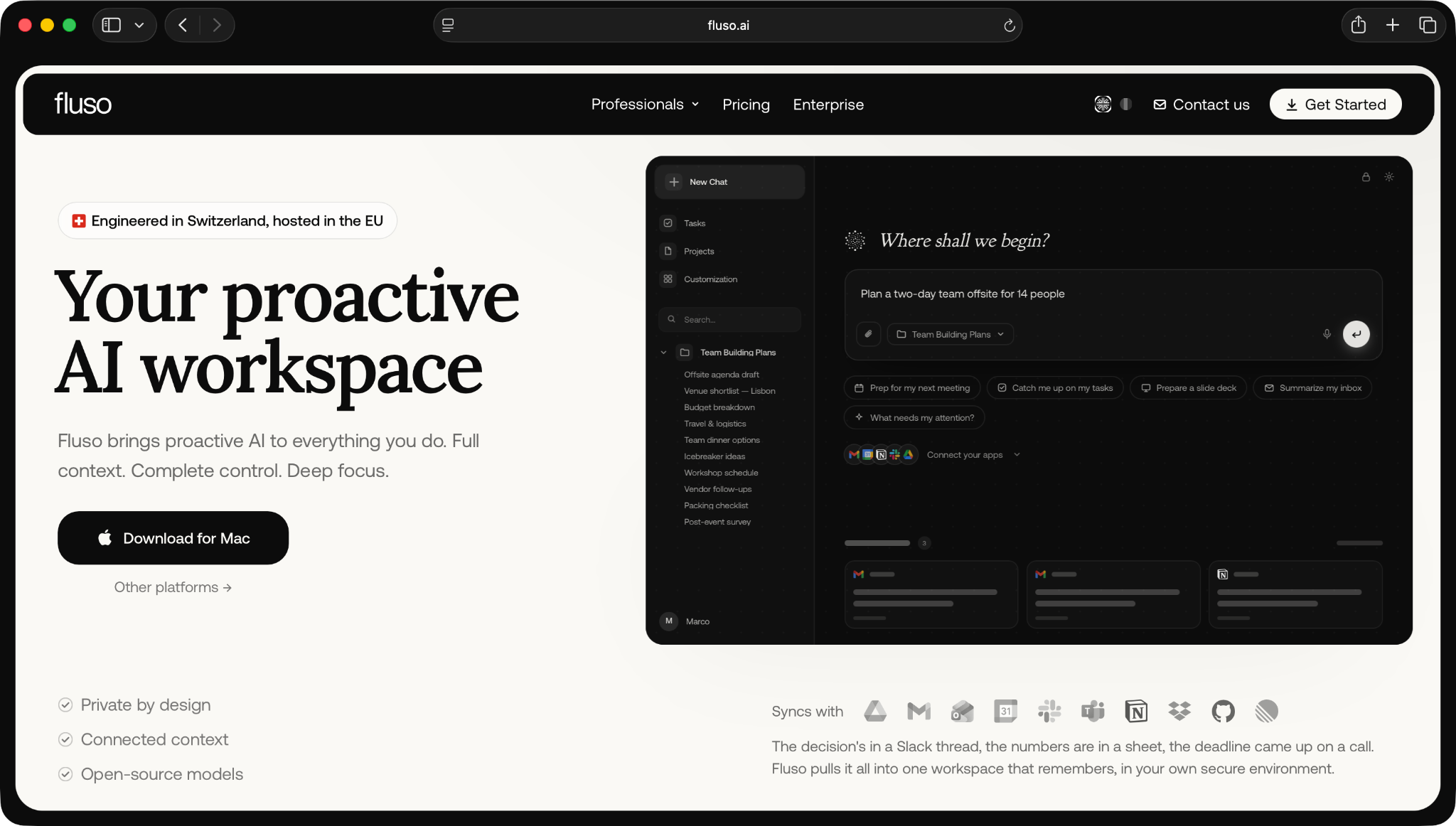
Fluso brings these capabilities together in one private AI workspace.
By combining connected business knowledge, open-source AI models, sovereign infrastructure, and enterprise-grade security, it helps you automate knowledge work while keeping your data private, auditable, and fully under your control.
Whether you're modernising operations, enabling secure collaboration, or preparing for the future of enterprise AI, Fluso provides the trusted foundation to scale AI with confidence.
An enterprise operating in highly regulated industries such as legal, healthcare, and finance, Fluso provides a secure AI workspace where productivity and privacy work together.
Book a discussion call with Fluso and discover how secure, privacy-first AI can transform the way your team works.
Frequently asked questions about private AI workspaces
What is a private AI workspace?
A private AI workspace is a secure environment where your organisation can use AI without giving up control of its data.
It connects approved business knowledge, documents, emails, meetings, and workflows so AI understands your business context while keeping sensitive information private and protected.
Why do enterprises need a private AI workspace instead of public AI?
Public AI tools are designed for general use and often require you to provide the same context repeatedly.
A private AI workspace securely connects your organisation's knowledge, enforces permissions, supports compliance requirements, and keeps business data under your control, making it better suited for enterprise AI adoption.
Is ChatGPT a private AI workspace?
No. ChatGPT is a general-purpose AI assistant, whereas a private AI workspace is built specifically for organisations.
A private AI workspace securely connects enterprise knowledge, business systems, workflows, and permissions to provide context-aware AI while supporting governance, privacy, and compliance across the organisation.
How does a private AI workspace protect enterprise data?
A well-designed private AI workspace protects sensitive business information through encrypted infrastructure, role-based access controls, audit logs, governance policies, and secure deployment options.
Many enterprise platforms also ensure that your prompts, documents, and outputs are not used to train public AI models, giving your organisation complete control over its intellectual property.
Can a private AI workspace help with GDPR and other compliance requirements?
Yes. Enterprise private AI workspaces are designed to support regulatory frameworks such as GDPR, the EU AI Act, ISO security standards, and industry-specific compliance requirements.
They also provide governance controls, audit trails, permission management, and data residency options that help organisations meet legal and internal security obligations.
Can I choose different AI models inside a private AI workspace?
Yes. Modern private AI workspaces support multiple open-source large language models (LLMs), allowing you to choose the best model for coding, document analysis, reasoning, multilingual tasks, or automation.
This flexibility reduces vendor lock-in while keeping your enterprise data inside a secure environment.
Can a private AI workspace connect with our existing business tools?
Yes. Most enterprise private AI workspaces integrate with the tools your teams already use, including email, cloud storage, calendars, CRMs, document repositories, communication platforms, and project management software.
This allows AI to work with your existing business knowledge instead of forcing employees to constantly upload files or switch between applications.
What is a proactive AI workspace?
A proactive AI workspace goes beyond responding to prompts.
It understands your ongoing work, remembers relevant context across projects, connects information from different business systems, identifies what needs attention, and helps complete tasks before you have to ask, making AI a true productivity partner instead of just a chatbot.
What should you look for when choosing a private AI workspace?
When evaluating a private AI workspace, look for enterprise-grade AI inferencing, support for multiple open-source models, sovereign or regional data hosting, audit-ready governance, strong security certifications, enterprise integrations, and deployment options that match your organisation's privacy and compliance requirements.
These capabilities ensure your AI platform can scale securely as adoption grows.
What is the best private AI workspace for an enterprise?
Fluso. It combines connected business knowledge, proactive AI, open-source models, enterprise-grade AI inferencing, and privacy-first infrastructure in one secure workspace.
Unlike traditional AI assistants, Fluso understands your organisation's context across documents, emails, meetings, and workflows while keeping your data private, auditable, and fully under your control.
Whether deployed in the EU, your VPC, or an air-gapped environment, Fluso helps enterprises adopt AI securely without compromising governance, compliance, or flexibility.