Best LLM API Providers with Zero Data Retention (ZDR) & Privacy
Zero Data Retention (ZDR) means an LLM API does not retain your prompts or outputs after processing, though this is separate from where your data is processed.
- ZDR controls retention, while data residency controls jurisdiction. A provider can offer ZDR while still processing data outside your control, so enterprises often need both.
- We have chosen 5 European LLM API providers evaluated for ZDR coverage, deployment options, and infrastructure control.
- Prem AI offers confidential computing through its Enclave API, with cryptographic attestation you can verify yourself, and a standard ZDR mode for everyday inference.
- Before choosing a provider, check whether ZDR applies to all models and endpoints, whether it's backed by a signed DPA, and whether features like agents or file storage are excluded.
In May 2023, Ireland's Data Protection Commission fined Meta €1.2 billion, the largest GDPR penalty ever issued, for unlawfully transferring European users' personal data to the United States, according to the CMS GDPR enforcement tracker. The case highlighted a basic privacy issue: where personal data is processed can matter just as much as how it is protected.
The same applies when you send data to an LLM API. Before choosing a provider, you need to know where your data is processed and which laws apply to it.
When you send prompts to a hosted model, your data is processed on infrastructure operated by a third party. The laws that apply to that data can depend on where the infrastructure is located. Retention policies and the provider's security controls all affect your privacy and compliance status.
This concern is becoming more common as businesses use more AI services. According to Kiteworks' 2026 Risk Forecast Report, nearly 30% of organizations now see AI providers transferring data across borders as one of their biggest privacy risks.
Zero data retention (ZDR) addresses one part of the problem. If an LLM API does not retain your prompts or outputs, there is no stored copy left with the provider after processing. But ZDR and data residency are not the same thing. A provider can offer ZDR while still processing your data in a jurisdiction you do not control.
For enterprises handling sensitive data, you need both. Your LLM API should limit data retention and give you meaningful control over where your data is processed and whether you can verify those protections.
That is where private AI infrastructure, sovereign AI, and technologies such as trusted execution environments (TEEs) become important. They give you greater control over the infrastructure that processes your data.
When you're choosing an LLM API, your focus needs to be on finding providers that actually offer ZDR, meaning strict privacy and data residency controls your business requires.
Parameters to check before choosing an LLM API with ZDR
When you’re checking a provider’s ZDR policy, make sure the models and endpoints you plan to use are covered. Also check whether features such as logging, file storage, etc., have separate retention.
| What to check | What it means |
|---|---|
| ZDR scope | Does ZDR apply to all models, endpoints, and API calls, or only certain ones? |
| Contractual guarantee | Is ZDR backed by a signed agreement or DPA, or is it only stated in the provider's policy? |
| Exceptions and stateful features | Are features such as agents, file storage, batch processing, or memory excluded from ZDR? |
| Deployment options | Can you use a managed API, private cloud, VPC, or on-premises deployment? |
| Compliance certifications | Does the provider have relevant certifications such as SOC 2 or ISO 27001, along with applicable GDPR or other privacy controls? |
Get the best LLM API with Zero Data Retention
Run enterprise AI workloads through an OpenAI-compatible LLM API with zero data retention.
Get started with Enclave APIBest LLM API providers with Zero Data Retention (ZDR) and privacy
If you’re sending sensitive data through an LLM API, ZDR is only one part of the decision. You also need to see how your data is handled and how much control you have over where and how it is processed.
We’ve narrowed it down to five European LLM API providers that stand out for ZDR, privacy, and data control, so you can see how they compare.
| Platform | ZDR coverage | Deployment options | Infrastructure control |
|---|---|---|---|
| Prem AI | ZDR for standard inference; confidential computing with cryptographic attestation for the Enclave API mode | Managed Enclave API | High |
| Scaleway Generative APIs | ZDR by default; prompts and outputs are not collected, read, reused, or analyzed | Serverless API or Dedicated Deployment in European data centers | Moderate |
| OVHcloud AI Endpoints | ZDR by default; only billing-related data is retained | Managed, serverless API with free sandbox testing | Limited to moderate |
| IONOS AI Model Hub | Stateless by design; prompts and outputs are not retained | Managed OpenAI-compatible API hosted in Germany | Limited |
| Regolo AI | Prompts and outputs are processed in memory and discarded after the response | Serverless OpenAI-compatible API hosted in Italy | Limited |
Prem AI
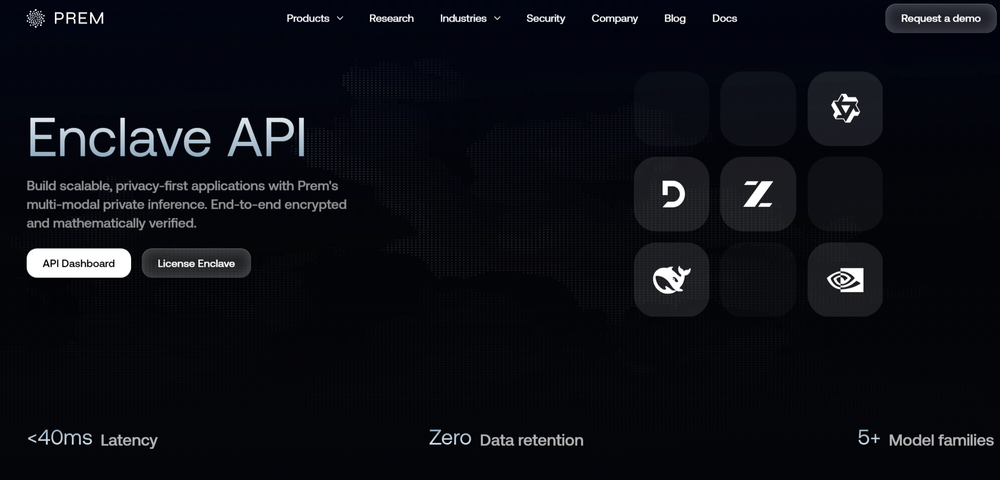
Prem AI is a Swiss AI infrastructure company built for enterprises that need private, secure, and verifiable AI. Founded in 2023, we focus on protecting your data when it's used with AI.
Our infrastructure is built for enterprises that need more than a policy promise about how your data is handled. You get private AI infrastructure, confidential computing, data residency, and hardware-level security, with ways to verify how your AI workloads are processed and protected.
Enclave API: managed private AI inference
Our Enclave API gives you a single API endpoint to access leading open models, while your AI workloads run in a confidential computing environment. You can use the API without managing the GPUs or the underlying infrastructure yourself.
What you get with our Enclave API
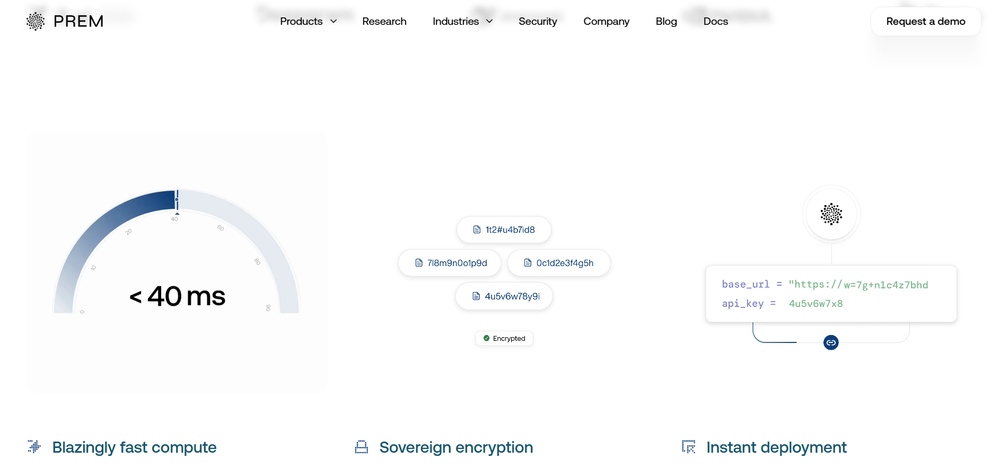
Fast inference
Dedicated GPU clusters are built for fast inference, with time-to-first-token designed to match leading AI providers.
OpenAI compatibility
Switch your base URL and API key without rebuilding your existing application.
Multimodal inference
Use one API for voice transcription, image analysis, chat, document analysis, and other AI workloads.
Zero data retention
Your prompts and completions are not retained after processing, whether you're using standard inference or the confidential, TEE-based mode.
Encrypted inference
Your workloads run on encrypted GPUs inside hardware-enforced Trusted Execution Environments (TEEs).
Verifiable security
Cryptographic attestation lets you verify the environment processing your requests. You can also run the verification yourself before sending sensitive data.
We support model families including Kimi K3, DeepSeek V4 Pro, Qwen 3.8, GLM 5.2, and GLM 5.3 Flash, along with integrations such as NVIDIA and Deepgram.
Prem Confidential API's and ZDR API's have already processed 3.8 billion tokens across 124,000 requests and 11 models.
— Prem (@premai_io) September 9, 2026
None of those 3.8 billion tokens is sitting on a server anywhere. Your prompts and completions aren't written to a log or a cache, and they're not used to train… pic.twitter.com/p9BZR9eJGd
Why our ZDR approach stands out
Enclave API processes your data inside isolated, encrypted environments, and cryptographic attestation lets you verify that environment yourself. ZDR, our separate standard inference mode, keeps nothing written to a log, cache, or storage.
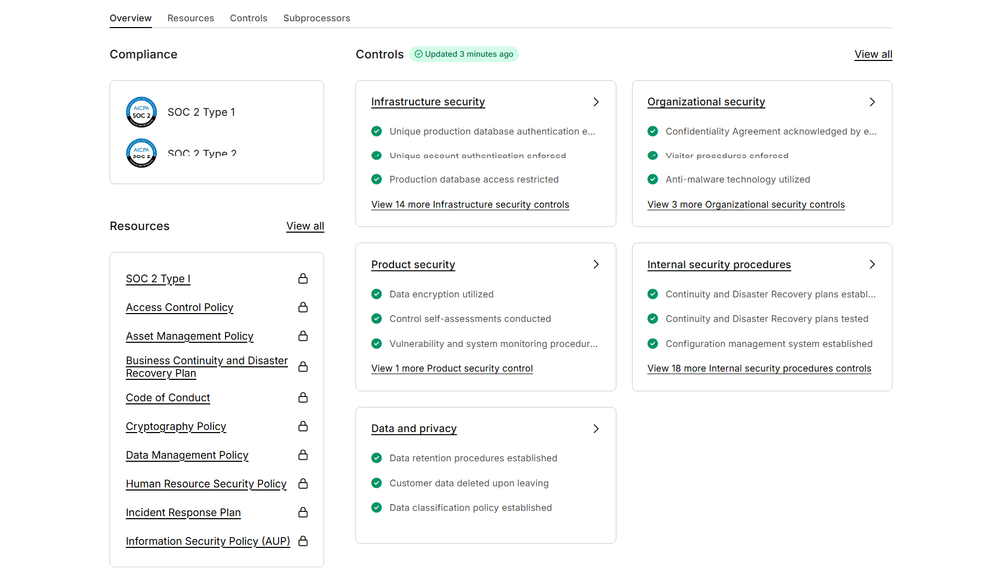
We hold a SOC 2 Type I report, along with FADP and GDPR controls. These give you additional safeguards when you are handling sensitive data and managing privacy requirements.
Want an LLM API built around verifiable zero data retention rather than a policy promise? Contact our sales team or email us at sales@premai.io.
Scaleway Generative APIs
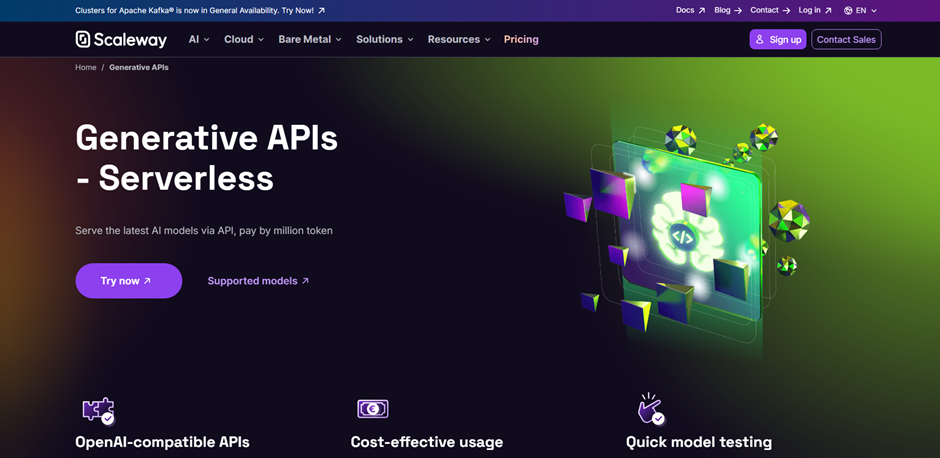
Scaleway is a French cloud provider that offers access to open-weight AI models through European data centers. Zero data retention is the default for its Generative APIs.
ZDR approach
As per Scaleway, it does not collect, read, reuse, or analyze your prompts or outputs. This data is not used to train models or shared with other customers or model providers. In some cases, such as serious errors or suspected malicious activity, Scaleway may temporarily store request data to investigate the issue.
Scaleway also states that its AI services are not subject to extraterritorial laws such as the US CLOUD Act.
Deployment options
You can use Scaleway's serverless Generative APIs without managing any infrastructure or choose a dedicated deployment for more control and predictable performance. Both options are hosted in European data centers.
Its model lineup includes GLM 5.2, DeepSeek-V4-Flash, Qwen3.6, and other open-weight models.
Switch to a ZDR LLM API
Keep your prompts and completions out of persistent storage with an LLM API built for private AI inference.
Get started with Enclave APIOVHcloud AI Endpoints
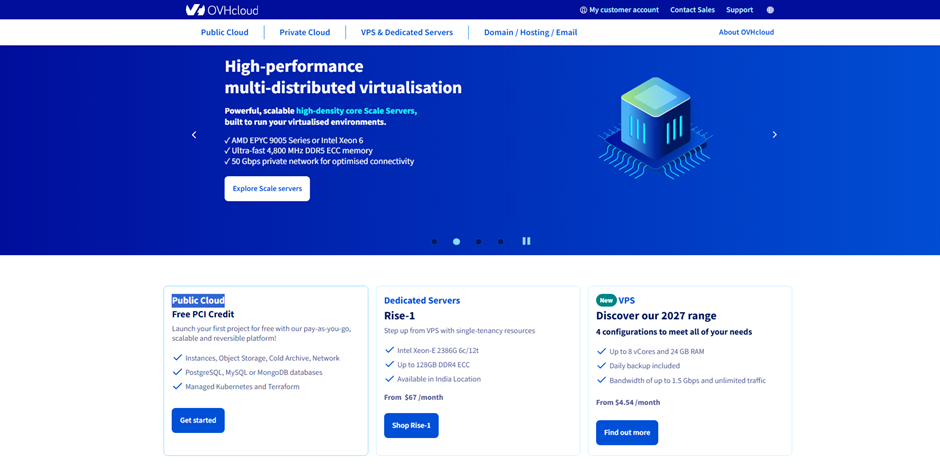
OVHcloud is a European cloud provider offering serverless access to more than 40 open-weight AI models through its AI Endpoints platform.
ZDR approach
According to OVHcloud, it keeps only the data needed for billing and does not use your data to train or improve AI models. This protection applies across its AI model catalog without requiring a separate opt-in.
Deployment options
AI Endpoints uses an OpenAI-compatible API, so you can connect it to existing applications without major changes. You can test models in a free sandbox or use an API key for higher limits and production workloads.
The platform supports models from providers such as Llama, Qwen, and DeepSeek.
Run Your LLM API With Verifiable Security
Enclave API runs your workloads inside hardware-enforced Trusted Execution Environments, with cryptographic attestation you can verify yourself.
Get started with Enclave APIIONOS AI Model Hub
IONOS is a German cloud provider whose AI Model Hub is designed as a stateless service, meaning it does not retain your prompts or outputs.
ZDR approach
Your prompts and outputs are not recorded or used to train or improve models. Any operational logs are only accessible to IONOS personnel in the European Union.
IONOS also mentions that model developers cannot access your data and that it does not use third-party subprocessors for the service.
Deployment options
With AI Model Hub, you can use foundation models, vector databases, and RAG through an OpenAI-compatible API without managing the underlying infrastructure yourself.
If you use RAG, your document collections are stored in a dedicated database at IONOS’s Berlin data center, keeping that data within Germany.
Build on a Private LLM API With Zero Data Retention
Run your workloads through Enclave API, with client-side encryption and cryptographic attestation on every request.
Get started with Enclave APIRegolo AI
Regolo AI
Regolo AI is an Italian AI inference provider focused on private AI and European data residency.
ZDR approach
Your prompts and outputs are processed in temporary memory and discarded once your response is generated. They are not written to disk. Regolo retains only limited metadata, such as token counts and timing information, for billing.
Regolo also says your data is not used to train or fine-tune models by default. Its inference infrastructure runs in Italian data centers operated by Seeweb.
Deployment options
You can connect Regolo through its OpenAI-compatible API without rebuilding your existing applications.
You can access models including GPT-OSS-120B, Qwen3.5-122B, Gemma 4, Llama 3.3 70B, Mistral Small, and Apertus, along with embedding, reranking, and speech-to-text models.
How to enable ZDR on an LLM API
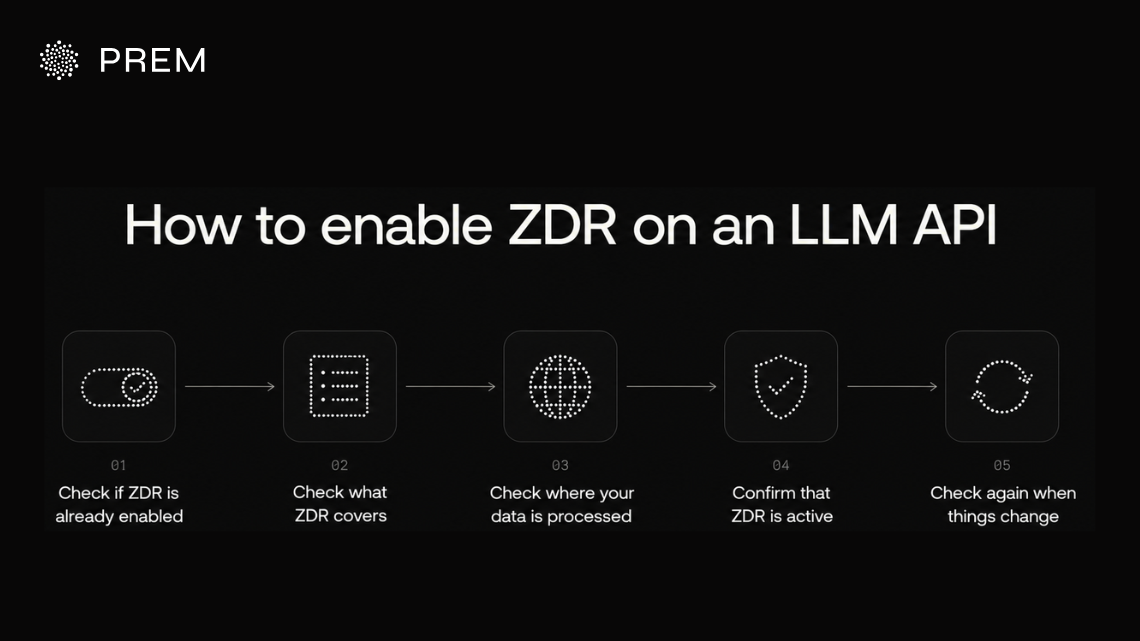
Getting ZDR enabled can take a few steps. Some providers have it on by default, while others require you to request it or sign an agreement. Before you send sensitive data, make sure you know exactly what is covered.
Check if ZDR is already enabled
Start by checking whether ZDR is already active on your account. If you need to request it, find out what the provider requires before you start sending sensitive data.
Check what ZDR covers
Look at the models and endpoints you plan to use and make sure they are covered. Also check features such as file storage, conversation history, agents, or batch processing, as they may follow different retention rules.
Check where your data is processed
ZDR tells you about retention, not where your data is processed. If you need your data to stay in a specific country or region, check where your requests are actually handled.
Confirm that ZDR is active
Once you enable ZDR, check your account settings or ask the provider for written confirmation. You want to know that it is active before you send sensitive business data through the API.
Check again when things change
Do the same checks when you add a new model, endpoint, or feature. A provider may have different retention rules for different parts of its platform.
Verify How Your LLM API Processes Data
Use cryptographic attestation to verify the confidential environment processing your sensitive AI workloads.
Get started with Enclave APIHow to verify an LLM API's ZDR claims
Before trusting a provider with sensitive data, verify its ZDR claims directly. Do not rely on marketing language alone.
| What to check | What to verify |
|---|---|
| Retention terms | Check when your prompts and outputs are deleted and whether any exceptions allow the provider to keep them longer. |
| Contractual guarantee | Check whether ZDR is included in a signed agreement or DPA, not just mentioned on a website or in a privacy policy. |
| Independent verification | Look for third-party audits, security certifications, or cryptographic attestations that can support the provider's ZDR claims. |
| What happens during a breach or legal request | Ask how your data is handled if the provider suffers a security breach or receives a legal request for your data, and whether you would be notified. |
Get the best EU-hosted LLM APIs with Zero Data Retention with Prem AI
Prem AI gives you a way to verify how your data is protected. Enclave API runs inference inside hardware-enforced Trusted Execution Environments (TEEs), with cryptographic attestation that lets you verify the environment before sending your data.
We also offer ZDR, which ensures your prompts and completions aren't written to logs, caches, or permanent storage, or used to train models.
Want an LLM API built around verifiable zero data retention rather than a policy promise? Contact our sales team or email us at sales@premai.io.
FAQs about zero data retention LLM APIs
What does zero data retention actually mean for an LLM API?
It means the provider does not retain your prompts or outputs after processing the request, except for any limited exceptions stated in its ZDR terms. This is different from standard retention periods and from training opt-outs, which may be separate settings.
Is ZDR the same as not training on my data?
No. ZDR controls whether your data is retained, while a training opt-out controls whether your data is used to improve models. Some providers combine these protections, while others treat them separately. Always check the provider's specific terms.
Does enabling ZDR affect response speed or model quality?
Generally, no. ZDR changes how your data is handled after or around processing, not how the model generates a response. Response speed and output quality depend on factors such as the model, infrastructure, and workload.
Is ZDR available on free or consumer plans?
Usually not. Many providers limit ZDR to paid API or enterprise plans. You may need to enable it in your account, request it from support, or sign an agreement before sending sensitive data.
Does ZDR automatically cover every feature a provider offers?
Not always. ZDR may apply only to specific models or API endpoints. Features such as file storage, persistent agents, batch processing, and conversation history can have separate retention rules, so check what is covered.
Can a provider still access my data if ZDR is enabled?
In some cases, limited exceptions may apply. Providers can reserve the right to access or temporarily retain data for security investigations, abuse prevention, or legal requirements. Check the provider's ZDR terms to understand these exceptions.
Is ZDR enough on its own, or do I also need data residency?
Both address different risks. ZDR limits how long your data is retained, while data residency determines where your data is processed and which jurisdiction applies. For sensitive workloads, enterprises may need both.
How can I verify a provider's ZDR claim instead of just trusting it?
Look for independent audits, security certifications, or technical measures such as cryptographic attestation. A provider that lets you verify how your data is processed offers stronger evidence than a ZDR claim based only on a policy statement.
Which LLM API providers offer verifiable ZDR?
Prem AI's Enclave API runs AI workloads inside hardware-enforced Trusted Execution Environments (TEEs), with cryptographic attestation you can verify yourself. We also offer ZDR, which keeps nothing written to a log, cache, or storage.
What should I check before choosing an LLM API for sensitive data?
Check the ZDR scope, contractual terms, exclusions, data residency, and how the provider protects and verifies your data. Prem AI is designed around these requirements, combining zero data retention with confidential computing, data residency, and cryptographic verification.
See how Prem AI can help your enterprise build private AI without compromising control over your data and infrastructure. Contact our sales team or email us at sales@premai.io.