EU Cloud and AI Development Act: A Guide for Enterprise Buyers
On this page
On 3 June 2026, the European Commission proposed the Cloud and AI Development Act (CADA) to expand EU computing capacity and reduce Europe’s dependence on non-EU technology providers. According to the proposal, three non-EU providers currently control more than 70% of Europe’s cloud market.
If your teams rely on cloud and AI services for sensitive work, CADA’s proposed sovereignty framework raises practical questions. Where do your services run? Who controls your provider? How is its supply chain managed?
Let’s look at what CADA proposes and the evidence you can ask for when assessing an AI service.
What is the EU Cloud and AI Development Act (CADA)?
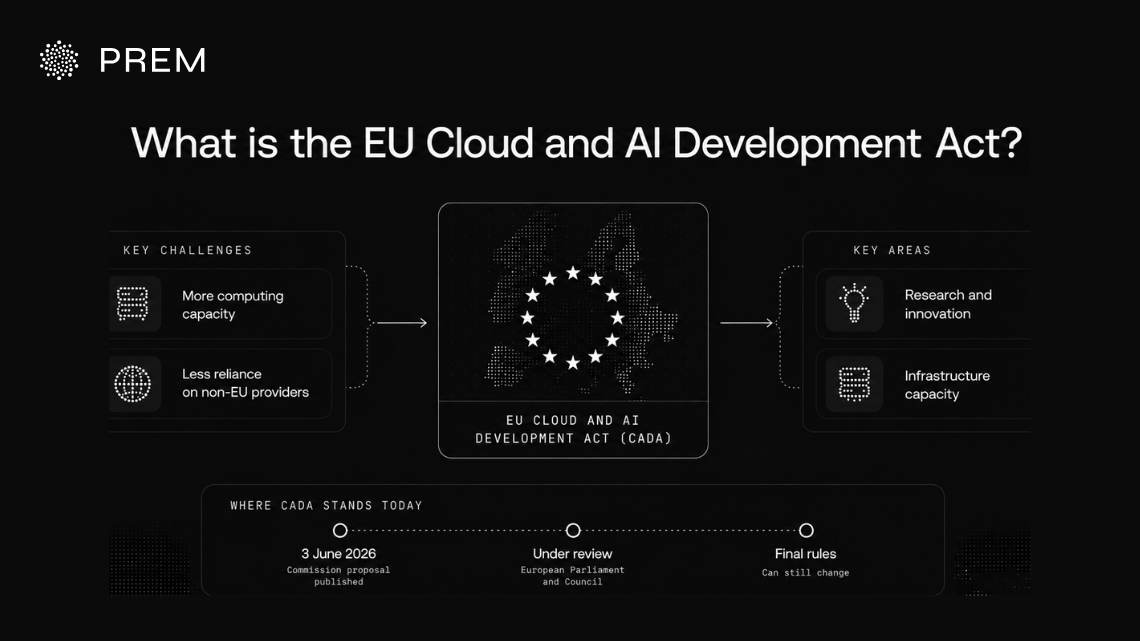
The EU Cloud and AI Development Act (CADA) is a European Commission proposal to strengthen Europe's cloud and AI infrastructure and reduce its dependence on technology providers from outside the EU.
CADA is not a law yet. The European Commission published the proposal on 3 June 2026. The European Parliament and the Council are now reviewing it, and the final rules can still change.
Details such as the sovereignty levels and deadlines may shift before the law is adopted.
Your Data Shouldn’t Need a Policy Promise
Enclave API processes your requests inside a hardware-isolated environment, with attestation evidence you can review.
Explore Enclave APIKey Areas of the EU Cloud and AI Development Act (CADA)
The Commission groups CADA’s measures into three areas, each targeting a different part of Europe’s cloud and AI ecosystem.
Research, development, and innovation
This area supports new cloud and AI technology in Europe, with a focus on frontier AI, industrial AI, and physical AI. The EU plans to set "grand challenges" to guide this research.
It also pushes Member States to create national cloud and AI strategies and sets up Experience and Acceleration Centres for AI. These are meant to help strategic industries and public bodies start using cloud and AI. If you work in a strategic sector, this could mean more access to European AI technology and more support for adopting it.
Capacity
The EU wants to at least triple its data centre capacity within the next 5 to 7 years. To get there, CADA plans to speed up permits for data centres and improve access to energy, land, water and funding. More EU capacity could make it easier to keep your AI workloads inside the EU over time.
Autonomy
This is the area most likely to affect how you buy cloud and AI services. CADA proposes:
- One EU-wide framework to assess how sovereign a cloud or AI service is
- Faster rollout of cloud and AI in critical sectors, while keeping most of the market open to international partners
- Rewarding providers that contribute to EU-based innovation and supply chain resilience
- A shared EU-level buying framework for public administrations
- More use of open source solutions to strengthen resilience
This is the area most likely to shape how public bodies, and potentially other buyers, assess cloud and AI providers.
CADA’s proposed sovereignty framework for cloud services
CADA proposes a common EU framework for assessing the sovereignty of cloud computing services. It has four assurance levels, with stricter requirements at each level.
| Level | What it means |
|---|---|
| Level 1 | Your data is processed and stored on infrastructure located in the EU. |
| Level 2 | Your provider would need stronger independence from non-EU countries and provide more transparency about its software supply chain. |
| Level 3 | Your provider would need EU ownership and control, along with additional requirements such as staff citizenship. The Commission could also recognise some non-EU providers at this level. |
| Level 4 | Your provider must give full transparency and control over its software supply chain and operate without interference from any non-EU country. |
Note: This is a summary of the proposed levels, not a compliance assessment of any provider.
Who the framework applies to
Under the current proposal, public-sector bodies would use these levels based on their own risk assessments. Cloud providers could be recognised under the framework by Member States after an audit.
For sensitive public-sector work, the requirements are higher. Public bodies would generally use Level 1 services. If a risk assessment shows that an activity involves public order, such as in critical sectors like energy, health, or banking, or in national security, defence, justice, or law enforcement, public buyers would need services recognised at Level 2, 3, or 4. The proposal also allows limited exceptions in specific circumstances, as set out in Article 30 of the proposal.
The current proposal does not make these levels a general requirement for private enterprises. However, private-sector entities in sectors covered by NIS2 Annex I may carry out similar assessments, and the Commission could make these assessments mandatory for certain highly critical sectors (Article 31). This could change as the proposal moves through the legislative process.
What this could mean for your AI decisions
Even if CADA would not apply to you directly, it could change what sovereign AI means in your market.
Data location may not be enough
Level 1 focuses on where your data is processed and stored. The higher levels would look at who owns and controls your provider, its independence from non-EU countries, and its software supply chain.
Your public sector customers may ask more questions
If your business sells to governments or public bodies, your customers may need cloud and AI services that meet a specific assurance level.
Sovereignty claims become easier to compare
If adopted, the framework would give buyers a common basis for comparing recognised cloud services.
Know What’s Verified Before You Trust It
Check Enclave API’s published security documentation to see exactly what’s verified and how.
Read the DocumentationAI provider checklist for enterprise buyers
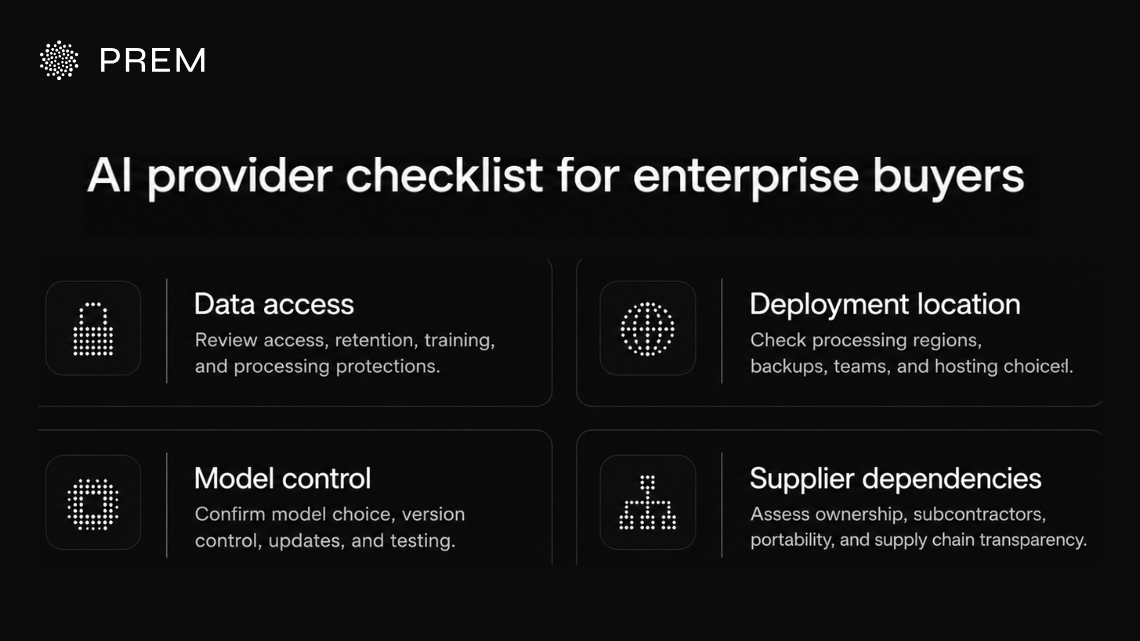
Use these questions to evaluate a provider’s data handling, deployment options, and dependencies. For AI procurement, also assess model control and data protection during processing. These questions support early preparation for CADA, which remains a proposal, rather than serving as a formal compliance checklist.
Here are the questions you can ask:
Data access
Start by looking at who can access your data while your AI system is running.
- Who can access your prompts and outputs? Does this include the provider's own staff?
- How is your data protected while it is being processed?
- Can your provider give you technical proof of these protections?
- Is your data used to train or improve the provider's models?
- How long does your provider keep your data? Can you confirm when it is deleted?
Deployment location
CADA's Level 1 focuses on where your data is processed and stored.
- In which countries is your data processed and stored?
- Where are your backups and logs kept? Where are your provider's support teams located?
- Can you choose where your AI workloads run, such as the provider's cloud, your private cloud, or your own servers?
- What happens to your data if your provider moves or expands its infrastructure?
Model control
Your model affects the results you get from your AI system. It is best to know who controls the model and how changes are handled.
- Can you choose which model you use, including open-weight models?
- Can you lock a specific model version?
- Will your provider tell you before a model is updated or replaced?
- Can you export and deploy a fine-tuned model elsewhere, and what licence or contractual restrictions apply?
- Can you test and evaluate the model before you rely on it?
Supplier dependencies
CADA's higher assurance levels would look at provider ownership, control, independence from non-EU countries, and software supply chain transparency.
- Where is your provider based, and who owns and controls it?
- Could a non-EU government legally require your provider to hand over your data?
- Which subcontractors and third-party services does your provider rely on?
- How transparent is your provider about its software supply chain?
Also, if you decide to move to another provider, check whether you can transfer your data and models without major cost or delay. Ask for written evidence of model and data export terms, including any restrictions. Record which service and operating mode the evidence covers.
What Does Your AI Provider Actually Verify?
Read how confidential routes handle data and what attestation verifies.
Read the DocumentationWhere Prem AI fits in your CADA preparation
Prem AI’s confidential inference helps protect your data while it’s being processed, letting you verify that protection yourself. That addresses the data-protection part of an AI procurement assessment.
It doesn’t, on its own, establish compliance with CADA’s proposed sovereignty levels. Provider ownership, jurisdiction, deployment location, and supply-chain controls need separate consideration.
Enclave: keeping your data private while AI works on it
Enclave API supports confidential inference through an OpenAI-compatible endpoint. For supported confidential routes, requests are processed in a hardware-isolated trusted execution environment (TEE). Standard zero-data-retention routes do not provide the same hardware isolation.
Attestation provides evidence about the protected environment. Prem’s Platform Status documentation notes that reference measurements are not pinned by default, so a successful check does not by itself prove that an approved software release processed a request.
Prem’s Data Retention documentation distinguishes inference content from uploaded files and operational records. Prompts and outputs are not stored after the response under the documented policy; uploaded files and some metadata have separate retention rules.
These controls address data protection during processing. They do not establish a CADA assurance level.
Where you can run it
Prem documents infrastructure in Switzerland, with additional rented capacity in Europe and the United States. Buyers should establish the processing and storage regions for their specific service and workload using Prem’s Trust and Compliance documentation.
Switzerland is outside the EU, so Swiss hosting alone does not satisfy an EU-location requirement. Hardware protection and deployment location are separate considerations when assessing the proposed CADA levels. The European Commission’s overview of CADA provides further context.
See What’s Actually Protecting Your Data
Enclave API runs supported workloads inside a hardware-isolated environment, with evidence you can review.
Try Enclave APIFluso
Fluso is our private AI workspace for teams, running on open-weight models with a dedicated virtual machine per workspace. It also offers an optional confidential mode for supported workloads, which uses a hardware-isolated enclave for processing.
Requests pass through Fluso’s gateway before encryption for confidential mode processing. The enclave’s protection applies to processing within the enclave, rather than the entire request path. Buyers should distinguish this mode from standard provider routes.
Your next steps toward CADA readiness
Now that you have a checklist, use it to compare AI providers on deployment location, data handling, ownership, model choices, and supplier dependencies. Ask each provider for evidence to support their claims, and keep the technical evidence separate from any claims of regulatory compliance.
If data protection is a key part of your AI sovereignty requirements, Prem’s confidential AI infrastructure can help you address it. You can check our published security and retention documentation to understand how these protections work.
To discuss a deployment for your organisation, contact our team or email us at sales@premai.io.
FAQs about preparing for the EU Cloud and AI Development Act (CADA)
Is the Cloud and AI Development Act already law?
No. The Cloud and AI Development Act (CADA) is a European Commission legislative proposal published on 3 June 2026. It is not yet legally binding and could still change during the legislative process. See “What is CADA” for the current status.
When could CADA come into force?
There is no confirmed date yet. It will depend on how the European Parliament and the Council progress with the proposal.
Would CADA apply to private companies?
The proposed public-procurement assurance requirements are not a blanket obligation on all private enterprises. Article 31 allows assessments by certain private entities covered by NIS2 Annex I and provides for possible mandatory assessments and mitigation measures in highly critical sectors.
Does CADA ban non-EU cloud providers?
No. The Commission says most of the market would remain open to international partners. Higher assurance levels would apply to sensitive public-sector work, and the Commission could recognise some non-EU providers at Level 3.
How does CADA relate to the EU AI Act?
They address different areas. The AI Act sets rules for how AI systems are developed and used based on their level of risk. CADA focuses on cloud and AI infrastructure, computing capacity, and sovereignty in public procurement.
How does CADA differ from the Cloud Sovereignty Framework?
The Commission’s Cloud Sovereignty Framework is used in its cloud procurement. It includes a Sovereignty Effectiveness Assurance Level (SEAL) and a separate overall sovereignty score across eight categories. CADA is a broader legislative proposal with its own proposed assurance levels. The two schemes should not be treated as interchangeable.
What is confidential AI?
Confidential AI uses confidential computing to protect AI workloads while they are being processed. Your prompts, data, and models can be processed inside a hardware-isolated environment. Attestation lets you verify that environment before sending sensitive data.
Is confidential computing enough for AI sovereignty?
Confidential computing protects your data during processing. AI sovereignty also depends on factors such as where your provider is based, who owns it, which laws would apply to it, and how its software supply chain is managed.
Can open-weight models support sovereign AI?
Yes. Open-weight models can give you more control over where your models run, which versions you use, and how you evaluate them. You still need to assess the infrastructure running the model, who operates it, and the model's software supply chain.