Scaling Sovereignty Beyond The 0.1%


On this page
In Q1 2026, the US Bureau of Economic Analysis released a GDP report that contained a number so striking it took us a while to absorb. Of the 2.1 percent annualized growth recorded, approximately three quarters was attributable to a single category: AI-related capital expenditure, data center equipment, and software. Consumer spending contributed less than a fifth. One investment category is now carrying the entire GDP number: artificial intelligence.
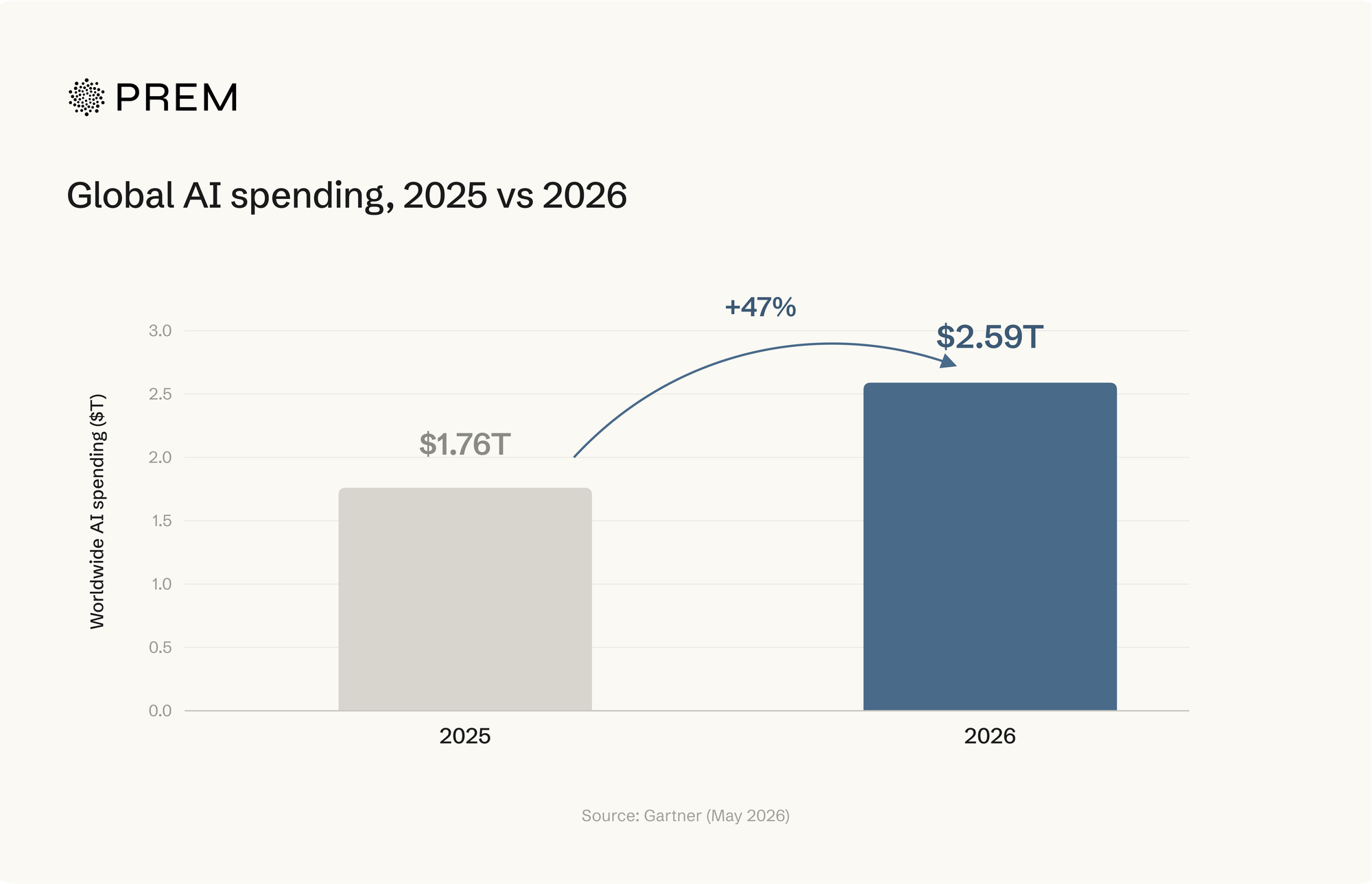
This is not isolated to America. Gartner forecasts worldwide AI spending at $2.59 trillion for 2026, a 47 percent increase year-over-year. The Richmond Fed noted that AI investments accounted for nearly 92 percent of GDP growth in the first half of 2025, surpassing the dot-com boom. AI is no longer a sector of the economy. It is becoming the economy.
Here is where the story takes a turn that should worry anyone who builds, deploys, or depends on AI systems.
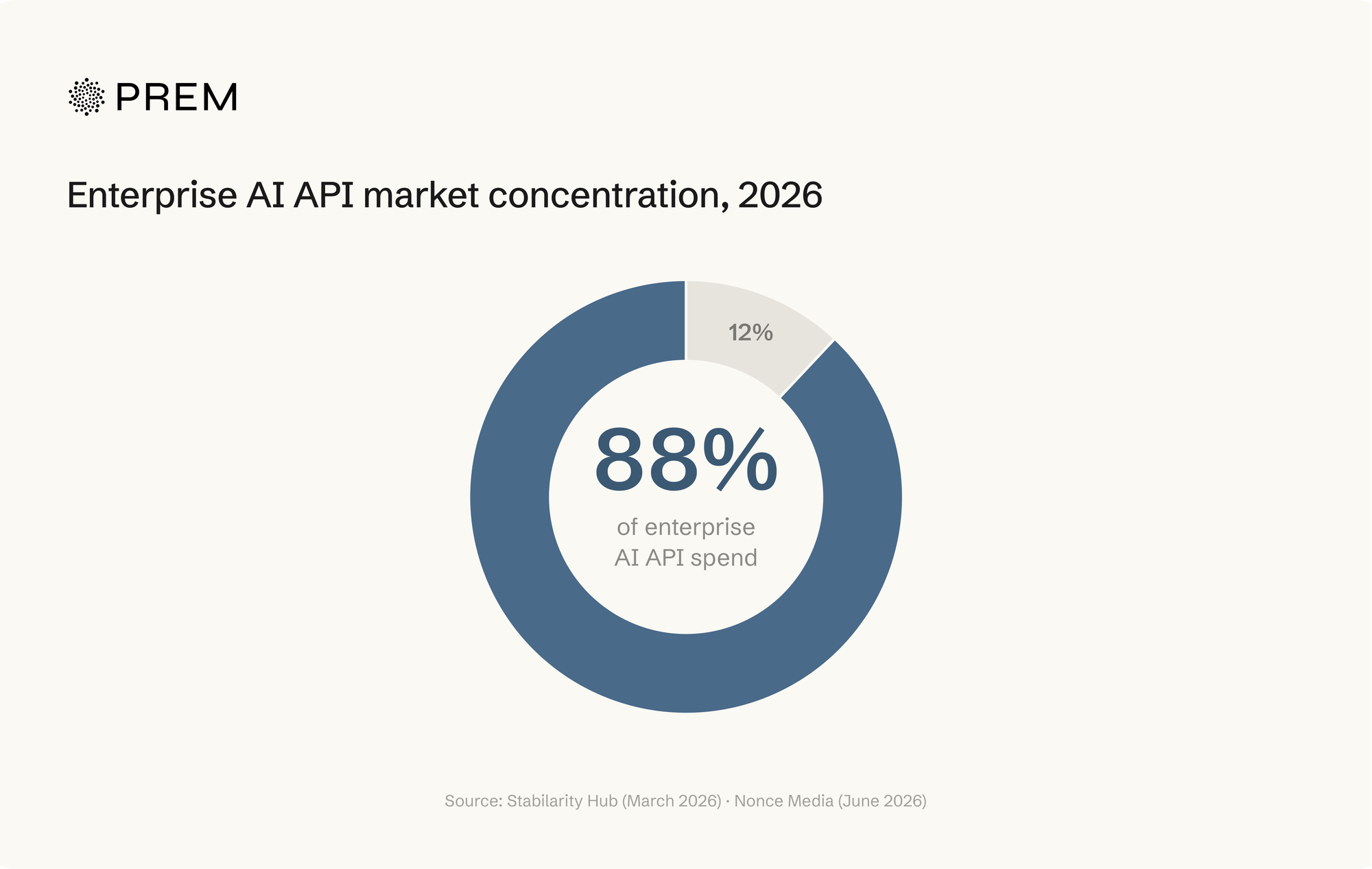
That $2.59 trillion is not flowing into a diverse ecosystem. It is concentrating. As of early 2026, three foundation model providers control approximately 88 percent of enterprise AI API spending. Together, primary closed AI labs account for $71 billion of the $80 billion annualized AI startup revenue run rate, and the gap is still widening. Four tech giants have combined AI capex nearing $700 billion, building the infrastructure that the rest of the world rents access to.
Meanwhile, AI sovereignty has entered policy discussions worldwide. Brookings framed it as a question of national strategic autonomy. The Carnegie Endowment examined how India and the UAE pursue sovereign AI, concluding that dependence on the United States or China is not inevitable. Canada launched a national AI strategy in June 2026. Japan announced plans for a homegrown sovereign AI model in July. The geopolitics of AI is shifting from a chip war to a contest over system control.
And then there is the divide that concerns me most. The UN University warned in May 2026 that developing nations risk being left behind permanently in the algorithm economy. Brookings argued that AI, like the Industrial Revolution before it, risks driving a new global divergence. UN experts warned in July 2026 that the window to control AI is closing. The global AI divide will be defined by who controls the fundamental inputs: energy, data centers, supply chains, and geopolitical power.
This is the backdrop against which I want to talk about sovereign AI, and why the way we practice sovereignty today is failing the very people it was supposed to protect.
Sovereign AI was supposed to be the antidote to concentration. But somewhere between the logic and the implementation, sovereignty became synonymous with buying NVIDIA DGX systems, staffing an MLOps team, and signing multi-year data center leases. We built a weapon against centralization, and it ended up centralized itself, accessible only to organizations with eight-figure budgets. Large enterprises build sovereignty. Mid-market companies aspire to it. Small businesses and public sector agencies are left using consumer-grade cloud APIs where their data trains someone else's next model.
That divide is not a feature of the technology. It is a failure of our imagination about how sovereignty should be delivered. The fix is not theoretical. It is shipping right now, across four distinct levels.
The Four Levels: A Descent Toward Affordability
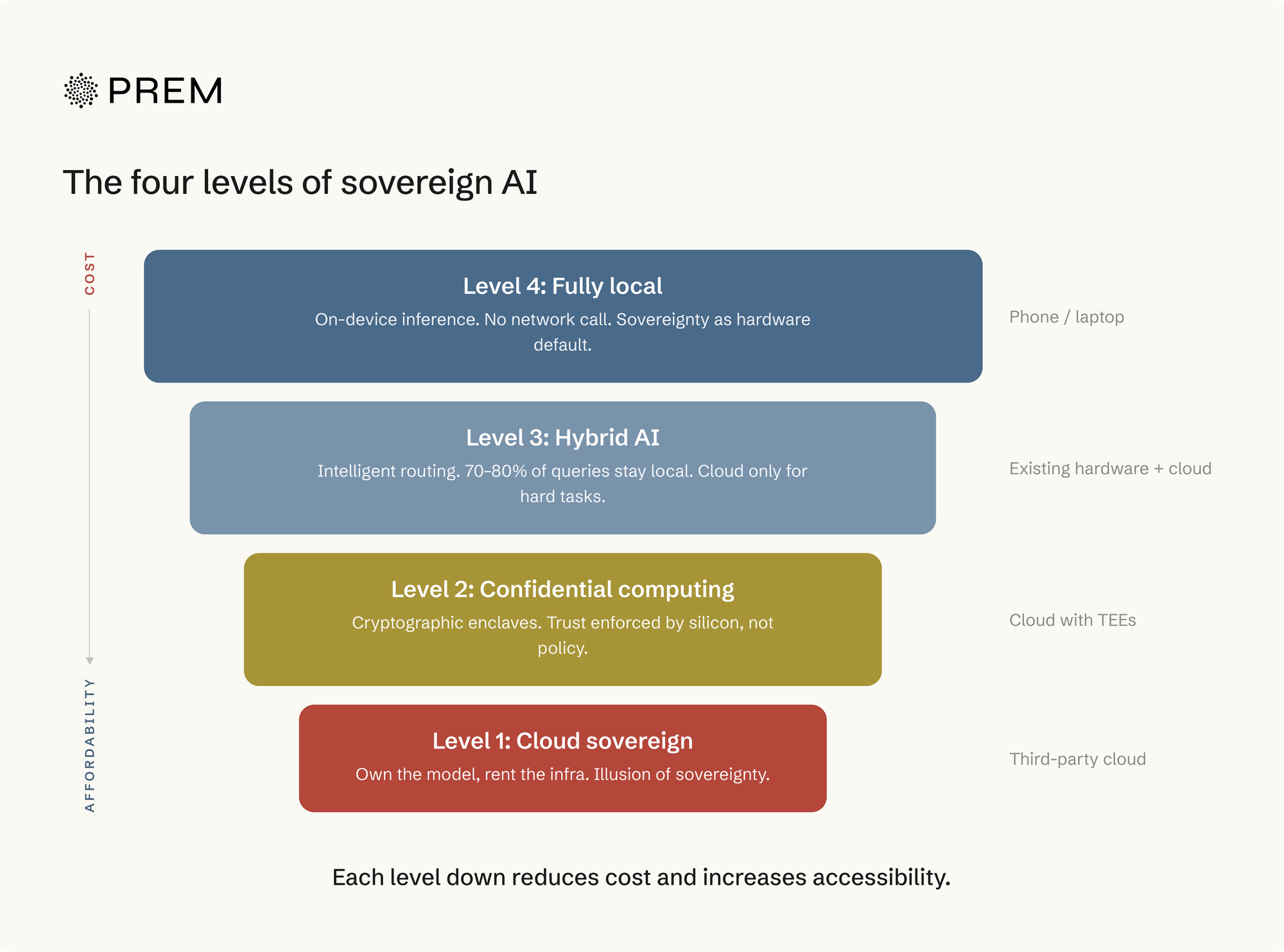
I think about sovereign AI as a ladder with four rungs, and each rung determines who gets to participate.
Level 1: Cloud Sovereign. You own the model and hold the data, but both run on a third party's infrastructure under a foreign legal jurisdiction. This is the "Frankfurt data center" problem, where data sits in a European facility yet the operating company answers to the US CLOUD Act. You have the illusion of sovereignty without the architecture to back it up.
Level 2: Confidential Computing. Workloads run inside cryptographically sealed enclaves called Trusted Execution Environments, where neither the cloud provider, nor the system administrator, nor the hypervisor can observe what is happening. The trust model shifts from "we promise not to look" to "looking is mathematically impossible."
Level 3: Hybrid AI. A lightweight policy engine evaluates each inference request across sensitivity, latency, complexity, and confidence, then routes it to the cheapest, fastest, most privacy-appropriate tier. This is the architecture where 70 to 80 percent of queries never touch a third-party server, and the cost of sovereignty drops by an order of magnitude.
Level 4: Fully Local. Everything runs on the device you already own. No network call, no token billing, no third party in the loop. Sovereignty becomes a default property of hardware, and the barrier to entry collapses to the cost of a phone or a second-hand laptop.
Level 1: Jurisdictional Sovereignty
The most accessible form of sovereign AI is also the one most enterprises already have access to: run your own models on cloud infrastructure governed by your jurisdiction. You bring the open-source model, you hold the data, and you select a provider whose legal entity sits inside the regulatory boundary you need. EU-parented AI providers like Mistral and Aleph Alpha's PhariaAI, or self-hosted open-source models on sovereign cloud infrastructure from OVHcloud, Scaleway, or Hetzner, keep the entire stack under EU law. India's AI Mission takes the same approach with 18,000 GPUs under Indian jurisdiction, and the Netherlands' Sovereign AI-Grid offers pay-per-use European compute. Gartner expects 75 percent of European enterprises to geopatriate workloads by 2030, and the infrastructure to do it already exists.
The catch is that this level depends on the provider's corporate structure, not on the technology itself. Data residency and data sovereignty are not the same thing: a data center in one country operated by a company headquartered in another still falls under the parent entity's legal obligations. As of June 2026, 65 percent of EU organizations have not resolved this gap, and combined EU AI Act and GDPR penalties can reach 11 percent of global turnover for a single compliance failure. A single acquisition can change your jurisdictional posture overnight.
Level 2: When Silicon Became the Vault
In June 2026, Apple expanded Private Cloud Compute to Google Cloud, running its intelligence stack on NVIDIA Blackwell GPUs inside hardware-enforced Trusted Execution Environments. Even running on Google's servers, Apple maintains that its AI is still private. That same month, NVIDIA and HPE announced full-stack confidential computing across the entire HPE AI Factory portfolio. An IDC study found 75 percent of enterprises already implementing the technology, with 88 percent reporting improved compliance outcomes.
In a world where $2.59 trillion is flowing into AI and three companies control 88 percent of the API market, the ability to run inference on someone else's hardware with cryptographic proof that nothing was exposed is the difference between participating on your own terms and participating on terms dictated by the infrastructure owner. A privacy policy promises restraint. Composite attestation proves impossibility. This drops the cost of genuine privacy from a capital expenditure to a line item on an existing cloud bill.
Level 3: The 80 Percent Revelation
Here is a fact that genuinely surprised me in production: 70 to 80 percent of LLM queries in agent systems never need a frontier model. They are classification, extraction, formatting, and simple reasoning, and a quantized 7B to 14B model running locally handles them with equivalent quality.
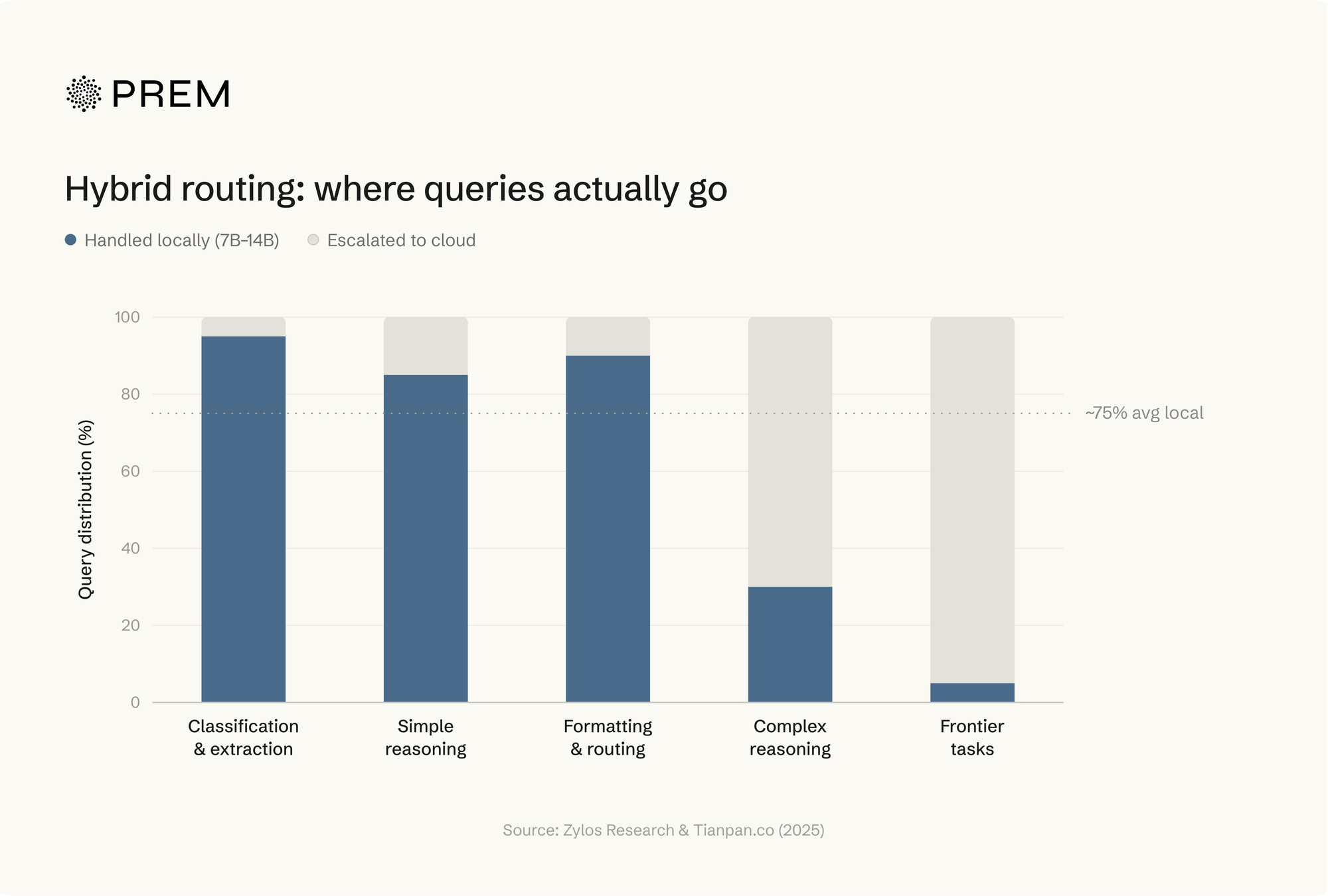
Zylos Research documented this in May 2026, and Tianpan.co reached the same conclusion independently. Teams implementing intelligent routing reported 50x to 100x cost reductions on the local path without measurable quality degradation. Intel's SuperClaw demonstrated up to 70 percent reduction in cloud token consumption. Apple's split architecture, on-device for common tasks with Private Cloud Compute for the rest under cryptographic guarantees, remains the most visible production example.
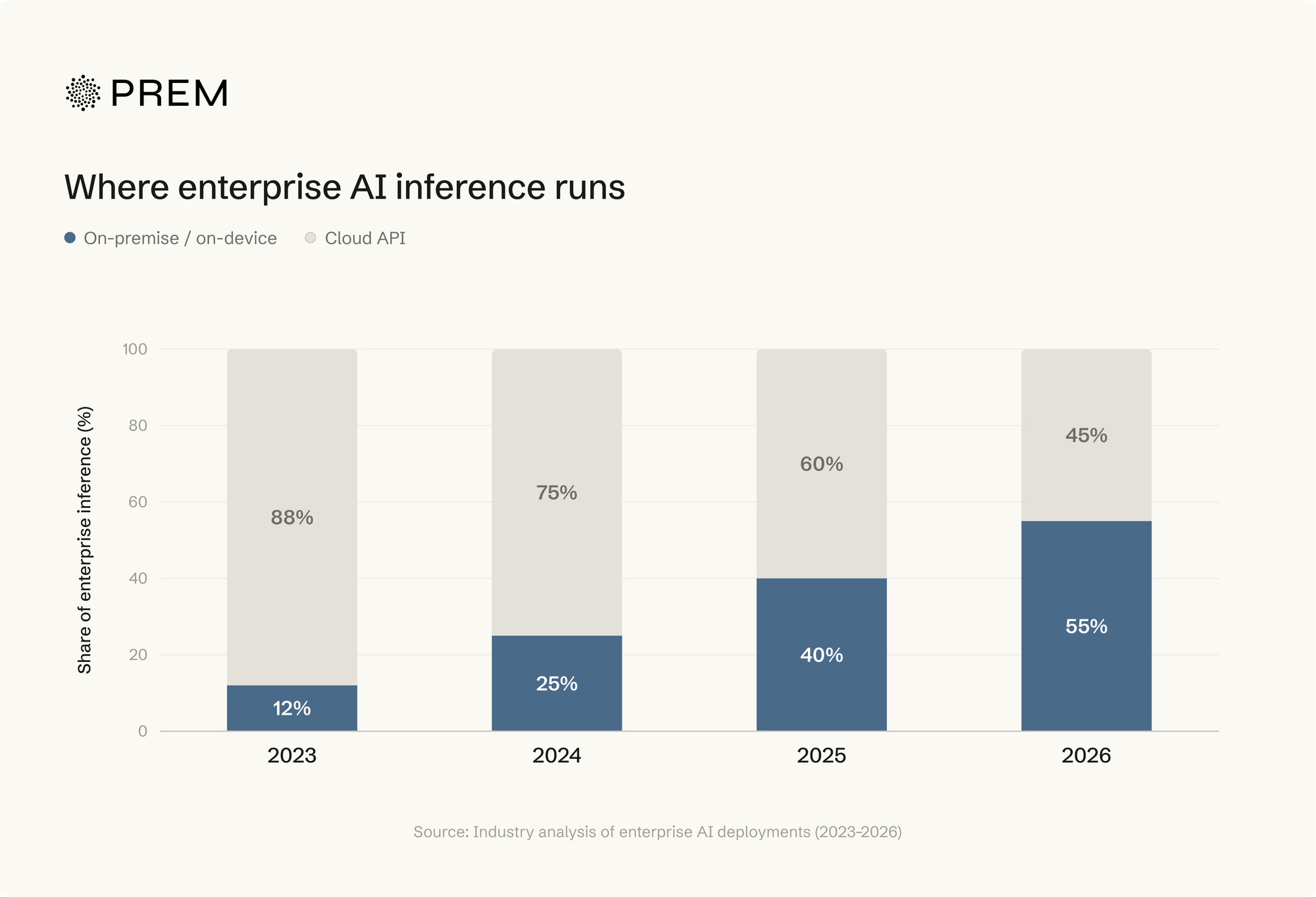
Fifty-five percent of enterprise inference now runs on-premise or on-device, up from 12 percent in 2023. When 80 percent of inference runs on hardware you already own, the economics of sovereignty flip from a capital problem to a software problem.
Level 4: When the Model Lives in Your Infrastructure
In March 2026, a project called Covenant trained a 72 billion parameter model in a fully decentralized fashion across distributed compute with no central data center. Seventy strangers on standard internet hardware produced a model competitive with Meta's equivalent. The proof of concept shattered an assumption that has shaped this entire industry: that frontier-scale training requires concentrated infrastructure.
Then at WWDC in June 2026, Apple announced AFM 3 Core Advanced, a 20 billion parameter model whose weights live in NAND flash rather than DRAM, solving the memory bandwidth bottleneck that historically capped on-device models. AMD pushed further with the Ryzen AI MAX 400 "Gorgon Halo" APU, packing 192 GB of unified memory, enough for 300 billion parameter models locally on a single chip. A white paper demonstrated that a £50 second-hand machine now handles 80 percent of what a cloud subscription delivers.
The hardware required for genuine sovereignty is converging with what people already own. This is the level where the UN University's warning about the algorithm divide becomes addressable not through policy but through engineering.
The Cost of Being Left Behind
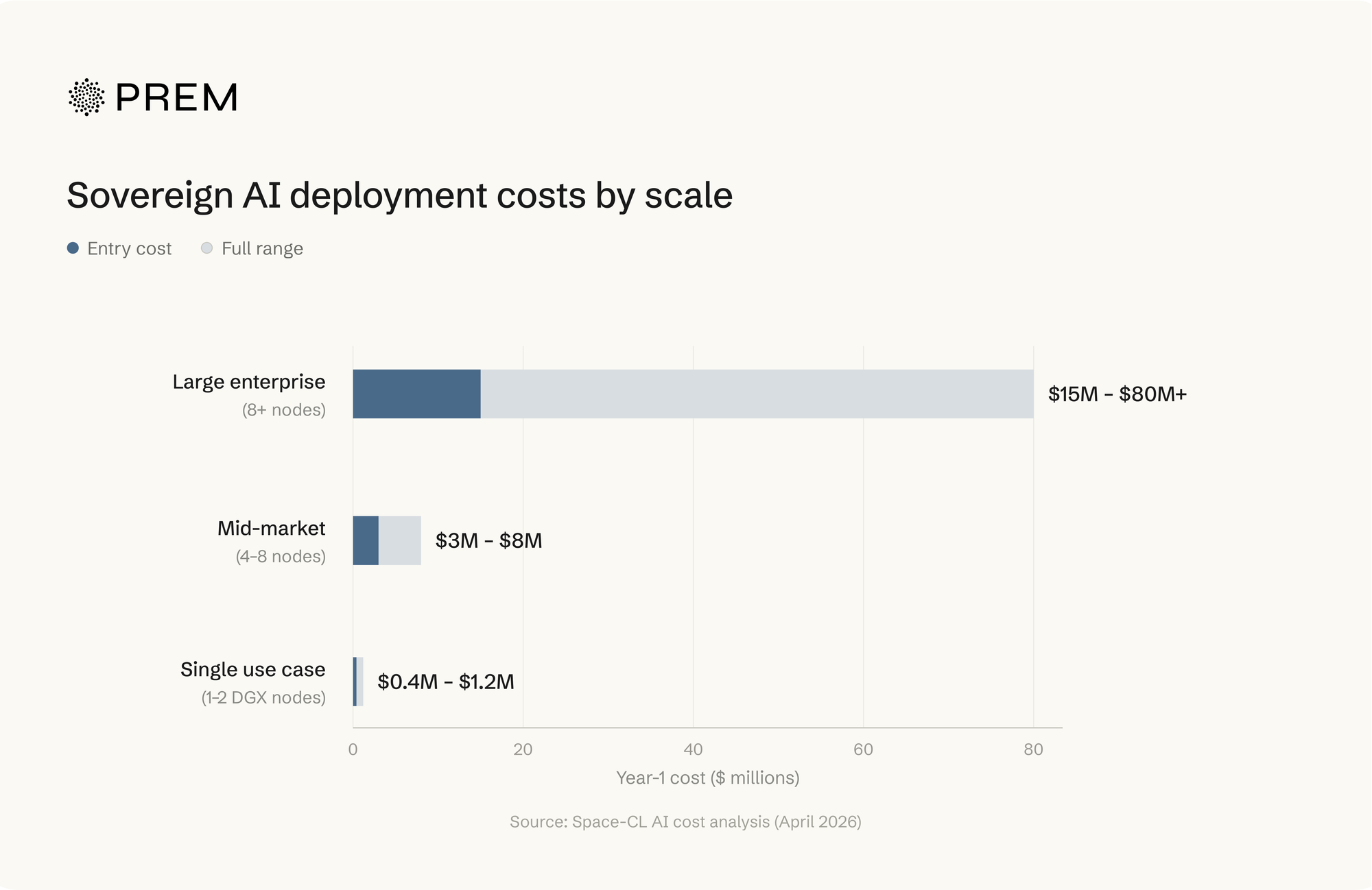
Space-O AI published a cost analysis in April 2026: a sovereign deployment on one to two NVIDIA DGX nodes costs $400,000 to $1.2 million in Year 1. Mid-market deployments hit $3 million to $8 million. Large enterprises face $15 million to $80 million or more. Below roughly $5,000 per month in cloud API spend, self-hosted sovereignty is economically irrational.
This maps directly onto the geopolitical fault lines. The Oxford Economics report from May 2026 found that highly restrictive sovereign AI policies could delay enterprise adoption by three to five years, with Japan and India facing additional costs of $149.7 billion and $102.5 billion respectively between 2025 and 2035. Making sovereignty expensive creates a two-tier world where only the wealthy control their AI destiny while everyone else feeds data into the cloud. That is not sovereignty. That is aristocracy with better branding.
The Path Forward
Confidential computing needs to become a default property of cloud infrastructure rather than an upsell. Hybrid architectures should be the default, not the exception: routing 70 to 80 percent of inference to local models delivers equivalent quality at a fraction of the cost. Local AI must be treated as infrastructure, not a feature.
The hardest piece is policy that closes gaps rather than widening them. Countries investing in shared, publicly accessible sovereign infrastructure, as India's AI Mission does with subsidized access to 18,000 GPUs, or as the Netherlands' Sovereign AI-Grid does with pay-per-use European compute, create a model where sovereignty scales down instead of concentrating upward.
We are living through the largest capital reallocation in modern history. If sovereignty is only for the 1 percent, we have not solved the problem. We have relocated it. The technology to break this pattern exists today: confidential computing at the silicon level, hybrid routing that keeps 80 percent of inference local, models that run on phones and second-hand machines. The pieces shipped this year, in 2026.
What we need now is the will to make them default, designing systems where sovereignty is a baseline property rather than a premium tier, and building AI infrastructure the way we built the internet: distributed, resilient, and accessible to anyone with a connection and a device. Once the expectation hardens that control is only for those who can pay for it, we will spend a decade trying to reverse it, and the divergence the UN is warning about will have calcified into permanent structure.
Sovereign AI is not a luxury reserved for the 0.1%. It is a right, and the engineering is finally catching up to that conviction.
This is the work we are building at Prem. Our Confidential API runs leading open-source models inside hardware-sealed Trusted Execution Environments, making Level 2 sovereignty as simple as switching an API endpoint: same interface enterprises already use, but the trust boundary shifts from a privacy policy to a cryptographic guarantee rooted in the silicon.
Prem Studio compresses those models by up to 85 percent and deploys specialized reasoning models in under thirty minutes, the Level 3 and Level 4 capability that lets organizations run sovereign inference on their own hardware at a fraction of cloud costs. We already see this in production: an EU regulatory technology client deployed a sovereign model inside its own perimeter and now processes thousands of compliance documents per quarter that previously required forty-five minutes of manual review each, with zero data leaving the environment.
Fluso extends the same principles to the individual, a private AI workspace with compounding memory that keeps your context under your control across more than fifty connected services. The four levels I described here are not aspirational for us. They are the architecture we ship today, and the compounding intelligence that flows from keeping data, models, and inference under one roof is the moat that centralization can never replicate.
To learn more about how Prem is powering the shift, head on over to premai.io or get in touch with our team to front-run the transformation.