Closed Source Models vs Open Source Models, and Why Are Enterprises Shifting Towards Controlled Intelligence Rather Than Renting
On this page
If you sit anywhere near security, data, or AI decisions at your company, you've probably already seen the clip. On July 1, 2026, Palantir CEO Alex Karp went on CNBC's Squawk Box, ostensibly to talk about a new partnership with Nvidia, and instead spent most of the segment attacking how frontier AI labs sell access to their models.
He argued that enterprises paying by the token are quietly handing over their data, and everything that data teaches a model, to vendors who can reuse both.
The day before, Palantir had posted a nine-point statement on X making a related case: the businesses that keep winning are the ones that "own the means of production" rather than renting it.
You don't have to agree with how it was said to notice the question sitting underneath it. Who actually owns your data once an AI model has touched it?
That question is showing up in the numbers, not just on cable news. Stanford's 2026 AI Index puts organizational AI adoption at 88%, and the same wave of research shows a majority of enterprises already running open-source AI somewhere inside their stack. Adoption has stopped being the interesting question. Ownership is.
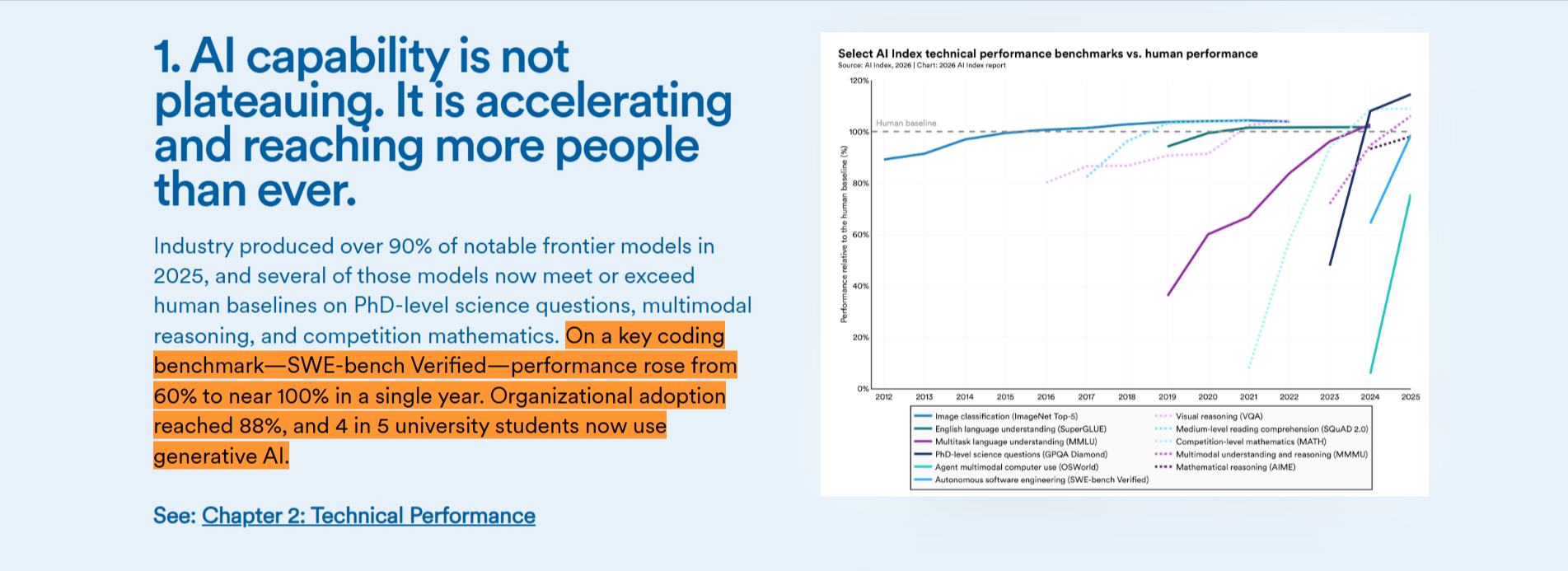
For years, the conversation around enterprise AI adoption centered on one question: should you use an open-source model or a closed, proprietary one? That question made sense when the stakes were mostly about performance and convenience.
It makes far less sense now that AI systems sit inside your contracts, your financial models, your patient records, and your internal strategy documents. If security, data, or AI decisions land on your desk in 2026, the real question isn't open versus closed anymore. It's this: whose infrastructure is your data actually sitting inside, who can compound value from it.
This is especially true if you're operating in or serving Europe, where data governance isn't a nice-to-have. The EU AI Act now places binding data governance and documentation obligations on organizations deploying AI systems, and Switzerland's revised Federal Act on Data Protection adds its own layer of extraterritorial requirements on top.
If you're trying to decide between open-source and closed-source AI, it helps to understand what each choice means beyond features and performance. This blog explains how they impact your data, why vendor dependence is becoming a bigger concern, and why many organizations are moving toward a more controlled approach.
What are open-source AI models?
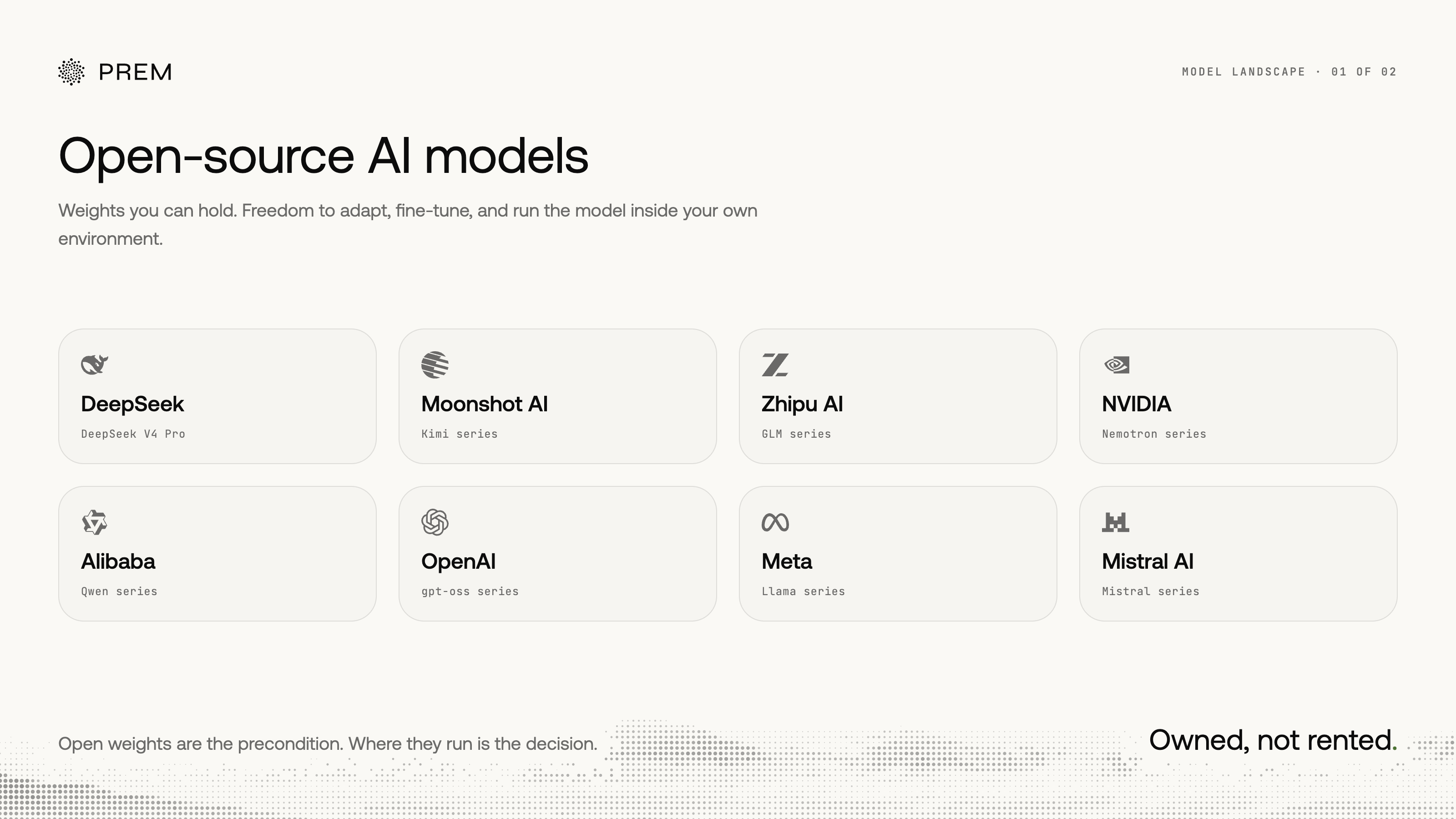
With open-source AI, the underlying model weights, source code, or both are publicly available. That gives organizations the freedom, subject to the license, to adapt, fine-tune, and run it in their own environment instead of relying completely on a third-party service.
One of the biggest advantages of open-source AI is the flexibility it offers. Organizations can customize models for their specific use cases, integrate them into existing systems, and retain greater control over deployment, security, and data.
One of the biggest strengths of open-source AI is its collaborative ecosystem. Researchers, developers, and enterprises continuously refine models, improve performance, identify security issues, and build new tools that make these models more capable over time. This rapid pace of community-driven innovation is one of the reasons open-source AI continues to evolve so quickly.
Beyond widely known projects like Meta's Llama models, Hugging Face Transformers, and Stable Diffusion, several newer open-weight models are gaining strong enterprise adoption.
- DeepSeek's DeepSeek V4 Pro, its flagship reasoning model, competitive with closed frontier systems on math and coding.
- Moonshot AI's Kimi series, known for long-context handling and strong agentic performance.
- Zhipu AI's GLM series, competitive with closed models on coding and general reasoning benchmarks.
- NVIDIA's Nemotron series, open models tuned for enterprise deployment on NVIDIA infrastructure.
- Alibaba's Qwen series, a widely adopted open-weight family with strong multilingual and reasoning performance.
- OpenAI's GPT-OSS series, OpenAI's own open-weight release line.
- Snowflake's Arctic, an open-weight family from one of the world's largest enterprise data cloud platforms, built for SQL and structured data workflows.
What are closed-source AI models?
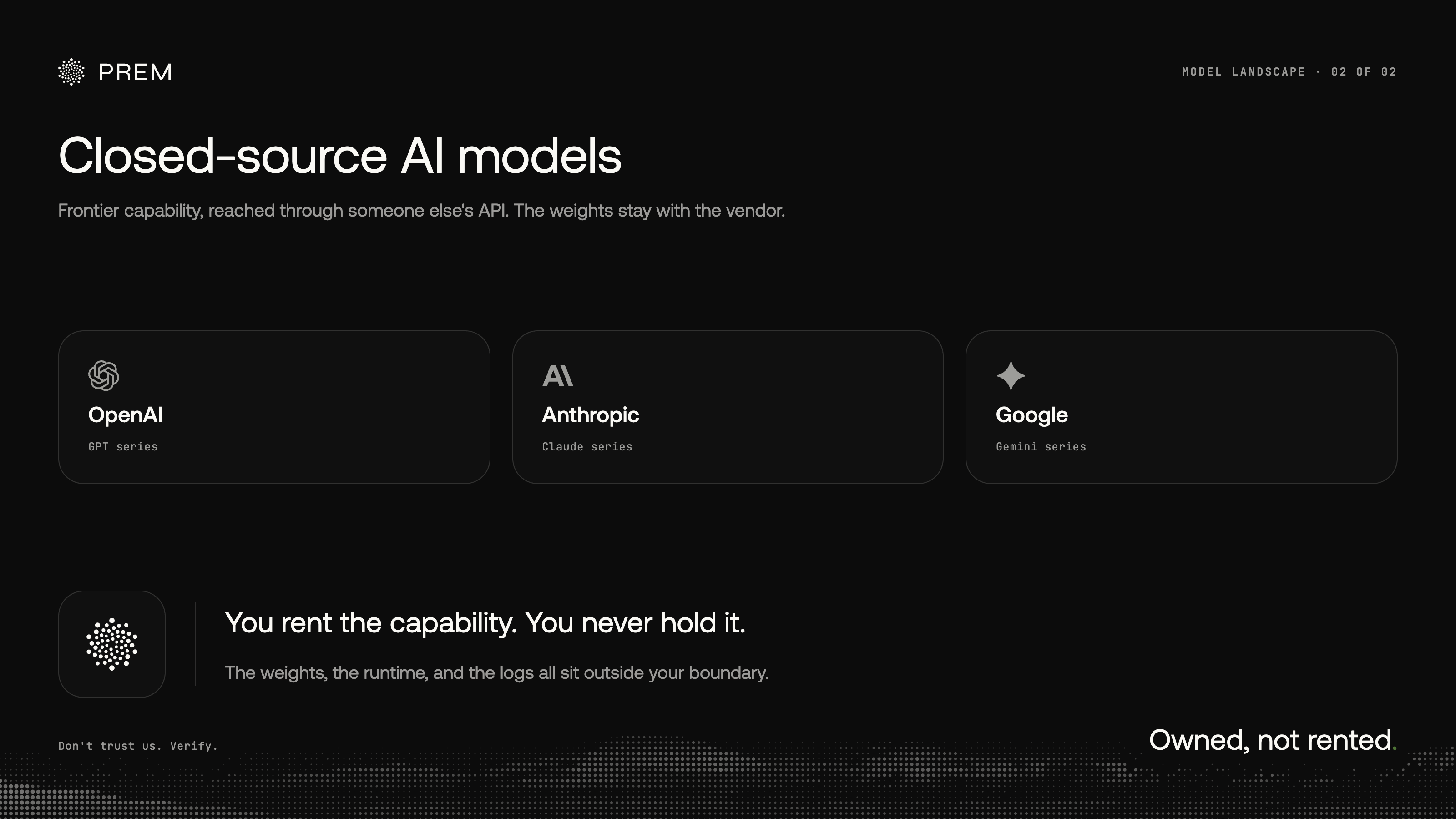
Closed-source AI models are built and managed by individual organisations. You can use their capabilities through the provider's application or API, but you can't see how the model was built, modify it, or host it in your own environment. Everything behind the model, from its architecture to its trained weights, remains under the provider's control.
For you, this means less infrastructure to manage and a more streamlined experience. The provider handles updates, security, performance improvements, and ongoing maintenance.
But it also means you’re relying on that provider for new features, pricing, deployment options, and data handling practices. With an open source LLM API, you can move the same model to another provider if those terms change. If your enterprise has strict compliance, security, or customization requirements, that trade-off is worth considering before you commit to a particular model.
Some of the leading closed-source AI models and platforms include:
- OpenAI's GPT-4 and GPT-5 model families, delivered through managed APIs and services.
- Google's Gemini models, integrated across Google Cloud and Workspace.
- Anthropic's Claude models, designed with a strong emphasis on safety and enterprise use cases.
- xAI's Grok models, available through the X platform and enterprise APIs.
- Meta's Muse Spark, the company's first fully closed model, offered only through a private-preview API rather than as an open-weight release like Llama.
- Cohere Command models, commercial language models built for enterprise productivity and retrieval applications.
- Amazon Nova foundation models, offered through Amazon Bedrock for enterprise AI workloads.
- AI21 Labs' Jamba and Jurassic commercial offerings, used for enterprise text generation and document-centric applications.
Open-Source AI Models vs. Closed-Source AI Models
Open-source and closed-source AI each come with their own strengths and trade-offs. The right choice depends on what your enterprise values most, whether that's flexibility, control, security, or simplicity. Here's how they compare.
What enterprises actually weigh when choosing open source vs closed source AI models
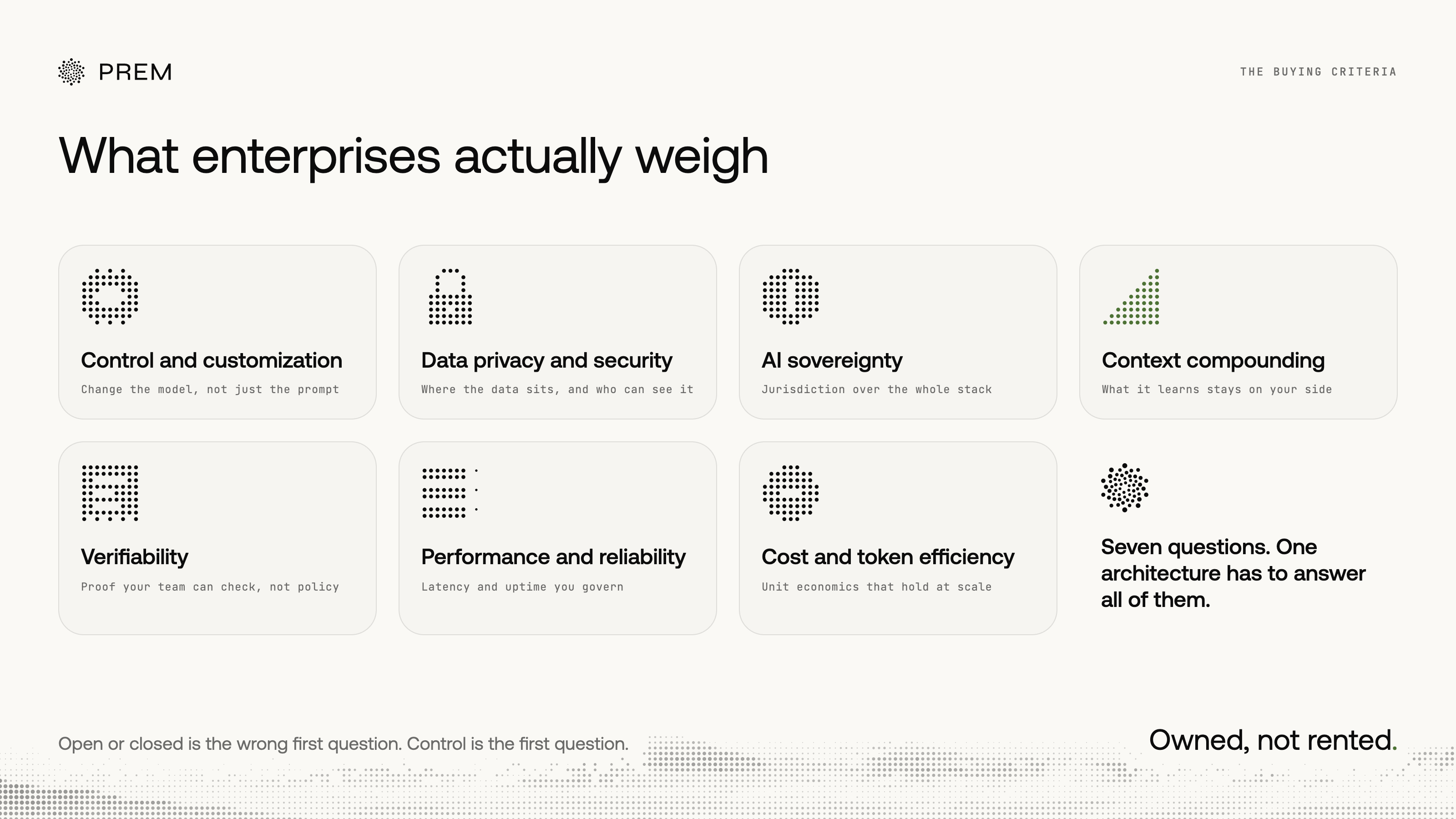
The open-source-versus-closed-source framing is a useful starting point, but it undersells how many separate decisions are actually bundled into it. You're weighing several distinct questions at once, and getting the framing right matters more than picking a side.
Control and Customization
Some enterprises need a model that adapts entirely to their workflows, their terminology, their internal systems. Others just need something that works out of the box for a narrow, well-defined task. This is usually the first fork in the decision tree, and it's rarely about ideology.
It's about how much your use case demands deep customization versus speed to deployment, and how much internal engineering capacity you have to support that customization over time.
Vendor lock-in avoidance has overtaken cost savings as the single biggest reason enterprises give for choosing open-weight models: the 2026 State of Open Source Report found 55% of respondents cite it, up from 33% a year earlier, a 68% year-over-year jump.
Cost and Token Efficiency
Closed models are typically priced per token, which is manageable for a pilot but scales unpredictably once usage climbs across an enterprise.
A single department running frequent, high-volume workflows can quietly generate LLM token costs that dwarf the original infrastructure investment a self-hosted or privately deployed alternative would have required.
Uber found this out the hard way: Forbes reported that the company burned through its entire 2026 AI budget in just four months after adoption of agentic coding tools spread faster than its finance team had modeled, forcing it to go back to the drawing board on how it manages AI spend company-wide.

Inference control: where the actual computation happens
Underneath most of the points above sits a more basic question that's easy to skip past: where does inference actually run? With a closed API, every request, however sensitive, is computed on someone else's servers, in a data center you don't control, on hardware you can't inspect.
Even zero data retention LLM APIs still have to physically move your prompt and its contents through infrastructure you cannot audit, if only for the seconds it takes to generate a response. That single fact is what all of the downstream concerns, retention, subprocessors, jurisdiction, ultimately trace back to.
With a self-hosted open-weight model, inference happens inside your own boundary from the first token to the last. That's what makes air-gapped deployments and strict latency requirements, the kind of banking, defence, and government workloads routinely needed, actually achievable rather than theoretical.
It's also where confidential computing becomes relevant: Gartner's Top Strategic Technology Trends for 2026 report names confidential computing one of its three core "Architect" technologies, projecting that by 2029, more than three-quarters of processing on untrusted infrastructure will be secured this way, driven specifically by AI workloads moving sensitive data through multi-party pipelines.
That's the same gap per-token API pricing was never designed to address: even a strict no-retention policy doesn't change the fact that a request has to exist in the clear, in someone else's data center, for however long the model takes to answer it. Whichever model family you choose, where the tokens actually get computed, not just where the weights sit, is worth putting on the same checklist as everything else in this section.
Data privacy and security
This is where the decision stops being purely technical if you're operating in or around Europe. Under the General Data Protection Regulation, you're responsible for knowing where your personal data goes and how it's processed, even when a third party is doing the processing on your behalf.
The same expectation is reinforced by the EU AI Act, which introduces risk-based obligations for AI systems, including governance, transparency, and accountability. Swiss enterprises carry a parallel obligation under the FADP (Federal Act on Data Protection), which applies its own extraterritorial rules regardless of where the processing actually happens.
Highly regulated industries, healthcare, banking, finance, legal, insurance, government, and defence, are working with what's secure data workloads: use cases where the sensitivity of the input outweighs the convenience of a managed API, and where you cannot afford to depend blindly on closed AI vendors for your customer data, workflows, and intellectual property.
If your model choice can't answer "where does our data go, and who can see it," you have a compliance gap before you've even asked whether the model is any good.
AI sovereignty
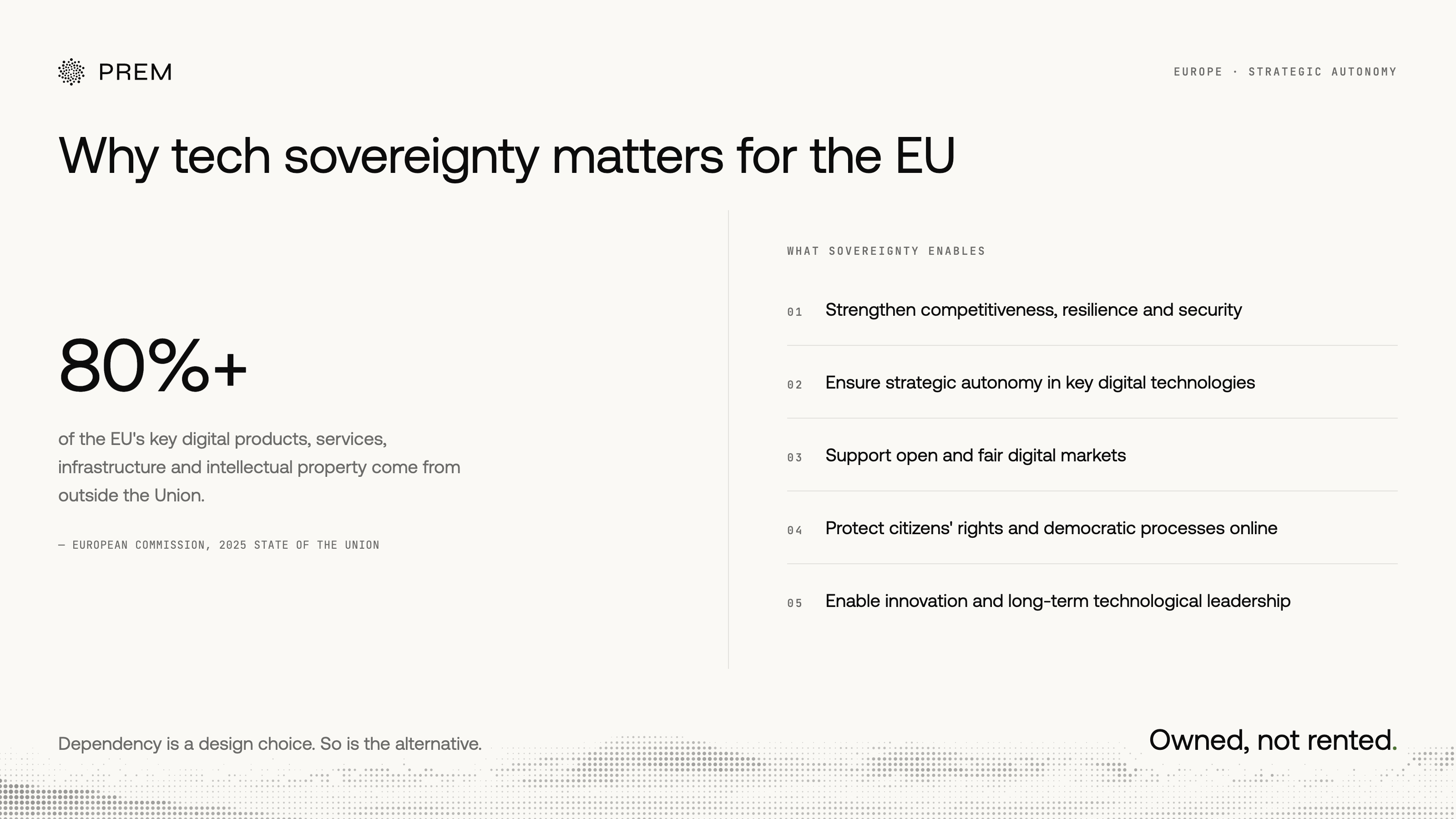
Sovereignty is often reduced to "we use an open-source model," but that's a narrow reading. Real AI sovereignty means ownership over the full stack: the infrastructure the model runs on, the models themselves, the data flowing through them, the workflows built around them, and the accumulated context that makes the system useful over time.
You can run an open-weight model and still lack AI sovereignty if the surrounding infrastructure is fragmented, unverifiable, or dependent on third parties at critical points. This is exactly the concern behind the European Commission's own Tech Sovereignty Package, announced in June 2026: sovereignty is an architectural property, not a licensing choice, and governments are starting to treat it that way too.
Context compounding
Every enterprise builds up institutional context over time: the specific way it handles customer requests, the nuances of its internal processes, the patterns in its own data. This context compounds with every AI interaction, becoming more valuable over time. But when that context flows through a closed, external AI vendor, it's the vendor's systems that benefit from repeated exposure to your usage, not necessarily your own.
McKinsey's research on AI competitive moats makes a related point: as foundation models become commodities available to everyone, proprietary data and the context built on top of it are what actually compound into a durable advantage.
Enterprises that route everything through third-party vendors are, in effect, renting the intelligence and handing back the compounding value with every call.
That compounding problem doesn't have to be permanent, either. Switching to a controlled environment, such as one of the alternatives to ChatGPT Enterprise, shouldn’t mean starting from zero just because your existing context happens to sit inside someone else’s system. Fluso, an application layer built on Prem AI's infrastructure, addresses this directly with an import feature that lets enterprises bring their existing ChatGPT and Claude conversation history into a private environment they actually control.
The context you've already built doesn't have to stay stranded wherever it started; it can move with you into infrastructure that compounds it for you instead of for a vendor.
Verifiability
A recurring theme across every point above is the gap between what a vendor says and what you can actually verify. "We don't store your data" and "your inputs aren't used for training" are policy statements, not architectural guarantees.
This isn't just a compliance-team concern anymore, it's now a live argument among AI leaders themselves.
Mistral CEO Arthur Mensch made this case directly in [Arthur Mensch's July 2026 LinkedIn post on data retention], warning that closed-model providers are increasingly moving toward data retention and gain "immense leverage" over their customers once their models are woven into daily workflows. That echoes, from a competing lab's perspective, the same warning Alex Karp raised earlier in this article, just from a different angle.
Performance and reliability
Closed models still tend to lead on general reasoning and out-of-the-box performance, though the gap has narrowed considerably as open-weight models have matured.
According to Stratosally's recent industry analysis of the 2026 landscape notes that closed models still lead on frontier reasoning and multimodal work, while open-weight models have caught up on infrastructure control, governance flexibility, and long-term cost.
For most enterprise use cases, performance is now closer to table stakes than the deciding factor, which is exactly why the other considerations above have moved to the center of the conversation.
The trade-off nobody talks about enough: renting vs. owning intelligence
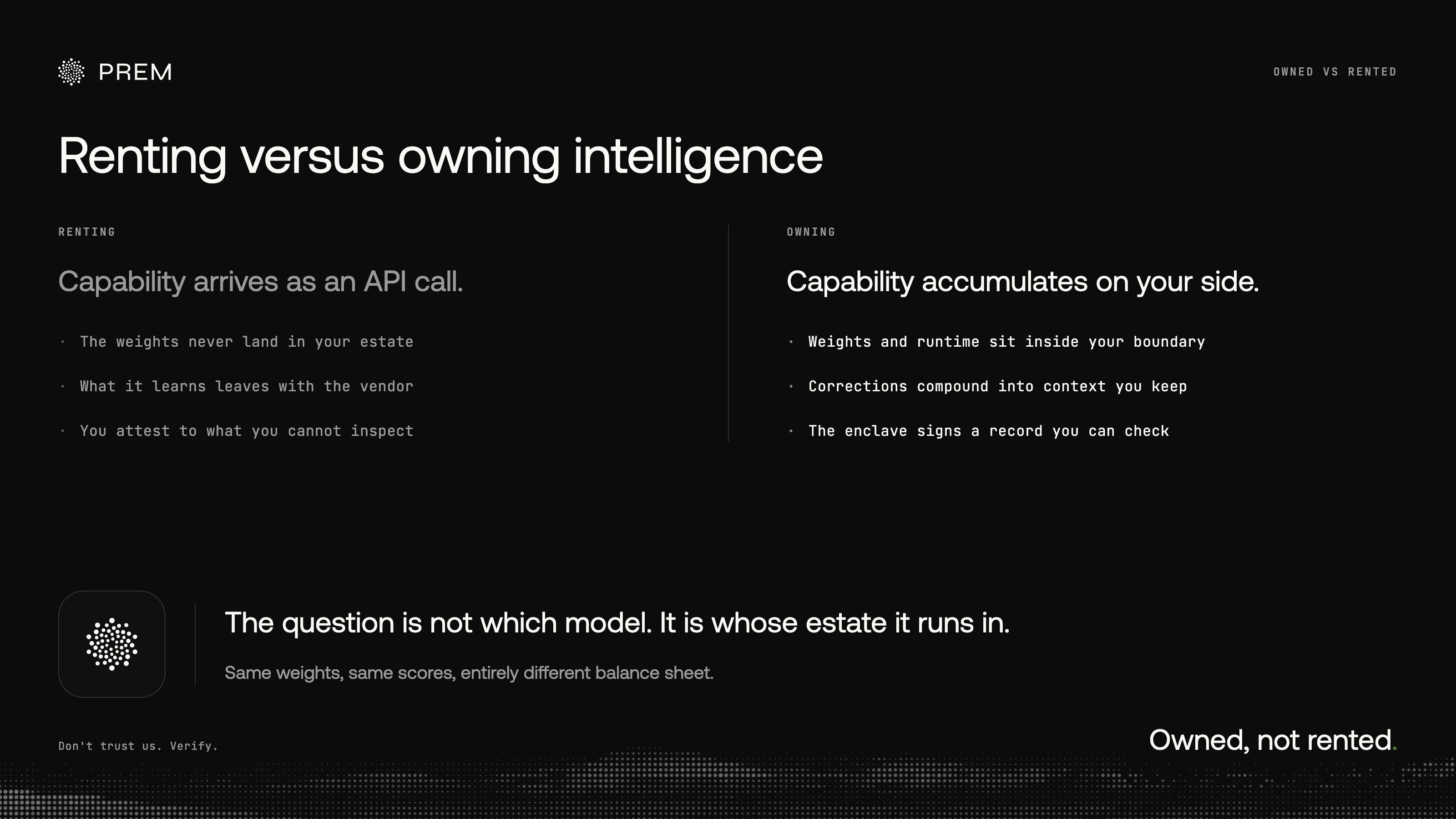
Renting intelligence from a vendor looks simple on the surface: send a request, get a response, pay for what you use.
That simplicity is exactly what hides a set of structural risks that rarely surface until an audit, a security review, or a regulator asks a direct question. The three issues below are the ones that come up most often once you look past the initial convenience.
What "renting" intelligence actually means
When you rely entirely on a closed API, you are, in a very real sense, renting your intelligence layer. You don't control the pricing changes, the roadmap, or the infrastructure decisions the provider makes. If they change terms, deprecate a model version, or shift their data handling practices, you find out after the fact, and your options are limited.
This walkthrough on avoiding vendor lock-in for generative AI covers exactly this problem: enterprises that build entirely on one provider's platform often don't realize how constrained their options are until they actually try to leave.
You're also renting away the compounding value of your own usage data, since that context sits inside someone else's systems rather than your own.
The visibility problem
Most vendor agreements include language along the lines of "we don't store your data" or "your inputs aren't used for training." These are policy commitments, not architectural guarantees. There's usually no way for you to independently verify that a provider's staff, systems, or subprocessors never had visibility into a given request. You're trusting a document, not a mechanism.
This black box extends further than most enterprises realize. Many commercial AI products are themselves built on top of other enterprises' models, which means your data can pass through several layers of infrastructure, each with its own retention practices, its own subprocessors, and its own jurisdiction, before you ever see a response.
According to the Assembly’s report, A 2026 enterprise risk framework on AI vendor lock-in found that only 6 percent of enterprise leaders believe they could switch AI enterprises without material disruption, and documented cases where governance and compliance evidence lived entirely inside a vendor's systems, unavailable the moment that vendor relationship ended.
Few vendor contracts map this chain out in a way your security team could actually audit.
The consequence shows up at the worst possible time: during an incident review or a regulatory inquiry, when "we were told our data wasn't stored" is not something you can prove one way or the other. Infrastructure built for verifiability avoids this problem entirely, because the guarantee lives in the architecture rather than in a document that has to be taken on faith.
Why this Is a sharper concern in regulated, data-sensitive markets
For a bank in Zurich, a hospital system in Munich, or a law firm in Geneva, that gap between "we promise" and "we can prove it" isn't an abstract concern. It's the difference between passing an audit and failing one. Regulators and clients in these sectors increasingly expect you to demonstrate, not just describe, how data is handled at every step.
This expectation is only getting stricter. As the EU AI Act's obligations move from published text to enforced deadlines, and as Swiss FADP requirements apply regardless of where a vendor is headquartered, organizations are facing greater scrutiny.
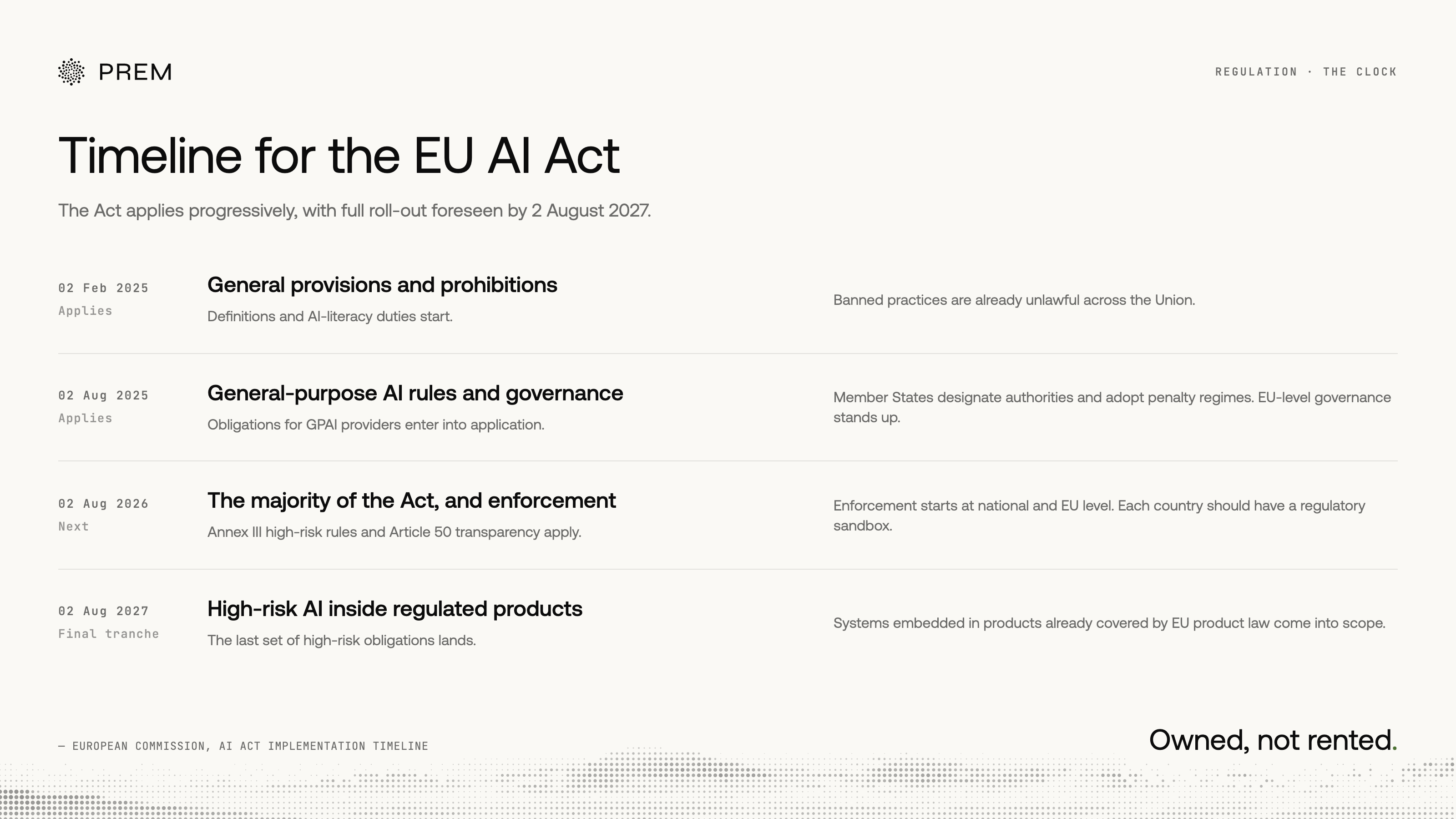
You're increasingly being asked to produce evidence, not explanations, of how your AI systems handle sensitive data. A closed vendor's privacy policy, however well written, was never designed to serve as that evidence.
Beyond open vs.closed: building frontier intelligence for sensitive data
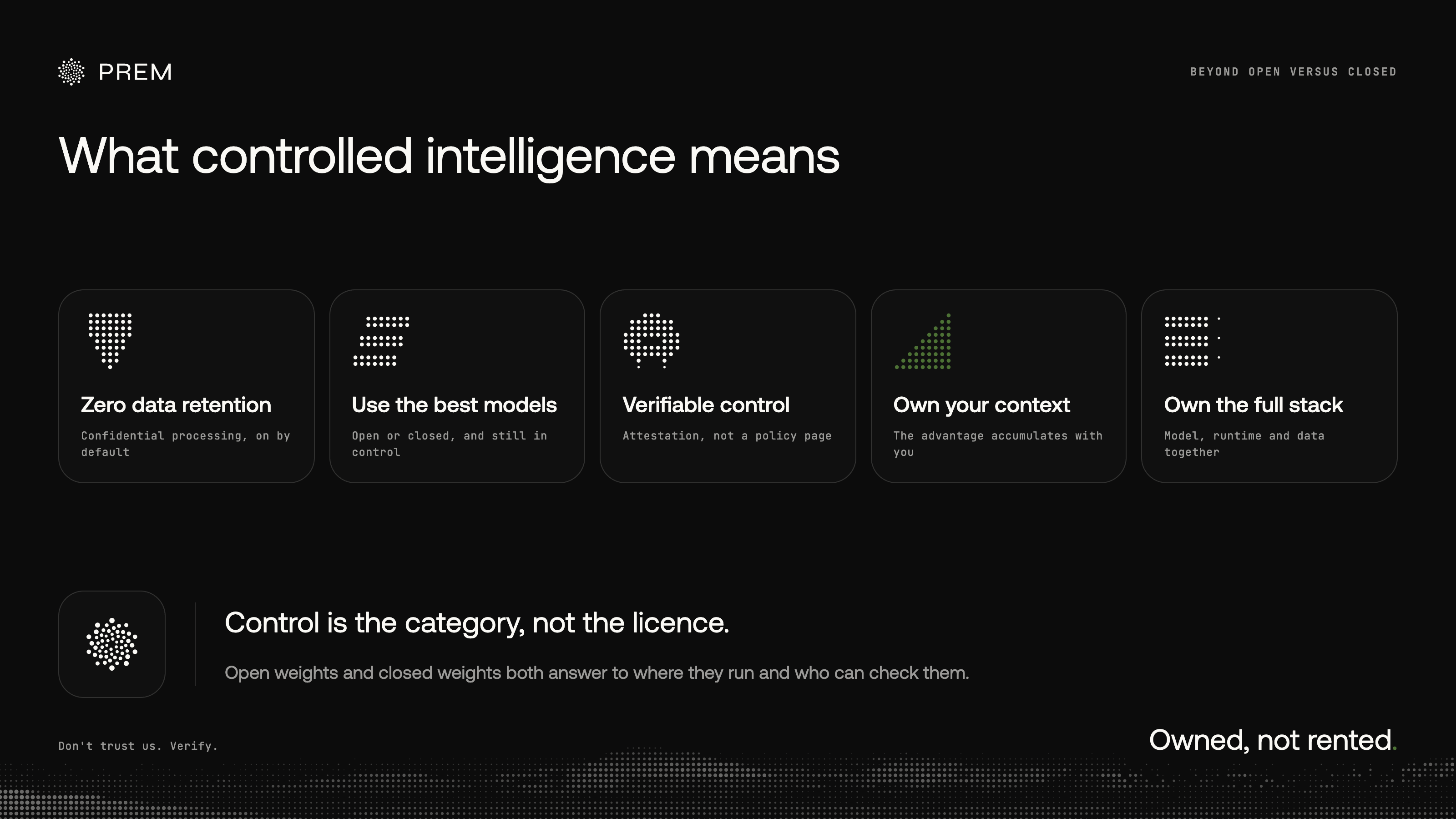
The open-source versus closed-source debate is useful, but it no longer answers the question most enterprises are actually asking. What matters now is whether you can use the world's best AI models without giving up ownership of your data, infrastructure, workflows, and governance.
This is where frontier intelligence comes in. Instead of choosing between open and closed models, enterprises build AI systems that can securely use frontier models while keeping sensitive information, business context, and operational controls entirely within their own environment. The model becomes only one layer of the stack. Ownership of everything around it remains with the enterprise.
This approach gives enterprises the flexibility to adopt newer models as the AI landscape evolves without rebuilding their applications or creating vendor lock-in.
Governance, security, retrieval pipelines, permissions, and business knowledge remain under enterprise control regardless of which model performs the reasoning. Platforms like Prem AI are designed around this idea. They enable enterprises to work with frontier AI models while maintaining control over where data lives, how it is processed, and who has access to it. Instead of choosing between capability and control, enterprises can build AI systems that deliver both.
Zero data retention (ZDR) and confidential processing
Zero data retention (ZDR) is a core requirement for enterprises handling sensitive information. With ZDR, data is never retained, reused, shared with third-party model providers, or used to train external AI models.
Confidential processing strengthens this approach by ensuring data is processed in a secure AI environment built on hardware-based isolation, as defined by the Confidential Computing Consortium. Combined with ZDR, this means the protection comes from the system's architecture, not just provider policies, helping enterprises keep sensitive data confidential throughout the AI lifecycle.
Ownership across the full stack
Enterprises pursuing this approach aim to own the infrastructure, the models they choose to run, the data itself, the workflows built on top, and the context that accumulates over time.
That ownership is what turns AI from an operating expense into a long-term asset. Independent 2026 benchmarking research points to exactly why this is now realistic: open deployment ownership now comes with auditability and no vendor lock-in, without the steep performance penalty it carried even two years ago. It's also what lets you switch or add models without re-architecting your entire data strategy each time.
Why controlled intelligence emerging as the practical path forward
For you, needing both flexibility in model choice and provable data governance, this approach is becoming less of a nice idea and more of an operational requirement.
Market research on confidential computing estimates that over 70 percent of enterprise AI workloads will involve sensitive data by 2026, which is exactly the demand pulling this kind of infrastructure from niche to mainstream.

The practicality isn't theoretical anymore; the underlying technology has caught up to the requirement.
Where enterprises are already making this shift
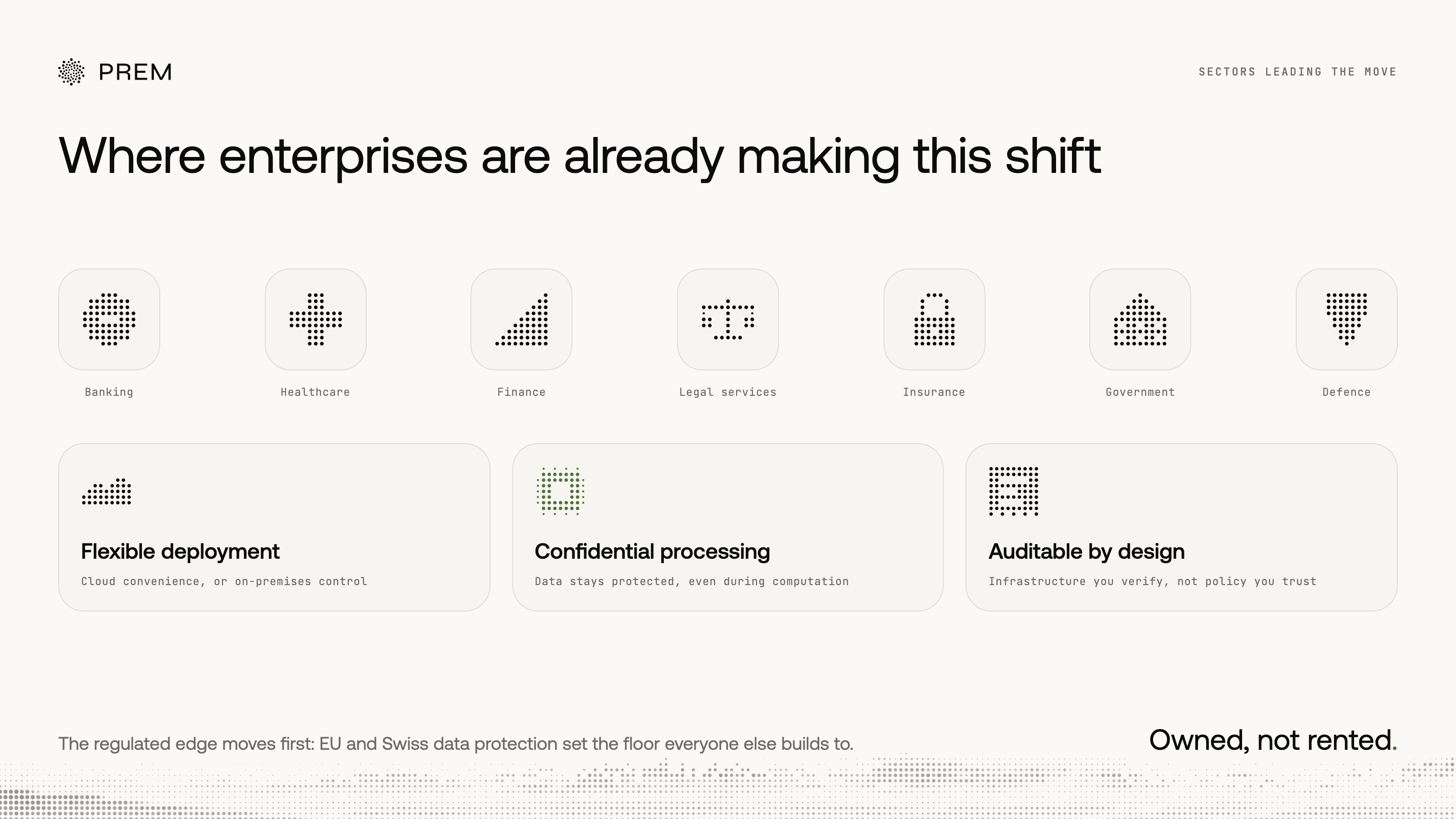
This is no longer a hypothetical debate confined to vendor whitepapers.
Specific sectors, and specific functions within them, are already moving to infrastructure they can verify rather than infrastructure they simply trust, and the pattern holds consistently across geography and industry.
Banking, Healthcare, and Government Lead the Shift to Verifiable AI
Banking, healthcare, finance, legal services, insurance, government, and defence, and any enterprise operating under Swiss or EU data protection law, are the ones moving first, largely because they have the least room for ambiguity when a regulator or client asks how their data is handled.
Founders and investors backing regulated businesses are also starting to ask sovereignty and data-ownership questions as part of standard diligence, long before they'd ever sit down with a vendor in person.
In sectors like these, the content an enterprise puts out about how it handles data often does more work than any sales conversation could.
Why enterprises are shifting toward controlled intelligence over renting
Three forces are converging at once, and any one of them alone would be enough to change how you buy AI. Together, they're making the shift from renting to owning practically unavoidable if you handle sensitive data.
Start with regulation. Obligations are moving from published text to enforced deadlines, and Switzerland's FADP already applies extraterritorial rules to any enterprise processing Swiss personal data, regardless of where the AI vendor happens to be headquartered.
Then there's competitive pressure. When you route your internal context, the specific way you handle your own customers, products, and workflows, through an external vendor, you're effectively donating that context to someone else's model.
Research on the enterprise AI divide found that enterprises are increasingly hedging against this by working across three or more model families rather than committing everything to one vendor, precisely to avoid handing a single provider that much visibility into their operations. The enterprises pulling ahead are the ones treating internal context as an asset they build, not an expense they renew.
This risk isn't hypothetical, and a recent case makes it concrete. On April 14, 2026, Mike Krieger, Anthropic's chief product officer, resigned from Figma's board the same day The Information reported that Anthropic's next model would ship with design tools that could compete with Figma's core product.
Three days later, on April 17, Anthropic launched Claude Design, and Figma's stock dropped as much as 9 percent on the news. The two companies had been actively collaborating on AI-assisted design tooling right up until that point.
What happened next was reported directly by Upstarts Media, which spoke with people in the room when Figma's CEO was asked about the relationship at a private Sequoia Capital-hosted event days after the launch: he called Krieger personally "a great guy" but, of Anthropic as a company, said, "They were not consistently candid in their communications."
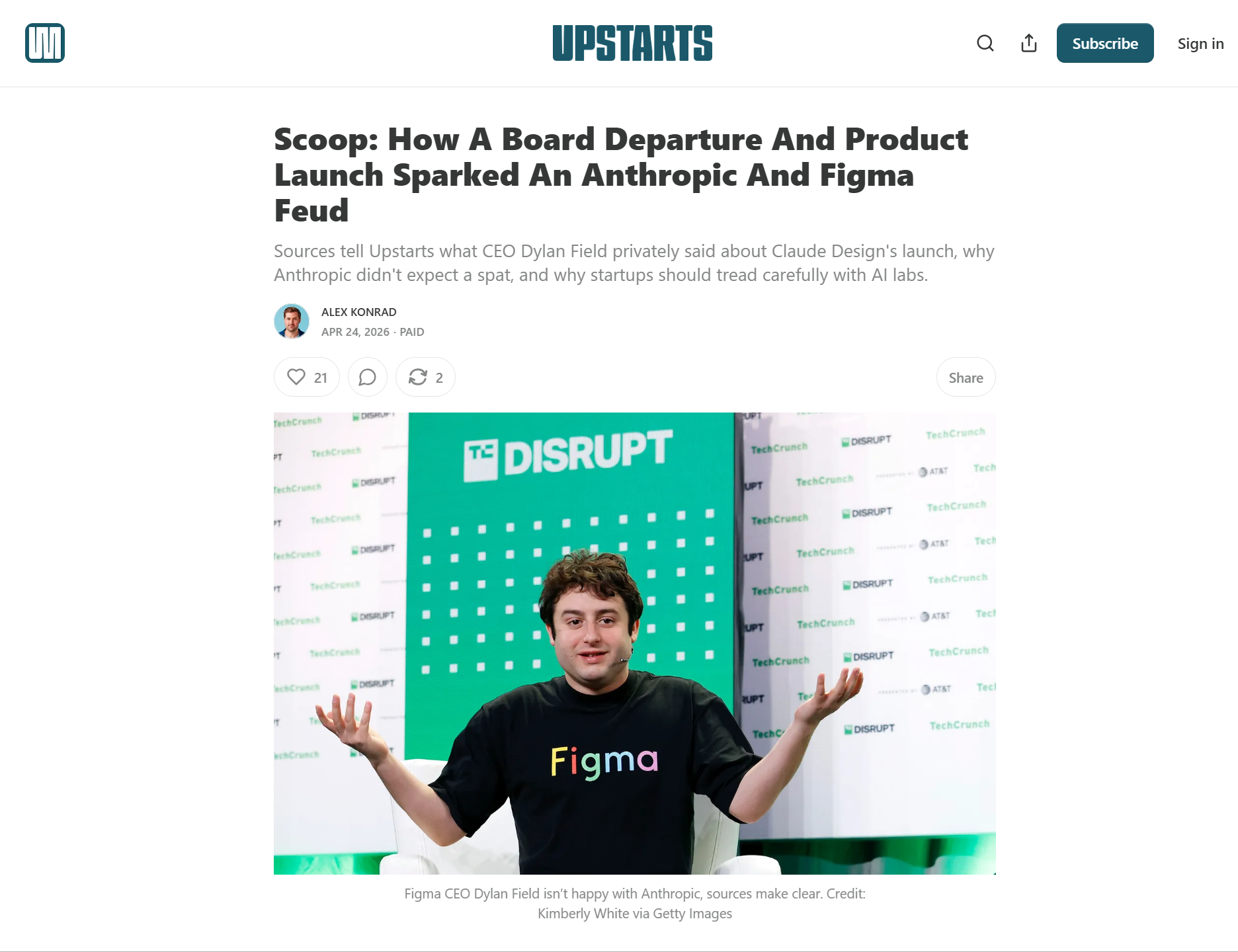
Whatever the specifics, the episode is a real-world illustration of exactly the risk: even a closely integrated AI partner, one with a literal seat at the table, can end up building the next competing product out of the context gathered inside that partnership, and the other party often doesn't find out until the launch is already public.
Finally, there's technical maturity. Confidential computing, open-weight models capable of production-grade performance, and genuinely verifiable infrastructure have only recently become practical at enterprise scale.
A 2026 Linux Foundation press release found that security and privacy concerns among enterprises adopting AI jumped from 17 percent in 2024 to 48 percent in 2026, a clear signal that the infrastructure conversation has shifted from cost to control.
What used to require a trade-off between control and capability no longer does, and that's exactly what has turned controlled intelligence from a theoretical preference into a decision you can actually make today.
Choose frontier intelligence over renting: Prem AI's approach
The debate has shifted from open versus closed to a sharper question: who owns your data, context, and infrastructure, and can you prove it holds up under scrutiny.
Prem AI is built to answer that question directly, building frontier intelligence for sensitive data workloads in a private, verifiable, and compounding manner, so enterprises own their data, context, workflows, and AI moat rather than renting them by the token.
Prem AI's proprietary private AI technology gives enterprises confidential AI infrastructure and APIs built on these core commitments.
This enables regulated organizations across healthcare, banking, finance, legal, insurance, government, and defence to build a private, Claude or ChatGPT-like experience without their data ever leaving their own environment.
See how Prem AI can help your enterprise build private AI without compromising control over your data and infrastructure. Contact our sales team, or email us at sales@premai.io.