Total Cost of Enterprise AI Infrastructure: A CIO's Roadmap for Budgeting, Security and Deployment
On this page
For many enterprises, the AI budget approved at the start of the year doesn't look anything like the invoice sitting on the desk months later.
Compute costs creep up, a security review adds months of unplanned work, and a deployment that was supposed to stay contained ends up touching three other systems.
This isn't a one-off problem. It's the default outcome when AI infrastructure is budgeted like a software license instead of a strategic system with its own security and deployment logic. Gartner's forecast puts worldwide AI spending at $2.52 trillion in 2026.

IDC's survey found that 96 percent of enterprises running generative AI and 92 percent running agentic AI are already spending more than they planned to.
This blog walks through why that gap opens up for your enterprise and what it actually takes to close it across budgeting, security, and deployment.
Why most enterprise AI budgets miss the mark
If your team budgets AI the way most enterprises do, you're probably starting with the wrong question. You ask, "What does the API cost per token?" instead of "What does this specific workload cost end-to-end, at production volume, under our compliance obligations?" That second question is the one that actually protects your budget.
The first framing hides most of your real cost. Licensing, API fees, and GPU rental are the easy part to forecast because they show up on a single invoice.
What doesn't show up as cleanly is the data engineering work needed to get your information into a usable state, the security retrofits your compliance team asks for after the fact, and the integration work needed to connect a new AI system to everything your enterprise already runs. Most budgets are built around the visible cost and treated as done.
The other blind spot is usage growth inside your own enterprise. As your teams get more comfortable with AI, they don't just add users. They add longer context windows, more retrieval steps, and more agentic tool calls per task, and each of those steps carries its own cost. Recurring, repetitive work is exactly where this adds up fastest, since every manual re-run of a task your team already automated once is a cost you're paying twice.
Prem AI's Concierge project has been built around closing that gap directly, an always-on assistant that learns how your team works, compounds memory over time, and automates recurring tasks on a schedule instead of starting over with every session.
🌻 Introducing Concierge - an open research project by Prem
— Prem (@premai_io) February 20, 2026
We believe the most valuable workflows for AI agents haven't been invented yet, because they'll come from people whose problems look nothing like the ones these tools have been designed around. Concierge is our bet on… pic.twitter.com/pNVYpG0hPH
Cost categories your enterprise AI budget must account for
Most AI budgets fail for the same structural reason: they're built around a single number instead of the full set of costs that actually make up an enterprise AI system. A realistic budget has to account for six distinct categories, each with its own drivers and its own risk of being underestimated. Here's how they break down for your enterprise.
Compute and inference
This is the cost you already track and the one your finance team asks about first: cloud API calls or GPU hours, depending on the deployment model you choose. It's an easy number to point to because it arrives on a bill every month, and it scales in a way that's intuitive to model against usage projections.
The problem is that compute is rarely the biggest line item once your enterprise moves past the pilot stage. Server pricing itself is shifting under you too.
Dell'Oro Group found that global data center capital expenditure will exceed $1 trillion in 2026, driven in large part by rising memory and storage pricing for AI-optimized systems, meaning the underlying hardware your compute bill depends on is getting more expensive even before you factor in your own usage growth.
Data engineering, talent and model maintenance
Long before a model produces anything useful for your enterprise, your data has to be cleaned, structured, and continuously monitored for quality. That work rarely gets its own line item. This is exactly why it becomes the most common source of budget overrun.
You also need engineers who can tune models to your specific use cases, review them for security issues, and keep them from drifting once they're live. None of that is a one-time cost.
Most enterprises underestimate this category twice over. Once when they scope the project, and again when the system is live and needs constant tending rather than a one-time setup.
The visibility gap backs this up: KPMG's Global AI Pulse survey found that only 26% of organizations have real-time visibility into what running their AI systems actually costs, even as spending holds steady near $188 million per organization. Both underestimation and blind spending are budgeting failures as much as technical ones, and both are far easier to plan for upfront than to explain to finance after the fact.
Compliance, governance and integration
The last piece is the work your legal and compliance teams will eventually ask you for. Audit trails, access controls, and regulatory reporting have to exist whether or not you planned for them upfront.
Add to that the cost of integrating your AI systems with the tools your enterprise already depends on, which is almost always more involved than the initial scoping suggests.
Governance maturity hasn't kept pace with deployment, and that gap carries a cost of its own. Deloitte's State of AI report found that only 21% of enterprises have a mature governance model for autonomous AI agents, even though half of leaders cite legal and regulatory compliance as a top concern.
If you're tracking all six of these categories as one lump "AI budget", that's usually how forecasts fall apart. Tracking them separately is how you keep control of the number.
Choosing between cloud APIs, on-premise, and hybrid deployments
The deployment model you choose changes which of those six categories dominates your spend. Cloud APIs are the fastest way to get something running.
Your team can go from zero to a working application in hours, and the cost per call is transparent from day one. But that convenience comes with a tradeoff: the cost curve steepens with volume, and every call routes your sensitive data through a third party's infrastructure. Here's how the three main models compare for your enterprise.
The hidden cost of data security and compliance gaps
Your employees are probably already putting sensitive information into tools you haven't fully vetted, and that habit has a cost attached to it long before any breach happens. When something does go wrong, the price tag is steep on its own terms, and it gets steeper the more scattered your data environment is.
IBM's research found that breaches spanning multiple environments, public cloud, private cloud, and on-premise together, cost an average of $5.05 million, compared to $4.01 million when data stays fully on-premise. The same research found that one in five studied enterprises had experienced a breach linked to unsanctioned shadow AI tools, adding as much as $670,000 to the average breach cost.
The deeper issue is that most enterprise AI security still runs on policy, not proof. A vendor can commit in writing to not retaining your data and still be compelled to hand it over, still suffer a breach, or still employ an engineer with standing access to a production database.
Confidential computing changes that equation by giving you a hardware-signed proof of exactly how your data was processed, shifting the trust boundary from paperwork to silicon. That shift matters enough to enterprises that Mordor Intelligence's market report values the confidential computing market at roughly $15 billion in 2026, growing at a compound annual rate above 60 percent through the early 2030s.
Why security needs to be budgeted in from day one
If your enterprise is treating security as an afterthought you add after the architecture is built, you're already budgeting incorrectly.
Retrofitting encryption, access controls, and audit logging onto a system you've already put into production costs you significantly more than designing for them from the start, because retrofits require re-architecting data flows that are already live and serving your users. Waiting for a security review to fail before you invest in the right infrastructure is one of the most expensive habits a CIO can carry into 2026.
The regulatory floor underneath all of this is also shifting under you. Under the EU AI Act, high-risk system obligations were originally due to take effect on August 2, 2026, though a recently adopted Digital Omnibus has pushed most of that deadline into December 2027, while transparency requirements for AI-generated content still apply from August 2026 as planned.
Penalties for the most serious violations can still reach €35 million or 7 percent of global annual turnover. If your enterprise operates in healthcare, banking, finance, legal, insurance, government, or defense, this isn't a future budgeting concern. It belongs in this year's infrastructure decisions, not next year's retrofit project.
Seven cost and risk factors CIOs should prioritize in their AI budget
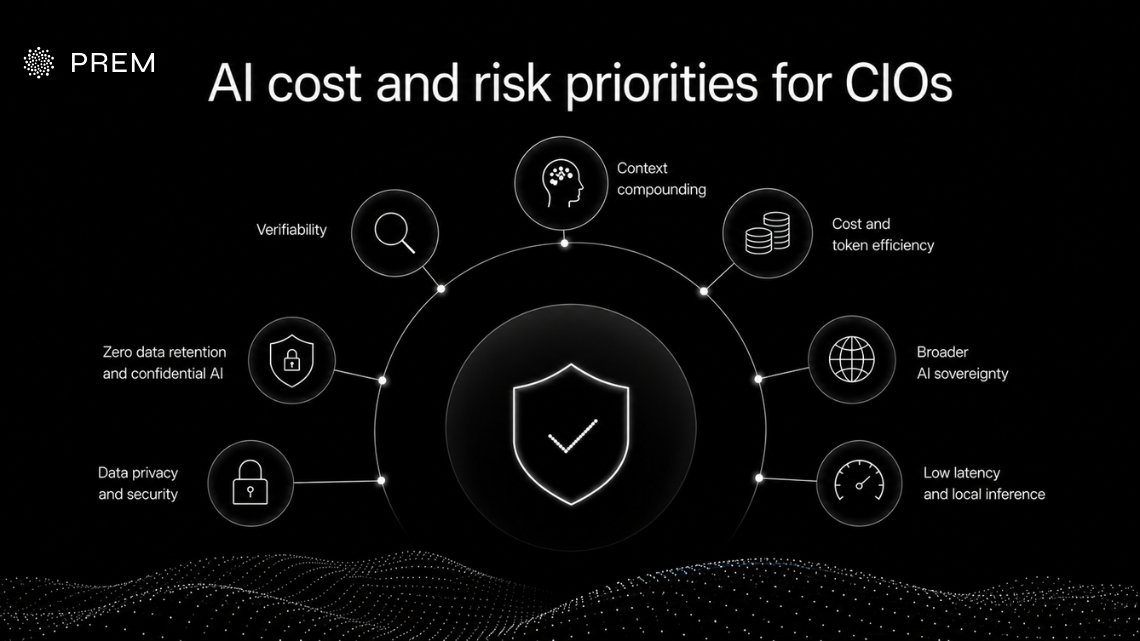
Beyond the standard TCO categories above, seven specific factors decide whether your enterprise AI deployment stays within budget or quietly becomes a liability.
Data privacy and security
This has to be your starting point. Enterprises are increasingly using vendor privacy certifications as a filter before they'll even consider a tool, and that filter is only getting stricter.
Cisco's benchmark found that nearly half of employees admit to entering confidential and sensitive company information into generative AI tools, that 27 percent of enterprises have banned GenAI outright at some point, and that 98 percent now say external privacy certifications matter to their buying decisions, the highest level Cisco has recorded in its multi-year study.
If you budget without this factor, you're budgeting for a system your own compliance team may later block.
Zero Data Retention (ZDR) and confidential AI
ZDR guarantees that your prompts and outputs are never stored beyond the life of a request. Paired with confidential computing, your inference runs inside hardware-isolated memory where data is never written to disk and disappears the moment processing finishes.
For your regulated workloads, this is frequently the only architecture that satisfies legal and security review at the same time.
Verifiability
A promise not to misuse your data is not the same as a mathematical proof that it wasn't. The next step past a written policy is infrastructure that lets you verify, rather than trust, exactly how your data was handled.
Prem AI's confidential API launch details how its verification stack lets developers cryptographically confirm the integrity of the execution environment directly, producing hardware-signed attestations for every interaction instead of an unenforceable data processing agreement.
Context compounding
Most enterprise AI tools reset context with every session your team starts, which means you pay for the same setup work over and over again. Infrastructure designed for compounding context and intelligence keeps memory, connectors, and workflow history inside your own walls, so the system gets more useful the longer you use it.
McKinsey's 2026 agentic AI research found that most enterprises are still stuck moving individual pilots into production rather than scaling agentic AI across the business, and a lack of systems that retain and build on prior context is a recurring reason why.
Over a multi-year deployment, closing that gap directly reduces the retraining and re-integration work your team would otherwise repeat indefinitely.
Cost and token efficiency
Token prices have been falling fast, and it's tempting to assume that alone will keep your AI budget under control.
a16z's analysis found that inference pricing for a fixed level of model performance has dropped by roughly 10x every year since GPT-3's public release, faster than the cost curves that defined the PC revolution or the dot-com bandwidth boom. But falling unit prices are only half the story for your budget.
Your enterprise usage volume is rising even faster, so you'll only capture that savings if you're actively managing routing, caching, and batching, not just betting on cheaper tokens alone.
Broader AI sovereignty
AI Sovereignty means more than choosing a data center in the right country for your enterprise. It means knowing who actually operates the infrastructure, who holds the encryption keys, and which laws that operator answers to.
Deloitte's report found that 83 percent of companies see data residency as at least moderately important to strategic planning, 66 percent are concerned about reliance on foreign-owned AI infrastructure, and 77 percent say a solution's country of origin now influences vendor selection. A server in Frankfurt operated by a company still subject to foreign disclosure laws doesn't actually give you sovereignty, which is the gap Prem AI's sovereignty positioning describes itself as closing, framing itself as building Sovereign Intelligence.
Low latency and local inference
If your workloads involve fraud detection, real-time document review, or agentic workflows with many sequential steps, round-trip latency to a distant cloud API becomes your bottleneck, and every extra hundred milliseconds compounds across a long agentic chain.
NVIDIA's MLPerf benchmark results showed edge platforms delivering more than a 6x throughput gain and better than a 2x latency improvement in a single benchmark cycle, the kind of local, on-device performance that centralized cloud inference, which typically runs 100 to 500 milliseconds once network round trips are factored in, simply cannot match.
Any one of these seven factors, handled poorly, becomes a hidden cost line on your books later. Handled well from the start, together they're what actually makes your enterprise AI infrastructure both affordable and defensible in front of your board or a regulator.
How each deployment model shapes your enterprise's long-term costs
Once your budget and security architecture are set, the deployment model you pick determines how those costs play out over the life of the system, and each of the three main options carries a very different long-term profile.
Managed API deployment
keeps your operational overhead low and gets you moving fastest, since your team doesn't need to manage any underlying infrastructure. The tradeoff is that your enterprise stays dependent on a third party's roadmap, pricing changes, and data handling practices for as long as you use it, and switching away later usually means re-architecting whatever you built around that API. This is the right call for your low-sensitivity, high-velocity use cases, where speed matters more than control.
Private or sovereign infrastructure deployment
puts you in control of every layer of the stack, from the model weights to the hardware itself. It costs you more to stand up and requires internal expertise to operate, but it removes vendor lock-in entirely and gives your compliance team a direct audit trail rather than a vendor's word for it. Prem AI frames this as your models, your infrastructure, and your keys, with no dependency on a provider's continued goodwill or pricing decisions.
Confidential computing (TEEs)
sits between the two for you. You get the operational simplicity of an API-style integration while your inference runs inside a hardware-isolated enclave that even the infrastructure operator cannot access, so you're not trading control for convenience the way you would with a standard managed API.
Prem AI positions this as the practical middle path for enterprises that need frontier-model capability without moving their most sensitive data onto someone else's servers or taking on the full operational burden of running their own infrastructure from scratch.
Each model carries a different long-term flexibility cost for your enterprise. Managed APIs are cheapest for you to start and most expensive to leave. Sovereign infrastructure is the reverse. Confidential computing is designed specifically to avoid that tradeoff for you, which is why it's becoming the default choice for regulated enterprises that have outgrown pilot-stage thinking.
Why moving your enterprise to private AI is a budgeting decision
Your budget is harder to predict when your infrastructure is shared with a third party. Your security posture is harder to prove when it rests on a vendor's policy instead of your own architecture.
And your long-term flexibility is harder to protect when your models, your data, and your keys all sit on someone else's servers. Private AI infrastructure is what addresses all three at once, not as separate fixes, but as one architectural decision.
That's a different case than the one usually made for private AI, which tends to focus on security alone. For your enterprise, the stronger argument is financial.
A predictable cost curve, an audit trail your compliance team can actually verify, and freedom from a vendor's pricing and roadmap decisions all compound over the life of a deployment in a way a cheaper API rate never will. The enterprises that treat private AI as a cost decision, not just a compliance one, are the ones that get their TCO math right the first time.
A practical framework for building your AI infrastructure budget
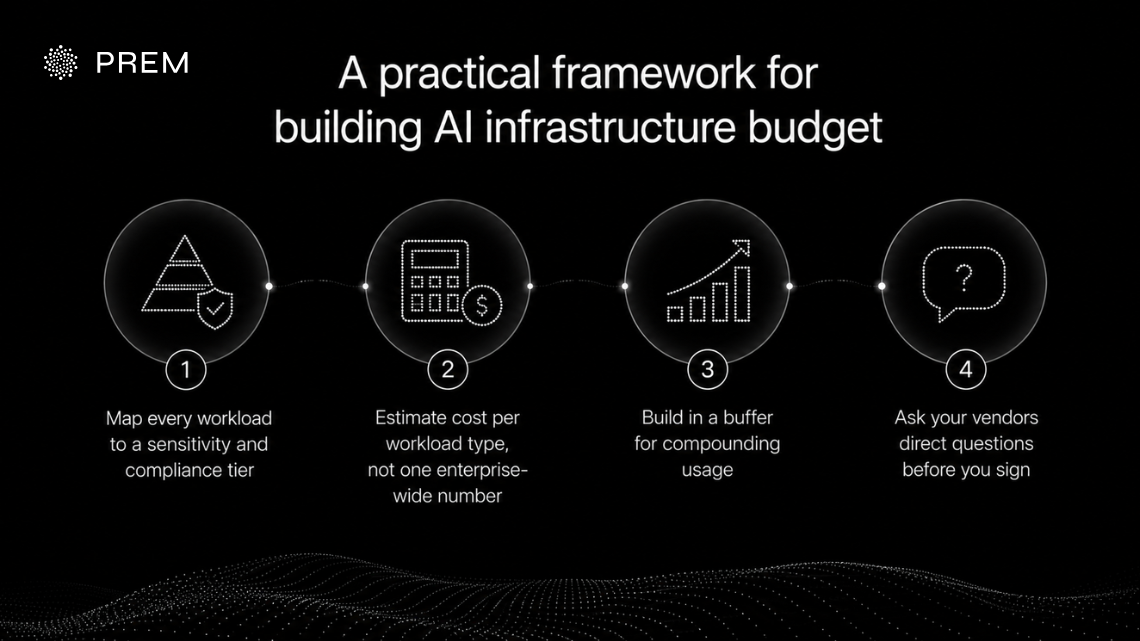
If you're building a realistic AI infrastructure budget for 2026, work through these four steps with your team.
Map every workload to a sensitivity and compliance tier
Not every use case in your enterprise needs sovereign infrastructure, and treating all of them the same way is how budgets get inflated in the wrong places. Start by sorting your workloads into tiers based on what kind of data they touch and which regulations apply, so the infrastructure decision follows the risk profile rather than the other way around.
Estimate cost per workload type, not one enterprise-wide number
Your customer-facing chatbot and your internal legal document review tool have entirely different cost and risk profiles, and lumping them together into a single enterprise-wide AI budget is one of the most common ways forecasts go wrong. Build separate cost models per workload category so you can see exactly where your money is actually going.
Build in a buffer for compounding usage
Longer context windows, more agentic steps, and more retrieval calls all increase your token consumption independent of headcount growth. If your budget only accounts for user growth and not usage intensity per user, you'll be revising it again within a quarter.
Ask your vendors direct questions before you sign
Where does inference actually run? Who can technically access your data in transit and at rest? What happens to your prompts and outputs after a session ends? Is there hardware-backed proof, or only a policy promise? That last question usually tells you whether a vendor's security story is architecture or marketing, and it's worth pushing on before you commit a budget to a multi-year contract.
Where Prem AI fits into your budgeting, security and deployment roadmap
Prem AI's Confidential API, Prem Enclave, and Fluso help enterprises build private, verifiable, and compounding AI infrastructure. It isn't a premium add-on. It's how you avoid the hidden costs described throughout this blog in the first place.
With Prem AI, inference runs inside volatile enclave memory, so your data is never written to disk and never persists after your request completes. Every interaction generates a hardware-signed proof, replacing the unenforceable data processing agreements your legal team currently relies on with cryptographic evidence your audit team can actually check.
Budgeting, security, and deployment architecture aren't three separate conversations. Every dollar spent retrofitting compliance onto a live system, every workload your legal team blocks, and every breach response you pay for after the fact all trace back to the same root cause: infrastructure decisions made without security built in from day one.
Want to see how a confidential, verifiable deployment model changes the TCO math for your enterprise? contact our sales team or email us at sales@premai.io.
FAQs about total cost of enterprise AI infrastructure
What factors contribute to the total cost of enterprise AI infrastructure?
The total cost of enterprise AI infrastructure goes far beyond GPUs or cloud compute. It includes AI model licensing, storage, networking, inference infrastructure, security controls, governance platforms, monitoring tools, and the engineering resources required to deploy and maintain AI systems.
CIOs should evaluate infrastructure costs across the entire AI lifecycle rather than focusing only on upfront investments. A comprehensive view of total cost of ownership (TCO) helps prevent budget overruns and supports long-term scalability.
How should CIOs budget for enterprise AI infrastructure?
Effective AI budgeting starts with identifying business use cases and estimating the infrastructure required to support them. Compute capacity, data storage, model access, security, compliance, and operational support should all be included in the planning process.
Instead of treating AI as a standalone technology expense, CIOs should build a phased investment roadmap. This approach makes it easier to scale infrastructure as AI adoption grows while keeping costs aligned with business priorities.
What are the biggest hidden costs of deploying enterprise AI?
Many enterprises underestimate expenses related to data preparation, model monitoring, governance, compliance, security, and ongoing infrastructure maintenance. These operational costs often exceed initial deployment expenses over time.
Hidden costs can also arise from inefficient resource utilization, unexpected cloud consumption, or integrating AI into existing enterprise systems. Identifying these factors early leads to more accurate budgeting.
How do AI model licensing costs affect enterprise AI budgets?
Commercial AI models may involve subscription fees, usage-based pricing, or token-based billing that increases as adoption expands. These recurring costs can become a significant portion of an enterprise AI budget.
CIOs should compare licensing models alongside infrastructure costs to understand the long-term financial impact. In some cases, self-hosted or open-weight models may offer better cost predictability depending on business requirements.
What infrastructure is required to deploy AI securely in an enterprise?
A secure AI deployment requires reliable compute infrastructure, secure data storage, encrypted networking, identity and access management, monitoring systems, and governance controls. Security should be built into the architecture rather than added later.
Enterprises operating in regulated industries may also require audit logging, policy enforcement, data residency controls, and compliance monitoring. These capabilities help reduce operational risk while supporting regulatory requirements.
How can enterprises reduce the cost of AI infrastructure without sacrificing performance?
Organizations can improve cost efficiency by selecting the right models for each workload, optimizing GPU utilization, automating infrastructure scaling, and reducing unnecessary inference costs. Regular monitoring also helps identify underused resources.
Choosing deployment architectures that match business needs is equally important. Many enterprises combine cloud and on-premises infrastructure to balance flexibility, performance, and cost.
What role do GPUs, storage, and networking play in enterprise AI costs?
GPUs are typically the largest compute expense because they power AI training and inference workloads. Storage platforms, high-speed networking, and data movement infrastructure also contribute significantly to overall infrastructure costs.
These components should be planned together rather than independently. An imbalance between compute, storage, and networking can create performance bottlenecks while increasing operational expenses.
Why are security and governance essential components of AI infrastructure spending?
Security and governance protect enterprise data, AI models, and business operations from misuse, data breaches, and compliance risks. They are foundational investments rather than optional add-ons.
Governance capabilities such as access controls, monitoring, audit trails, and policy enforcement help enterprises deploy AI responsibly. Investing in these areas early often reduces the cost of managing risk later.
Should enterprises build their own AI infrastructure or use managed AI platforms?
The right choice depends on business objectives, compliance requirements, available expertise, and budget. Managed AI platforms reduce operational complexity, while self-managed infrastructure provides greater control over data, customization, and deployment.
Many enterprises adopt a hybrid approach that combines managed services with dedicated infrastructure. This strategy allows organizations to balance flexibility, security, and long-term costs.
How can CIOs calculate the total cost of ownership (TCO) for enterprise AI infrastructure?
Calculating AI TCO requires accounting for capital expenses, operating costs, AI model licensing, cloud services, staffing, maintenance, security, governance, and ongoing infrastructure operations. Looking beyond hardware provides a more accurate financial picture.
CIOs should evaluate TCO over multiple years instead of focusing only on initial deployment costs. A long-term assessment supports better investment decisions and helps ensure AI initiatives remain sustainable as enterprise adoption grows.
See how Prem AI can help your enterprise build private AI without compromising control over your data and infrastructure. Contact our sales team, or email us at sales@premai.io.