How to Reduce LLM API Costs in Production for Your Enterprise AI
A consultant mentioned in Axios's sticker shock report that one client had spent half a billion dollars on Claude in a single month because employees had no usage limits in place. Around the same time, Peter Steinberger's X post showed the other side of the same problem. The OpenClaw creator posted a screenshot of his own OpenAI bill, $1.3 million spent in 30 days, run up by 100 coding agents working around the clock.
The latest CodexBar update renders API costs wayyyy nicer. https://t.co/lJ4dxNHwzG pic.twitter.com/fCkWutJGzT
— Peter Steinberger 🦞 (@steipete) May 15, 2026
Once you start using LLM APIs in production for your enterprise, your costs can rise much faster than you expect. And if you are not tracking usage closely, you may not notice the problem until the bill lands.
That is why you should plan for LLM API costs from the start. If your team uses AI across many workflows, small amounts of wasted usage add up fast. To control your LLM API spending, you need to match each task with the right model. You also need to track what each workload costs and spot where you are spending more than necessary.
What makes your LLM costs go up in production
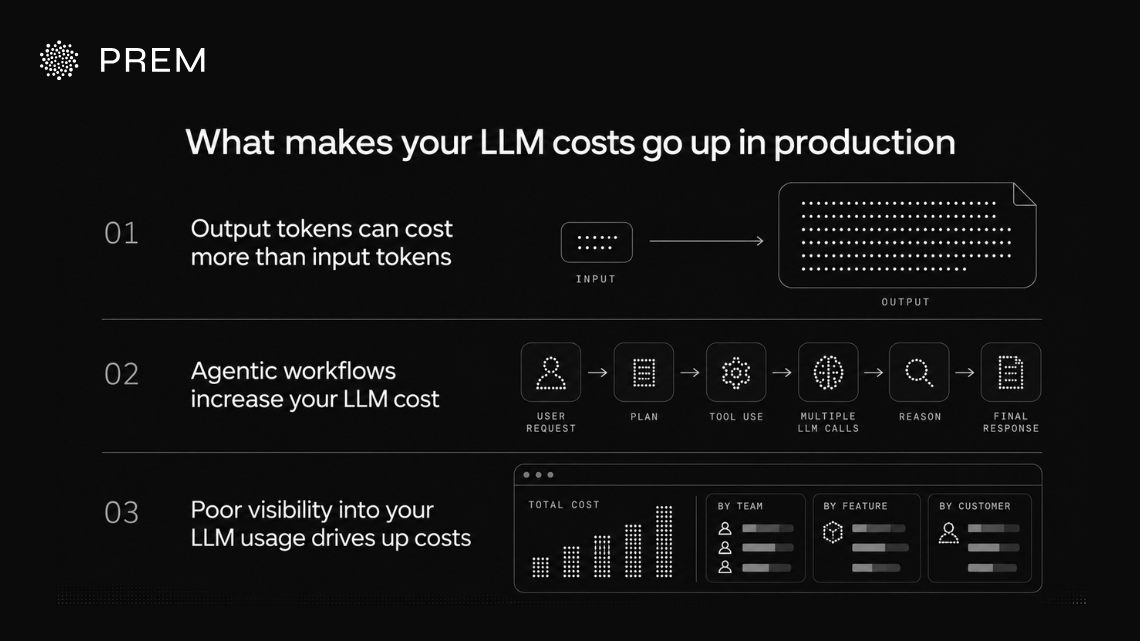
These are some of the main factors that make your LLM API costs go up.
Output tokens can cost more than input tokens
With many leading LLM APIs, generated tokens are priced higher than the tokens you send in. That means a long prompt or attached document may not be the most expensive part of the request.
Your costs rise when the model generates long responses, and this is pretty common with code generation and report summaries. Multi-turn conversations also add more output over time. If you estimate a feature using only input pricing, your production spend may end up much higher.
Agentic workflows increase your LLM cost
When you use an agentic workflow, completing one task takes several calls to the model rather than a single request and response. Those extra calls use more tokens, which increases the total cost of the task.
According to Gartner's agentic workflow forecast, inference costs per agentic workflow will increase more than fivefold through 2028 as enterprises use agents for more complex, multi-step work.
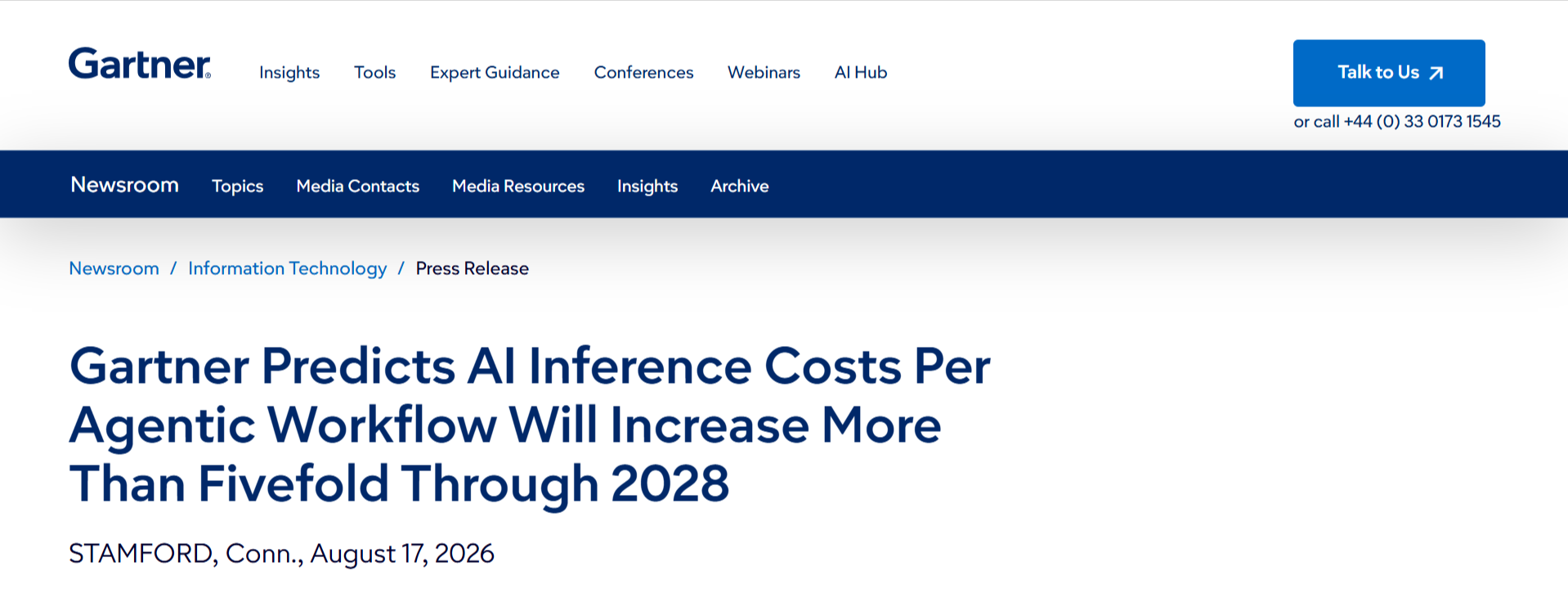
This means your LLM bill can grow even if the price per token does not change. If each task requires more model calls, you end up spending more to complete the same piece of work.
Poor visibility into your LLM usage drives up costs
If you only track your total LLM spend, it is hard to see what is driving the increase. You need to have visibility into costs by team, feature, or customer. That becomes more important as AI use grows across your business. TechCrunch reported that Uber had used its full 2026 AI coding budget by April. It also noted that a Priceline employee saw a routine contract renewal come back four to five times more expensive than expected.
For your enterprise, you need to know where your LLM spend is going before costs get out of hand. You also need to track usage by team, feature, or workload. This gives you a clearer view of what is driving the bill and where you need to reduce waste.
Get More Control Over Your LLM Spend
Run your workloads with more flexibility around model choice, infrastructure and inference costs.
Talk to Prem AIMetrics you should track to reduce your LLM costs
Below are some of the metrics you should track to reduce LLM costs for your enterprise AI.
Track what each completed task costs you
First, you need to define what a completed task looks like for each workflow. Then calculate the total cost of finishing that workflow, including every model call and token used for your enterprise.
According to a Tech Times report based on EY data, a simple AI workflow costs about $0.04 per interaction. An agentic workflow costs around $1.20, and tracking cost per completed task makes that difference much easier to see.
Track how many tokens each workflow uses
You need to look beyond individual API calls to understand how many tokens a full workflow is using. Give each workflow its own ID and track the total token use from start to finish.
Stax's agent cost breakdown points to a coordination loop built with LangChain that ran for 11 days and generated a $47,000 bill before it was noticed.
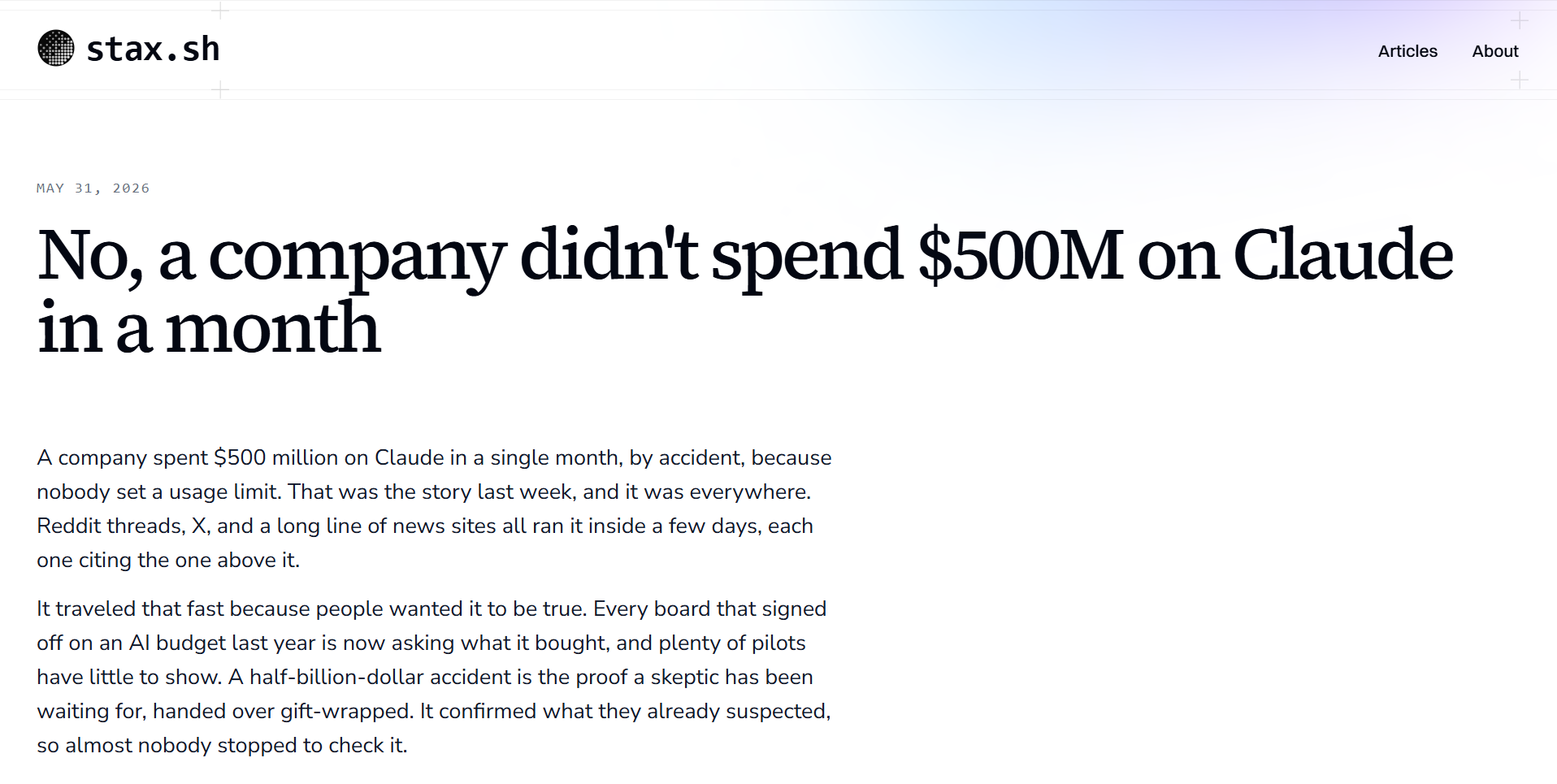
The loop kept making new calls, so the cost continued to grow with every run. Tracking token use across the full workflow helps you spot this kind of repeated activity earlier, before it turns into a much larger bill.
Give each team and feature its own LLM budget
Set a budget for each team or feature so you can see exactly where your LLM spend is running over plan. Tag requests so the cost goes back to the right team or feature. Then check actual spend against the budget each week instead of waiting for the monthly bill.
The FinOps Foundation's 2026 report found that 98% of FinOps practitioners now manage AI spend, up from 31% two years earlier. It also identified AI cost management as the top skill teams need to develop next. Weekly tracking gives you time to act before a small overspend becomes a much larger one.
How to Optimize LLM Costs in Production for Your Enterprise AI
You can lower your LLM costs by choosing the right models and routing workloads more efficiently.
Switch to Open-Source Models from Closed-Source Models
Start by testing open-source models for tasks such as document processing and internal search. You can also test them for extraction or customer support. Compare cost and speed first, and then check output quality before moving the workload.
| Category | Closed-Source Models | Open-Source Models |
|---|---|---|
| Pricing | Fixed frontier rate per token, set by the vendor | Open-weight rates, often a fraction of frontier pricing |
| Data handling | Varies by vendor terms | Zero data retention (ZDR), encrypted enclaves |
| Latency | Varies with provider load | Dedicated GPUs |
| Integration | Vendor-specific SDK | OpenAI-compatible, swap the base URL |
| Compliance | Depends on vendor certifications | SOC 2 Type I, ISO 27001, ISO 9001, FADP/GDPR |
Open-source models give you more control over pricing and infrastructure. You can choose the model that fits your workload, but running it securely in production still requires you to manage the infrastructure.
At Prem AI, we make this easier through Enclave API, you can access open-source models such as Kimi K3, DeepSeek V4 Pro, Qwen 3.8, and GLM models through an OpenAI-compatible API. This lets you test and switch models without rebuilding your existing integration.
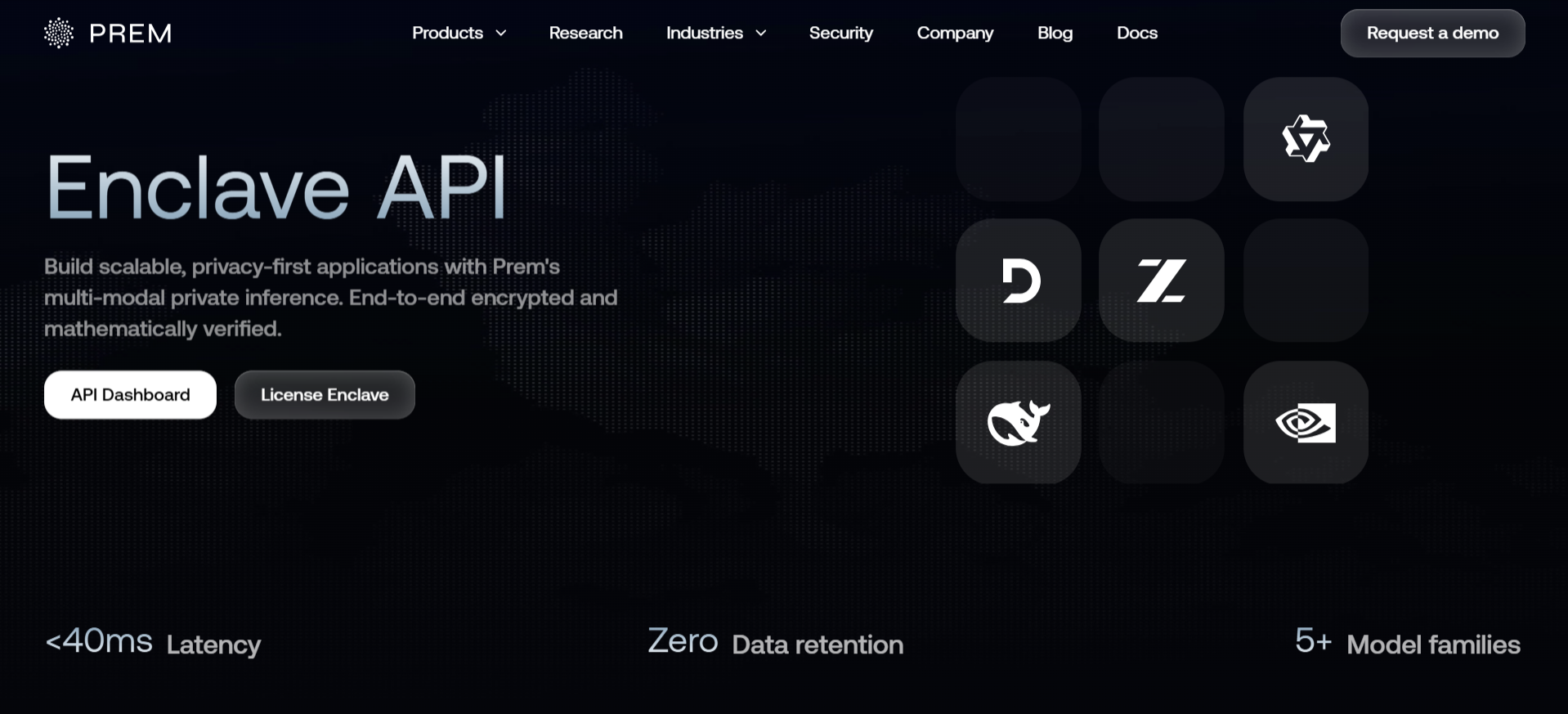
Your requests run inside a hardware-sealed environment with encrypted GPU memory and communication, verified through cryptographic attestation. Prem also offers a separate Zero Data Retention (ZDR) mode for standard inference.
Moving your enterprise workloads to open-source models helps lower your LLM API costs. open-source models handle the same tasks at a lower cost than the closed-source models, shifting more of that workload away from closed APIs becomes a practical way to reduce your overall LLM spend.
Lower Your LLM API Costs With Open-Source Models
Keep your existing code and move your workloads to open-source models.
Request an Enclave API demoRoute requests by task complexity
You do not need to use the same model for every request. A simpler task can often run on a smaller model, while more complex work can go to a more capable one.
| Task type | Example | Right-sized model tier |
|---|---|---|
| High-volume, low-complexity | Classification, extraction, routing | Small open-weight model |
| Conversational, moderate reasoning | Support chat, summarization | Mid-size open-weight model |
| Complex, multi-step reasoning | Code generation, agentic planning | Frontier-tier model, used selectively |
Routing requests this way helps you avoid using your most expensive model for work that does not need it. Over time, that will make a meaningful difference to your LLM API cost without forcing you to use a smaller model for every task.
Prompt optimization for your enterprise workloads
Your prompts also add to your LLM API cost. If you send the same system prompt or examples with every request, you keep paying for those tokens each time. Keep your prompts focused on the task and remove repeated instructions where possible. You should also shorten examples and set clear limits on response length.
Ruben Hassid's token newsletter also shows how repeatedly uploading the same large document can use far more tokens than processing it once and reusing it. At enterprise scale, small prompt changes can make a noticeable difference to your overall LLM spend.
Use enterprise RAG to reduce unnecessary token usage
If you send full documents or your entire knowledge base with every request, you end up paying for a lot of tokens the model does not need.
With enterprise RAG, you first retrieve the most relevant information from your knowledge base and send only that context to the model. This keeps your prompts shorter and reduces token usage for each request. For enterprises working with large document sets, RAG can be a practical way to lower LLM API costs while still giving the model the information it needs to answer the request.
Reduce LLM cost in production for your enterprise with Prem AI
Reducing your LLM API costs in production starts with using the right model for each workload and cutting unnecessary token usage.
We built Prem AI for enterprises that want more control over LLM API costs. Through Enclave API, you can access open-source models and move suitable workloads away from expensive closed-model APIs.
This gives you more flexibility to choose the model that works best for each task. If you want to run those models on your own infrastructure, Prem AI Enclave gives you that option as well.
If you want to reduce LLM costs in production for your enterprise, contact our sales team or email us at sales@premai.io. We can help you find the right setup for your workloads.
FAQs about how to reduce LLM API costs in production
What is the best way to reduce LLM API costs in production?
Start by tracking the cost of each workflow along with token usage and model calls. Then choose the right model for each task and keep your prompts focused. You should also improve RAG retrieval and use caching where it makes sense. Batch workloads that do not need real-time responses.
Why do LLM API costs increase after moving to production?
Production workloads bring higher request volumes and more model calls. Longer conversations and repeated prompts also increase usage. Costs rise fast when expensive models process unnecessary context or generate more output than needed.
How can model routing reduce LLM API costs?
Model routing sends simpler tasks such as classification, extraction, and basic summarization to lower-cost models while reserving larger models for complex reasoning. This prevents enterprises from paying premium model rates for workloads that do not require them.
Can RAG help reduce LLM costs in production?
Well-tuned RAG can reduce input-token costs by retrieving only the information relevant to each request instead of sending entire documents or knowledge bases. Better chunking, filtering, reranking, and context selection can further reduce unnecessary tokens.
How can enterprises track LLM costs more effectively?
Enterprises should track cost per completed task and tokens per workflow. You should also monitor model calls along with team and feature-level spending. This makes it easier to spot expensive workloads and repeated calls. It also helps you catch oversized prompts and other patterns that drive up LLM costs.