9 Best AI Enterprise Search Platforms for Internal Knowledge Management in 2026
On this page

An AI enterprise search platform lets you search across all your company's knowledge applications, like email, documents, and chat, and get a clear answer in one place.
- You can use it to find information from across your company instantly, instead of searching through each app one by one or asking a coworker.
- Before you connect a search tool to your company's data, check three things. The tool should only show you what you are already allowed to see. You should know where your data gets stored. And you should be able to see who looked at what.
- With Fluso, you can connect the knowledge applications you already use, like Slack, Notion, Gmail, and Google Drive, into one private workspace.
- Fluso shows you exactly which document, email, or meeting an answer came from. Your security team can check for themselves that your data is safe.
In June 2026, security researchers at Varonis found a serious flaw in Microsoft 365 Copilot.
The flaw showed how an attacker could use a normal Microsoft link to reach information through Copilot. A single click was enough. There was no file to download and no extra permission to approve. The attacker could then access emails, calendar details, MFA codes, and SharePoint files.

Copilot could find anything the employee already had access to. That included old files, shared folders, and information the company may have forgotten about. Once AI could search across all of it, finding that information became much easier.
It is a reminder that access permissions are something we need to be really careful about when introducing AI search.
That is why you need to choose your enterprise search platform carefully. The platform you choose decides how your teams find information and where that information is processed.
So before you connect an AI search platform to your company's knowledge, you need to understand what sits behind the search box.
Let’s look at what you should check and how some of the leading enterprise search platforms approach it.
What to look for in an AI enterprise search platform
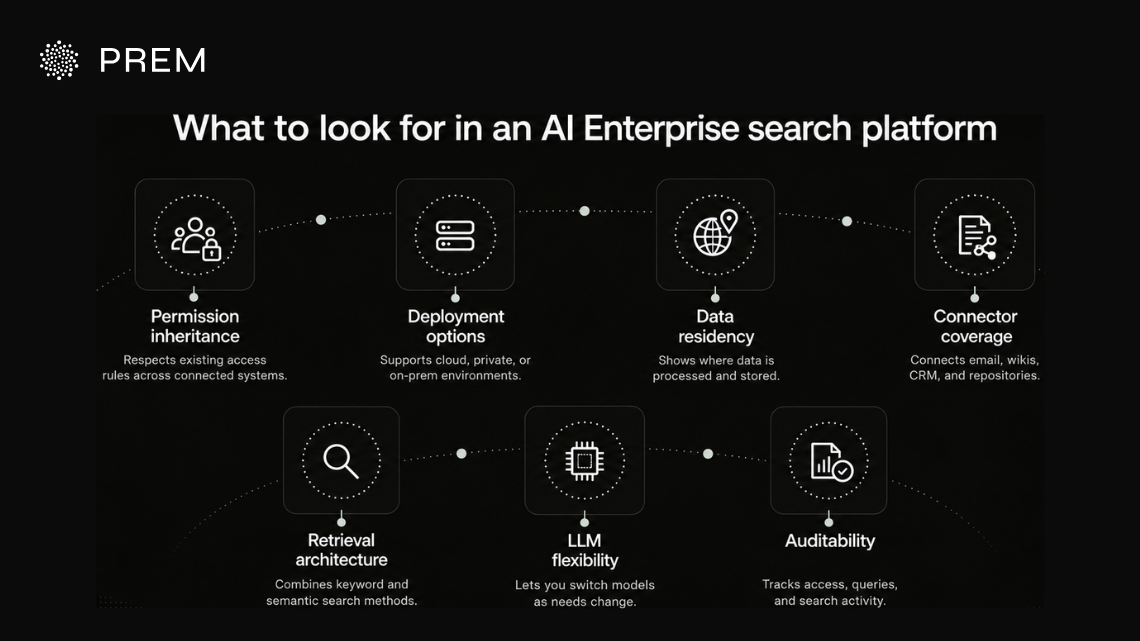
Not every enterprise search platform handles your data and access controls in the same way. Before connecting one to your company's internal knowledge, check how it handles the following.
| What to check | What it means |
|---|---|
| Permission inheritance | Make sure the platform follows your existing access rules. A user should only see information they are allowed to access. |
| Deployment options | Check where the platform can run, such as managed cloud, private cloud, or on-premises, based on your data and security requirements. |
| Data residency | Check where your data and search queries are processed and stored, and which laws apply to that data. |
| Connector coverage | Check which tools the platform can connect to, such as email, wikis, CRM systems, and code repositories. Also check how much work is needed to add new data sources. |
| Retrieval architecture | Understand how the platform finds information, such as through keyword search, semantic search, or a combination of both. |
| LLM flexibility | Check which AI models you can use and whether you can change models as your needs, costs, or data requirements change. |
| Auditability | Make sure you can see what information was accessed, who accessed it, and when. This helps your team review access and investigate unexpected results. |
Tired of Ctrl+F-ing Docs, Slack, and Everything Else?
Fluso brings every tool, doc, and chat into one AI enterprise search platform, so the answer finds you.
Download Fluso9 best AI enterprise search platforms in 2026
AI enterprise search platforms take different approaches to helping teams find and work with company knowledge. Some are built around private infrastructure and data control, while others focus on connecting workplace knowledge with AI.
What matters most is how well a platform fits your data environment along with security requirements and way of working. The nine platforms below take different approaches to enterprise search, giving you a clearer view of what each one can offer.
| Platform | Deployment | Retrieval | LLM Flexibility | Connectors | Security |
|---|---|---|---|---|---|
| Fluso | Confidential computing infra (via Confidential Mode) | Traces answers to source | Open-weight models | Gmail, Drive, Slack, Teams, Notion, Calendar, MCP | Confidential Mode attestation, ZDR for supported workloads, SOC 2 Type I |
| Sinequa | On-prem, private cloud, SaaS | Neural search + RAG | Leading LLMs | 200+ connectors | ISO 27001, SOC 2 |
| Mindbreeze InSpire | On-prem, SaaS, private/public cloud | Knowledge graph | Choice of LLM | M365, Teams, Salesforce, ServiceNow | Entra ID permissions |
| Squirro | Public/private cloud, on-prem, hybrid | RAG + knowledge graph | Leading LLMs | Federated search, auto-classification | Audit trails, AI guardrails |
| Dust | US/EU residency, single-tenant option | Agent-based retrieval | OpenAI, Anthropic, Google, Mistral | 70+ integrations | No training on customer data |
| Mistral Vibe | On-prem, private cloud, Mistral Cloud (EU default) | RAG | Fine-tune via Mistral Forge | 100+ tools | ZDR unavailable on Vibe itself |
| IntraFind iFinder | On-prem, Germany cloud, hybrid | Semantic + phonetic search | LLM integration via platform | 80+ connectors, 600+ formats | Role-based search profiles |
| Elastic | Cloud, self-managed, air-gapped | Full-text + vector + hybrid | ELSER + third-party models | Custom pipelines | Search-layer access controls |
| Glean | Dedicated, bring-your-own-cloud | Vector search + Enterprise Graph | Choice of LLM | 275+ applications | Real-time permission updates |
Fluso: Your Private Knowledge Search Workspace
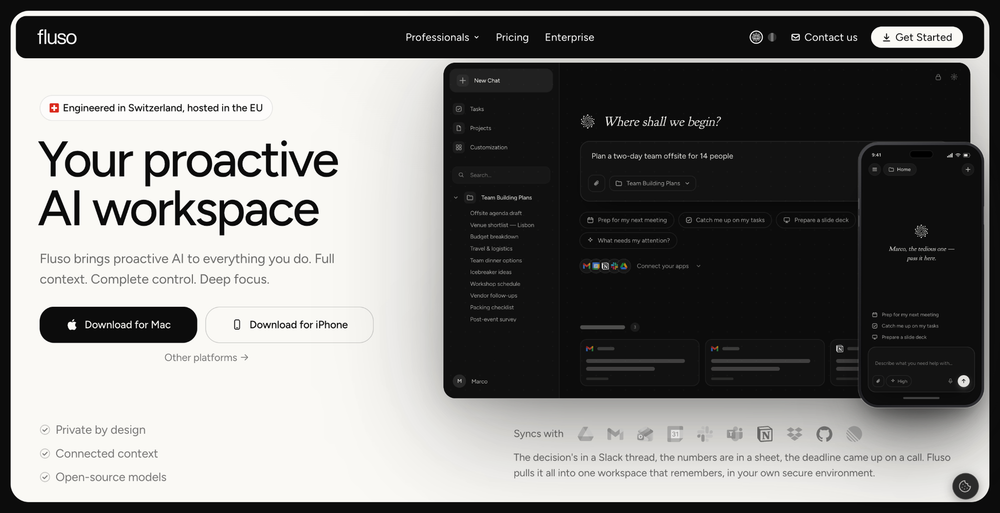
Fluso by Prem AI is our agentic AI workspace for working with your company's knowledge. You can connect the systems your teams already use and give employees a unified way to search, understand, and work with internal information within a private AI environment.
Introducing the world's most Proactive AI Workspace - ciao Fluso 👋 https://t.co/0zARljJBnw
— Fluso (@fluso_ai) June 17, 2026
The Problem Fluso Solves
When AI search connects to your company's knowledge, one question matters more than the rest: how much control do you have over your data while AI processes it? Your employees need fast answers, and your organization needs control over how that information is processed.
How Fluso Supports Your Enterprise
We bring enterprise search, AI agents, connected data, and model flexibility into one private workspace. Your teams can connect their existing tools, search across company information, trace answers to their sources, and use AI for multi-step workflows.
Connected Enterprise Knowledge
Fluso connects with the workplace tools your teams already use, including Gmail, Google Drive, Slack, Teams, Notion, and Calendar. Your teams can work with information across these systems from one private AI workspace.
Fluso also supports MCP, allowing AI agents to work across connected tools and carry out multi-step tasks within your existing workflows.
Grounded Answers, Traced to Their Source
Fluso generates answers from the enterprise information connected to your workspace and traces those answers back to their source, the underlying document, email, or record.
Fluso can also retain useful organizational context across sessions, so your team doesn't have to re-explain projects or background every time.
AI Agents for Multi-Step Work
Your teams can use AI agents for recurring tasks, document creation, meeting summaries, communication, and other workflows that involve multiple steps.
Model Flexibility
Fluso gives you access to open-weight AI models. GLM 5.2 has been available in Fluso since early July. You can choose models based on the performance, privacy, and infrastructure requirements of your workloads.
GLM 5.2 has been available in Fluso since early July. When you turn on confidential mode, the model runs entirely through Prem's confidential compute infrastructure. End-to-end encrypted inference, nothing leaving the private path with verifiable zero data retention
— Prem (@premai_io) July 24, 2026
Confidential and Verifiable Inference
When you turn on Confidential Mode, your data is processed inside Prem's confidential computing infrastructure. Your data stays private because it's encrypted the whole way, and cryptographic attestation lets your security team check that the environment is doing what it's supposed to.
You don't have to take our word for it. Just tap the Encrypted badge inside Confidential Mode, and Fluso checks the hardware and model behind your request, right then and there.
Fluso also supports Zero Data Retention for some inference workloads. This means your data isn't stored after it's processed.
Security and Compliance
We maintain a security model designed for enterprise AI workloads. Prem holds a SOC 2 Type I report and maintains controls aligned with FADP and GDPR requirements.
These controls give your organization a clearer basis for evaluating how enterprise information is processed when you use AI across your internal workflows.
Get Started
Want to bring your enterprise knowledge into one private AI workspace? Get started with Fluso or contact our sales team to see how Fluso can fit your enterprise workflows.
Sinequa by ChapsVision
Sinequa brings enterprise information from multiple business systems into a unified search experience. Sinequa describes its platform as an enterprise AI search and agentic AI platform that combines search, retrieval, generative AI, and AI agents across structured and unstructured content.
Sinequa's deployment
You can deploy Sinequa on-premises, through a private cloud, or as managed SaaS, with its cloud infrastructure running on Microsoft Azure.
Sinequa's LLM and retrieval
Sinequa describes itself as LLM-agnostic, so you can connect the models you prefer, and it uses Hybrid Neural Search with RAG to ground responses in your data.
Sinequa's connectors and security
Sinequa offers 200+ connectors that, according to Sinequa, preserve your existing access permissions. It lists SOC 2 Type II, ISO 27001, HIPAA, GDPR, and CCPA among its compliance standards.
Mindbreeze InSpire
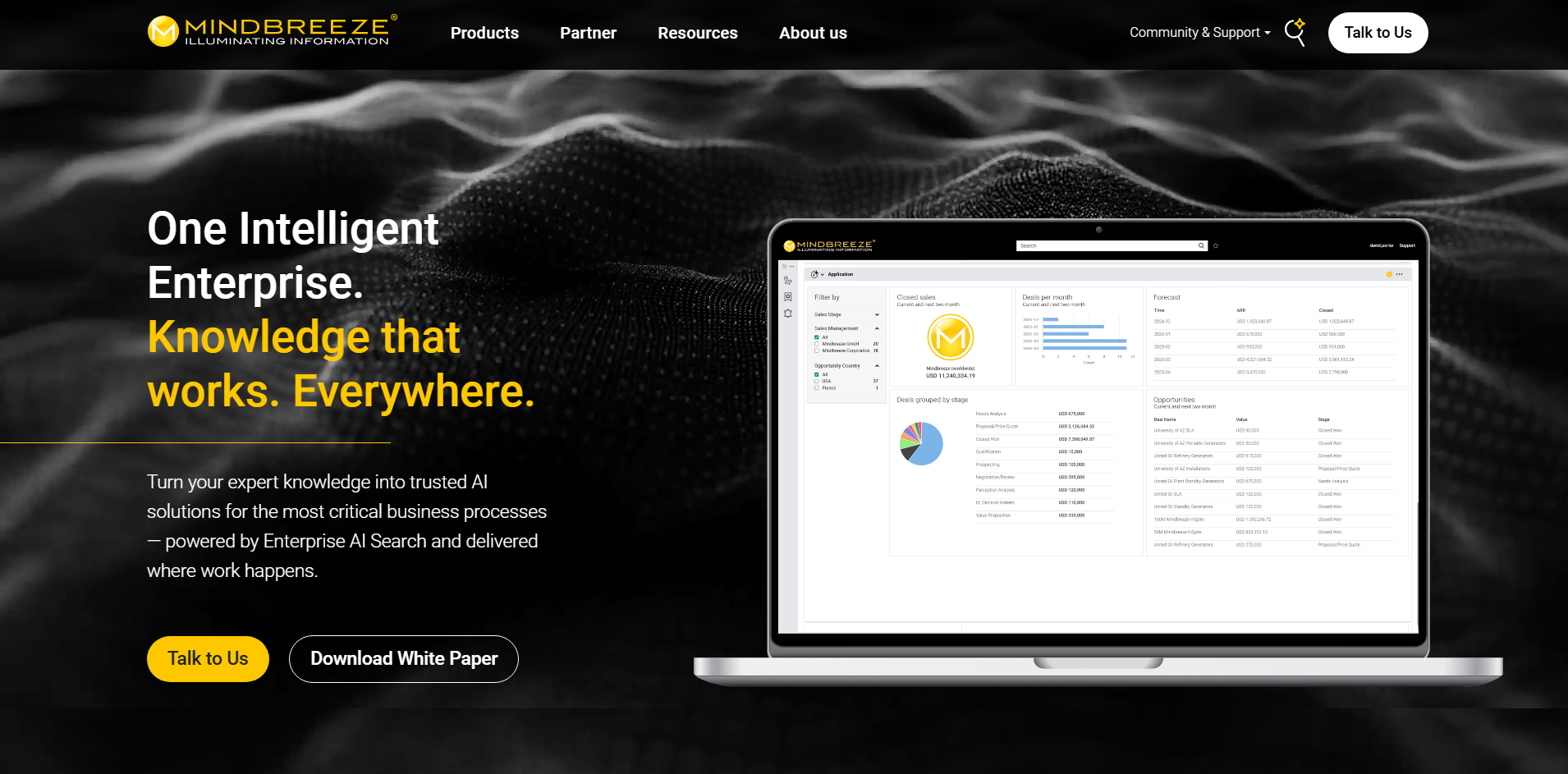
If you want enterprise search with more control over your deployment environment, Mindbreeze InSpire gives you options across on-premises and cloud environments. Its knowledge graph and AI-powered search capabilities help your teams connect information across complex enterprise content. According to Mindbreeze, InSpire also supports flexible deployment models designed to fit different enterprise infrastructure requirements.
Mindbreeze's deployment
Specifically, that includes an on-premises appliance you can run inside your own infrastructure, plus cloud options through AWS, Microsoft Azure, Google Cloud, and Oracle Cloud.
Mindbreeze's LLM and retrieval
You can choose the LLM that fits your needs, including models run within Mindbreeze's own infrastructure, with support for OpenAI-compatible model access.
Mindbreeze's connectors and security
InSpire connects to 500+ data sources and enforces your existing permissions, so users only see information they are authorized to access.
Your Search Platform Says "Trust Us." Fluso Says "Check for Yourself."
With Fluso's Confidential Mode, your AI enterprise search platform runs inside hardware-protected infrastructure you can actually verify.
Download FlusoSquirro
According to Squirro, it combines enterprise search with knowledge graphs and generative AI, built for organizations that need security and privacy controls around sensitive information.
Squirro's deployment
Squirro says you can deploy it in a private VPC, on-premises, or hybrid, with Squirro generally using AWS, Azure, and Hetzner for cloud infrastructure.
Squirro's LLM and retrieval
It connects to LLMs that support OpenAI API standards and tool calling, without hosting or managing the LLM infrastructure itself, as per Squirro. Its Enhanced RAG pulls from connected sources in real time, and its Knowledge Graph add-on adds semantic structure to improve relevance.
Squirro's connectors and security
Squirro supports federated search across connected systems, with access control lists, a privacy layer, AI guardrails, and audit trails built in.
Dust
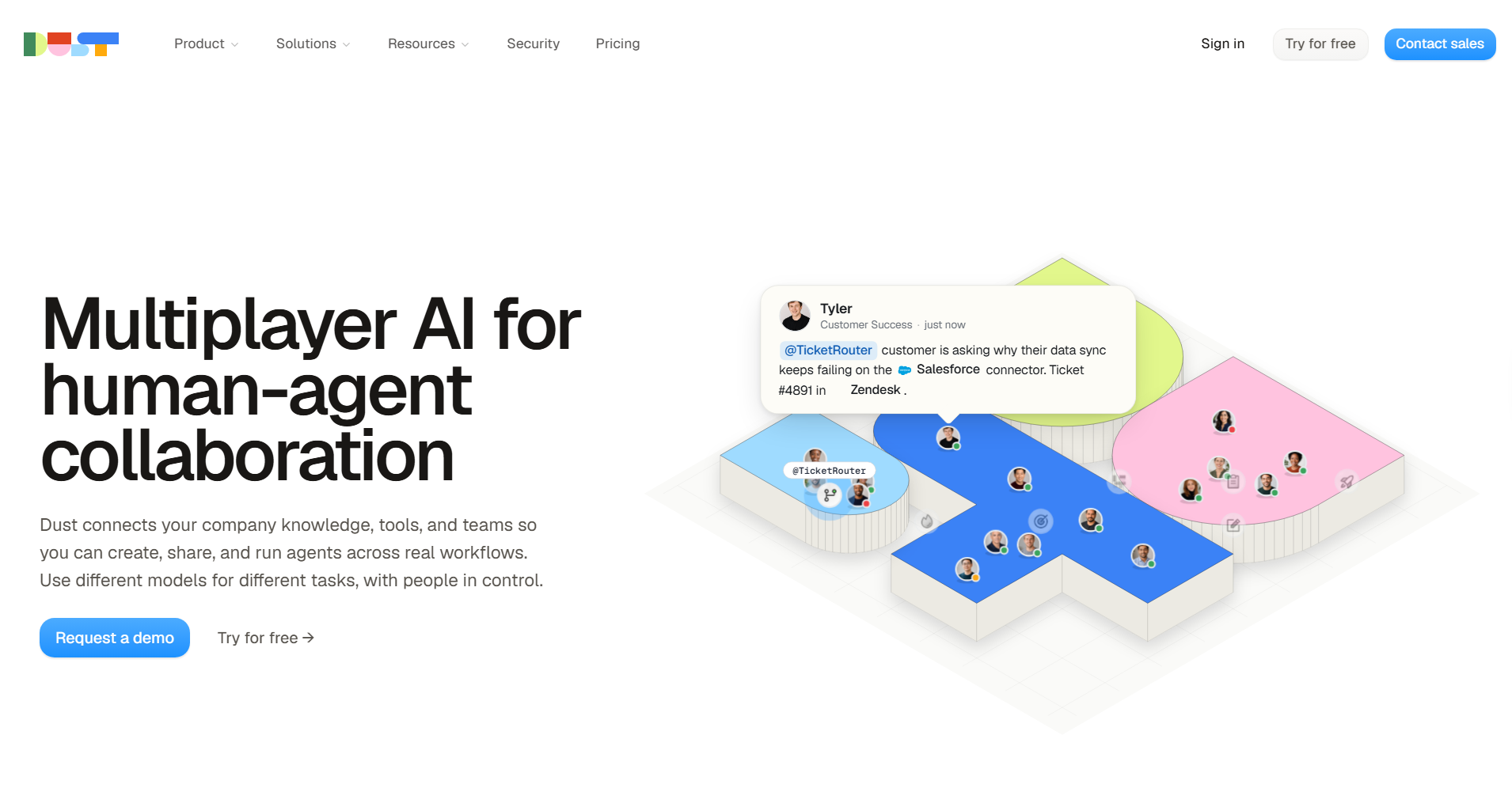
According to Dust, it combines access to your company data with AI agents that work on specific tasks for you. Dust describes its approach as "multiplayer AI," where teams across your organization build and share their own agents.
Dust's deployment
You get US or EU data residency, with a dedicated single-tenant option available on Enterprise if you need full isolation from other customers.
Dust's LLM and retrieval
According to Dust, you can choose from models by OpenAI, Anthropic, Google, or Mistral on a per-agent basis. Dust says its agents retrieve relevant information directly as part of their assigned tasks, respecting the access controls already in place on your connected systems.
Dust's connectors and security
Dust connects to 70+ tools, including Slack, Notion, Google Drive, GitHub, Salesforce, and Zendesk. It holds SOC 2 Type II certification, supports SSO and SCIM, and states that your data is never used to train its models.
One Model Forever? That's So 2023.
Fluso runs on multiple open-weight models so your AI enterprise search platform never locks you into one vendor.
Download FlusoMistral Vibe
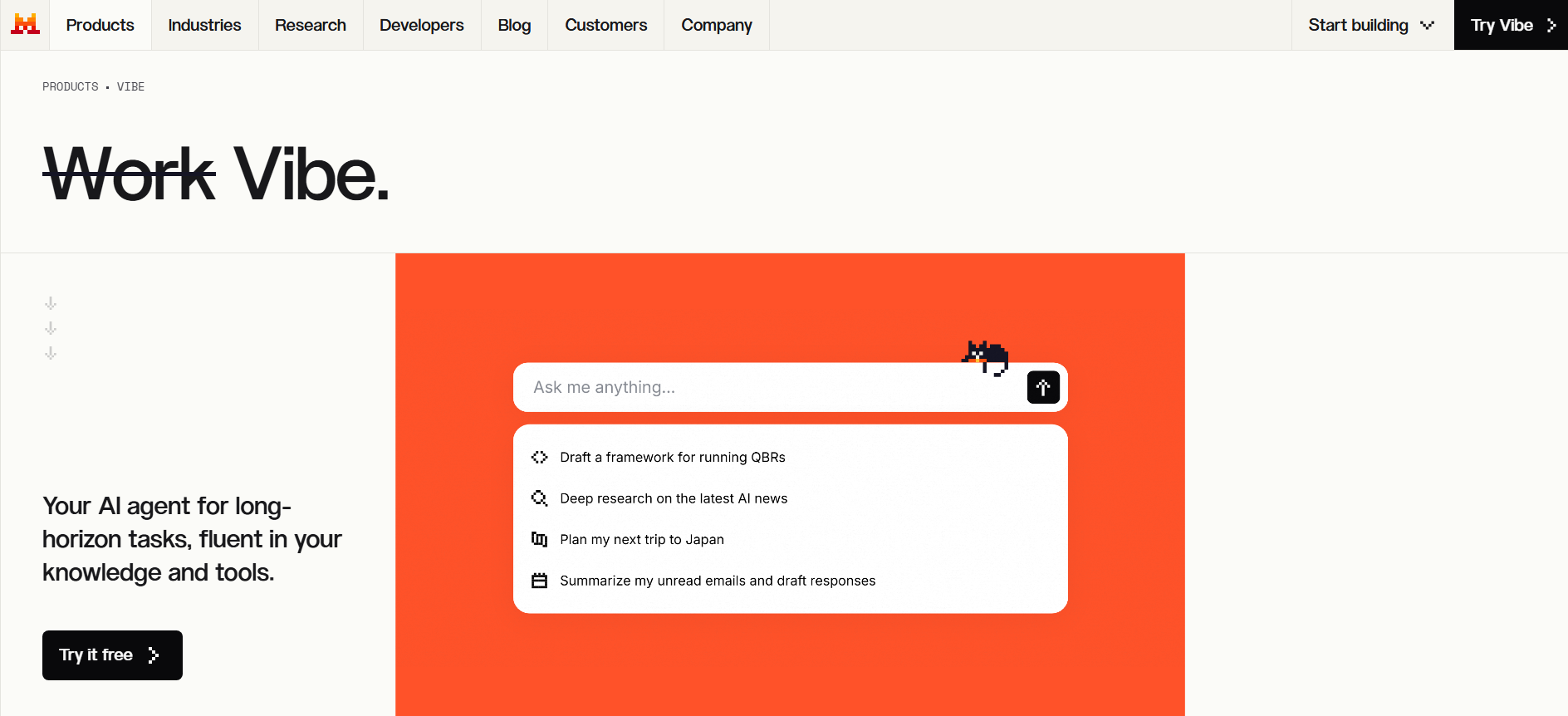
Mistral describes Vibe as bringing chat, agents, and enterprise search into one place, built by the only major AI provider headquartered in the EU.
Mistral Vibe's deployment
As per Mistral, you can deploy it on-premises, in a private cloud, or through Mistral Cloud, with data hosted in the EU by default and a US endpoint available when selected.
Mistral Vibe's LLM and retrieval
Mistral Forge lets you fine-tune your own models, and Vibe uses Knowledge Connectors to index your content so it can search and retrieve relevant information.
Mistral Vibe's connectors and security
Vibe connects to 100+ tools like SharePoint, Gmail, and Jira. One thing worth knowing: Mistral's Help Center says Vibe itself doesn't support Zero Data Retention, since it stores conversation history for the product experience; ZDR is only available separately through Mistral's API. Mistral also states that Vibe uses your input and output data for training by default, while Vibe Enterprise customers are opted out of training by default.
IntraFind iFinder
According to IntraFind, iFinder gives you deployment options built for data sovereignty, with a strong focus on keeping data inside Germany.
iFinder's deployment
As per IntraFind, you can run iFinder on-premises, use cloud services hosted in a German data center under ISO 27001 standards, or combine both through a hybrid setup.
iFinder's LLM and retrieval
According to IntraFind, you can plug in the LLM of your choice through its Enterprise AI Platform. iFinder uses semantic and phonetic search to find information across your systems, with its iAssistant grounding answers in your enterprise sources.
iFinder's connectors and security
With IntraFind, you get 80+ connectors, support for 600+ file formats, and rights- and role-based search profiles to control who sees what.
Make Enterprise Search Part of Your Everyday Workflow
Why jump between tabs when everything you need is in one secure place? Search More. Worry Less.
Get started with FlusoElastic
Elastic describes itself as the building blocks to build your own search experience, suited to teams with engineering resources to spare.
Elastic's deployment
As per Elastic, you can run it on Elastic Cloud, Elastic Cloud Serverless, self-managed, hybrid, on-premises, or air-gapped environments.
Elastic's LLM and retrieval
According to Elastic, it combines full-text and vector search into hybrid retrieval, and works with Elastic's own ELSER models or third-party models you integrate yourself.
Elastic's connectors and security
Ingestion pipelines and access controls are largely left in your hands to configure. Since Elastic is infrastructure rather than a turnkey layer, your implementation needs to map these controls carefully to the permissions applied to your connected enterprise data.
Glean
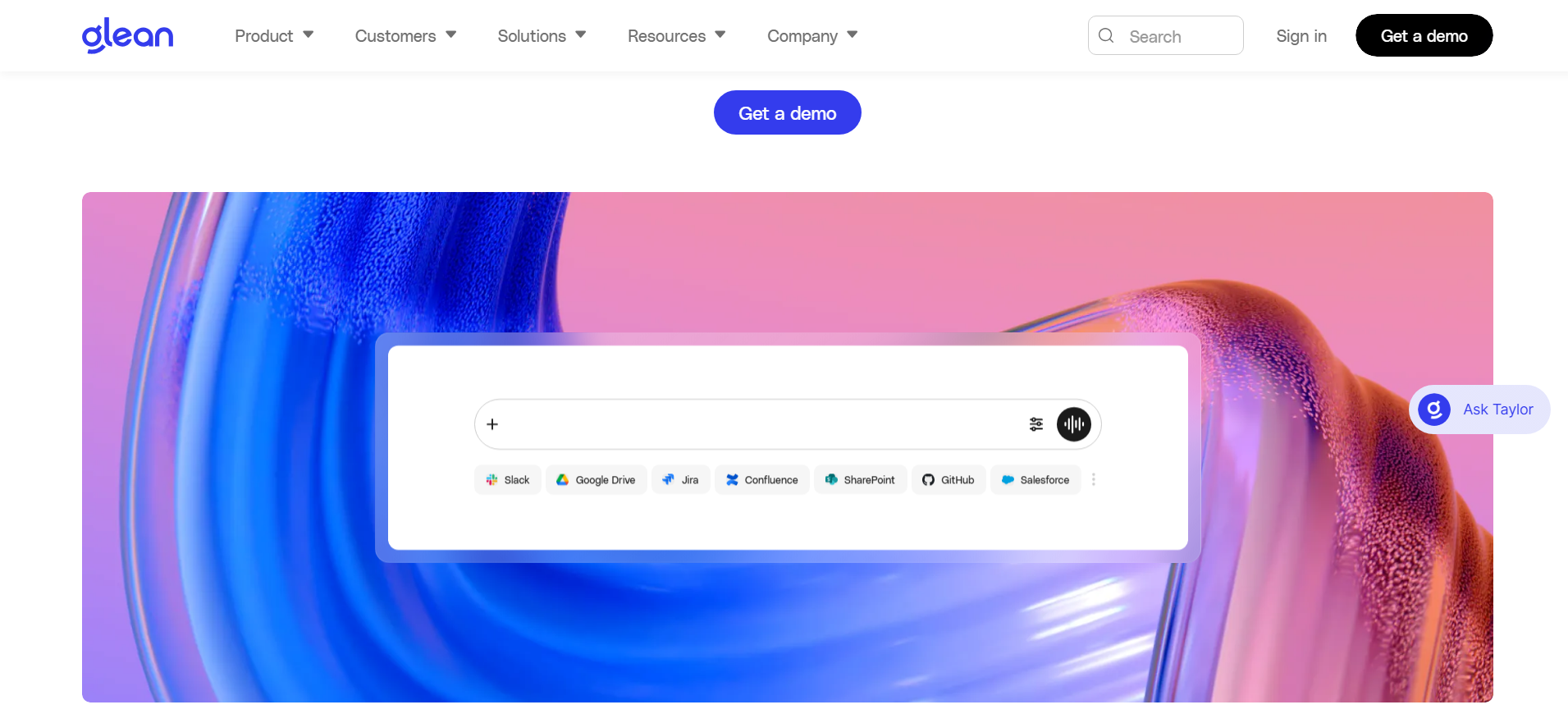
Glean describes its platform as connecting your company's applications through what it calls its Enterprise Graph, mapping documents, people, and relationships across your workplace.
Glean's deployment
With Glean, you can deploy it in a single-tenant environment or use customer-managed deployment in your own cloud environment, including AWS, Azure, or GCP.
Glean's LLM and retrieval
According to Glean, you can choose your own underlying LLM through its Model Hub, which supports both commercial and open models.
Glean's connectors and security
Glean says it supports 275+ applications, with permissions-aware retrieval that updates in real time as access changes.
Make Enterprise Search Part of Your Everyday Workflow
Why jump between tabs when everything you need is in one secure place? Search More. Worry Less.
Get started with FlusoFluso: One enterprise search platform for all your company knowledge
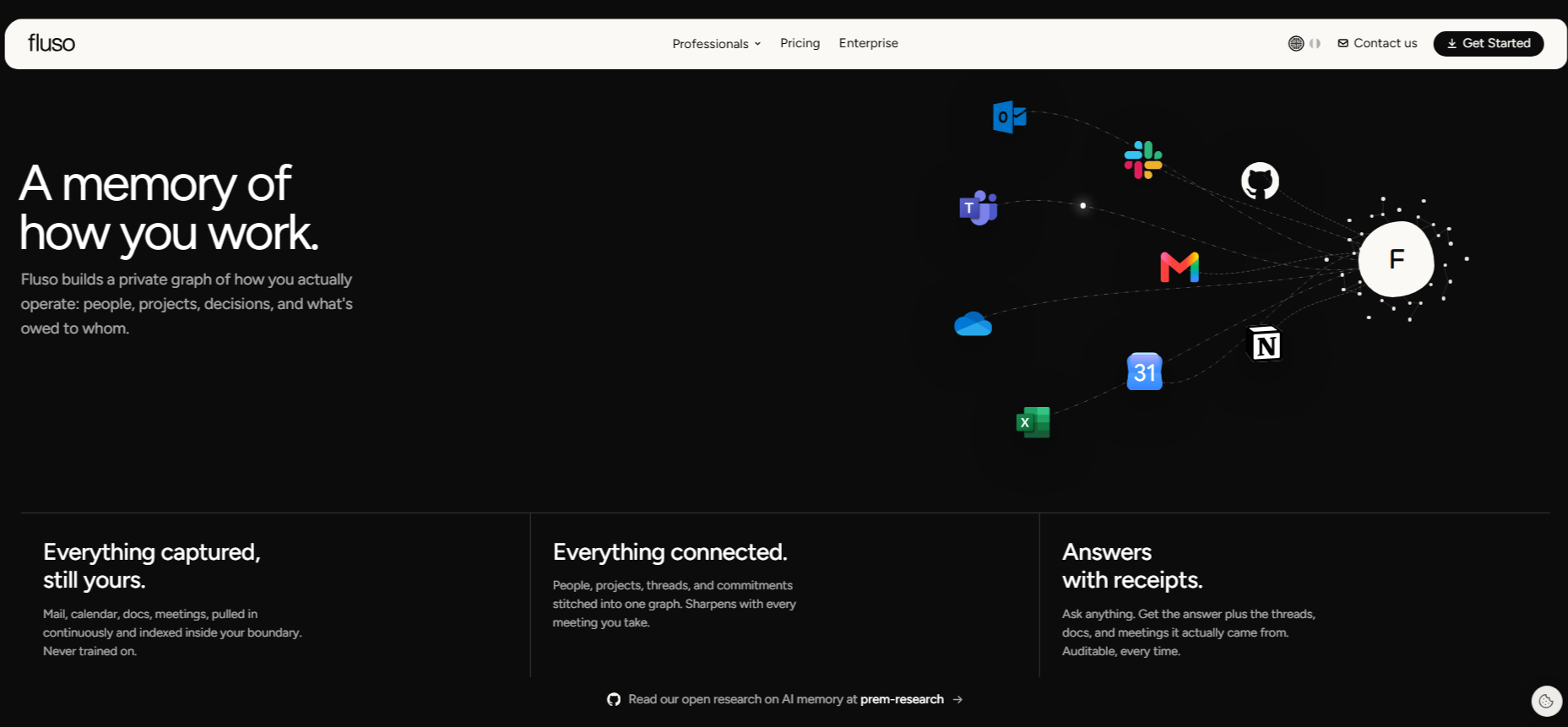
Once you connect AI to your company's internal knowledge, you need visibility into how that information is being used. You need to know what the AI can access and what sources were used to generate an answer.
Fluso gives you exactly that.
It's a private AI workspace for managing your company's knowledge. You can trace AI-generated answers back to the documents or meetings used to generate them, giving your team a clear way to review what the AI relied on.
With Confidential Mode, your data is processed on hardware-based infrastructure your team can verify independently.
Fluso runs on open-weight models, giving your team flexibility as your AI requirements change, and your data is never used to train models.
Bring your enterprise knowledge into one private AI workspace, download Fluso and get started today.
FAQs About AI Enterprise Search Platforms
What is an AI enterprise search platform?
An AI enterprise search platform connects your company's internal systems, such as email, wikis, CRM tools, documents, and knowledge bases. You can search across this information using natural language and receive AI-generated answers grounded in the data your platform retrieves.
Does an AI search tool bypass existing access permissions?
Your AI search platform should carry your existing access permissions into search and retrieval. A user should only receive information they are authorized to access. Your existing permissions still matter because AI can make information much easier to find. Before connecting your data, review whether users and groups have the right level of access across your connected systems.
What's the difference between enterprise search and a knowledge graph?
Enterprise search helps you find relevant information across your company's systems. A knowledge graph maps relationships between people, projects, documents, systems, and other entities. This gives your AI system additional context about how different pieces of information relate to each other.
Can enterprise search platforms be deployed on-premises?
Yes, some enterprise search platforms support on-premises deployment. You can also find private cloud, hybrid, managed cloud, and air-gapped options. The right deployment depends on where you need your data processed, the controls your organization requires, and any regulatory requirements that apply to your workloads.
Does using an AI search tool mean my data trains someone else's model?
That depends on the provider's data and training policies. Before connecting sensitive company information, check whether your data can be used for model training and review the provider's retention terms separately. These are different parts of the data policy and should both be evaluated.
Why does LLM flexibility matter for enterprise search?
Your choice of LLM can affect your search costs, response quality, performance, and future AI strategy. When your platform supports multiple models, you have more flexibility to change models as your requirements, pricing, and available capabilities evolve.
How many connectors does an enterprise search platform typically need?
The number you need depends on the systems your organization uses. You should check whether the platform connects to your core business applications and whether those integrations preserve the permissions associated with your data. A large connector count is useful when it covers the systems your teams actually rely on.
Is a fully cloud-native enterprise search platform less secure than an on-premises one?
Security depends on how your chosen platform handles access controls, encryption, data processing, retention, and auditability. An on-premises deployment can give you more direct control over your infrastructure and data environment. A cloud deployment can provide different operational and security controls. Your requirements should determine which deployment model fits your organization.
What should I check before connecting an enterprise search platform to sensitive company data?
Start by checking where your data is processed and how your existing permissions are enforced. You should also be able to understand which sources were used to generate an answer and review the security controls behind the platform. These checks give you a clearer picture of what happens to your information once it enters an AI search system.
Why is Fluso by Prem AI a good fit for private knowledge management?
Fluso gives you a private AI workspace for working with your company's knowledge. Your data is processed on Prem AI's confidential computing infrastructure, with hardware-based protections your team can verify independently. Fluso runs on open-weight models and gives you traceability into the sources behind AI-generated answers. This gives your team greater visibility into how your enterprise knowledge is being used through AI.
See how Prem AI can help your enterprise build private AI without compromising control over your data and infrastructure. Contact our sales team or email us at sales@premai.io.