
Private AI for Financial Services: Building Secure, Sovereign AI for Sensitive Financial Data
In October 2025, according to Fortune, Deloitte's Australian arm was paid AU$440,000 for a 237-page report on the country's welfare penalty system. When Sydney University researcher Chris Rudge reviewed it, he found references to academic papers that did not exist, a made-up quote from a federal court judge, and around 20 other errors. "I instantaneously knew it was either hallucinated by AI or the world's best-kept secret," he said.
Deloitte later confirmed the errors, disclosing that it had used Azure OpenAI to help create the report.
It contained the kind of confident, unverified errors AI can produce, and a government relied on it for decisions affecting thousands of people.
That is the real risk behind AI adoption in financial services. Your investment team may use AI to analyse earnings reports. Your compliance team may use it to review regulatory filings. Your operations or finance team may use it to process thousands of records. Each use case makes sense, but each involves sensitive data, financial decisions, and AI outputs that someone will rely on.
The key is being able to verify AI outputs before they influence business decisions.
So what does that verification require? It starts with choosing the right way to deploy AI and protecting your data while it is being processed.
Risks of using AI in financial services
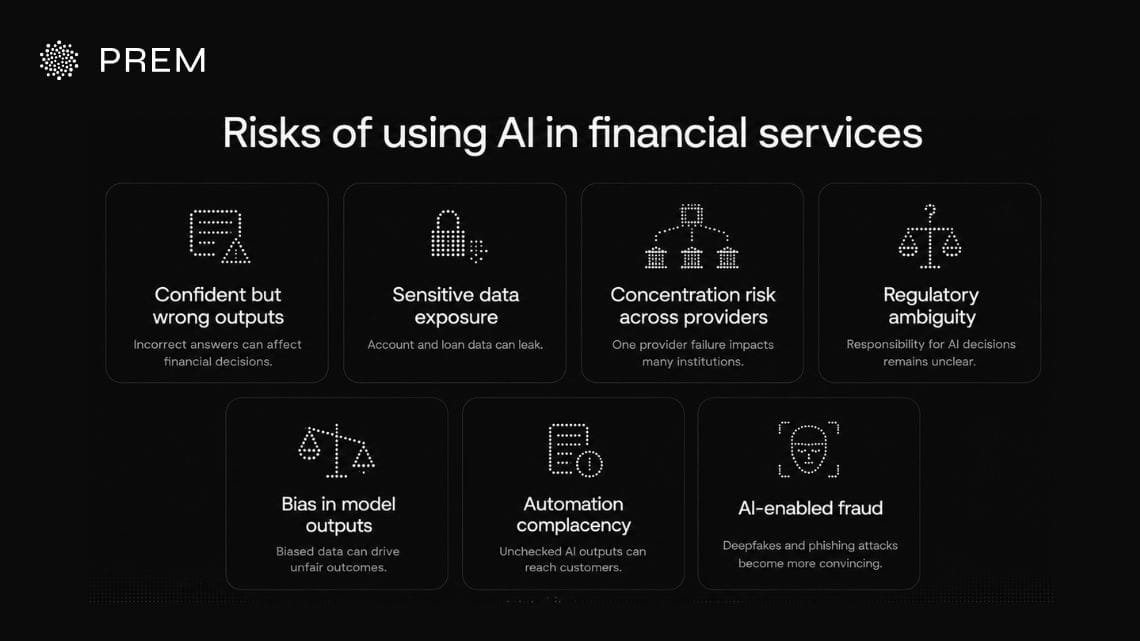
The more financial institutions use AI, the more these risks can grow. AI is not inherently unsafe, but mistakes can be costly when financial data and decisions are involved.
| Risk | What it means |
|---|---|
| Confident but wrong outputs | AI can provide incorrect information with high confidence. If that output is used in a loan decision or investment report without verification, the consequences can affect a customer's finances. |
| Sensitive data exposure | Systems handling account numbers, transaction histories, and loan files are highly vulnerable. Sensitive data can easily leak through a simple human error like uploading the wrong document. It can also happen through targeted prompt attacks designed to trick the AI into revealing private information. |
| Concentration risk across providers | Many institutions use the exact same AI platforms. This creates a major vulnerability for the industry. If one AI provider has a security breach or a system failure, it instantly impacts multiple financial companies at the same time. |
| Regulatory ambiguity | It is still not always clear who is responsible when AI makes a bad financial decision, such as wrongly rejecting a loan or giving poor financial advice. Regulators are still working out how existing rules apply to AI. |
| Bias in model outputs | AI can learn unfair patterns from old or biased data. This could lead to some people being treated unfairly when applying for loans or credit. |
| Automation complacency | When employees get used to AI giving useful answers, they may stop checking those answers carefully. That can allow mistakes to reach real customers and affect financial decisions. |
| AI-enabled fraud | Criminals can use AI to create realistic deepfakes, fake voices, and more convincing phishing messages. This gives financial institutions more sophisticated fraud attempts to deal with. |
This is why more financial institutions are looking at private and sovereign AI. These approaches give institutions greater control over how their data is processed, where AI systems run, and how security measures are verified. They cannot remove every risk, but they can help reduce some of the biggest risks above.
Build Financial AI Around Your Data and Jurisdiction
Keep greater control over where your AI workloads run and how your financial data is handled.
Talk to Prem AIWhat Private AI means for financial services enterprises
For your enterprise, this means running AI in an environment where you can clearly define how your data is handled and who can access the underlying systems.
You can manage key areas such as infrastructure and workload location.
There isn’t one setup that works for every financial institution. You might want to run models on your own servers, use a private cloud or VPC, or may even use infrastructure built around confidential computing, based on how sensitive your workloads are and what your security team requires.
The easiest way to understand these differences is to compare what each approach gives your organisation control over.
| PUBLIC AI | PRIVATE AI | SOVEREIGN AI | |
|---|---|---|---|
| Where AI runs | Provider-managed infrastructure | Infrastructure controlled or dedicated to your organization | Infrastructure under defined national, organizational, or jurisdictional control |
| Data control | Primarily governed by provider architecture and contract | Greater control over data, access, and processing | Control extends to data, infrastructure, jurisdiction, and legal authority |
| Deployment | Public APIs or shared cloud services | On-premises, private cloud, or private VPC | Sovereign infrastructure, private environments, or nationally controlled cloud |
| Data residency | Depends on provider and configuration | Can be defined through deployment and infrastructure choices | Determined by specific jurisdictional and sovereignty requirements |
| Third-party dependency | Generally higher | Can be reduced | Designed to minimize reliance on external infrastructure or jurisdictions |
| Typical use in finance | General-purpose AI workloads | Sensitive internal workloads | Highly regulated or strategically sensitive workloads |
Private AI vs. public AI
Let’s start with the simplest comparison.
When you use a public AI service, your request is typically processed through infrastructure operated by an external provider. That can be perfectly practical for everyday tasks, but when you’re dealing with financial data, you may want much more control over where that information goes and how it is processed.
With private AI, you can control or isolate the environment where your sensitive AI workloads run. That can include the infrastructure, network access, data flows, and permissions around the system.
But there’s an important detail here.
Private does not automatically mean fully controlled. A private VPC, for example, gives you a private network boundary, but it does not necessarily mean that every part of the AI stack is under your control.
So when you evaluate a private AI platform, look beyond the label. Ask what you actually control, what the provider controls, and where your data moves during the AI workflow.
Private AI vs. sovereign AI
Private AI and sovereign AI are related, but they are not the same thing.
Private AI is mainly about controlling or isolating your AI workloads. Sovereign AI goes further. It also considers where the data and infrastructure are located, who owns and operates them, which laws apply, and who ultimately has legal authority over the environment.
For example, you might need customer data to remain within the EU or Switzerland. You may also need the infrastructure to process that data to remain under specific legal and operational controls.
In that situation, simply choosing a private deployment may not be enough.
You need to look at the whole setup: location, ownership, jurisdiction, infrastructure, and any external services or dependencies involved.
What "data never leaves your perimeter" really means
This is a phrase you’ll hear quite often when evaluating private AI.
In simple terms, “data never leaves your perimeter” means your sensitive information stays within the infrastructure and network environment you have designated for that workload.
For a financial institution, that could be your own data centre, a private cloud, a VPC, or any other isolated computing environment.
But suppose one of your analysts needs AI to summarise a confidential earnings report. The document has to reach the environment where the model is running so the AI can process it.
If that environment is controlled by your enterprise, the document does not need to be sent to a public AI service just to get the summary.
But there’s another question you should ask: What happens to the data while the model is actually processing it?
Encryption at rest protects stored data. Encryption in transit protects data as it moves between systems. But neither one, by itself, answers what happens to sensitive information during inference.
That is where technologies such as confidential computing become important. They can help protect data while it is being processed and, depending on the implementation, provide additional ways to verify the computing environment handling the workload.
So when you evaluate private AI for financial services, don’t stop at “Is it private?”
Look at where your data goes, who controls the environment, what happens during inference, and what evidence you have that those protections are actually working.
Protect Financial Data While AI Is Processing It
Use confidential computing and hardware-based attestation to protect sensitive data during AI inference.
Talk to Prem AIWhat financial services enterprises need from a private AI platform
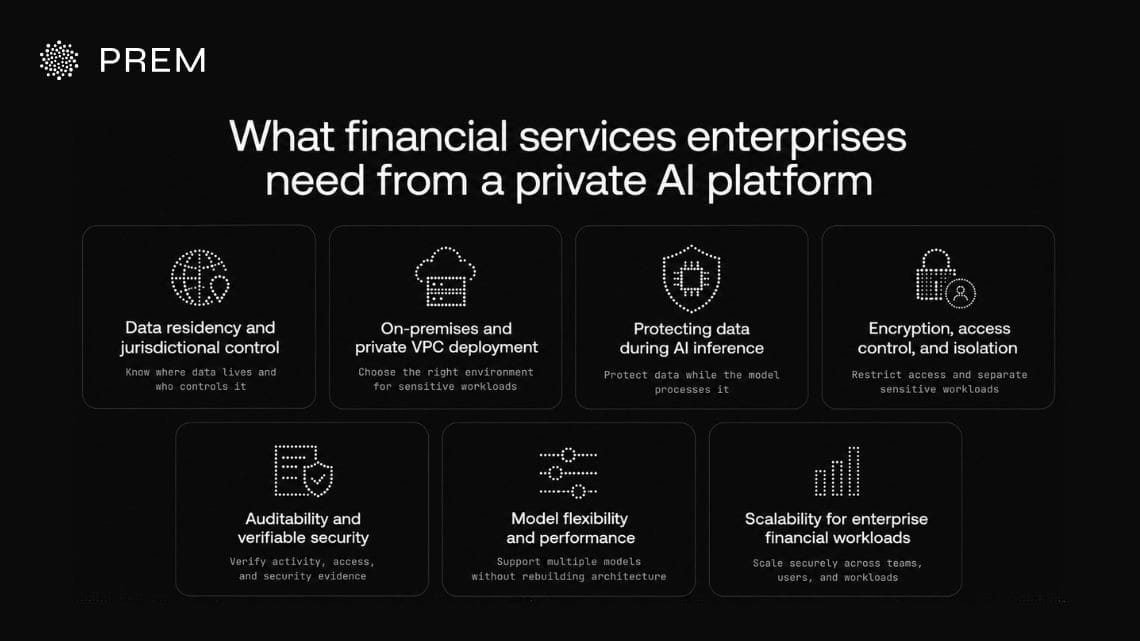
Now let’s understand what to look for when you’re evaluating one for your financial institution.
Because it matters a lot whether the platform gives you the controls you need once you put real financial workloads on it.
Data residency and jurisdictional control
If you’re handling customer information, transaction data, or confidential financial research, you may have specific requirements around where that data can be stored and processed.
In order to do that, you need to understand which legal jurisdiction applies to the provider, who owns the infrastructure, and whether any third parties or vendors can access or process your data.
So when you evaluate a platform, look at both where your data is and who has legal control over the environment handling it.
According to the BBC, in 2023 Ireland's Data Protection Commission fined Meta €1.2 billion for unlawfully transferring European users' personal data to the United States. It was the largest GDPR fine at the time and showed how data location can have real regulatory consequences.
On-premises and private VPC deployment
Sensitive AI workloads often need more control than a standard shared environment can provide.
According to VRLA Tech, financial institutions were early adopters of on-premises AI because IP sensitivity and data governance can make cloud AI a poor fit for some quantitative and risk workloads.
With an on-premises deployment, you run AI on infrastructure managed by your enterprise. A private VPC gives you a dedicated network boundary within your cloud environment, with greater control over networking, access policies, infrastructure, and data flows.
Make sure your deployment model fits how sensitive your workloads are and how much control your security team needs over the infrastructure.
Protecting data during AI inference
This is one area that deserves more attention.
Your data needs protection when it is stored and when it moves between systems. But what happens when the AI model is actually using that data to generate an answer?
That is where private AI inference becomes important, because sensitive information needs to remain protected while the model is processing it.
Look for architectures that protect data during processing, not just at rest or in transit. Confidential computing can provide one approach by creating protected environments for sensitive workloads while they are being processed.
Prem AI's Enclave API runs inference inside hardware-sealed Trusted Execution Environments, so your data stays protected even while the model is processing it.
Encryption, access control, and isolation
Encryption at rest and in transit protects data as it is stored and moved. Identity and access controls, role-based permissions, network isolation, and workload-level controls add another layer around who can reach that data and how the system can be used.
Isolation becomes especially important in a financial environment. Different teams may be working with completely different sets of sensitive information, so one workload should not automatically have access to another team's data just because both run on the same platform.
With Enclave API, each enclave keeps its own KV cache inside protected memory, so cached context is never shared across enclaves, and one workload cannot read another's data.
Auditability and verifiable security
A compliance certificate can tell you that certain controls have been assessed. It doesn't necessarily tell you what happened to your specific AI workload.
That is why auditability matters. Your security team should have visibility into access and activity, while stronger technical controls can provide evidence about the environment processing your data.
Audit logs help track what happened and who accessed the system. Hardware-based attestation can go further by providing cryptographically verifiable evidence about the computing environment running the workload.
For sensitive financial data, that difference matters. You shouldn't have to rely entirely on what your AI provider says. You should have a way to verify important security properties for yourself.
Prem AI's Enclave API supports this with hardware-signed attestation, which your team can verify independently before sending sensitive data.
Model flexibility and performance
Security is only one part of the decision. The AI still has to perform well for the work your teams actually do.
A bank could use different models for financial research, document analysis, etc. Those requirements can change quickly as new models become available.
A multi-model platform gives your teams more room to adapt. Support for open-weight models can add another layer of flexibility, particularly when you want greater control over where models run or how they are customised.
Prem AI's Enclave API supports confidential model families, including Qwen 3.8, DeepSeek v4 Flash, and DeepGram for audio transcription. If your applications already use the OpenAI API, you can switch to Prem AI by changing the API base URL.
This makes it easier to adopt new models without rebuilding your existing AI architecture each time.
Scalability for enterprise financial workloads
An AI pilot with ten employees tells you very little about what happens when thousands of employees start using it.
At an enterprise scale, inference capacity and GPU availability become important. So do concurrent users, data volumes, integrations, and the number of workloads running at once.
Once AI moves beyond a small pilot, more people are using it, more data is being processed, and more workloads are running across your teams and systems.
Prem AI's Confidential API and Zero Data Retention APIs have already processed 3.8 billion tokens across 124,000 requests and 11 models. This shows the platform can support significant AI inference volumes across multiple models and workloads.
The right private AI platform should scale with your financial workloads while keeping your data protected and your organisation in control. Your security team should have the visibility to understand how those workloads are handled, where they run, and who can access them.
Prem Confidential API's and ZDR API's have already processed 3.8 billion tokens across 124,000 requests and 11 models.
— Prem (@premai_io) September 9, 2026
None of those 3.8 billion tokens is sitting on a server anywhere. Your prompts and completions aren't written to a log or a cache, and they're not used to train… pic.twitter.com/p9BZR9eJGd
Common mistakes to avoid when choosing private AI
When you’re evaluating private AI for a financial institution, the obvious questions are usually about models, pricing, and deployment. But the details that create problems later often sit somewhere else.
Before you make a decision, here are a few mistakes worth avoiding.
| Common mistake | What to check |
|---|---|
| Assuming private means fully secure | A private deployment gives you more control. Check what happens to your data during inference and who can access the underlying infrastructure. |
| Looking only at data residency | Check the provider’s jurisdiction, infrastructure ownership, and third-party dependencies alongside where your data is processed. |
| Locking yourself into one model or deployment | Your AI requirements will change as you adopt more use cases and new models become available. Look for flexibility across models and deployment options. |
| Treating compliance as proof of security | Certifications and compliance reports are useful. Also ask what technical evidence you get about how your data is processed and protected. |
| Leaving verification until later | Build verification into your evaluation from the start. Check what your security team can actually verify about how your data is processed and protected. |
Build Financial AI Around the Models You Need
Access multiple AI models through a flexible infrastructure built for sensitive enterprise workloads.
Talk to Prem AIWhat to look for in a private AI platform for financial services
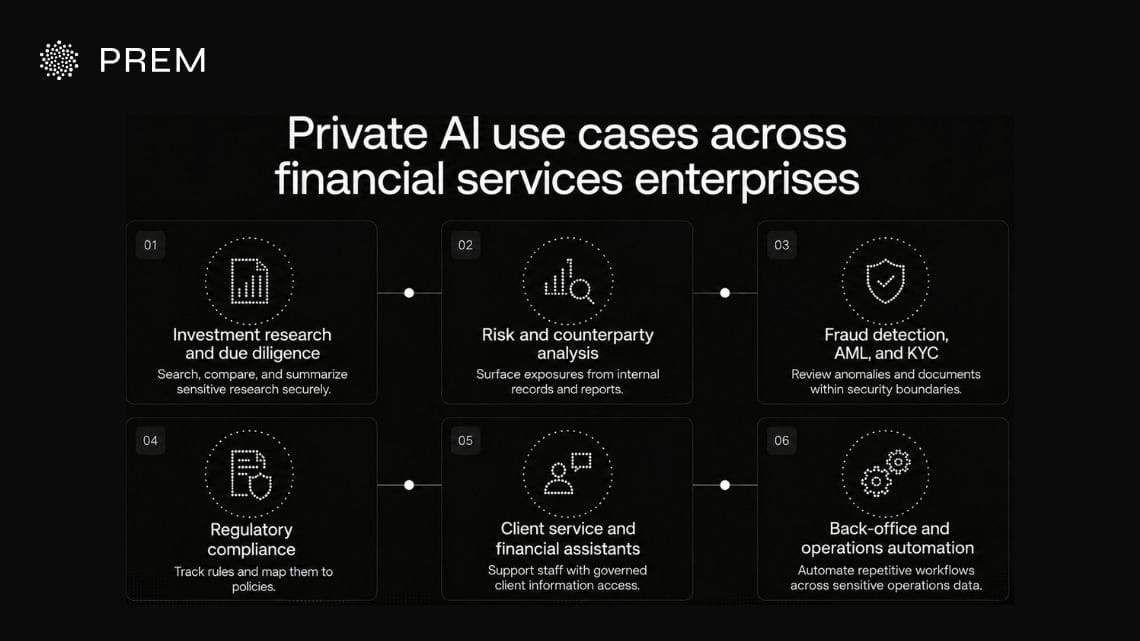
Once the security and deployment side is clear, the next question is more practical: where can you actually use private AI across your financial operations?
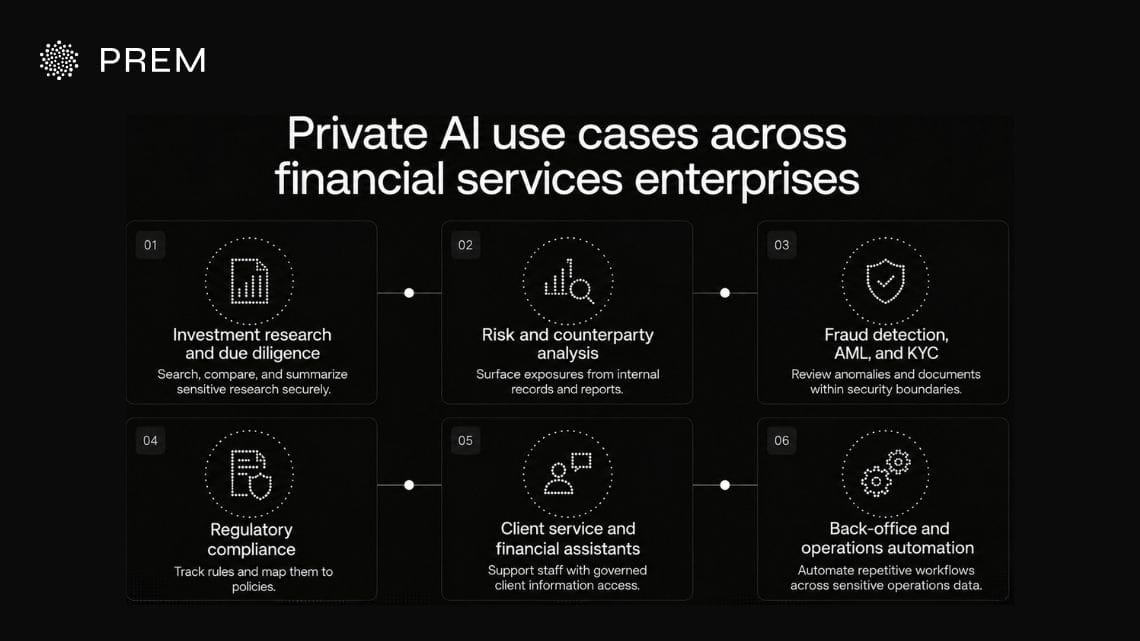
The answer goes well beyond chatbots. Private AI can support teams working with sensitive research, customer information, regulatory documents, and operational data while keeping those workloads within the controls your organization requires.
Investment research and due diligence
Investment teams work with large volumes of earnings reports, market research, filings, portfolio information, and internal analysis. Private AI can help teams search, compare, summarise, and analyse these materials without moving sensitive research into a public AI environment.
Risk and counterparty analysis
Risk teams need to bring together information from financial records, reports, contracts, and other internal sources. Private AI can help analyse this information and surface relevant risks while keeping the underlying data within a controlled environment.
Fraud detection, AML, and KYC
Fraud, AML, and KYC processes involve highly sensitive customer and transaction data. Private AI can support document review, anomaly detection, customer risk analysis, and investigation workflows while keeping these workloads within your security boundaries.
Regulatory compliance
Compliance teams spend significant time reviewing regulations, policies, reports, and internal documentation. Private AI can help compare regulatory requirements, identify relevant changes, and connect them with internal policies without sending confidential compliance data to a public AI service.
Client service and financial assistants
AI assistants can help employees answer questions, retrieve client information, prepare summaries, and support customer-facing workflows. With private AI, these assistants can work with approved internal data while maintaining the access controls and governance required for financial services.
Back-office and operations automation
A large part of financial operations involves repetitive work across documents, records, emails, and internal systems. Private AI can help automate tasks such as document processing, reporting, reconciliation support, and workflow management while keeping sensitive operational data within a controlled environment.
Build Private AI for Your Financial Workloads
Bring private infrastructure, confidential computing, verifiable security, and model flexibility together for sensitive AI workloads.
Talk to Prem AIPrivate AI deployment models for financial services
Once you know where private AI fits into your operations, the next decision is how you actually deploy it. There isn't a single right answer here. The best deployment model depends on how sensitive your workloads are, what your regulators expect, and how much control your security team needs over the infrastructure.
On-premises AI infrastructure
On-premises deployment means running your AI workloads on infrastructure your enterprise owns and manages directly, inside your own data centre.
While many financial institutions now use hybrid or multi-cloud environments, keeping AI infrastructure in-house can still make sense for critical workloads, especially when data residency rules require it.
Data leakage is a major AI security concern for financial institutions. According to the Cloud Security Alliance's State of Cloud and AI for Financial Services 2026 report, 61% of respondents cited it as their main concern, ahead of model attacks, prompt injection, and other adversarial techniques.
Security and data leakage are also a top challenge for 55% of community banks surveyed by Wolf & Company.
Keeping the infrastructure in-house gives your team direct control over the hardware, network, and AI stack, without relying on a third party's infrastructure decisions.
That control also comes with more responsibility. Your team needs to manage GPU capacity, scaling, maintenance, security patching, and the expertise needed to keep the system running reliably as usage grows.
This approach makes the most sense when you already have data centre infrastructure, handle highly sensitive workloads such as core banking data, or need your AI infrastructure to remain under your direct control because of regulatory requirements.
Private cloud and VPC deployment
Choosing a private cloud or virtual private cloud (VPC) deployment provides a dedicated, isolated environment inside a cloud provider's infrastructure.
This approach reflects where much of the industry is heading right now. Forrester's 2026 predictions indicate that at least 15% of enterprises will shift toward private AI deployments built on private clouds this year. Their motivations align perfectly with the core worries of financial institutions, specifically rising AI costs, data lock-in risks, and the operational vulnerabilities exposed by major cloud outages in 2025.
The main advantage is that, unlike a traditional on-premises setup, you do not have to manage physical hardware. At the same time, unlike standard public AI services, your workloads run within a network boundary dedicated to your organisation. This means you retain full control over access, routing, and data flows.
This strategy works well when you need strong isolation while still wanting the flexibility and lower operational burden of the cloud.
There is, however, an important point to consider. A private environment does not automatically give you full control. A VPC provides a secure network boundary, but you still need to verify how your data is handled during processing, who has access to the underlying infrastructure, and how the provider’s jurisdiction affects your compliance.
Air-gapped AI environments
If you need maximum security, an air-gapped environment takes isolation to the absolute limit. It completely severs the link between your AI tools and external networks. This means no internet access, zero external API calls, and no data movement unless it passes through a strict, manual verification process.
Historically, stronger security meant less flexibility. Many AI tools lose their agentic capabilities when they are disconnected from the network. Financial institutions need to consider this trade-off when choosing a deployment model.
When you are managing ultra-sensitive workloads such as core transaction systems or heavily regulated sovereign data, this trade-off is often worth it. The isolation gives you a stronger network boundary, even if it means planning carefully around model updates, data transfers, and which tools your AI workloads can actually use.
Build AI Around the Security Boundary You Need
Choose an AI architecture that gives your finance team greater control over data and workloads.
Talk to Prem AIHow confidential computing protects sensitive financial data
By now, you may have decided where your AI runs: on-premises, in a private VPC, or fully air-gapped. But location alone doesn't answer everything. There's still the question of what happens to your data the moment the AI actually starts working with it.
Why encryption at rest and in transit is not enough
Encryption at rest protects your data when it's stored. Encryption in transit protects it while it moves between systems. Most financial institutions already have both, and regulators expect it.
But neither protects data while it's actually being processed. And that gap matters a lot. According to IBM's 2026 Cost of a Data Breach Report, financial services breaches now cost USD 6.29 million on average, 26% above the global figure. Institutions took roughly 220 days to identify and contain a breach.
In many of these breaches, the data was already encrypted at rest and in transit. Therefore, the most important question to address is what occurs in the operational gap between those two points. You need to look closely at the moment your data gets decrypted so an AI model can perform its work.
Protecting data during AI inference
When an AI model processes a document, a transaction record, or a customer query, it has to work with that data in an unencrypted, readable form. That's simply how computation works.
During inference, your data is decrypted in memory so the model can process it. That memory also contains the model's weights and the intermediate processing steps generated along the way. On a standard server, all of this becomes part of the attack surface. Anyone with sufficiently privileged access to the underlying infrastructure, including, in theory, the cloud or AI provider, could potentially access it.
This is exactly the gap confidential computing is built to close. It protects data while it's being computed on, not just before and after.
TEEs for confidential AI
Trusted Execution Environments, commonly known as TEEs, are isolated hardware regions that keep data and code encrypted even from the infrastructure operator or anyone outside the enclave itself. The primary hardware foundations supporting this technology are Intel TDX, AMD SEV-SNP, and NVIDIA's Confidential Computing mode on Hopper and Blackwell GPUs.
Financial services are already actively adopting this shift. According to a Confidential Computing Consortium study, 75% of enterprises are now adopting confidential computing in some form. In fact, financial services lead every other regulated industry in full production deployment at 37%, placing it well ahead of healthcare at 29% and government at 21%.
This high number is no coincidence. Financial institutions handle some of the most heavily regulated, high-value data in the world, and TEEs offer them a concrete way to mathematically prove data protection.
Hardware-based attestation and verifiable security
A TEE only protects you if you can actually verify that it is genuine. Without that visibility, you are simply back to trusting a claim instead of checking a fact.
This is why hardware-based attestation is critical. It generates a cryptographically signed report proving that the hardware configuration is secure and running the intended workloads before your data ever leaves your control. In the CCC study mentioned earlier, 73% of organisations named confidentiality backed by proven technical assurances as one of the strongest benefits of adopting the technology, second only to improved data integrity.
Build Financial AI Around Your Data
Build AI for financial risk and compliance while keeping greater control over your data and AI workflows.
Talk to Prem AIHow Prem AI enables secure, sovereign AI for financial services
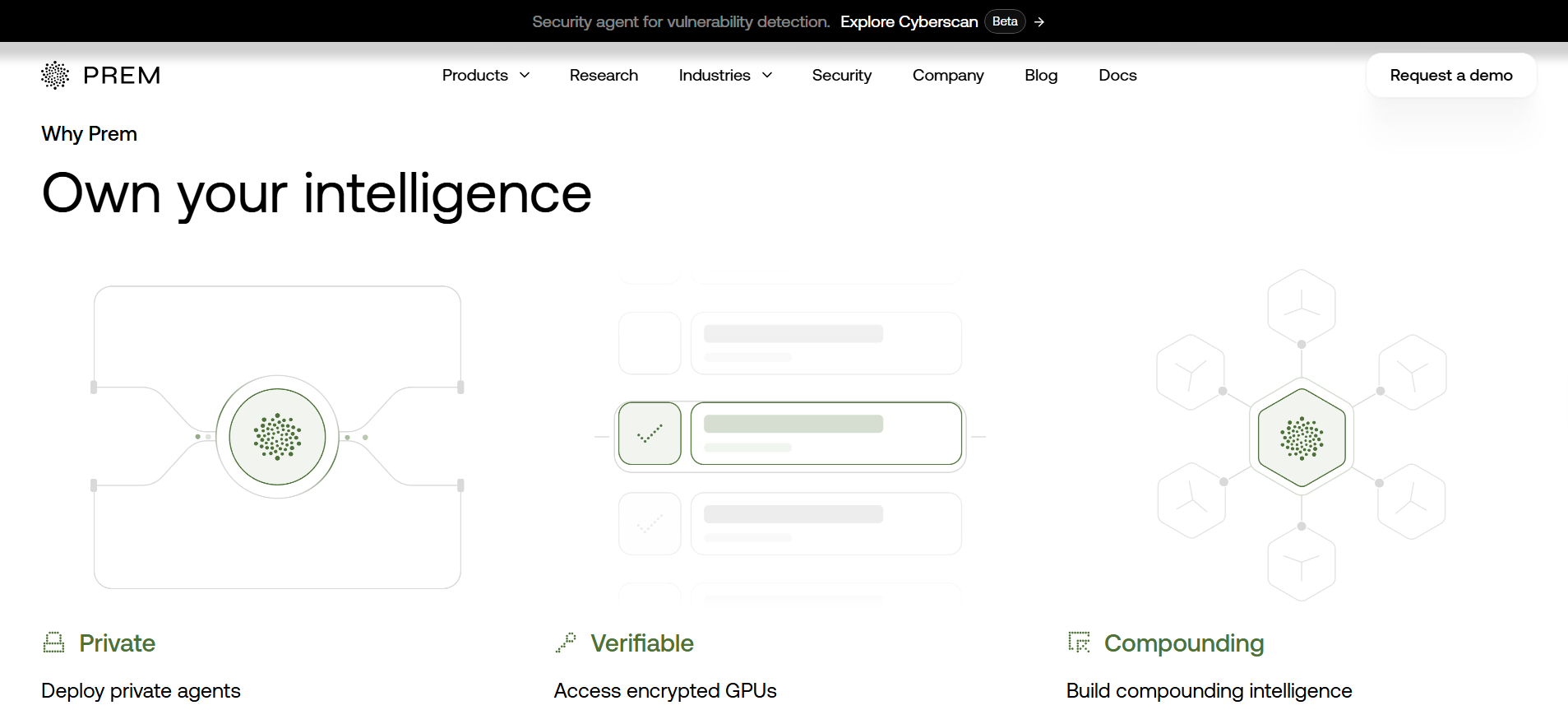
Everything we've covered so far comes down to one question: Can you actually get AI that's this useful without giving up control of your data? Prem AI is built to answer that, specifically for financial institutions.
Build private financial agents with Fluso
Fluso is Prem's agentic workspace for teams that need AI to work across earnings reports, compliance documents, and internal research. It connects your existing tools and learns from how your team works, including what gets edited or rejected.
For financial institutions, Fluso can handle multi-step tasks such as investment research, compliance document review, and KYC workflows. It runs on open-source models, keeping you flexible instead of locked into one provider.
Bring Private AI Into Your Financial Workflows
Connect your financial data, tools, and AI workflows in a private workspace built for enterprise teams.
Get started with FlusoRun confidential AI inference with Enclave API
Enclave API provides confidential AI inference for LLMs, vision models, and transcription through a single, OpenAI-compatible API, so you can switch models without rebuilding your integrations.
For financial workloads, this flexibility supports use cases such as investment research, fraud detection, and compliance review, where different tasks may require different models. Your data is encrypted before it leaves your system and processed inside a hardware-isolated environment, where it stays invisible to Prem.
Run Financial AI With Verifiable Security
Build on an OpenAI-compatible API with confidential inference and hardware-based attestation.
Get started with Enclave APIVerify AI execution with hardware-based attestation
Verification isn't a one-time step during setup. Prem's SDK uses Reticle to check attestation on an ongoing basis, so your security team isn't relying on a single check made once and forgotten.
This means your team can independently verify that the workload is running in the expected environment.
Build private & sovereign AI for financial services with Prem AI
Prem AI gives financial enterprises a way to build and run AI with greater control over their infrastructure and workloads.
With private AI infrastructure, confidential computing, and hardware-based attestation, you can protect sensitive data while it is being processed and verify the environment handling your workloads.
You can choose the models and AI capabilities that fit your workloads while keeping greater control over how your data is processed and protected.
Want to see how private AI could work for your financial workloads? Talk to our team and tell us what you're trying to build, where your data needs to stay, and how much control you need over the infrastructure. You can also email us at sales@premai.io.
Frequently asked questions about private AI for financial services
What is private AI for financial services?
Private AI means running AI workloads on infrastructure your institution controls, whether on-premises, in a private VPC, or on isolated hardware, rather than sending sensitive data through a public API. You control access, data flow, and where processing happens, instead of relying entirely on a provider's architecture.
How is private AI different from sovereign AI?
Private AI focuses on controlling or isolating your workloads. Sovereign AI goes further, covering where infrastructure is physically located, who owns it, and which laws govern it. A private VPC can still fall under another country's jurisdiction, so sovereignty requires checking ownership and legal authority too.
Can a financial firm run AI entirely on-premises for confidential data?
Yes. On-premises deployment means running AI on infrastructure your enterprise owns and manages directly. It's the most direct way to keep sensitive data under your control, though your team takes on responsibility for GPU capacity, scaling, and security patching that a cloud provider would otherwise handle.
How can financial institutions meet data residency requirements like GDPR or Swiss banking secrecy?
Start by matching your deployment model, on-premises, private VPC, or sovereign cloud, to your jurisdiction's requirements. Then verify your provider's legal jurisdiction, infrastructure ownership, and any third-party dependencies. Data residency isn't just about where data sits; it's about who has legal authority over it.
What does "data never leaves your perimeter" actually mean?
It means sensitive information stays within the infrastructure and network boundary your enterprise controls, such as your own data centre or private cloud. But it only covers storage and movement. It doesn't automatically protect data while an AI model is actively processing it; that requires confidential computing.
Why isn't encryption at rest and in transit enough for AI workloads?
Both protect data when it's stored or moving between systems. Neither protects it during inference, when an AI model needs the data decrypted and readable to actually process it. That gap, the moment of computation itself, is where confidential computing and trusted execution environments come in.
What is confidential computing and how does it protect AI inference?
Confidential computing uses Trusted Execution Environments, isolated hardware regions built on technologies like Intel TDX, AMD SEV-SNP, and NVIDIA Confidential Computing, to keep data and code encrypted even from the infrastructure operator. It protects sensitive financial data specifically during the moment it's being computed on.
How can I verify an AI vendor's security claims instead of just trusting them?
Look for hardware-based attestation: a cryptographically signed report proving the hardware is genuine and correctly configured before your data reaches it. Tools like Prem's Reticle let your security team independently verify this themselves, shifting the conversation from "trust us" to something you can actually check.
What is an air-gapped AI environment, and when do financial institutions need one?
An air-gapped environment has no connection to external networks, no internet access, and no external API calls. It suits the most sensitive workloads or strictest sovereignty mandates. The trade-off is flexibility: updates and integrations require deliberate, often manual transfer processes rather than automatic connectivity.
Can private AI also solve hallucination and accuracy problems in financial outputs?
Private AI solves where your data goes, not whether the model's answers are correct. Hallucination risk requires a separate approach, grounding responses in verified data sources and using deterministic logic for numbers. The two problems, data control and output accuracy, need to be addressed together, not conflated.
See how Prem AI can help your enterprise build private AI without compromising control over your data and infrastructure. Contact our sales team, or email us at sales@premai.io.