7 Best Enterprise AI Platforms with Zero Data Retention (ZDR) in 2026
In 2025, a US federal court ordered OpenAI to keep ChatGPT conversations indefinitely, including some chats users had already deleted. The order was part of the process in The New York Times v. OpenAI, a copyright lawsuit filed by The New York Times against OpenAI and Microsoft in 2023.
According to The Verge, OpenAI challenged the order, saying it risks privacy without actually helping resolve the lawsuit, and continued to appeal it. However, the order did not affect API customers using Zero Data Retention (ZDR) endpoints because their prompts and responses were never retained. That means there was no stored content for the court order to reach. OpenAI itself confirmed that ZDR customers were excluded from the preservation order.
recently the NYT asked a court to force us to not delete any user chats. we think this was an inappropriate request that sets a bad precedent.
— Sam Altman (@sama) June 6, 2025
we are appealing the decision.
we will fight any demand that compromises our users' privacy; this is a core principle.
That difference shows why ZDR matters. If your provider keeps your prompts and outputs, a court, regulator, or subpoena may require the provider to save that data. With ZDR, the data is not stored in the first place. However, ZDR reflects the provider’s current technology and policies. Future laws could still require the provider to keep records.
Zero data retention (ZDR) means a provider does not retain your prompts or outputs after processing your request, subject to its specific terms, exceptions, and safety requirements.
But ZDR is only one layer of your privacy strategy. Data sovereignty, private AI, encryption, confidential computing, and AI governance each address a different part of protecting your AI workloads.
So, which enterprise AI providers actually offer Zero Data Retention, and what privacy, deployment, and security controls come with it? Let's compare the top options.
Parameters to check before choosing an enterprise ZDR AI platform
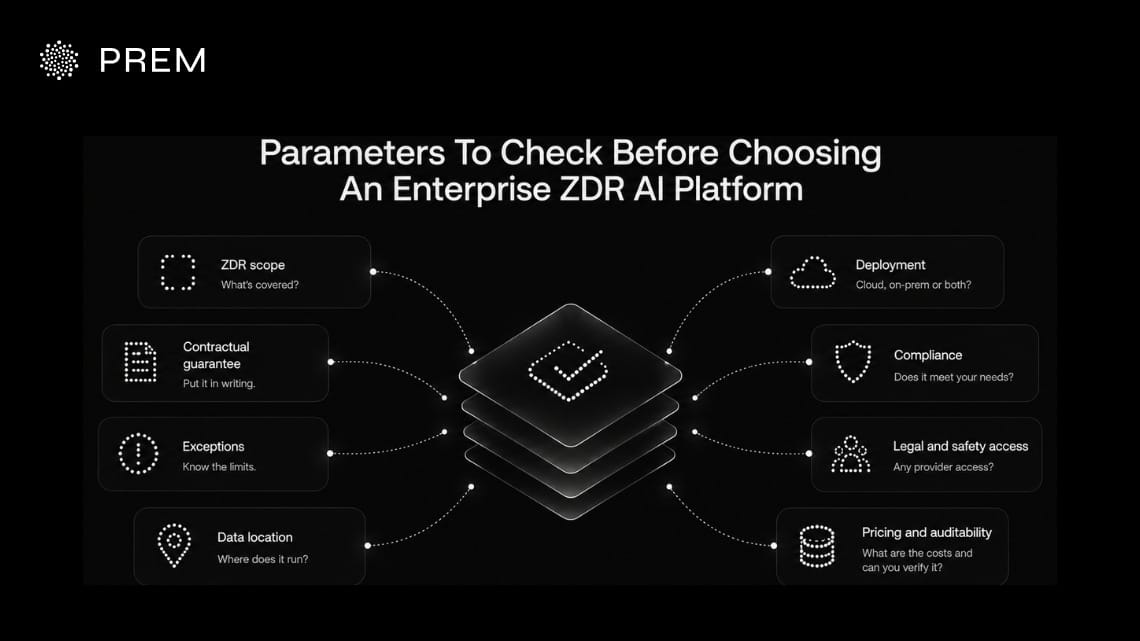
Review the provider's ZDR coverage and identify their system limits before you sign a contract. Use this checklist to guide your platform evaluation.
Keep Your AI Prompts and Outputs Private with Prem AI
Keep Your AI Prompts and Outputs Private with Prem AI
Explore Prem AI7 best enterprise AI platforms with ZDR in 2026
The platforms listed below provide genuine ZDR options. Because coverage varies based on the specific model, endpoint, and contract, you can find the exact details for each provider below. You can use the table to compare ZDR coverage, deployment options, and infrastructure control before reviewing the details for each provider.
Prem AI
Prem AI is a Swiss AI infrastructure company built for enterprises that need real control over their AI workloads and data, not just a policy promise.
The Technology Behind Prem AI's ZDR
Prem's Enclave technology gives you two ways to run confidential AI workloads. This hardware-protected computing environment isolates your sensitive prompts and completions from the underlying infrastructure during processing. You can choose the deployment type based on the level of infrastructure control your organization requires:
Enclave API
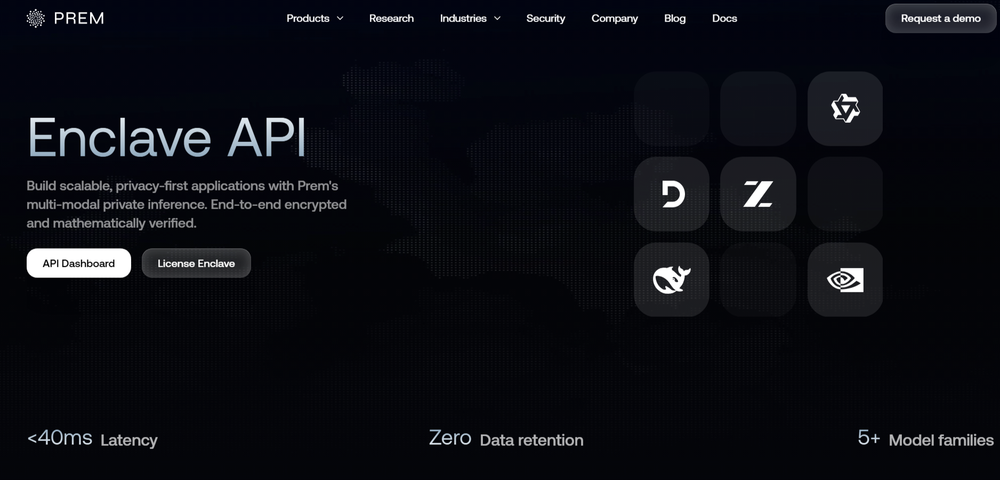
Our Enclave API is a managed service you access through an API, where Prem runs your inference inside hardware-enforced Trusted Execution Environments (TEEs). This is a good fit if you want confidential inference without having to operate the underlying infrastructure yourself.
Licensed Enclave
Licensed Enclave is a customer-controlled version that lets you run the enclave technology on your own GPU infrastructure, including your private cloud, VPC, or on-premises environment.
So, what's an enclave, and why does it matter for your AI workloads?
An enclave is a hardware-protected environment that keeps your sensitive data and AI workloads separate from the infrastructure running them. It is part of confidential computing, which protects your data while you use it.
This matters for AI inference because your prompts and data must be processed before a model can give you a response. With confidential computing, your data can be processed inside a protected environment that helps prevent unauthorized access while it is being used.
Both Enclave API and Licensed Enclave use this approach. The main difference is who controls the infrastructure. With Enclave API, Prem manages it for you. With Licensed Enclave, your organization runs it on your own infrastructure.
ZDR approach of Prem AI
Prem's zero data retention approach is designed to prevent your prompts and completions from being retained or used for model training. The Enclave architecture adds technical controls around the environment where your inference takes place.
Your workloads are processed inside isolated, hardware-protected enclaves, and cryptographic attestation lets you verify the environment before sending sensitive data.
This is where Prem's approach goes beyond a ZDR policy alone. ZDR addresses retention, while confidential computing protects data during processing. Combining the two gives your enterprise protection at different stages of the AI inference process.
What Sets Prem AI's ZDR Apart
Sovereign
Prem's infrastructure approach is designed for enterprises that need greater control over where their AI workloads run and how they are governed. With Licensed Enclave, you can run the technology on infrastructure your organization controls.
Verifiable
Cryptographic attestation lets you verify the enclave environment before sending sensitive data, so your security team has a way to establish trust in the execution environment.
Confidential computing
Your data is protected while it is actively being processed inside hardware-enforced TEEs, not just when it is stored or transmitted.
Open-weight models
You can access open-weight models through an OpenAI-compatible API, giving your teams flexibility across models and applications.
Flexible deployment
Choose a managed Enclave API when you want simplicity, or a Licensed Enclave when you need greater control over the underlying infrastructure.
Stronger workload isolation
Hardware-enforced isolation adds another layer of protection around sensitive AI inference.
This makes Prem particularly relevant for workloads where mishandling sensitive data can create serious consequences, including legal, healthcare, financial services, and other highly regulated environments.
Want to see how Prem AI's zero data retention approach can help your enterprise build private AI without compromising control over your data and infrastructure? Contact our sales team or email us at sales@premai.io.
OpenAI API
OpenAI offers ZDR for eligible API customers across designated endpoints and models. Under this policy, OpenAI does not retain your prompts and model responses after processing, and your content is unavailable to their workforce for review. This option serves enterprises that require stricter controls over sensitive API workloads.
ZDR approach of OpenAI API
OpenAI's ZDR means eligible prompts and model responses are not kept after processing, and OpenAI staff cannot access your content for review. Because this feature is separate from other data controls, you must verify which endpoints, features, and models actually qualify for ZDR. You should also note that certain capabilities may carry different data retention requirements.
Deployment options for OpenAI API
OpenAI is primarily available through its hosted API rather than customer-managed infrastructure. For eligible ZDR deployments, your customer content remains on infrastructure you control. OpenAI's Private Safety Processing is designed to provide additional automated safety monitoring while keeping ZDR in place, without giving OpenAI personnel access to the underlying prompts or responses.
Run AI Inference Inside Hardware-Protected Enclaves
Protect your sensitive data while it is being processed with Prem AI's Enclave technology and confidential computing.
Get StartedAnthropic Claude API
If you are looking at Claude, Anthropic does provide ZDR agreements for their eligible commercial API customers. But just like the other providers, their coverage can vary depending on the model and service. You will have to look closely at their current terms for the specific Claude models and features you plan on running.
ZDR approach of Anthropic Claude API
With an approved ZDR arrangement, Anthropic does not retain your inputs and outputs for eligible API traffic. However, Claude Fable 5 and Fable 5.1 currently require 30-day retention for safety and abuse monitoring.
Anthropic is rolling out Enterprise Frontier Safeguards (EFS), which will let eligible customers store this data in their own cloud infrastructure instead of Anthropic's. Until EFS is available, eligible customers can use ZDR with Fable 5 and Fable 5.1.
Deployment options for Anthropic Claude API
You can access Claude through Anthropic's API or through cloud platforms such as Amazon Bedrock, Google Cloud, and Microsoft Foundry. However, ZDR coverage can differ by model, service, and deployment route, so you should verify the retention terms for the specific Claude model and platform you plan to use.
Scaleway Generative APIs
Scaleway delivers a straightforward option for your secure AI needs. They give you zero data retention alongside EU-hosted access to open-weight AI models. Under their standard setup, they do not collect, read, reuse, or analyze the content of your inputs, prompts, or outputs.
ZDR approach of Scaleway
For standard API processing, Scaleway does not retain your actual prompt content. It logs API request metadata such as HTTP calls, status codes, timestamps, and token counts, but not your prompt itself. If your traffic causes an abnormal error or is suspected to be malicious, Scaleway may temporarily store the relevant HTTP request content for up to two weeks to investigate the issue. Batch processing is a separate exception, with your input data stored temporarily during processing for up to 24 hours.
Deployment options for Scaleway
You have two distinct paths for deployment. You can access them through Generative APIs: Serverless using endpoints in a secure Paris data center, or deploy via Generative APIs: Dedicated Deployment for dedicated infrastructure, private network access, and predictable throughput.
Run Confidential AI on Infrastructure You Control
Use Licensed Enclave to deploy confidential AI workloads on your private cloud, VPC, or on-premises GPU infrastructure.
Explore Licensed EnclaveOVHcloud AI Endpoints
OVHcloud AI Endpoints delivers true zero data retention and European data sovereignty. Under their standard setup, the platform never stores your user data during or after model execution. The only data they collect and keep is the bare minimum required to process your billing.
ZDR approach of OVHcloud AI Endpoints
They do not retain your actual prompt data. Because their system natively blocks data retention and sharing, your teams get a secure ZDR setup automatically. This ensures you do not have to spend time signing special custom privacy agreements with the provider.
Deployment options for OVHcloud AI Endpoints
You can build and test your applications seamlessly. They give you access to a growing catalog of open-weight models via a fully managed, serverless API using OpenAI-compatible formats. Your teams can also test setups in an isolated sandbox hosted entirely in Gravelines, France.
IONOS AI Model Hub
A completely stateless architecture anchors their data privacy. IONOS AI Model Hub processes your prompts and generated outputs entirely in volatile host and GPU memory, discarding them immediately after each request rather than writing them to persistent storage.
ZDR approach of IONOS AI Model Hub
Your prompts and outputs are processed as part of each session and discarded afterward rather than being written to persistent storage. Each request is handled completely independently, ensuring your inputs and outputs are never stored or used to train or fine-tune models. This gives your teams a clean zero-retention setup without needing a separate data privacy agreement.
Deployment options for IONOS AI Model Hub
They keep your AI workloads entirely within German infrastructure. You can connect open-source models directly into your existing applications using their OpenAI-compatible REST API, giving you a sovereign cloud environment without any infrastructure management.
Build Enterprise AI Without Giving Up Data Control
Combine zero data retention with confidential computing, flexible deployment, and customer-controlled infrastructure with Prem AI.
Get Started with Prem AIRegolo AI
Regolo AI gives your enterprise a secure, EU-native path for open-weight model inference. They host their physical GPU infrastructure through Seeweb in Italy, providing a direct alternative to major US cloud providers.
ZDR approach of Regolo AI
They do not store or reuse your prompt content. Your inputs and outputs are processed in memory and discarded after the response is delivered, without being retained or logged. Unless you set up an explicit, dedicated project agreement, your data is completely excluded from general service improvements or model training.
Deployment options for the Regolo AI
You get flat per-token billing with simple integration. The platform runs as a serverless, Kubernetes-native inference API hosted across Italian data centers. Their API is fully OpenAI-compatible, making it incredibly easy for your teams to migrate existing codebases.
How to verify an AI platform's ZDR policy
Before sending sensitive data, it’s better that you verify the provider's actual ZDR terms.
Verify Where and How Your AI Workloads Run
Prem AI uses cryptographic attestation to help you verify the protected environment before sending sensitive data.
Explore Enclave TechnologyEnsure Zero Data Retention for your enterprise AI with Prem AI
Most ZDR arrangements can solve only part of the problem because your prompts are still processed on infrastructure you do not control. At Prem AI, our Enclave API closes that gap by running your prompts and completions inside hardware-enforced TEEs on confidential computing infrastructure hosted in Switzerland. Your data is never retained or used to train models, and because our API is OpenAI-compatible, you can move your existing workflows over without rebuilding your integration.
You can start with our managed API and then transition to our Licensed Enclave when you need your AI infrastructure running entirely inside your own environment.
Ready to build AI with more control over your data and infrastructure? Explore our Enclave API to see how it can support your private and sovereign AI workloads. If you want to discuss your requirements, contact our sales team or email us at sales@premai.io.
FAQs about Enterprise AI Platforms with Zero Data Retention
Does ZDR mean your data is never used to train AI models?
Not automatically. ZDR controls data retention, while training opt-out is often a separate setting. Some providers combine both commitments, while others treat them separately. Check your provider's terms to confirm whether your data is neither retained nor used for training.
Does enabling ZDR slow down your response times or affect model quality?
No. ZDR controls what happens to your data after your request is processed. It does not change the model or inference process itself, so your response speed and output quality should remain the same.
Can you get ZDR on a free or consumer plan?
Usually not. ZDR is generally available only to eligible enterprise or paid API customers. Depending on your provider, you may need a specific plan, approval, or signed agreement before you can enable it.
Is ZDR the same as HIPAA or SOC 2 compliance?
No. ZDR is only one data protection control. Frameworks and regulations such as HIPAA and SOC 2 cover broader requirements, including access controls, auditing, security processes, and contractual obligations. ZDR alone does not make your AI platform compliant.
Does ZDR cover your file uploads, tools, and agent features?
Not always. ZDR may exclude features such as file storage, batch processing, persistent agents, or other stateful services because they need to retain data to work. Before using these features, confirm exactly what your ZDR agreement covers.
If you enable ZDR, can anyone still see your data during processing?
Yes, your data still has to be processed to generate a response. It may be readable within the provider's processing environment during that time. ZDR controls retention after processing, but it does not eliminate data processing itself.
Is ZDR technically enforced or just a contractual promise?
It depends on your provider. Some platforms use technical controls to prevent data from being retained, while others rely mainly on contractual commitments. Ask whether your provider can technically enforce ZDR and provide documentation showing how it works.
Does ZDR apply automatically when you sign up?
Usually not. Your provider may have a default retention period for abuse monitoring or other purposes. ZDR often requires you to request access, sign an agreement, or enable a specific setting before it applies to your workloads.
Can your provider still access your data when ZDR is enabled?
Sometimes. Providers may have limited exceptions for abuse investigations, safety reviews, security incidents, or legal obligations. Check your provider's ZDR terms carefully to understand when your data may still be accessed or retained.
Does model-level ZDR also cover the tools and apps you build on top of it?
Not automatically. ZDR usually applies to the model provider's systems. Your applications, agents, monitoring tools, and third-party integrations may keep their own logs or copies of your data, so you need to check those systems separately.
See how Prem AI can help your enterprise build private AI without compromising control over your data and infrastructure. Contact our sales team or email us at sales@premai.io.