Private AI in Healthcare: How Enterprises Can Build HIPAA-Compliant AI for Sensitive Patient Data
On this page
You're leading an AI strategy for a healthcare enterprise, and you've probably already had this conversation internally: everyone wants AI, but nobody wants to be the one explaining to a regulator why patient data ended up somewhere it shouldn't have.
That tension is where most enterprise AI decisions actually get made now. Not "should we adopt AI," but "how do we adopt it without putting patient trust, regulatory standing, or clinical integrity at risk."
Here's what often gets overlooked: every large language model accessed through a public API is a model you don't fully control. It sits between your clinicians and some of the most sensitive data your organization handles, including Protected Health Information (PHI).
Physician AI use has climbed sharply in the last two years, and Healthcare IT News' AMA coverage found that data privacy assurances are now considered critical to broader adoption by the vast majority of physicians surveyed. In other words, your clinicians want the tools. They just don't trust the plumbing yet, and they're right not to by default.
This isn't a uniquely American concern, either. The European Commission's own guidance on AI in healthcare classifies AI-based software intended for medical purposes as high-risk under the EU AI Act, which means it has to meet the same kind of risk mitigation, high-quality data, and human oversight requirements that HIPAA pushes you toward here. When regulators on both sides of the Atlantic converge on the same set of controls, that's less a compliance hurdle and more a signal of where healthcare AI is actually headed.
Private AI is the credible way through that. It lets your enterprise use generative AI at scale while staying inside HIPAA's boundaries, on your terms rather than a vendor's.
Here's what that actually looks like: what private AI in healthcare means, where it delivers real value for your organization, and how you can architect, govern, and scale it responsibly. This blog assesses what private AI in healthcare actually means, where the technology delivers real value, and how enterprises can architect, govern, and scale it responsibly.
What is private AI in healthcare?
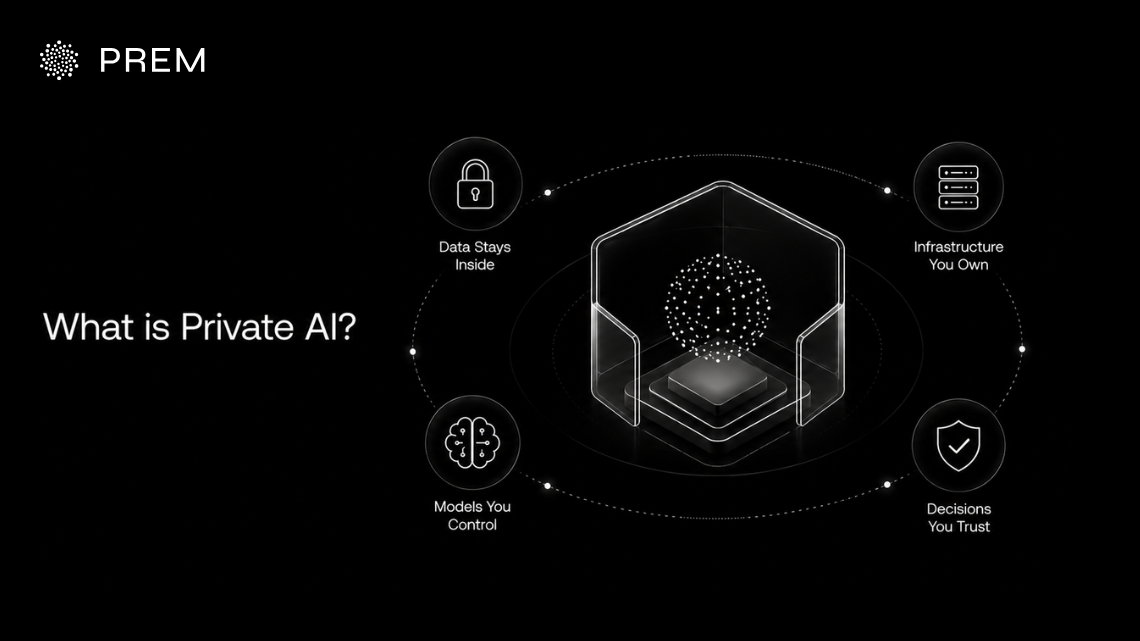
Think of it this way: when you send patient data to a public AI endpoint, you're handing a stranger your most sensitive records and trusting them to handle it well. Private AI flips that. You keep the model, the data, and the decision-making inside your own walls.
Private AI refers to AI models and tools that run within your organization’s own infrastructure or a dedicated, isolated environment. In a private AI setup, your patient data never leaves your security perimeter. It isn't used to train third-party models, and it isn't exposed to external inference logs you don't control.
Rock Health's H1 2026 market overview points to this same shift, with digital health capital increasingly concentrating in AI infrastructure rather than off-the-shelf tools bolted onto existing workflows.
For your health system, private AI can take a few different shapes. It's a self-hosted LLM running inside your virtual private cloud. It could be a dedicated, single-tenant instance of a foundation model licensed exclusively for you. In some cases, it means a private on-premises inference cluster serving your clinical applications directly from your own data center.
What actually defines it isn't the specific model or vendor. It's the boundary around your data. When you can trace exactly where a patient record travels, who touches it, and where it's stored at every stage of an AI workflow, that system qualifies as private. The moment any part of that path runs through infrastructure you don't own or fully audit, it doesn't.
This distinction matters more in your industry than in almost any other. A retail company can tolerate some ambiguity about where its marketing data flows. You can't, because a single exposure of patient records carries legal, financial, and reputational consequences that few other data types trigger, and your patients are trusting you with information they can't take back once it's out.
Why healthcare organizations are moving toward private AI
You've watched AI move well past pilot projects in your own organization. Clinical documentation, imaging triage, and patient-facing chat are now embedded in your daily operations, whether you run a hospital network, a payer, or a digital health platform. That growth hasn't slowed down. It's accelerated because your clinicians are seeing measurable time savings from tools that felt experimental only a year or two ago.
But you've probably also hit the same wall everyone else in your position has. Most consumer-grade AI tools were never built with PHI (Protected Health Information) in mind.
The moment you send patient notes, scan metadata, or claims data into a public LLM endpoint, you're opening up serious questions you can't easily answer: where does that data actually reside, who else can touch it, does it train someone else's model, and who's liable if it leaks. Your compliance team likely can't sign off on that level of uncertainty, even when a vendor hands you an enterprise agreement and a stack of assurances.
Private AI is how you resolve that, by keeping inference, storage, and logging inside your AI infrastructure you actually govern. You decide who can access outputs. You decide how long data is retained. You can map exactly how your Business Associate Agreement translates into the technical reality of where your data flows, instead of taking a vendor's word for their shared-responsibility language.
The Stanford HAI AI Index found that private AI investment grew 127.5% to $344.7 billion in 2025, and the same report makes a point worth sitting with: governance, infrastructure, and readiness, not raw model capability, are what actually determine whether your deployment scales or stalls.
Applications of private AI in healthcare
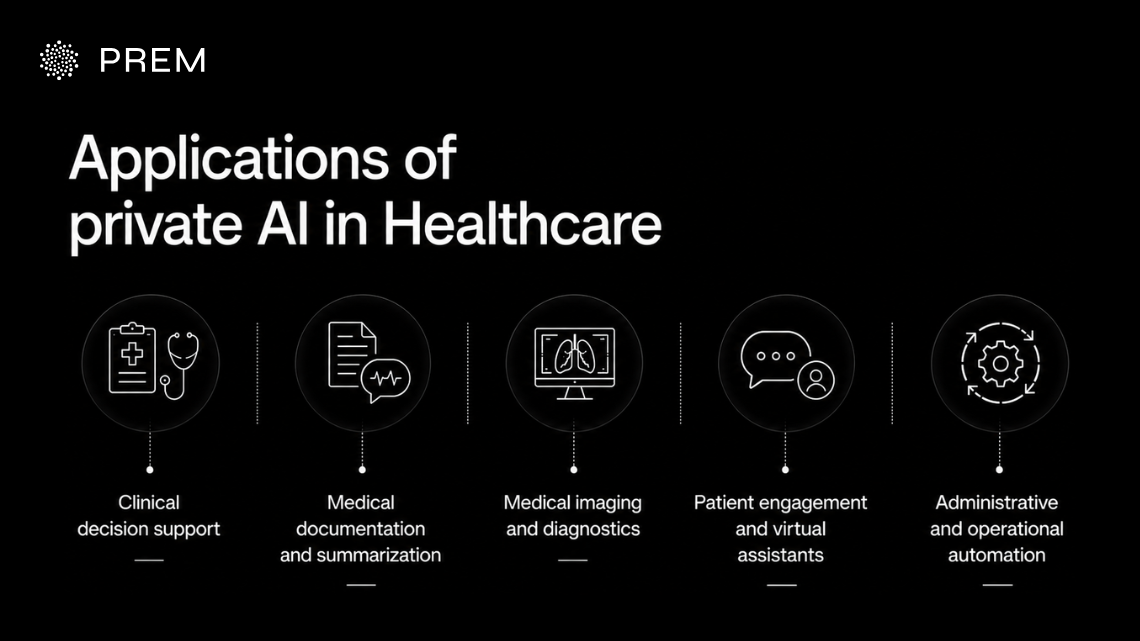
Clinical decision support
If you ground a private LLM in your own clinical guidelines and formularies, you can surface differential diagnoses at the point of care. It can flag drug interactions before your clinicians finalize a prescription. It can summarize relevant literature in seconds, work that would otherwise eat into your clinicians' limited time.
A PMC-published DDI study evaluating a drug-drug interaction clinical decision support system found that prescribers considered the tool genuinely useful even as they worked through a high volume of alerts, underscoring both the value and the tuning these systems still need.
Because the model runs in an environment you control, your clinical informatics team can version-control exactly which guidelines the AI references. This matters enormously for your liability and audit posture. If a decision support tool's recommendation is ever questioned, you can show precisely which protocol version informed that output and when you last updated it.
Medical documentation and summarization
Ambient documentation tools listen to or transcribe patient conversations and automatically turn them into structured clinical notes. This is one of the fastest-growing use cases in health AI today, largely because it addresses clinician burnout directly. Run it privately, and these tools keep raw audio and transcripts inside your own environment.
An AMA-reported JAMA study found that burnout among clinicians using an ambient AI scribe dropped significantly within 30 days, alongside gains in time spent with patients.
That containment reduces your exposure window for identifiable patient conversations significantly. It also means you retain full control over how long those recordings persist and who on your team can ever access them for review or quality assurance.
Medical imaging and diagnostics
Your imaging models in radiology, pathology, and dermatology need enormous volumes of highly sensitive scan data to perform well. A private deployment lets you fine-tune these models on your own imaging archives.
That data never has to touch a third party during training or inference. Radiology already accounts for the largest share of devices on the FDA's AI device list, reflecting how central imaging has become to healthcare's AI rollout.
This is often a prerequisite for your institutional review board and legal approval. You simply may not get a sign-off to send imaging archives to an external vendor, no matter how strong the model's accuracy claims are. A private deployment removes that obstacle entirely, since your data stays where it already lives.
Patient engagement and virtual assistants
Your patient-facing chatbots that answer billing questions, triage symptoms, or manage appointment scheduling handle PHI constantly. They process names, conditions, and insurance details in nearly every conversation your patients have with them.
A TechTarget-reported survey found that roughly half of insured adults have already used an AI chatbot to get medical advice, which raises the stakes for how you handle that data behind the scenes. A private deployment means those conversations stay inside your own data boundary rather than a shared vendor cloud.
This also gives your compliance and legal teams a much simpler story to tell regulators and patients alike. Instead of explaining a multi-party data flow involving several external vendors, you can point to a single, internally governed system handling the entire conversation lifecycle.
Administrative and operational automation
Your claims processing, prior authorization, and revenue cycle automation already handle PHI-adjacent data at significant scale. These workflows are often your highest-volume touchpoints for patient data, even though they rarely involve a clinician directly.
Private AI workspace lets your operations teams automate these workflows while keeping the underlying data and the full audit trail of who accessed it entirely internal. This is frequently where you'll want to start your private AI journey, since the risk profile is lower than direct clinical use while the operational upside is still substantial.
Adoption tends to start administratively and move toward clinical deployment as your trust in the architecture builds over time. A Healthcare Dive report on Bain and KLAS Research's joint survey found that ambient notetaking, documentation, coding, and prior authorization, all revenue-cycle-adjacent, are the four most common AI use cases among providers today.
Understanding HIPAA requirements for private AI systems
Before architecting anything, you need clarity on exactly what HIPAA requires of an AI system, not just of the organization deploying it.
What counts as Protected Health Information (PHI)
PHI is any individually identifiable health information that relates to a person's health condition, care, or payment for care. If your system touches it in any form, HIPAA applies to you.
This includes names, dates, diagnoses, and treatment notes. It also includes insurance identifiers and, in many cases, device or account IDs tied back to a patient record. HHS's Privacy Rule summary lays out exactly how broadly this standard is meant to be read.
Critically, PHI doesn't need to look sensitive on its own for you to be regulated. A timestamp combined with a zip code and a diagnosis code can be enough to re-identify a patient, even without a name attached. Any AI system you build that ingests, generates, or stores this kind of data falls inside HIPAA's scope. That includes the model's prompts, its outputs, and its logs, not just the underlying source records.
HIPAA safeguards that AI systems should support
HIPAA's Security Rule organizes requirements into three categories. Your AI systems need to satisfy all three, not just the technical one your engineering team will naturally gravitate toward. NIST's SP 800-53 catalog is a useful reference many healthcare organizations map their own AI controls against, even though it was written for federal systems.
Administrative safeguards require you to have documented policies governing who can build, train, or query AI systems that touch PHI. You'll also need workforce training and incident response procedures specific to AI misuse, not just the generic data breach protocols you carried over from older systems.
Physical safeguards apply to wherever your model actually runs. This could be a data center, a private cloud tenancy, or an on-premises server room. You need controlled physical access to that infrastructure, with the same rigor you already apply to servers hosting an EHR.
Technical safeguards cover encryption, access controls, audit logging, and transmission security for the AI system itself. This includes an often-overlooked fact: your model's prompts and completions are PHI if the inputs that generated them were PHI. Treating them as somehow separate from the source record is a common and serious mistake.
Common HIPAA compliance risks when using AI
The most common failure point isn't malicious misuse. It's architectural drift. Your team pilots a tool with synthetic data, passes a compliance review, and then quietly starts feeding it real patient records once it reaches production. The system you reviewed is no longer the system actually in use, and by the time anyone notices, it's already the default.
Other frequent risks you should watch for: third-party model providers retaining prompts for abuse monitoring without a clear retention limit; insufficiently scoped API keys that let any employee query PHI-bearing endpoints regardless of their actual role; and logging that isn't granular enough to reconstruct who saw what and when, which turns a routine audit into a guessing exercise.
The HHS HIPAA Security Rule guidance remains the definitive reference for how these safeguards apply to you. Treat it as a living checklist rather than a one-time read, since interpretation and enforcement continue to evolve alongside the technology, and what passed last year's review may not pass this year's.
Essential components of a secure private healthcare AI architecture
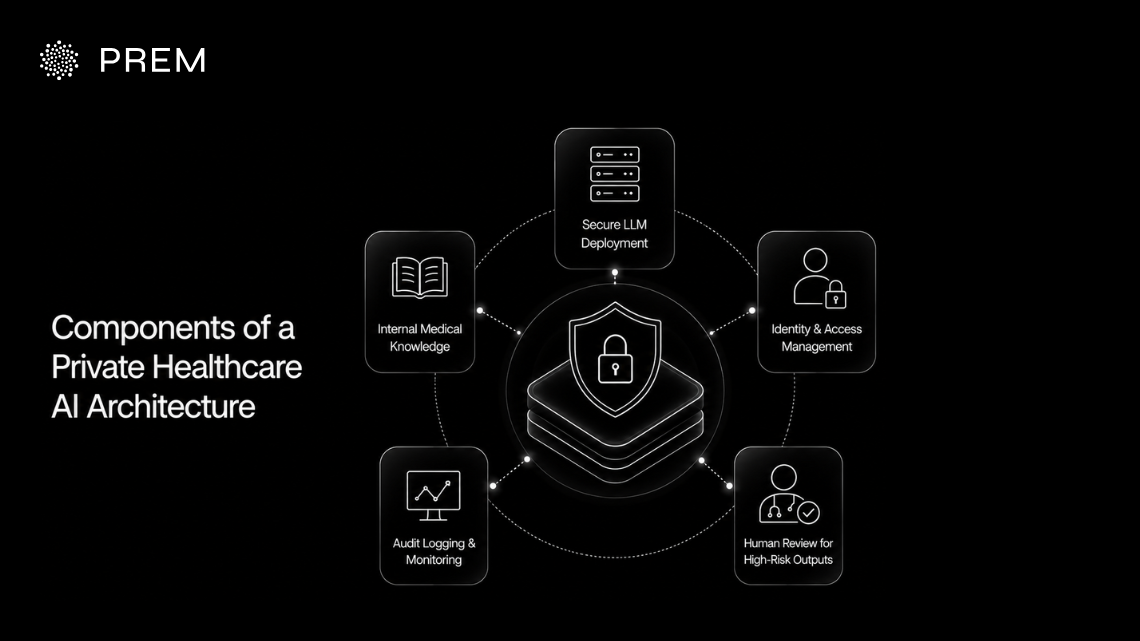
Once the regulatory requirements are clear, the architecture question becomes concrete. What does a HIPAA-aligned AI stack actually look like in practice, for your team specifically? Let’s see.
Secure LLM deployment
The foundation of any private AI system is a model that runs inside infrastructure you control. This could be a VPC-hosted open-weight model, a single-tenant enterprise deployment, or an on-premises GPU cluster you own outright. What matters is not the specific model chosen but the boundary drawn around where it runs, a shared responsibility spanning cloud provider, model provider, and customer that the CSA AI Controls Matrix breaks down into more than 240 distinct control objectives.
The deciding factor is whether inference happens inside a perimeter your own security team can audit end-to-end, without relying on a vendor's word for it. This includes the ability to inspect network traffic, review access logs directly, and confirm that no data silently leaves the environment during normal operation.
Confidential computing approaches, where each request runs inside a hardware-isolated enclave and its integrity can be verified through cryptographic attestation, are increasingly how enterprises turn that boundary from a policy statement into something they can actually check. Enterprises that skip this verification step often discover gaps only after an incident forces a closer look, which is a hard way to learn it.
Secure deployment also means treating the model itself as a controlled asset, not just the data around it. Version changes, fine-tuning updates, and even prompt template changes should go through the same change management process applied to any other clinical system. A model that quietly changes behavior after an update is just as risky as one that leaks data outright.
Retrieval-augmented generation (RAG) with internal medical knowledge
RAG lets your private model ground its answers in your institution's own clinical guidelines, formularies, and protocols instead of relying purely on whatever the model learned during pretraining.
This dramatically reduces hallucination risk in clinical contexts, where an invented drug interaction or a fabricated citation can carry real consequences for a real patient. The effect isn't just theoretical: pitting RAG-based chatbots against reliable source material, a JMIR Cancer study saw hallucination rates drop significantly, with the systems also getting noticeably better at admitting when they simply didn't know an answer.
Because the retrieval index lives inside the same secure environment as the model, RAG never requires PHI to leave the perimeter in order to be useful. Your institution's own protocols become the model's source of truth. That is a meaningfully different risk profile from asking a general-purpose model to reason about medicine from broad, unverified training data.
RAG also gives your compliance team something concrete to audit. Since retrieved documents are logged alongside the model's output, reviewers can trace exactly which guideline informed a given answer. This traceability is difficult to replicate with a model that has no explicit retrieval step, since its knowledge is baked into weights that cannot be inspected line by line.
Identity and access management
Every AI interaction needs to be tied to an authenticated identity. Role-based permissions should determine which datasets, prompts, or model outputs a given user can access, mirroring the same principle you've likely applied to EHR access for decades and now extending to your AI query layers, the same logic behind GSA's federal ICAM mapping, which ties identity assurance levels directly to access requirements for federal systems.
This is not simply a matter of turning on single sign-on. It requires mapping AI system permissions to the same clinical roles already defined in your identity provider, so a nurse, a billing coordinator, and an attending physician each see only what their role justifies.
Getting this mapping wrong is one of the fastest ways to accidentally overexpose PHI through an AI interface that otherwise looks secure on paper.
Audit logging and monitoring
Every prompt, retrieval, and completion involving PHI should be logged with enough detail to reconstruct exactly what happened during a compliance review, including who asked the question, what was retrieved to answer it, what the model generated, and who ultimately saw the output.
Monitoring should go beyond passive logging. Automated alerts for unusual query patterns, such as a single account pulling an abnormally high volume of patient records through the AI interface, can catch misuse far faster than a quarterly manual review ever could.
That gap between logging something and actually catching a problem shows up in the breach data too: Becker's breach report puts the share of breach notices in the first half of 2026 that actually disclosed how the incident occurred at barely one in four, a transparency shortfall that usually traces back to weak logging at the source.
Human review for high-risk clinical outputs
Any AI output that could directly influence a clinical decision needs a human clinician in the loop before it reaches a patient's care plan. This includes a differential diagnosis, a dosing recommendation, or an imaging read. The model can accelerate the work. It should not replace the final judgment call, and your clinicians will trust the tool more, not less, once that boundary is explicit.
This is not just good governance, and it's not only a NIST recommendation either, though the NIST AI Risk Management Framework does offer useful architectural guidance on human oversight for high-consequence AI decisions. Several state medical boards now treat human oversight of AI-assisted clinical decisions as a standard of care in its own right.
Skipping this step exposes the institution to liability that has nothing to do with HIPAA and everything to do with clinical negligence standards that predate AI entirely.
Key principles for building a HIPAA-compliant private AI platform
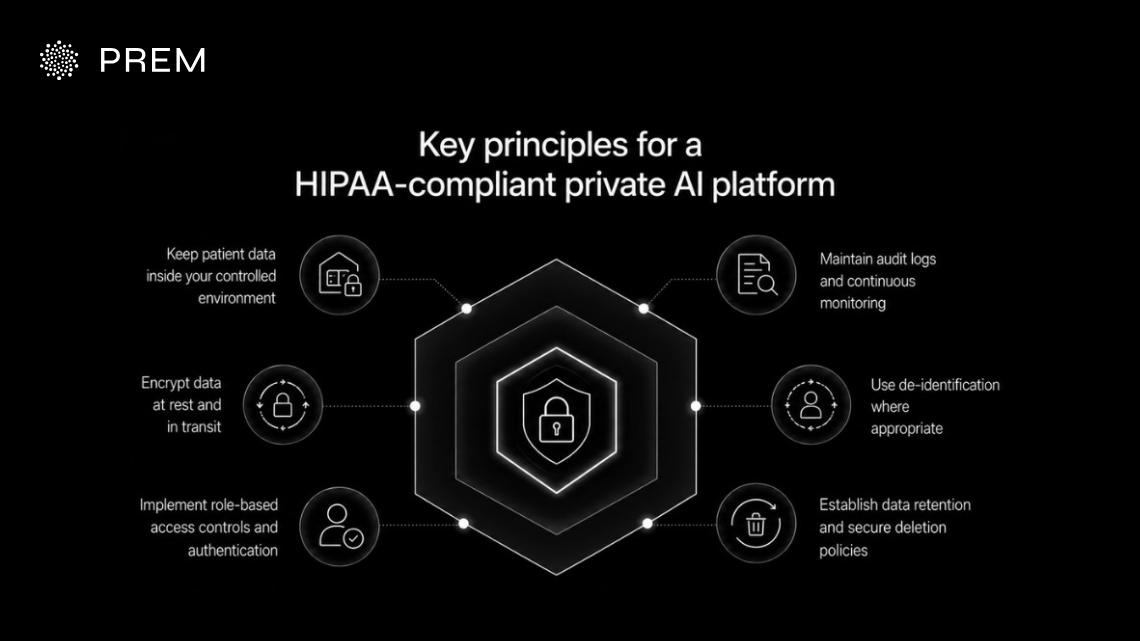
These are the operating principles that separate a genuinely compliant platform from one that merely looks compliant on a vendor slide.
Keep patient data inside your controlled environment
Every architectural decision should trace back to this single principle. PHI should not need to leave infrastructure you directly govern in order for the AI system to function.
If a feature requires sending patient data outside that boundary, the feature needs a redesign, not an exception. Healthcare has carried the highest breach costs of any industry for over a decade running, per IBM's Cost of a Data Breach report, a gap driven in large part by how many parties end up touching a single patient record.
This principle sounds simple, but it is easy to violate accidentally. A logging pipeline that ships error reports to a third-party monitoring service, or an analytics tool bundled into a vendor's platform, can quietly move PHI outside the perimeter without anyone intending it.
Your regular architecture reviews should specifically hunt for these unintentional leaks, because nobody sets out to create them on purpose.
Encrypt data at rest and in transit
Encryption should extend well beyond storage. Model prompts, completions, and any intermediate caching layer need the same protection as the source database.
This is a frequently missed detail in AI pipelines built on top of existing data infrastructure, since caching layers are often added later without the same security review the original system received. NIST's FIPS 140-3 standard sets the baseline for cryptographic modules that healthcare IT teams are expected to build toward, at rest and in transit alike.
Key management matters just as much as the encryption itself. Rotating keys on a defined schedule and ensuring that no single engineer holds standing access to decrypt production PHI without a logged approval closes a gap that pure encryption alone does not address.
Implement role-based access controls and authentication
Access should be scoped tightly enough that a clinician querying the system for one patient's care cannot incidentally retrieve another patient's information.
Non-clinical staff should not be able to query clinical models at all, regardless of their general system permissions elsewhere in the organization, which is exactly the standard the CDC's HIPAA overview points to when it notes that the Security Rule's access controls exist to keep ePHI limited to authorized individuals.
This requires treating the AI layer as its own permission surface, not an extension of whatever access a user already has. A billing analyst with broad access to claims data should not automatically inherit the ability to query a clinical decision support tool simply because both systems sit on the same network.
Maintain audit logs and continuous monitoring
Logs need to be tamper-evident. They also need to be retained long enough to satisfy both HIPAA's documentation requirements and your organization's own incident response timelines, which are sometimes longer than the regulatory minimum.
Regulators clearly think current practice falls short here; HHS's proposed Security Rule update would tighten audit control requirements further, a signal that they see logging as a persistent weak point industry-wide.
Continuous monitoring should be treated as an operational function, not a compliance formality reviewed once a quarter. Assigning clear ownership for reviewing AI access logs, the same way security teams already own firewall and intrusion logs, keeps this from becoming a box that only gets checked after something has already gone wrong.
Use de-identification where appropriate
For research, model evaluation, or analytics use cases that do not require patient-level identity, de-identifying data under HIPAA's Safe Harbor or Expert Determination methods significantly reduces the system's compliance surface area.
Fewer identifiers in the pipeline means fewer places a breach can actually cause harm, though that math is starting to shift. A recent Gartner-cited analysis expects AI-generated inferences, not just direct exposure of identifiers, to increasingly drive privacy incidents going forward, which means de-identified datasets that once looked safe deserve a second look.
De-identification is not a one-time technical step, though. Re-identification risk can creep back in when de-identified data is combined with other datasets, particularly in smaller patient populations. Periodic re-evaluation of de-identified pipelines, not just a single review at launch, is necessary to keep this protection meaningful over time.
Establish data retention and secure deletion policies
AI systems tend to accumulate logs, embeddings, and cached completions indefinitely by default, simply because nobody configured a limit.
Every one of these data stores needs an explicit retention limit and a deletion process that actually executes on schedule, rather than existing only on paper. This is a harder problem than it sounds, and IAPP's guidance on AI retention policy makes the point that most organizations only discover the conflict between AI-generated data and existing records-management rules after the fact, not before.
You should test your deletion processes the same way you test backups. A retention policy that has never actually been exercised in practice is a policy nobody can be confident actually works when it matters.
Best practices for deploying and scaling private AI in healthcare
Getting the architecture right is necessary but not sufficient. How you roll it out determines whether the platform actually earns clinical trust over time, and that trust, once lost, is hard to rebuild.
Start with low-risk AI use cases
Administrative automation and internal documentation tools are lower-stakes starting points than direct clinical decision support.
They let your governance processes mature and build organizational confidence before your institution moves toward higher-risk deployment involving direct patient care decisions, exactly the kind of risk tiering that shows up in a Forbes-reported Menlo Ventures study of the health systems seeing the most success, which moved low-risk administrative use cases first and let patient-facing tools follow with greater scrutiny.
Starting small also gives your technical teams a realistic sense of how the private AI infrastructure performs under real production load before that infrastructure is asked to support something clinically critical. Problems discovered here are far cheaper to fix than problems discovered inside a clinical workflow.
Build AI governance and security policies
A standing AI governance committee, spanning compliance, clinical leadership, and security, should own approval of new use cases before they touch production PHI. This committee needs real authority to say no, not just an advisory role that gets bypassed when a department wants to move fast.
That mandate needs to cover more ground than HIPAA alone. If your enterprise operates in the EU or simply serves patients whose data touches EU infrastructure, EU AI Act compliance runs on the same risk-based logic your HIPAA program already uses, which makes it easier to fold into your existing governance structure than most new regulations are. High-risk AI systems face documented governance, bias testing, and human oversight obligations that will look familiar if you've already built a HIPAA-aligned architecture, alongside penalties of up to €35 million or 7% of global annual turnover for the systems that fall short.
Policies for AI governance should be written specifically for AI systems, rather than repurposed from general IT security policy. AI introduces failure modes, like hallucination and model drift, that traditional software governance frameworks were never designed to address, and your committee's mandate should say so explicitly rather than assume existing policy already covers it.
Continuously evaluate model performance
Clinical and operational accuracy should be tracked on an ongoing basis, not just at launch. Model drift and changing clinical guidelines can quietly degrade output quality over months, long after the initial validation that got the system approved.
The FDA expects exactly this kind of forward planning, laid out in its guidance on predetermined change control plans for AI-enabled tools, which requires manufacturers to pre-specify how they'll monitor for and respond to drift after deployment.
This evaluation should include regular spot checks against known correct answers, not just aggregate accuracy metrics. A model can maintain a strong average score while consistently failing on a specific, dangerous edge case that aggregate numbers hide.
Train employees on responsible AI usage
Your frontline staff need concrete training on what they should and should not paste into an AI tool. Most compliance failures start with a well-intentioned employee trying to save time, not with a technical gap in the architecture itself.
Regulators have also raised the bar on proof, not just intent: current HIPAA workforce training requirements now call for evidence that each employee actually completed training on the current policy version, not simply that training was offered.
Training should be specific and example-driven, rather than a generic slide deck about data privacy. Showing staff exactly what an unsafe prompt looks like, next to a safe alternative that accomplishes the same task, tends to change behavior far more effectively than abstract policy language.
Conduct regular compliance and security reviews
Periodic reviews should test your AI system the same way any other PHI-touching system is tested. This includes penetration testing, access audits, and tabletop breach exercises specifically scoped to the AI platform, not just the surrounding infrastructure.
These reviews should also test the human side of the system, not just the technical one. Simulating a scenario where an employee accidentally exposes patient data through an AI tool reveals gaps in incident response that a purely technical audit would never surface. If you want a sense of where you stand against peers, Deloitte's mid-year 2026 health care outlook across health systems is a reasonable benchmark, roughly a third scaled, a third still in pilot, and a third paused.
Real-world examples of private AI in healthcare
Here's how these principles play out once you get past the whiteboard and into production, and where you might see your own situation reflected.
Hospital networks deploying private AI infrastructure
Several large hospital networks have moved core AI infrastructure on-premises or into dedicated private cloud tenancies specifically to keep PHI inside institutional control. This is not limited to a handful of early adopters. McKinsey's healthcare technology analysis tracks domain-specific models for documentation, radiology, or pathology increasingly being deployed directly within hospital networks, specifically to reduce data leakage risk.
Leadership at these organizations consistently cites both HIPAA exposure and patient trust as the deciding factors behind this shift, rather than cost alone, which tells you something about where the real pressure is coming from if you're weighing the same decision.
AI-powered clinical documentation assistants
Ambient documentation tools deployed inside a private environment have been credited with meaningfully reducing clinician documentation time. Physicians using these tools report spending noticeably less time on notes after each patient encounter, time that can be redirected back toward direct patient care, which is ultimately the point of all of this.
This finding is echoed in a JAMIA cohort study on ambient scribe adoption, which found meaningful time savings in EHR use, including after-hours documentation, once the tool was deployed across a full clinical cohort rather than a limited pilot.
Internal medical knowledge assistants using RAG(Retrieval-Augmented Generation)
Health systems building RAG-based assistants over their own clinical guidelines report far lower hallucination rates than general-purpose models used straight out of the box. Grounding the model in verified, institution-specific source material makes a measurable difference in output reliability and in whether clinicians actually trust what it tells them.
This is consistent with findings from an MDPI-published study published twelve different retrieval-augmented pipelines against real patient vignettes, which found that self-reflective retrieval approaches cut hallucination rates to under 6%, well below ungrounded models.
Private AI for medical research and operational workflows
Research institutions running private LLMs over de-identified clinical trial data have been able to accelerate cohort identification and literature synthesis considerably. Tasks that once took research staff days can now be completed in a fraction of the time, without triggering IRB concerns tied to third-party data exposure.
This approach is detailed in the Mayo Clinic Platform overview of its AI research infrastructure, which outlines how keeping data inside a controlled research environment allows broader AI experimentation without slowing down the institution's existing approval processes.
Checklist for implementing HIPAA-compliant private AI
Turning the principles above into action requires a clear, working checklist that your compliance, security, and clinical teams can move through together.
Use the list below when scoping a new deployment or auditing an existing one, and consider it alongside CHAI's governance playbooks, which lay out baseline controls for many of the same steps in more operational detail.
Data privacy and security
PHI needs protection at every layer of your stack, not just the source database, since prompts, completions, and logs all carry the same regulatory weight as the record they came from.
Zero Data Retention (ZDR) and confidential AI
Inference should run in environments that discard each request once it is processed, so nothing persists on a vendor's servers beyond the moment your clinician actually needs an answer.
Verifiability
A private boundary is only as good as your organization's ability to check it, which is why cryptographic attestation on each request matters more than a vendor's contractual promise.
Context compounding
Your institution's own clinical guidelines, formularies, and protocols should benefit from context compounding, getting sharper the more the system is used, with that accumulated knowledge staying inside your organization rather than training someone else's model.
Cost and token efficiency
At hospital scale, inference costs compound quickly, so the architecture needs to be efficient enough to sustain daily clinical use without turning every query into a budget conversation.
Broader AI sovereignty
You should ensure complete AI sovereignty, retaining control over where your models run and how they change over time, rather than being subject to a vendor's infrastructure decisions or policy shifts you didn't sign up for.
Low latency and local inference
Point-of-care decisions cannot wait on a slow round trip, which makes local or regional inference a practical requirement for clinical workflows, not just a performance nicety.
Private AI is not a compliance checkbox. It is the architectural foundation that lets you actually use generative AI at the pace your clinicians and patients now expect, without gambling with the one thing your industry cannot afford to lose, which is trust.
Build your Private, HIPAA-Compliant AI for healthcare with Prem AI
If you are trying to bring private, sovereign AI into a clinical or patient-facing workflow without your PHI ever leaving your own boundary, that is exactly what Prem AI is built for.
Our Enclave API runs inference inside hardware-isolated, cryptographically attested enclaves with zero data retention, so every request is verifiable rather than taken on trust, whether you access it through our API or license it to run inside your own infrastructure.
Fluso extends that same private foundation into a workspace where your clinical guidelines and institutional knowledge stay inside your walls and get sharper the more your teams use it.
If you want to see what a HIPAA-aligned private AI deployment looks like for your enterprise, contact our sales team or email us at sales@premai.io.
Frequently asked questions about Private AI in Healthcare
What is private AI in healthcare?
Private AI in healthcare refers to AI systems deployed in controlled environments where sensitive patient data remains within an enterprise’s approved infrastructure. This can include on-premises servers, private clouds, customer-managed VPCs, or other isolated environments.
Unlike public AI services, private AI gives healthcare enterprises greater control over data access, storage, processing, and model behavior. This makes it better suited for use cases involving protected health information (PHI).
Is private AI automatically HIPAA compliant?
No. Using a private AI deployment does not automatically make an AI system HIPAA compliant. Compliance depends on how patient data is collected, processed, stored, accessed, and protected throughout the AI workflow.
Enterprises also need appropriate safeguards, access controls, audit mechanisms, encryption, policies, and agreements such as a Business Associate Agreement (BAA) where required.
How does private AI protect patient data?
Private AI can keep sensitive patient data inside an enterprise-controlled environment instead of sending it to a public AI provider. This reduces exposure to third-party data processing and gives organizations more control over who can access the data.
Enterprises can also use encryption, identity-based access controls, network isolation, confidential computing, and audit logs to strengthen protection throughout the AI pipeline.
Can private AI be used to process PHI?
Yes, private AI can be designed to process PHI when the required technical and administrative safeguards are in place. The AI environment should be configured to restrict unauthorized access and prevent unnecessary exposure of patient information.
Organizations should also assess each AI use case before deployment. Data minimization, role-based access, encryption, logging, retention controls, and appropriate vendor agreements are important parts of the process.
What are the best deployment models for private AI in healthcare?
Healthcare enterprises can deploy private AI on-premises, in a private cloud, within a customer-managed VPC, or in an isolated environment such as an air-gapped infrastructure. The right model depends on security requirements, infrastructure capabilities, and regulatory needs.
For highly sensitive workloads, enterprises may prefer environments that provide stronger control over data and network access. Hybrid deployments can also be useful when organizations need to balance security with scalability.
What security controls are important for HIPAA-compliant private AI?
Important controls include encryption at rest and in transit, strict identity and access management, role-based permissions, network segmentation, audit logging, secure key management, and continuous monitoring. Enterprises should also secure the models, APIs, data pipelines, and underlying infrastructure.
Additional protections such as confidential computing and trusted execution environments (TEEs) can help protect data while it is being processed. Regular security assessments and vulnerability testing are also important.
Can private AI prevent patient data from being used to train AI models?
Private AI can be configured so that enterprise data is not used to train models by default. Organizations can maintain tighter control over whether patient information is stored, retained, or used for model improvement.
However, this depends on the architecture and configuration. Enterprises should clearly define data retention and training policies and verify that their AI infrastructure and any third-party components follow those policies.
What healthcare use cases can benefit from private AI?
Private AI can support use cases such as clinical documentation, medical record summarization, patient communication, clinical research, medical knowledge retrieval, and internal healthcare analytics. These applications can benefit from AI without requiring sensitive information to leave a controlled environment.
The appropriate safeguards depend on the specific use case and the type of data involved. Higher-risk applications may require stronger validation, human oversight, and additional regulatory controls.
How can enterprises implement private AI for healthcare securely?
Enterprises should begin by identifying AI use cases that involve PHI and mapping how that data moves through the system. They can then select an appropriate deployment model, establish access and security controls, and evaluate the models and vendors involved.
Before going into production, organizations should test the system for security, privacy, accuracy, and compliance risks. Ongoing monitoring, audit logging, model evaluation, and periodic risk assessments should continue after deployment.
What are the biggest challenges of deploying private AI in healthcare?
The main challenges include infrastructure costs, model performance, integration with existing healthcare systems, data governance, security, compliance, and ongoing monitoring. Enterprises also need specialized expertise to manage both AI systems and healthcare data requirements.
Another challenge is scaling private AI without losing control over sensitive information. A well-designed architecture can address this by combining secure infrastructure, strong governance, controlled model access, and continuous compliance monitoring.